
clocwork
Run clocwork inside any git repository and get a dashboard of its whole
history: lines per language and type (code, comment, blank) at every commit,
which commits an AI agent co-authored and when each model first appeared, and,
when the repository was worked on with Claude Code, Codex CLI or Gemini CLI,
what that work cost in tokens, dollars and electricity. Every commit is
measured with cloc --git --diff, cached per file, and reconciled against a
cloc snapshot of HEAD so drift is visible rather than silent.
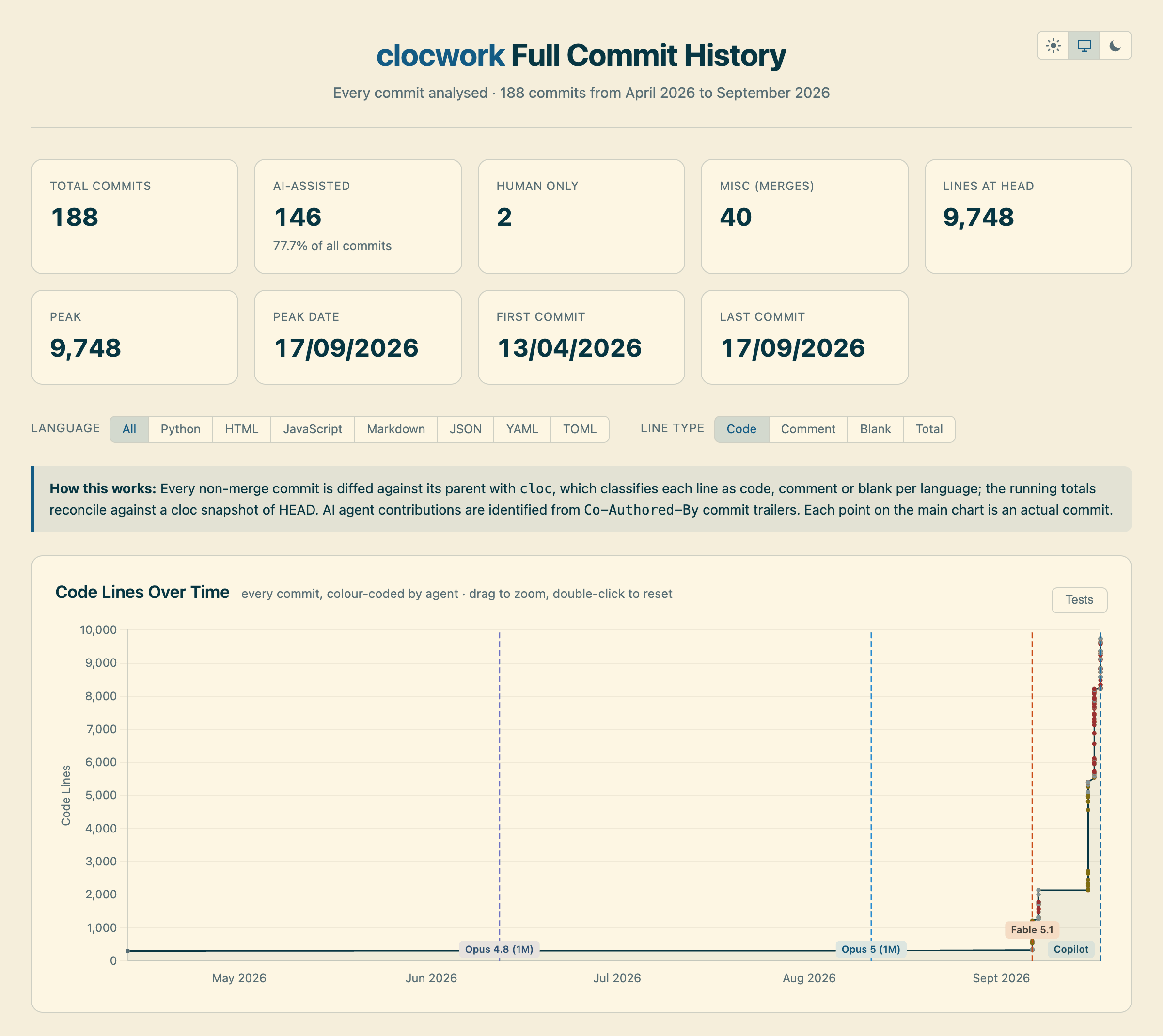
The top of the page clocwork writes for its own history. Each point on the chart is a commit, coloured by the agent that co-authored it (grey when none did), and each dashed line marks the first commit of a new model.
The output is one index.html (its charts load Chart.js and its plugins from
a CDN) plus a commit_bodies.js sidecar for the full commit messages, written
to a workspace next to the repository, never inside it.
Requirements
The Homebrew formula below brings its own Python and cloc, so with Homebrew
only git is needed.
- Python 3.11 or later (standard library only)
cloc2.06 or later onPATH. On macOS,brew install clocgives a current release. Linux distributions often package an older one (Ubuntu 24.04 has 1.98). clocwork refuses an older cloc, because earlier releases list file extensions in a form it misreads. If yours is older, savecloc-<version>.plfrom the cloc releases as an executable namedcloconPATH.git
Installing
With Homebrew, which also installs cloc and the manual page:
brew install nicktoumpelis/tap/clocwork
Installing by the full name, as above, trusts the formula. The
tap's README
covers a bare brew install clocwork, which needs brew trust first, and a
Brewfile entry, which trusts it with trusted: true.
From PyPI:
pipx install clocwork # or: pip install clocwork
pip does not install the manual page; man/clocwork.1 is in the repository
and in the source distribution.
Each release also carries clocwork.pyz, the whole command in one file, which
runs with no install step:
curl -LO https://github.com/nicktoumpelis/clocwork/releases/latest/download/clocwork.pyz
chmod +x clocwork.pyz
./clocwork.pyz ~/code/foo
Or run it from a clone:
git clone https://github.com/nicktoumpelis/clocwork.git ~/code/clocwork
cd ~/code/foo && ~/code/clocwork/clocwork
Both run under the first python3 on PATH, which must be 3.11 or later;
an older one is refused with a message naming it. On macOS,
/usr/bin/python3 comes from Apple's developer tools and can be older
(Xcode's is 3.9); name a newer interpreter instead, as in
python3.13 clocwork.pyz.
For development, pip install -e ~/code/clocwork installs the clocwork
command from the clone.
Running
Run clocwork inside the repository to analyse, or pass its path. The first
run over a long history measures every commit with cloc, running one
cloc process per CPU core (--jobs N chooses the number). On a 10-core
machine the 289 commits of spf13/cast take
14 seconds (113 seconds with --jobs 1), and a repository of 3,800 commits,
2,700 of them non-merge, takes about four minutes. Results are cached, so
later runs take seconds. --max-commits N caps one run and a later run
continues from where it stopped.
Commands
clocwork [REPO]          analyse, archive tokens, render, open the dashboard
clocwork tokens [REPO]   archive agent token logs only
clocwork render -o DIR   re-render the dashboard from existing workspace data
REPO is the repository or any directory inside it; the default is the
current directory. A first argument that is not a subcommand is taken as
REPO, so clocwork ~/code/foo works.
tokens is a separate command because the two halves of the pipeline have
opposite economics. The cloc pass is slow and fully regenerable. The token
archive is cheap and irreplaceable: coding agents delete their logs (Claude
Code after roughly 30 days), and a day that is not archived while its logs
exist is gone for good. clocwork tokens is what to run from cron.
render needs no repository, only a workspace; it exists so the page can be
iterated on without re-analysing.
Options (clocwork run --help):
  -q, --quiet       print nothing but errors
  --config PATH     explicit clocwork.toml
  --locale TAG      region locale for the page (default: $CLOCWORK_LOCALE,
                    else the machine's region)
  --no-open         do not open the dashboard in a browser
  -o, --output DIR  workspace directory (default: <repo-parent>/<repo-
                    name>-stats)
  --branch REF      ref to analyse (default: the checked-out branch)
  --max-commits N   measure at most N uncached commits this run
  -j, --jobs N      cloc processes to run at once (default: one per CPU core)
  --no-tokens       skip the agent log scan
  --cache-dir DIR   cache location (default: $XDG_CACHE_HOME/clocwork, else
                    ~/.cache/clocwork; wins over both)
tokens takes only -o and -q: it writes no page. render takes the page
options and -q, and its -o is required. --version prints the version.
The same reference is a manual page: man clocwork after a Homebrew install,
man ./man/clocwork.1 from a clone.
The page formats every number, date and unit for a region locale. The
generator records it, because browsers expose only the language list: the
CLOCWORK_LOCALE environment variable wins (a BCP 47 tag such as en-SE),
then the macOS Language & Region setting, then LC_ALL, LC_NUMERIC and
LANG; --locale overrides all of them for one run.
The workspace
Output goes to a sibling of the repository: ~/code/foo produces
~/code/foo-stats. It is deliberately not inside the repository, because the
tool would then be measuring its own output and dirtying the working tree of
the repository it reports on. Pass -o DIR to put it elsewhere.
foo-stats/
  clocwork.json           which repository this workspace belongs to
  clocwork.toml           optional configuration (see below)
  token_usage.json        the per-day, per-agent token archive; cannot be regenerated
  full_commit_data.json   the analysis
  index.html              the dashboard
  commit_bodies.js        full commit messages, loaded when a row is expanded
The workspace is meant to be committed to its own repository: that is the
backup for token_usage.json. clocwork.json is an identity guard. On every
run the target repository is compared against it, by remote URL first and
absolute path second, and a mismatch is refused with an error naming both
repositories, so no ordinary mistake can overwrite one repository's token
archive with another's.
The cloc cache lives outside the workspace, in
$XDG_CACHE_HOME/clocwork/<name>-<hash>/ or ~/.cache/clocwork/, keyed by
the repository's absolute path. It holds per-file rows rather than
per-language totals, so changing the language table or the test-path rules
below re-reads the cache instead of re-running cloc.
Configuration
Optional. Searched in this order, first hit wins: --config PATH, then
<workspace>/clocwork.toml, then <repo>/.clocwork.toml. The last is read and
never written, so a repository can commit its own settings while someone
analysing it can still override them from their workspace.
title = "MyApp"                         # page heading; default is the repository's directory name

[tests]
include = ["integration/**", "e2e/**"]  # added to the built-in test-path rules
exclude = ["tests/fixtures/**"]         # applied last, wins over everything
replace = false                         # true drops the built-ins entirely

[agents]
extra = [{ match = "Jules", name = "Jules" }]   # substring of a Co-Authored-By trailer, reported name
Globs match the whole path from the repository root: ** matches across
directories, * within one, ? one character. *.py therefore matches only
top-level files; **/*.py matches at any depth.
What counts as test code
Built in, by directory: test, tests, __tests__, testdata (any
case); spec and specs for Ruby, JavaScript, TypeScript and CoffeeScript
files only, so a specs/ directory of design documents is not counted; a directory named *Test or
*Tests (Xcode, JVM); the src/test/, src/androidTest/ and
src/integrationTest/ layouts. By filename: *_test.go; test_*.py, *_test.py, conftest.py; *.test.*
and *.spec.* for JavaScript and TypeScript; *Test.* and *Tests.* for
Java, Kotlin, C# and Swift; *_spec.rb, *_test.rb, *_test.dart,
*_test.exs. Inline test code (Rust's #[cfg(test)], Go examples in a
non-test file) is not detectable from paths.
The run summary prints the test share of HEAD. A share that is obviously wrong is the signal to add a rule; the fix costs a config line and a re-read, not a re-measure.
Which commits are AI-assisted
Attribution comes from Co-Authored-By: trailers only, so a commit that
merely mentions an agent is not counted. Any Claude model is recognised and
normalised (Claude Opus 4.6, Claude Opus 5 (1M)), and Copilot, Cursor,
Codex, Devin, aider, Gemini and Gemini Code Assist are recognised by name.
Anything else stays unmatched rather than guessed at; [agents].extra names
the rest.
Token usage
The token section appears when the workspace's token archive holds at least
one day. Each run reads the logs coding agents keep on the machine and
archives per-day totals, per agent and model, into token_usage.json:
| Agent | Logs read | Override |
|---|---|---|
| Claude Code | ~/.claude/projects/, the directory named after the repository's path |
none |
| Codex CLI | ~/.codex/sessions/ and ~/.codex/archived_sessions/ |
CODEX_HOME replaces ~/.codex |
| Gemini CLI | ~/.gemini/tmp/ and ~/.cache/.gemini/tmp/, sessions started in the repository or a directory it tracks |
GEMINI_CLI_HOME replaces ~ |
A Codex session belongs to the repository when it records the same remote
as the repository's origin, so sessions from any clone or worktree count.
A session that recorded another remote still belongs when it ran in the
repository, or a directory inside it, from one of the repository's commits.
A renamed or transferred repository keeps its sessions that way, and a
different repository later cloned to the same path gets them only if it
holds the commit they started from. When the session records no remote, or
origin is missing or not a URL clocwork recognises, the session belongs
when it ran in the repository or a directory inside it.
Gemini CLI identifies a session's project only by a hash of the directory it
started in, so its sessions count when that is the repository's current path
or a directory tracked at HEAD below it.
Only dates, model names, and token and turn counts reach the archive; prompts and replies are never kept. The archive keeps the larger record for each day and agent, because agents delete their logs and a day not archived in time is gone.
A day the archive does not cover for an agent, but on which that agent's commits changed lines, is estimated from the agent's own tokens-per-line ratio; a record that holds no tokens covers nothing. The result is priced at API list prices, each measured day at the prices in force on it and the estimated days at the measured mix, and its electricity is estimated. For any repository not worked on with these agents on this machine, the section and the commit table's Tokens column are simply absent; that is the normal case, not an error.
Tokens land only on the commits of the agent whose logs measured them,
split across that agent's commits of the day by lines changed. A commit
carries no token figure when its agent's logs are not read (Copilot, Cursor,
Devin, aider, Gemini Code Assist or any other), or when they cover no day on
which that agent's commits changed lines, and it is never priced at another
agent's rate. When the repository has token data, the run summary counts
those commits and names their agents. Gemini Code Assist is the name for
gemini-code-assist[bot], which GitHub credits when one of its review
suggestions is accepted.
Codex asks its model to end commit messages with
Co-authored-by: Codex <noreply@openai.com> unless attribution is turned
off. Gemini CLI adds no trailer, so its tokens reach a commit only when the
commit credits Gemini by hand, in a trailer such as
Co-Authored-By: Gemini CLI <address>; otherwise the page says its tokens
land on no commit. Codex rollouts that Codex has compressed are read on
Python 3.14 and later; earlier versions count them as unreadable and say so
in the log.
An archive written by an earlier version is read as Claude Code's and rewritten in the per-agent shape the next time a scan finds logs; an archive of a version this clocwork does not know is refused with an error rather than read or overwritten.
Development
python3 -m unittest discover -s tests -t . -q     # the Python suite
node tests/dashboard/run_all.js                   # the page, in a fake DOM under node
The dashboard suite renders a synthetic workspace (tests/dashboard/fixture.py)
through ./clocwork render. Set CLOCWORK_DASH_WORKSPACE=<dir> to run the
checks over any rendered workspace, a real one included; the files that
exercise the token-less page and the page with several agents render their
own synthetic variants regardless. Checks that assume the fixture's size,
such as the 500-row cap, fail over a short history.
tests/fixtures/ holds real Codex CLI and Gemini CLI sessions from two
MIT-licensed repositories, reduced to identity, model, usage and timestamps;
its README names the sources and carries their licence notices.
man/clocwork.1 is generated from the argparse parsers, and a test checks the
committed page is current. After changing any help text or the version,
regenerate it:
PYTHONPATH=src python3 -m clocwork.manpage > man/clocwork.1
To exercise the command end to end against a throwaway repository with Go, Python, JavaScript and Java test conventions:
R=$(python3 -c 'import sys, tempfile, os; sys.path[:0] = ["src", "."]
from tests import repo_fixture as fx
d = tempfile.mkdtemp(); r = os.path.join(d, "poly"); os.makedirs(r); fx.make_polyglot_repo(r); print(r)')
./clocwork "$R" --no-open --cache-dir /tmp/clocwork-cache
Licence
MIT.
1 maintainer

Metadata
1 maintainer
Release files for clocwork 0.1.1
For a detailed explanation of source distributions (sdists) and built distributions (wheels), please see the package formats documentation.
Source distribution (sdist)
| File | Size | Uploaded | |
|---|---|---|---|
| clocwork-0.1.1.tar.gz | 164.5 kB | Details |
Built distribution (wheel)
| File | Interpreter | ABI | Platform | Reset |
|---|---|---|---|---|
| clocwork-0.1.1-py3-none-any.whl | Python 3 | none | any | Details |
Total release size: 243.9 kB
Release files / clocwork-0.1.1.tar.gz
| Download URL | clocwork-0.1.1.tar.gz |
|---|---|
| Size | 164.5 kB |
| Tags | Source |
|
SHA-256 checksum How to use checksums |
c11f68baf2e948dd702a69150aaf5e2f0880c6f3f71723d6e20ed773a96d8212
|
|
BLAKE2b-256 checksum How to use checksums |
bcc2a40adb6b31b4a4591e786ed50cc6d857c63ca3ce6a605875c03dc3fbe130
|
| Upload date | |
|
Uploaded using Trusted Publishing? What is trusted publishing? |
Yes |
| Uploaded via |
twine/7.0.0 CPython/3.13.14
|
Provenance
Provenance describes where a file came from. On PyPI, provenance is shared via attestations, which provide a verifiable record of the build or publishing details. View details, limitations and caveats.


PyPI Publish Attestation
PyPI verified that this artifact, at this checksum, originated from the publisher listed below.
Signed by GitHub Actions, verified by PyPI on Sep 16, 2026.
Transparency logRelease files / clocwork-0.1.1-py3-none-any.whl
| Download URL | clocwork-0.1.1-py3-none-any.whl |
|---|---|
| Size | 79.5 kB |
| Tags | Python 3 |
|
SHA-256 checksum How to use checksums |
2f373fd1492834f9c397af5652f76d61566425d22294b2bf57374207c9e4c196
|
|
BLAKE2b-256 checksum How to use checksums |
02a8c15a4ed6ea3f76026068cac1c455f12268469811dc8711eb6df69b64c203
|
| Upload date | |
|
Uploaded using Trusted Publishing? What is trusted publishing? |
Yes |
| Uploaded via |
twine/7.0.0 CPython/3.13.14
|
Provenance
Provenance describes where a file came from. On PyPI, provenance is shared via attestations, which provide a verifiable record of the build or publishing details. View details, limitations and caveats.
PyPI Publish Attestation
PyPI verified that this artifact, at this checksum, originated from the publisher listed below.
Signed by GitHub Actions, verified by PyPI on Sep 16, 2026.
Transparency log













