
Python package that implements a Cobweb version of the Global Forest Trade Model

Project description
Cobwood is a Python package designed to analyse global forest products markets.
Key Features:
-
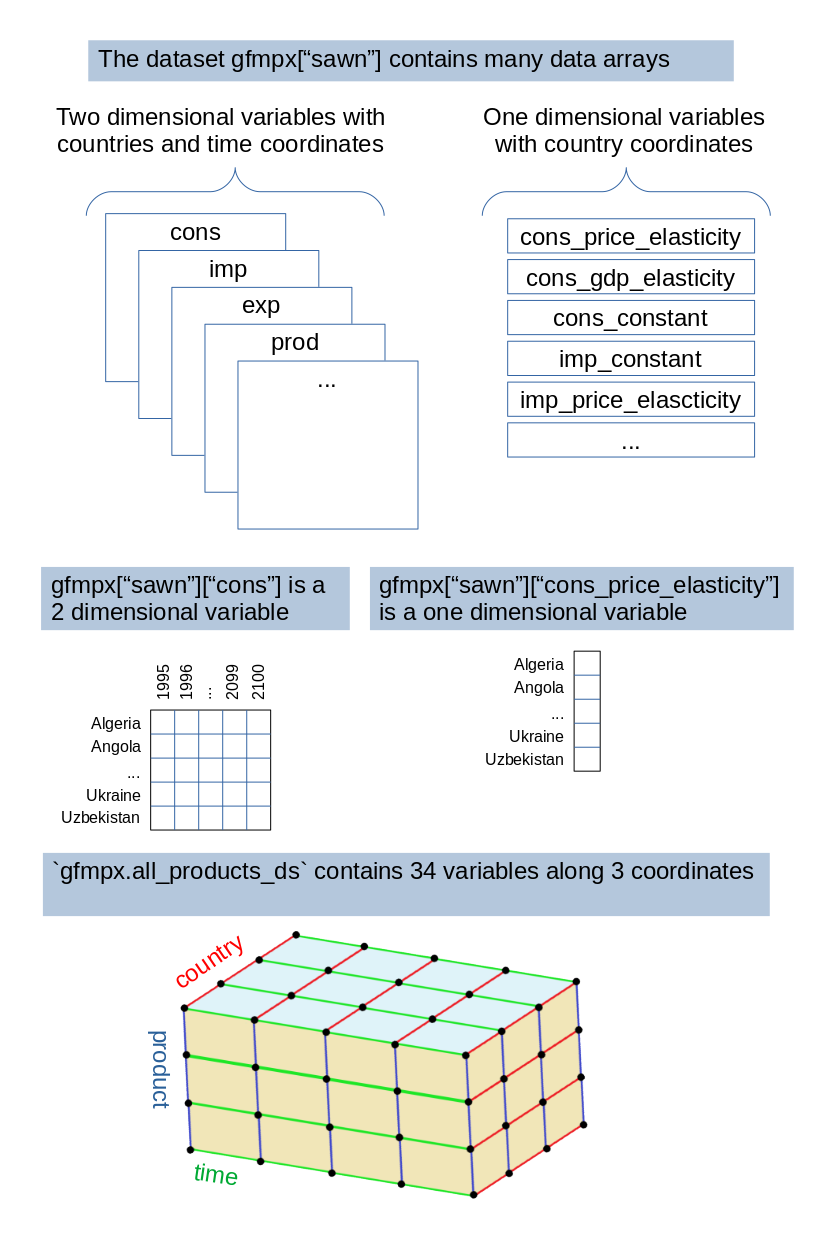
Panel Data Structure: The package represents international forest products market data through 2 dimensional arrays with multiple years and countries, enabling time-series and cross-sectional analysis.
-
Data Handling with Xarray: Utilizes Xarray datasets to efficiently manipulate multi-dimensional data structures. X array is tightly integrated with pandas. Conversion to and from pandas data frames is very straightforward. Xarray datasets are saved on disk using the NetCDF format. This format has the advantage of providing good metadata descriptors. NetCDF is a standard data format used in earth systems modelling, that will just help this model become a component of a greater modelling tool chain.
Documentation
-
The package documentation (generated from function and method docstrings) is available at https://bioeconomy.gitlab.io/cobwood/cobwood/cobwood.html
-
Instructions below explain how to install and run the model. They provide an overview of model formulation and data structure.
-
The paper at paper describes the context and purpose of cobwood.
Installation
Install from the python package index:
pip install cobwood
Clone the cobwood_data to create the cobwood_data structure at the default location,
alternatively clone it at any location and set the environment variable COBWOOD_DATA to
define the location of the data:
mkdir -p ~/repos
cd ~/repos
git clone git@gitlab.com:bioeconomy/cobwood/cobwood_data.git
Optional virtual environment
Optionally create a virtual environment and install the cobwood package and
its dependencies inside this virtual environment:
mkdir -p /tmp/cobwoodenv
cd /tmp/cobwoodenv/
python3 -m venv /tmp/cobwoodenv/
source /tmp/cobwoodenv/bin/activate
pip install cobwood
You can later on use the model inside this virtual environment by activating it each time with:
source /tmp/cobwoodenv/bin/activate
Run the model
Currently, only the GFFPMx model is available. We will now illustrate how to initiate a model instance for a given scenario. Scenarios are defined in the scenario input directory cobwood_data/scenarios as yaml files. They define variations of the model input, by changing some of the variables, such as the GDP projections for example. Here is how to run the model to reproduce a baseline scenario:
- Load the input data into a GFPMX model object.
from cobwood.gfpmx import GFPMX
gfpmxb2021 = GFPMX(scenario="base_2021", rerun=True)
- Run the model.At each step compare with the reference model run inside the Excel Sheet:
gfpmxb2021.run(compare=True, strict=False)
- Explore the model output tables and make plots.
print(gfpmxb2021["sawn"])
print(gfpmxb2021["sawn"]["cons"])
gfpmxb2021.facet_plot_by_var("indround")
Model Formulation
The core implementation serves as a foundation for developing various versions of global forest sector models. A panel data structure based on N dimensional arrays enable users to extend, or customize the model to fit specific research questions.
The first model formulation is based on GFPMX: "A Cobweb Model of the Global Forest Sector, with an Application to the Impact of the COVID-19 Pandemic" by Joseph Buongiorno https://doi.org/10.3390/su13105507
The GFPMX input data and parameters are available as a spreadsheet at: https://buongiorno.russell.wisc.edu/gfpm/
Equations
Equations are defined using Xarray time and country indexes so that they appear similar
to mathematical equations used in the papers describing the model. For example, the
consumption equation in cobwood/gfpmx_equations.py takes a dataset and a specific time
t as input and returns a data array as output. The input dataset ds contains price
and GDP data for all time steps and all countries, as well as price and GDP
elasticities. The computation at a given time and for a given set of countries is done
by using the time index t and the country index ds.c (which represents all
countries in the dataset) as follows:
def consumption(ds: xarray.Dataset, t: int) -> xarray.DataArray:
    """Compute consumption equation 1"""
    return (
        ds["cons_constant"]
        * pow(ds["price"].loc[ds.c, t - 1], ds["cons_price_elasticity"])
        * pow(ds["gdp"].loc[ds.c, t], ds["cons_gdp_elasticity"])
    )
Input data
The data is based on the FAOSTAT forestry production and trade data set available at: http://www.fao.org/faostat/en/#data/FO/visualize
Data structure
Cobwood implements simulations of the Global Forest Products Market (GFPM), covering data for 180 countries over 80 years. Each equation within the model is structured over two-dimensional Xarray data arrays, where:
- Countries form the first dimension (or coordinate), allowing for cross-sectional analysis.
- Years constitute the second dimension, facilitating time-series insights.
Data Manipulation and Export. Xarray data arrays can be converted to a format
similar to the original GFPMx spreadsheet with countries in rows and years in columns.
For example the following code uses DataArray.to_pandas() to convert the pulp import
array to a csv file using the pandas to_csv() method:
from cobwood.gfpmx_data import GFPMXData
gfpmx_data = GFPMXData(data_dir="gfpmx_8_6_2021", base_year = 2018)
pulp = gfpmx_data.convert_sheets_to_dataset("pulp")
pulp["imp"].to_pandas().to_csv("/tmp/pulp_imp.csv")
Example table containing the first few lines and columns:
| country | 2019 | 2020 | 2021 |
|---|---|---|---|
| Algeria | 66 | 61 | 56 |
| Angola | 0 | 0 | 0 |
| Benin | 0 | 0 | 0 |
The DataArray.to_dataframe() method converts an array and its coordinates into a long
format also called a tidy format with one observation per row.
pulp["imp"].to_dataframe().to_csv("/tmp/pulp_imp_long.csv")
Example table containing the first few lines and columns:
| country | year | imp |
|---|---|---|
| Algeria | 2019 | 66 |
| Algeria | 2020 | 61 |
| Algeria | 2021 | 56 |


Download files
Download the file for your platform. If you're not sure which to choose, learn more about installing packages.
Source Distribution
Built Distribution
Filter files by name, interpreter, ABI, and platform.
If you're not sure about the file name format, learn more about wheel file names.
Copy a direct link to the current filters
File details
Details for the file cobwood-0.2.0.tar.gz.
File metadata
- Download URL: cobwood-0.2.0.tar.gz
- Upload date:
- Size: 954.4 kB
- Tags: Source
- Uploaded using Trusted Publishing? No
- Uploaded via: twine/6.1.0 CPython/3.13.5
File hashes
| Algorithm | Hash digest | |
|---|---|---|
| SHA256 |
68c4d7188f697196754eac81e9902c93da854d540db4733f393cb6beb42ee45a
|
|
| MD5 |
0fda9191438aa5df9b7bd8dbea19fee6
|
|
| BLAKE2b-256 |
9873f5e173450638d72eca26b743d2af870691df724ff6814ab10554d4154032
|
File details
Details for the file cobwood-0.2.0-py3-none-any.whl.
File metadata
- Download URL: cobwood-0.2.0-py3-none-any.whl
- Upload date:
- Size: 33.2 kB
- Tags: Python 3
- Uploaded using Trusted Publishing? No
- Uploaded via: twine/6.1.0 CPython/3.13.5
File hashes
| Algorithm | Hash digest | |
|---|---|---|
| SHA256 |
923f989c994e6d277e89f40853484412e5a8a5a3181b35f8dd69825e839777bb
|
|
| MD5 |
47978d6fc110c17e5dd698c64427cceb
|
|
| BLAKE2b-256 |
3881e72dfbe02861726cd16e63491a272a7d2e05e5d62e0953b36999fad69e99
|






