

Find the right code. Follow its references.
Give Claude Code and Codex source context and typed graph navigation across languages.
71.4% code-block Recall@5 on 100 real issues.
Model-planned grep → Jev: +12.8 percentage points over the same grep candidates without reranking.
Experimental result · Method and limitations
Use with your agent · Browse a Wiki · Languages · Reproductions · Releases






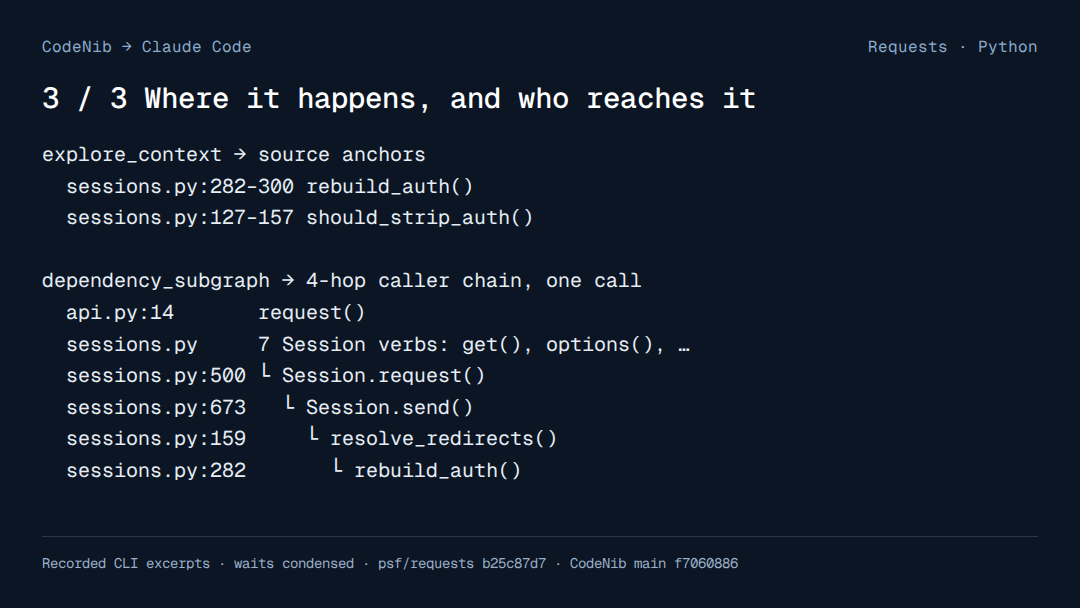
▶ Watch the 15-second replay · real CLI output · waits condensed · Pinned source, transcript and setup details.
New in 0.2.5: saved repository Wikis and portable OKF export, Pyrefly-backed Python graphs, static entry-path navigation and call-path rule checks. Read the release notes.
Quickstart
Requires Python 3.10+, Git, a clean repository, and Claude Code or Codex.
python -m pip install "codenib[graph,mcp]"
codenib codegraph init /path/to/your/repo
Then ask your agent: “Use CodeNib's explore_context to find where request
retry behavior is implemented. Cite the files and lines.”
This shipping path builds local search and a typed symbol graph, then connects installed agent clients. It needs no model, API key, or GPU for CodeNib; your agent uses its own model. It is separate from the grep/Jev experiment above. Language toolchain and project prerequisites vary.
Setup and troubleshooting · Source exclusions · All MCP tools · Local Wiki
Why CodeNib
- Inspect the evidence. Retrieve bounded code context with file and line references, then navigate definitions and static references. Read the source at each reference before describing a call path.
- Use the same tools across languages. The registry tracks 14 language entries, including 12 with graph backends. Check capability and setup differences in the language matrix.
- Compare methods on the same source. Pinned agent contracts, datasets, and scorer checks make the reproduction surface inspectable.
- Share what you found. Export a Wiki with source citations to your own GitHub Pages, or browse the public examples.
How it compares
What an agent can ask each tool. Peer interfaces were checked against upstream docs on 2026-09-28. This compares capabilities, not benchmark scores.
| Tool | Ask in plain language | Relationships beyond one hop | Relationships resolved by | Runs |
|---|---|---|---|---|
| grep / read | No; literal or regex | No | Text match | Local |
| CodeNib CodeGraph | Yes; ranked source anchors (explore_context) |
Incoming/outgoing static references; one dependency_subgraph call, depth ≤ 8 |
SCIP/LSP indexers (compiler-resolved) | Local |
| Serena | No; symbol name or regex | One level per call (find_referencing_symbols) |
Live language server or IDE | Local |
| CodeGraph (colbymchenry) | Yes; FTS5 full-text (codegraph_explore) |
Yes; call paths in codegraph_explore |
Tree-sitter AST extraction | Local; telemetry opt-out |
| DeepWiki public MCP | Yes; generated answers (ask_question) |
No structured graph tools | Generated Wiki | Hosted |
CodeNib's indexed references can include calls, fields, type uses and function values. Inspect the source to establish which references invoke a function; external and dynamic relationships may be missing. For a known string or file, your agent's native search and reads remain useful. Include indexing and rebuild costs when assessing graph navigation on your own tasks.
None of these repository tools needs its own model or API key; your agent uses its own model. Detailed comparison, sources and boundaries. CodeNib also includes an optional grep → Jev route using OpenRouter for planning and reranking; selected code goes to remote models. Authorization previews remain opt-in. The historical research result above is separate from the product evaluation and the model-free CodeGraph row.
Languages
Graph backends: Python, Go, Rust, C/C++, C#, Java, Ruby, PHP, Kotlin, Scala, JavaScript, and TypeScript. Swift and Lua support chunking/retrieval. Provider prerequisites and coverage differ by language.
The generated language matrix separates chunking, graph backends, incremental-backend support, and decoder parity. The product currently reuses or rebuilds views; file-level delta repair is not enabled.
Results and reproductions
| Start here | What you can inspect |
|---|---|
| Context methods and support matrix | Every retrieval pipeline, LLM workflow and agent route, sorted by the views it reads and who controls the search |
| Benchmarks | Localization, agent-context and resolution layers, evidence levels, and the method × benchmark matrix over CodeNib Base/Synthesis, SWE-bench Lite, Loc-Bench, SWE-Explore, Agent Retrieval Bench and ContextBench |
| grep → Jev result | 100-issue retrieval comparison, candidate controls, model use and limitations |
| Agent integration matrix | Revision-pinned LocAgent, Agentless, CoSIL, OrcaLoca and RepoNavigator contracts; compatibility does not imply reproduced paper scores |
| SWE-Explore validation | 1,020/1,020 real-output metric cells match the pinned official evaluator on a fixed 20-case run |
| DGX Spark deployment | Local Wiki, CodeGraph and model serving on GB10; a deployment guide, not a token-saving benchmark |
Documentation and community
Documentation · Architecture · Contributing · CI and testing · Changelog · Discord
CodeNib is in beta; public interfaces may change before a stable release. Historical research artifacts retain their published dataset identifiers.
Citation
If you use CodeNib in your research, please cite our arXiv paper:
@misc{yu2026codenibmultiviewdataserving,
      title={CodeNib: A Multi-View Data System for Serving Repository Context to Coding Agents},
      author={Zhongming Yu and Hengjia Yu and Boqin Yuan and Shuting Zhao and Yizhao Chen and Aryan Dokania and Mihir Jagtap and Jiayu Chang and Yitong Ma and Yash Jayswal and Wentao Ni and Hejia Zhang and Zhaoling Chen and Gangda Deng and Jishen Zhao},
      year={2026},
      eprint={2607.25431},
      archivePrefix={arXiv},
      primaryClass={cs.SE},
      url={https://arxiv.org/abs/2607.25431},
}
CodeNib is licensed under Apache 2.0.
1 maintainer

Metadata
1 maintainer
Release files for codenib 0.2.5
For a detailed explanation of source distributions (sdists) and built distributions (wheels), please see the package formats documentation.
Source distribution (sdist)
| File | Size | Uploaded | Provenance | Actions |
|---|---|---|---|---|
| codenib-0.2.5.tar.gz | 4.2 MB | With provenance | Details for codenib-0.2.5.tar.gz |
Built distributions (wheels)
| File | Interpreter | ABI | Platform | Actions Reset |
|---|---|---|---|---|
| codenib-0.2.5-cp310-abi3-manylinux_2_28_x86_64.whl | CPython 3.10 | abi3 | Linux glibc 2.28+ x86-64 | Details for codenib-0.2.5-cp310-abi3-manylinux_2_28_x86_64.whl |
| codenib-0.2.5-cp310-abi3-manylinux_2_28_aarch64.whl | CPython 3.10 | abi3 | Linux glibc 2.28+ ARM64 | Details for codenib-0.2.5-cp310-abi3-manylinux_2_28_aarch64.whl |
Total release size: 12.0 MB
Release files / codenib-0.2.5.tar.gz
| Download URL | codenib-0.2.5.tar.gz |
|---|---|
| Size | 4.2 MB |
| Tags | Source |
|
SHA-256 checksum How to use checksums |
935ff3db4b12803cddaf6753b2f0d6aebfaa499ff100d5520601c948b2197172
|
|
BLAKE2b-256 checksum How to use checksums |
2b70a6f2901b80f93abfc68c1812532bcb4bfc387c88569ca3fcb21ae3d2dd9a
|
| Upload date | |
|
Uploaded using Trusted Publishing? What is trusted publishing? |
Yes |
| Uploaded via |
twine/7.0.0 CPython/3.13.14
|
Provenance
Provenance describes where a file came from. On PyPI, provenance is shared via attestations, which provide a verifiable record of the build or publishing details. View details, limitations and caveats.


PyPI Publish Attestation
PyPI verified that this artifact, at this checksum, originated from the publisher listed below.
Signed by GitHub Actions, verified by PyPI on Nov 4, 2026.
Transparency logRelease files / codenib-0.2.5-cp310-abi3-manylinux_2_28_x86_64.whl
| Download URL | codenib-0.2.5-cp310-abi3-manylinux_2_28_x86_64.whl |
|---|---|
| Size | 3.9 MB |
| Tags | CPython 3.10 Linux glibc 2.28+ x86-64 abi3 |
|
SHA-256 checksum How to use checksums |
17ab91982d76c18f5915c2a1b104f5e9a6362d290e8d39ab153663cb0a412efa
|
|
BLAKE2b-256 checksum How to use checksums |
8bd3ab286fea4c811599d7b16b0120c844cc1f7545cd174952085d38315911d7
|
| Upload date | |
|
Uploaded using Trusted Publishing? What is trusted publishing? |
Yes |
| Uploaded via |
twine/7.0.0 CPython/3.13.14
|
Provenance
Provenance describes where a file came from. On PyPI, provenance is shared via attestations, which provide a verifiable record of the build or publishing details. View details, limitations and caveats.
PyPI Publish Attestation
PyPI verified that this artifact, at this checksum, originated from the publisher listed below.
Signed by GitHub Actions, verified by PyPI on Nov 4, 2026.
Transparency logRelease files / codenib-0.2.5-cp310-abi3-manylinux_2_28_aarch64.whl
| Download URL | codenib-0.2.5-cp310-abi3-manylinux_2_28_aarch64.whl |
|---|---|
| Size | 3.9 MB |
| Tags | CPython 3.10 Linux glibc 2.28+ ARM64 abi3 |
|
SHA-256 checksum How to use checksums |
6eff16bc2a78900201593aeb9cef7dc8c6f21be60cc4a8efff59e0bd40da948a
|
|
BLAKE2b-256 checksum How to use checksums |
227a3b30c6d0d207c7de220b058d5ad5db53895467fb1f081b331fd35d7423df
|
| Upload date | |
|
Uploaded using Trusted Publishing? What is trusted publishing? |
Yes |
| Uploaded via |
twine/7.0.0 CPython/3.13.14
|
Provenance
Provenance describes where a file came from. On PyPI, provenance is shared via attestations, which provide a verifiable record of the build or publishing details. View details, limitations and caveats.
PyPI Publish Attestation
PyPI verified that this artifact, at this checksum, originated from the publisher listed below.
Signed by GitHub Actions, verified by PyPI on Nov 4, 2026.
Transparency logSecurity for codenib 0.2.5
Provenance
Provenance describes where a file came from. On PyPI, provenance is shared via attestations, which provide a verifiable record of the build or publishing details. View details, limitations and caveats.
Full provenance
All 3 files in this release have been uploaded with provenance metadata.
Attestation for codenib-0.2.5.tar.gz
PyPI Publish Attestation
PyPI verified that this artifact, at this checksum, originated from the publisher listed below.
Signed by GitHub Actions, verified by PyPI on Nov 4, 2026.
Transparency logA note on package security
PyPI is a repository for distributing packages, not a service for auditing them. While third-party security researchers and our staff do their best to detect and remove malicious packages, PyPI cannot guarantee the quality, security or suitability of any given package.
To learn more about protecting yourself from malicious actors, visit our package security documentation.














