
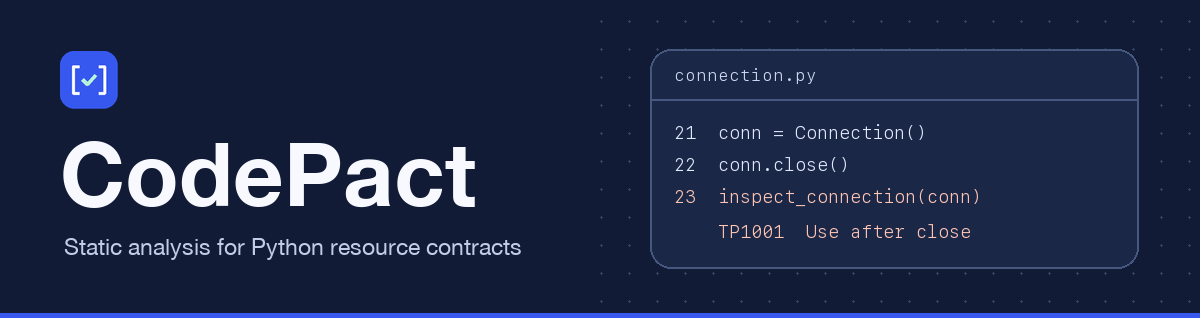
Find Python resource bugs before runtime. Declare which method closes a resource and which APIs own or borrow it. CodePact reads Python source and reports supported use-after-close, missed cleanup, and discarded must-use results. It checks your code without importing or running it.





Documentation · Install options · Rule catalog · Roadmap
New in 0.5.0. Opt in to explicit moves, lexical shared borrows, and a
bounded asyncio.TaskGroup model. The default scope retains lifecycle and
must-use checks. Ownership guide ·
Release availability
Quick start
In an existing uv project, install the helper package and its matching CLI.
uv add codepact==0.5.0
mkdir -p demo
Save this as demo/connection.py.
"""Small lifecycle example for `codepact check --root examples`."""

from codepact import resource
from codepact.rust import Borrowed


@resource(closed_by="close")
class Connection:
    def status(self) -> str:
        return "ready"

    def close(self) -> None:
        pass


def inspect_connection(conn: Borrowed[Connection]) -> str:
    return conn.status()


conn = Connection()
inspect_connection(conn)
conn.close()
inspect_connection(conn)  # TP1001 at this call; close is the related location.
uv run --locked codepact check --root demo
connection.py:23:1: error TP1001: Borrowed call requires an open resource
  certainty: definite
  trust: declared-unverified
  repair: Keep the use before close, or guard it with a lifecycle check.
  related: connection.py:22:1
1 diagnostics; 1 actionable; 0 suppressed; 0 rule-disabled; 1 returned
The check exits 1. Remove the call after conn.close() and rerun the same
command to get exit 0. The example uses a stub close method. CodePact checks
the declared state transition, while your implementation supplies the actual
cleanup. Quick start and report walkthrough
What you can check
| Declare | CodePact checks |
|---|---|
@resource(closed_by="close") |
Supported use after close and conflicting lifecycle metadata |
Owned[T] |
Cleanup duties across modeled exits and open resources at ownership handoff |
Borrowed[T] |
Closing a resource through a shared view |
@must_use or MustUse[T] |
Bare discarded calls to marked synchronous functions |
The helpers use typing.Annotated, so ordinary types remain available to mypy
and Pyright. The checker follows supported branches, aliases, calls, exceptions,
and cleanup paths. Check reports include primary and related source locations,
certainty, and coverage. Contract syntax ·
Supported syntax
Try experimental ownership
Add the following to pyproject.toml to enable move and lexical borrow checks.
[tool.codepact]
config-version = 1
experimental-ownership = true
Use move(value) to transfer a tracked handle and its cleanup duty. The
checker reports later use of the old handle. The TaskGroup model requires a
separate default-task-factory assumption.
Ownership examples and scope
Run in CI
Start with a narrow source root. Use strict mode when incomplete coverage should fail the job, and retain the JSON report alongside the exit status.
uv run --locked codepact check --root src --mode strict --json > codepact-report.json
| Exit | Meaning |
|---|---|
0 |
The completed report passed the selected policy |
1 |
The completed report failed policy |
2 |
The invocation or check failed |
Advisory mode can pass with incomplete coverage. The coverage field describes which parts of the program the checker could analyze. Teams can configure rule severity, review a baseline, and record line-level exceptions with a reason. Adoption guide · CI examples
Compatibility
The helper package runs on Python 3.11 and later, with CI on CPython 3.11–3.14. The analyzer supports Python 3.11–3.13 source targets. Native CLI wheels are available for Linux, macOS, and Windows on x86-64 and ARM64. Building from source requires Rust 1.96 or later and a linker. Platform matrix · Standalone CLI and Rust library
Contribute
Run uv sync --locked and uv run --locked make check after installing the
repository's pinned Cargo audit tools. The contributor guide lists the setup
and focused check targets.
Contributing ·
Build the docs ·
MIT license
1 maintainer

Metadata
1 maintainer
Release files for codepact 0.5.0
For a detailed explanation of source distributions (sdists) and built distributions (wheels), please see the package formats documentation.
Source distribution (sdist)
| File | Size | Uploaded | Provenance | Actions |
|---|---|---|---|---|
| codepact-0.5.0.tar.gz | 5.5 kB | Without provenance | Details for codepact-0.5.0.tar.gz |
Built distribution (wheel)
| File | Interpreter | ABI | Platform | Actions Reset |
|---|---|---|---|---|
| codepact-0.5.0-py3-none-any.whl | Python 3 | none | any | Details for codepact-0.5.0-py3-none-any.whl |
Total release size: 11.8 kB
Release files / codepact-0.5.0.tar.gz
| Download URL | codepact-0.5.0.tar.gz |
|---|---|
| Size | 5.5 kB |
| Tags | Source |
|
SHA-256 checksum How to use checksums |
07bd6d166456e22925a72e54beae4596f1755d65bcbc0fa37af022bc457ce678
|
|
BLAKE2b-256 checksum How to use checksums |
2006266ac94f19fe900069a0d535f6700b346839dd511dc0620062f7751ac1bb
|
| Upload date | |
|
Uploaded using Trusted Publishing? What is trusted publishing? |
No |
| Uploaded via |
twine/7.0.0 CPython/3.13.16
|
Release files / codepact-0.5.0-py3-none-any.whl
| Download URL | codepact-0.5.0-py3-none-any.whl |
|---|---|
| Size | 6.3 kB |
| Tags | Python 3 |
|
SHA-256 checksum How to use checksums |
f6e363e46779d29a6947de9a00293b2425e28748122c96eeb7df892fab8b46d2
|
|
BLAKE2b-256 checksum How to use checksums |
a31989065c952951b690706b73008279269967819522580b5193c00610caa4c2
|
| Upload date | |
|
Uploaded using Trusted Publishing? What is trusted publishing? |
No |
| Uploaded via |
twine/7.0.0 CPython/3.13.16
|
Security for codepact 0.5.0
Provenance
Provenance describes where a file came from. On PyPI, provenance is shared via attestations, which provide a verifiable record of the build or publishing details. View details, limitations and caveats.
No provenance found
None of the files in this release were uploaded with provenance metadata.
A note on package security
PyPI is a repository for distributing packages, not a service for auditing them. While third-party security researchers and our staff do their best to detect and remove malicious packages, PyPI cannot guarantee the quality, security or suitability of any given package.
To learn more about protecting yourself from malicious actors, visit our package security documentation.














