
A statically type-safe DataFrame abstraction layer
Verified details
These details have been verified by PyPIProject links
GitHub Statistics
Maintainers

Project description

Colnade



A statically type-safe DataFrame abstraction layer for Python.
Colnade replaces string-based column references (pl.col("age")) with typed descriptors (Users.age), so column misspellings and type mismatches are caught by your type checker — before your code runs.
Works with ty, mypy, and pyright. No plugins, no code generation.
Installation
pip install colnade colnade-polars
Colnade requires Python 3.10+. Install the backend adapter for your engine:
| Backend | Install |
|---|---|
| Polars | pip install colnade-polars |
| Pandas | pip install colnade-pandas |
| Dask | pip install colnade-dask |
Quick Start
1. Define a schema
import colnade as cn

class Users(cn.Schema):
    id: cn.Column[cn.UInt64]
    name: cn.Column[cn.Utf8]
    age: cn.Column[cn.UInt64]
    score: cn.Column[cn.Float64]
2. Create or read typed data
from colnade_polars import from_rows, read_parquet

# From Python data — schema drives dtype coercion
df = from_rows(Users, [
    Users.Row(id=1, name="Alice", age=30, score=85.0),
    Users.Row(id=2, name="Bob", age=25, score=92.5),
])

# Or from files
df = read_parquet("users.parquet", Users)
# df is DataFrame[Users] — the type checker knows the schema
3. Transform with full type safety
# Column references are attributes, not strings
result = (
    df.filter(Users.age > 25)
      .sort(Users.score.desc())
      .select(Users.name, Users.score)
)
4. Bind to an output schema
class UserSummary(cn.Schema):
    name: cn.Column[cn.Utf8]
    score: cn.Column[cn.Float64]

output = result.cast_schema(UserSummary)
# output is DataFrame[UserSummary]
Safety Model
Colnade catches errors at three levels:
- In your editor — misspelled columns, schema mismatches at function boundaries, and nullability violations are flagged by your type checker (
ty,pyright,mypy) before code runs - At data boundaries — runtime validation ensures files and external data match your schemas (columns, types, nullability) and that expressions reference columns from the correct schema
- On your data values —
Field()constraints validate domain invariants like ranges, patterns, and uniqueness
Where static safety ends: Static checking covers column references and schema-preserving operations (filter, sort, with_columns). Schema-transforming operations (select, group_by) return DataFrame[Any] — you call cast_schema() to assert the output schema, and runtime validation (if enabled) verifies it. No type checker plugin is needed, but this means output schemas aren't inferred statically. See Type Checker Integration for the full list of what is and isn't checked.
Key Features
Type-safe column references
Column references are class attributes verified by the type checker at lint time:
Users.name   # Column[Utf8] — valid
Users.naem   # ty error: Class `Users` has no attribute `naem`
Schema-preserving operations
Operations that don't change the schema (filter, sort, limit, with_columns) preserve the type parameter:
def process(df: DataFrame[Users]) -> DataFrame[Users]:
    return df.filter(Users.age > 25).sort(Users.score.desc())
Typed expressions
Column descriptors build an expression tree with typed operators:
Users.age > 18          # Expr[Bool] — comparison
Users.score * 2         # Expr[Float64] — arithmetic
(Users.age > 18) & (Users.score > 80)  # Expr[Bool] — logical
Users.name.str_starts_with("A")        # Expr[Bool] — string method
Aggregations
class UserStats(cn.Schema):
    name: cn.Column[cn.Utf8]
    avg_score: cn.Column[cn.Float64]
    user_count: cn.Column[cn.UInt64]

result = df.group_by(Users.name).agg(
    Users.score.mean().alias(UserStats.avg_score),
    Users.id.count().alias(UserStats.user_count),
)
Conditional expressions
df.with_columns(
    cn.when(Users.age > 65).then(cn.lit("senior")).otherwise(cn.lit("standard")).alias(Users.tier)
)
Vertical concatenation
combined = cn.concat(df_jan, df_feb, df_mar) # DataFrame[Sales]
Null handling
# Fill nulls, filter nulls, check nulls
df.with_columns(Users.score.fill_null(0.0).alias(Users.score))
df.filter(Users.score.is_not_null())
df.drop_nulls(Users.score)
Joins with typed output
joined = users.join(orders, on=Users.id == Orders.user_id)
# JoinedDataFrame[Users, Orders] — both schemas accessible

# mapped_from tells cast_schema which source column maps to each target column
class UserOrders(cn.Schema):
    user_name: cn.Column[cn.Utf8] = cn.mapped_from(Users.name)
    amount: cn.Column[cn.Float64]  # same name as Orders.amount — matched automatically

result = joined.cast_schema(UserOrders)
Schema-polymorphic utility functions
Write generic functions that work with any schema:
from colnade.schema import S

def first_n(df: cn.DataFrame[S], n: int) -> cn.DataFrame[S]:
    return df.head(n)

# Works with any schema — type preserved
users_subset: cn.DataFrame[Users] = first_n(users_df, 10)
Struct and List support
class Address(cn.Schema):
    city: cn.Column[cn.Utf8]
    zip_code: cn.Column[cn.Utf8]

class UserProfile(cn.Schema):
    name: cn.Column[cn.Utf8]
    address: cn.Column[cn.Struct[Address]]
    tags: cn.Column[cn.List[cn.Utf8]]
    tag_count: cn.Column[cn.UInt32]

# Access nested data
df.filter(UserProfile.address.field(Address.city) == "New York")
df.with_columns(UserProfile.tags.list.len().alias(UserProfile.tag_count))
Value-level constraints
import colnade as cn

class Users(cn.Schema):
    id: cn.Column[cn.UInt64] = cn.Field(unique=True)
    age: cn.Column[cn.UInt64] = cn.Field(ge=0, le=150)
    email: cn.Column[cn.Utf8] = cn.Field(pattern=r"^[^@]+@[^@]+\.[^@]+$")
    status: cn.Column[cn.Utf8] = cn.Field(isin=["active", "inactive"])

    @cn.schema_check
    def adult(cls):
        return Users.age >= 18

# Validate with df.validate() or auto-validate at the FULL level
cn.set_validation(cn.ValidationLevel.FULL)
Lazy execution
from colnade_polars import scan_parquet

lazy = scan_parquet("users.parquet", Users)
# LazyFrame[Users] — builds a query plan

result = lazy.filter(Users.age > 25).sort(Users.score.desc()).collect()
# Executes the optimized query plan
Performance
Colnade translates an expression AST into engine-native calls, adding a fixed cost per operation that doesn't grow with dataset size. For Polars and Pandas, this overhead is below the measurement noise floor — benchmarked pipelines (filter + sort + select) show no measurable difference from 100 to 1M rows. Dask graph construction adds ~200–300 us per operation, negligible compared to .compute() time.
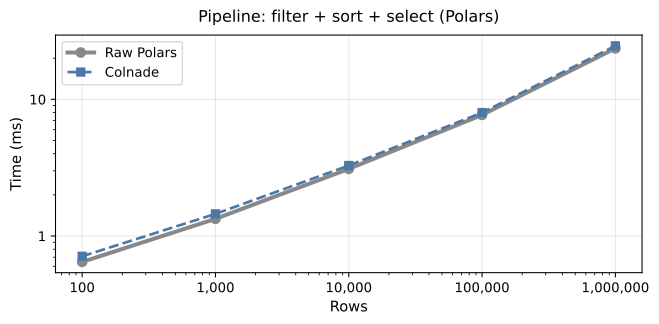
Validation (STRUCTURAL, FULL) adds measurable cost at data boundaries and is designed for development/CI, not production hot paths. See the full benchmark results for details.
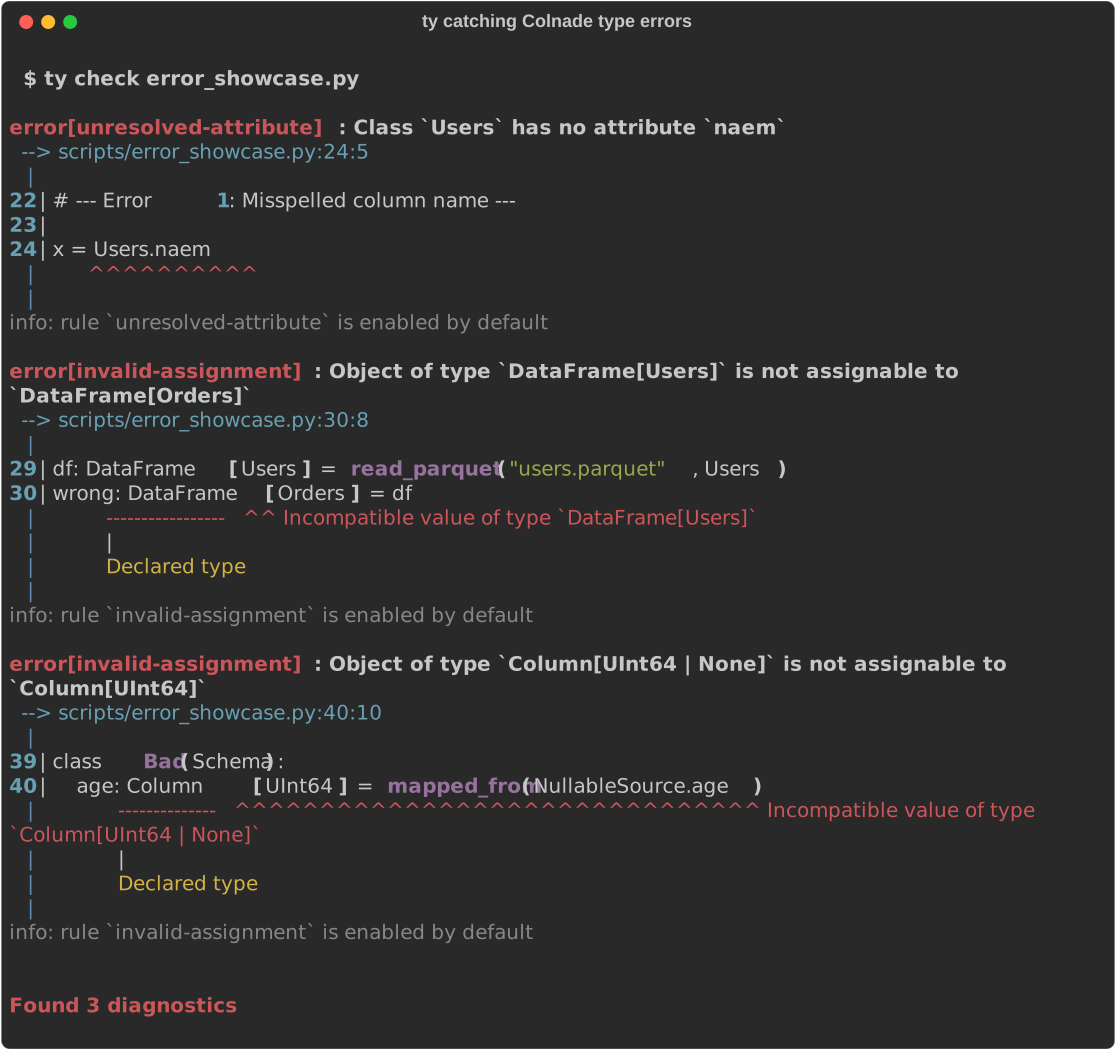
Type Checker Error Showcase
Colnade catches real errors at lint time. Here are actual error messages from ty:
Comparison with Existing Solutions
| Feature | Colnade | Pandera | StaticFrame | Patito | Narwhals |
|---|---|---|---|---|---|
| Column refs checked statically | Named attrs | No | Positional types | No | No |
| Schema preserved through ops | Through ops¹ | At boundaries² | No | No | No |
| Works with existing engines | Polars, Pandas, Dask | Pandas, Polars, others | Own engine | Polars only | Many engines |
| No plugins or code gen | Yes | Optional mypy plugin | Yes | Yes | Yes |
| Generic utility functions | Yes | No | No | No | No |
| Struct/List typed access | Yes | No | No | No | No |
| Lazy execution support | Yes | No | No | No | Yes |
| Value-level constraints | Field() |
Check |
No | Pydantic validators | No |
| Maturity / ecosystem | New (v0.7) | Mature, large community | Mature | Small | Growing fast |
| Engine breadth | 3 backends | 4+ backends | Own engine | 1 backend | 6+ backends |
| select/group_by output typing | DataFrame[Any]³ |
Decorator-checked | Positional types | No | No |
¹ Schema-preserving ops (filter, sort, with_columns) retain DataFrame[S]. Schema-transforming ops (select, group_by) return DataFrame[Any] — use cast_schema() to bind.
² Pandera's @check_types validates schemas at function boundaries via decorator, but column references within function bodies remain unchecked strings.
³ cast_schema() re-binds at runtime. A type checker plugin could theoretically infer output schemas, but Colnade intentionally avoids plugin coupling.
See Detailed Comparisons for a fuller discussion of tradeoffs.
Documentation
Full documentation is available at colnade.com, including:
- Getting Started — installation and quick start
- User Guide — concepts, schemas, expressions, joins
- Tutorials — worked examples with real data
- API Reference — auto-generated from source
Examples
Runnable examples are in the examples/ directory:
basic_usage.py— Schema definition, filter, select, aggregatenull_handling.py— Nullable columns, fill_null, drop_nullsjoins.py— Joining DataFrames, JoinedDataFrame, cast_schemageneric_functions.py— Schema-polymorphic utility functionsnested_types.py— Struct and List column operationsfull_pipeline.py— Complete ETL pipeline example
License
MIT
Project details
Verified details
These details have been verified by PyPIProject links
GitHub Statistics
Maintainers
Release history Release notifications | RSS feed


Download files
Download the file for your platform. If you're not sure which to choose, learn more about installing packages.
Source Distribution
Built Distribution
Filter files by name, interpreter, ABI, and platform.
If you're not sure about the file name format, learn more about wheel file names.
Copy a direct link to the current filters
File details
Details for the file colnade-0.8.0.tar.gz.
File metadata
- Download URL: colnade-0.8.0.tar.gz
- Upload date:
- Size: 311.0 kB
- Tags: Source
- Uploaded using Trusted Publishing? Yes
- Uploaded via: twine/6.1.0 CPython/3.13.7
File hashes
| Algorithm | Hash digest | |
|---|---|---|
| SHA256 |
cc364e3b56d6f8acba3c257d76d6b67f193a16f4c4c1650a3974ae9456cc022b
|
|
| MD5 |
2ba0da1d651456a3f3985f13dfd56fa0
|
|
| BLAKE2b-256 |
e8451f4eb08af1e17efb5ada4d6554396e81e79a0cb3f64c4fd69b58c4d3ea25
|
Provenance
The following attestation bundles were made for colnade-0.8.0.tar.gz:
Publisher:
publish.yml on jwde/colnade
-
Statement:
-
Statement type:
https://in-toto.io/Statement/v1 -
Predicate type:
https://docs.pypi.org/attestations/publish/v1 -
Subject name:
colnade-0.8.0.tar.gz -
Subject digest:
cc364e3b56d6f8acba3c257d76d6b67f193a16f4c4c1650a3974ae9456cc022b - Sigstore transparency entry: 1005445945
- Sigstore integration time:
-
Permalink:
jwde/colnade@303a9901e4688cd480890518d6fdb6783ff60e37 -
Branch / Tag:
refs/tags/v0.8.0 - Owner: https://github.com/jwde
-
Access:
public
-
Token Issuer:
https://token.actions.githubusercontent.com -
Runner Environment:
github-hosted -
Publication workflow:
publish.yml@303a9901e4688cd480890518d6fdb6783ff60e37 -
Trigger Event:
release
-
Statement type:
File details
Details for the file colnade-0.8.0-py3-none-any.whl.
File metadata
- Download URL: colnade-0.8.0-py3-none-any.whl
- Upload date:
- Size: 34.4 kB
- Tags: Python 3
- Uploaded using Trusted Publishing? Yes
- Uploaded via: twine/6.1.0 CPython/3.13.7
File hashes
| Algorithm | Hash digest | |
|---|---|---|
| SHA256 |
35ed0b4140192b7bf27cdf69716fb607343967dd3118105040459a2e8e7cb830
|
|
| MD5 |
38e15e800d3350c6fc00ba0b456fc807
|
|
| BLAKE2b-256 |
b9553cab79c652b632f152a09672130f9a82a57a44c6d1685d94a52711b7128b
|
Provenance
The following attestation bundles were made for colnade-0.8.0-py3-none-any.whl:
Publisher:
publish.yml on jwde/colnade
-
Statement:
-
Statement type:
https://in-toto.io/Statement/v1 -
Predicate type:
https://docs.pypi.org/attestations/publish/v1 -
Subject name:
colnade-0.8.0-py3-none-any.whl -
Subject digest:
35ed0b4140192b7bf27cdf69716fb607343967dd3118105040459a2e8e7cb830 - Sigstore transparency entry: 1005446023
- Sigstore integration time:
-
Permalink:
jwde/colnade@303a9901e4688cd480890518d6fdb6783ff60e37 -
Branch / Tag:
refs/tags/v0.8.0 - Owner: https://github.com/jwde
-
Access:
public
-
Token Issuer:
https://token.actions.githubusercontent.com -
Runner Environment:
github-hosted -
Publication workflow:
publish.yml@303a9901e4688cd480890518d6fdb6783ff60e37 -
Trigger Event:
release
-
Statement type:






