
compose-lint
Security-focused linter for Docker Compose files. Catches dangerous misconfigurations before they reach production — and auto-fixes the unambiguous ones, dry-run first. Grounded in OWASP and the CIS Docker Benchmark.









Static-analysis checks for docker-compose.yml and compose.yaml, covering privileged containers, unpinned images, host-network sharing, sensitive bind mounts, hard-coded credentials, and more. Full rule documentation lives at tmatens.github.io/compose-lint (the same pages --explain prints offline).
In a scan of 5,417 public Docker Compose files on GitHub, 91% of those that parse had at least one security finding. Nearly all skip basic capability restrictions, 49% run images without a pinned digest, and 64% bind ports to all interfaces. compose-lint catches these in CI before they ship. Read the full State of Docker Compose Security report →
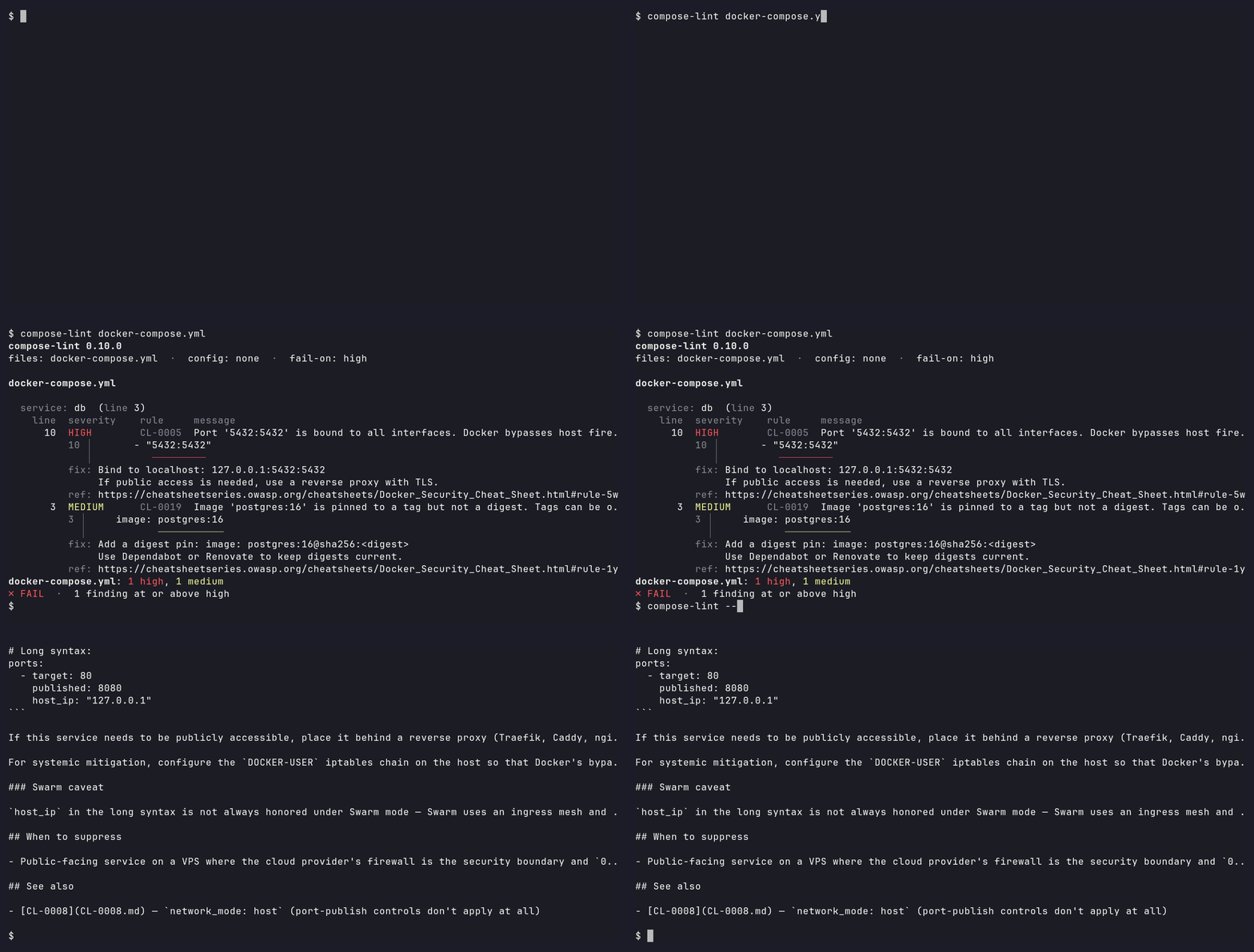
What it catches:
- Privilege flaws —
privileged: true, missingcap_drop,no-new-privilegesnot set, root user, host namespace sharing - Network exposure — wildcard port binds,
network_mode: host - Supply-chain — unpinned images, missing digest pins
- Filesystem and credential leaks — Docker socket mounts, sensitive host paths, plaintext credentials in
environment:
Use it if you ship Compose to production, want defense in depth in a homelab, or want a fast pre-merge gate on infrastructure-as-code. Fits the same niche as Hadolint, the Dockerfile linter and dclint, the Compose schema linter: zero-config, opinionated, fast, and grounded in the OWASP Docker Security Cheat Sheet and CIS Docker Benchmark.
Installation
pip
pip install compose-lint
Or run it ad hoc without installing anything:
uvx compose-lint docker-compose.yml # or: pipx run compose-lint docker-compose.yml
That resolves the newest release at install time. For a reproducible install (CI, production tooling), pin the version and install the dependency set from the repo's hash-pinned lockfile, which release automation keeps current:
pip install --require-hashes -r requirements.lock   # dependencies, hash-pinned
pip install --no-deps compose-lint==X.Y.Z           # the tool, version-pinned
Docker — composelint/compose-lint
docker run --rm -v "$(pwd):/src" composelint/compose-lint
The Docker image is distroless, multi-arch, and runs nonroot — see Security posture below for SLSA, Sigstore, and OpenVEX details.
Running with full hardening
Want to dogfood compose-lint's own rules against the container that runs it? See the hardening guide for the fully-hardened docker run invocation, the flag-to-rule mapping, and digest-pinning instructions.
Quick Start
Run without arguments to auto-detect compose.yml, compose.yaml, docker-compose.yml, or docker-compose.yaml in the current directory:
compose-lint
Or pass files explicitly:
compose-lint docker-compose.yml docker-compose.prod.yml
Preview the auto-fixable findings as a unified diff, then apply them — reading the ⚠ behavior-changing labels first (see Fixing findings):
compose-lint fix              # dry-run diff, writes nothing
compose-lint fix --apply      # write the fixes in place
Don't recognize a rule ID in the output? --explain prints the full rule doc — what it catches, why it matters, the fix, and the OWASP/CIS reference — without leaving the terminal:
compose-lint --explain CL-0005
Docker equivalent:
docker run --rm -v "$(pwd):/src" composelint/compose-lint docker-compose.prod.yml
Compose compatibility
compose-lint targets the Compose Specification used by Compose v2 and v3. Compose v1 files (services declared at the top level) are skipped with a stderr note rather than failing the run — Docker retired Compose v1 in 2023. Structural fragments (files containing only volumes: / networks: / configs: / secrets: / x-* keys, typically merged via -f overlay.yml) are skipped for the same reason, as is compose-lint's own .compose-lint.yml config if a glob happens to sweep it in. Genuinely unrecognised shapes still exit 2.
Python 3.10+ is required for the pip install path; the Docker image is self-contained.
Example Output
Given this docker-compose.yml:
services:
  traefik:
    image: traefik:v3.0@sha256:aaaabbbbccccddddeeeeffff00001111222233334444555566667777888899990
    read_only: true
    cap_drop: [ALL]
    security_opt: [no-new-privileges:true]
    mem_limit: 256m
    cpus: 0.5
    volumes:
      - /var/run/docker.sock:/var/run/docker.sock
    ports:
      - "8080:80"

  db:
    image: postgres:16@sha256:bbbbccccddddeeeeffff000011112222333344445555666677778888999900001
    read_only: true
    cap_drop: [ALL]
    security_opt: [no-new-privileges:true]
    mem_limit: 1g
    cpus: 1.0
    environment:
      POSTGRES_PASSWORD: hunter2
    volumes:
      - pgdata:/var/lib/postgresql/data
    tmpfs:
      - /tmp
      - /run

volumes:
  pgdata:
and this .compose-lint.yml (suppressing CL-0001 for traefik with a tracked reason):
rules:
  CL-0001:
    exclude_services:
      traefik: "SEC-1234 approved — socket proxy planned for 2026-Q3"
running compose-lint docker-compose.yml produces:
files: docker-compose.yml  ·  config: .compose-lint.yml  ·  fail-on: high

docker-compose.yml

  service: traefik  (line 10)
    line  severity    rule     message
      10  SUPPRESSED  CL-0001  Docker runtime socket mounted via '/var/run/docker.sock:/var/run/docker.sock'. This gives the container full control over the Docker runtime — equivalent to root on the host.
          reason: SEC-1234 approved — socket proxy planned for 2026-Q3
      12  MEDIUM      CL-0005  Port '8080:80' is bound to all interfaces. Docker bypasses host firewalls (UFW/firewalld), potentially exposing this port to the public internet.
          12 │       - "8080:80"
             │          ───────
          fix: Bind to localhost: 127.0.0.1:8080:80
               If public access is needed, use a reverse proxy with TLS.
          ref: https://cheatsheetseries.owasp.org/cheatsheets/Docker_Security_Cheat_Sheet.html#rule-5a-be-careful-when-mapping-container-ports-to-the-host-with-firewalls-like-ufw

  service: db  (line 22)
    line  severity    rule     message
      22  HIGH        CL-0020  Service has credential-shaped env key 'POSTGRES_PASSWORD' with a literal value. Env vars are exposed via `docker inspect`, `/proc/<pid>/environ`, `docker compose config`, process listings, and CI logs — any process or operator with daemon access can read them.
          22 │       POSTGRES_PASSWORD: hunter2
             │       ─────────────────
          fix: Move 'POSTGRES_PASSWORD' to Compose's `secrets:` primitive. If the image supports the `*_FILE` convention (Postgres, MySQL, MariaDB, MinIO, etc.), set `POSTGRES_PASSWORD_FILE: /run/secrets/<name>` and declare the secret under the top-level `secrets:` block sourced from a gitignored file or `external: true`. Otherwise, have the entrypoint read the secret file at startup and export the value into the workload's environment.
          ref: https://cheatsheetseries.owasp.org/cheatsheets/Docker_Security_Cheat_Sheet.html#rule-12-utilize-docker-secrets-for-sensitive-data-management
docker-compose.yml: 1 high, 1 medium  ·  1 suppressed (not counted)
✗ FAIL  ·  1 finding at or above high
Exit code is 1 (one finding at or above the default --fail-on high threshold). Suppressed findings are shown for auditability but do not count toward the threshold. Findings are grouped by service and ordered highest-severity first within each service; the fix block and reference URL print only once per rule id per file — pass -v / --verbose to repeat them on every finding, or -q / --quiet for one compact line per finding.
How it compares
| Tool | Compose security rules | Auto-fix | Scope | Zero config |
|---|---|---|---|---|
| compose-lint | Yes | Yes — dry-run diff first | Docker Compose | Yes |
| KICS | Yes | Yes (remediate command) |
Broad IaC (Terraform, K8s, Compose, ...) | No |
| Hadolint | No — Dockerfile only | No | Dockerfile | Yes |
| dclint | Yes — schema/structure only | Style/formatting only | Docker Compose | Yes |
| Trivy | No — image/CVE + IaC misconfig scanning, no dedicated Compose ruleset | No | Dockerfiles, images, IaC | Yes |
| Checkov | No — no dedicated Compose ruleset | No | Broad IaC (Terraform, K8s, ...) | No |
Competitor capabilities verified July 2026.
If you need broad IaC coverage across Terraform, Kubernetes, and more, KICS covers Docker Compose and is worth evaluating. If you want a lightweight, focused tool with zero config and actionable fix guidance for Compose files specifically, this is it.
Not in scope: compose-lint does not validate Compose schema, scan images for CVEs, or lint Dockerfiles. Pair it with dclint for schema/structure, Hadolint for Dockerfiles, and Trivy for image CVEs.
Rules
| ID | Severity | Description | OWASP | CIS |
|---|---|---|---|---|
| CL-0001 | CRITICAL | Host control socket exposed | Rule #1 | 5.32 |
| CL-0002 | CRITICAL | Privileged mode enabled | Rule #3 | 5.5 |
| CL-0003 | MEDIUM | Privilege escalation not blocked | Rule #4 | 5.26 |
| CL-0004 | MEDIUM | Image not pinned to version | Rule #13 | 5.28 |
| CL-0005 | MEDIUM | Ports bound to all interfaces | Rule #5a | 5.14 |
| CL-0006 | MEDIUM | No capability restrictions | Rule #3 | 5.4 |
| CL-0007 | LOW | Filesystem not read-only | Rule #8 | 5.13 |
| CL-0008 | HIGH | Host network mode | Rule #5 | 5.10 |
| CL-0009 | HIGH | Security profile disabled | Rule #6 | 5.2, 5.3, 5.22 |
| CL-0010 | HIGH | Host namespace sharing | Rule #3 | 5.16, 5.17, 5.21, 5.31 |
| CL-0011 | HIGH | Strong host-adjacent capability added | Rule #3 | 5.4 |
| CL-0013 | HIGH | Sensitive host path exposed | Rule #8 | 5.6 |
| CL-0014 | LOW | Logging driver disabled | — | — |
| CL-0016 | CRITICAL | Dangerous host device exposed | — | 5.18 |
| CL-0017 | LOW | Shared mount propagation | — | 5.20 |
| CL-0018 | MEDIUM | Explicit root user | Rule #2 | — |
| CL-0019 | MEDIUM | Image tag without digest | Rule #13 | — |
| CL-0020 | HIGH | Credential-shaped env key with literal value | Rule #12 | — |
| CL-0021 | HIGH | Credential embedded in connection-string env value | Rule #12 | — |
| CL-0022 | LOW | tmpfs mount re-enables exec/suid/dev | Rule #8 | — |
| CL-0024 | CRITICAL | Host-code-execution capability added | Rule #3 | 5.4 |
| CL-0025 | CRITICAL | Root-equivalent host path mounted writable | Rule #8 | 5.6 |
| CL-0026 | MEDIUM | No resource limits (memory/CPU) | Rule #7 | 5.10, 5.11 |
| CL-0027 | MEDIUM | Bounded-grant capability added | Rule #3 | 5.4 |
| CL-0028 | HIGH | Host-reaching capability added | Rule #3 | 5.4 |
| CL-0030 | HIGH | Host-disclosure capability added | Rule #3 | 5.4 |
| CL-0029 | HIGH | Host-availability capability added | Rule #3 | 5.4 |
Severity Levels
Findings are rated LOW, MEDIUM, HIGH, or CRITICAL. Each rule's severity is derived from a two-axis matrix — the attacker precondition the misconfiguration creates, and the impact scope it reaches — under a stated attacker baseline and a stated Docker posture. See docs/severity.md for the full scoring matrix, the derivation of every rule, and the override mechanism.
Configuration
Create .compose-lint.yml to disable rules, exclude specific services, or adjust severity:
rules:
  CL-0001:
    enabled: false
    reason: "SEC-1234 — approved 2026-07-01"
  CL-0003:
    exclude_services:
      minecraft: "entrypoint switches users via su-exec"
  CL-0005:
    severity: medium
Disabled and excluded findings still appear marked SUPPRESSED with the reason flowing to JSON's suppression_reason and SARIF's justification (recognized by GitHub Code Scanning) — they do not affect exit code. Pass --skip-suppressed to hide them. A severity: override is reported too, as (severity overridden from …) in text and severity_overridden_from / properties.severityOverriddenFrom in JSON and SARIF, so a re-graded finding is distinguishable from one the rule declared at that level.
See docs/configuration.md for per-service exclusion semantics, precedence rules, and the full output-format mapping.
CLI Reference
compose-lint [check] [OPTIONS] [FILE ...]   Lint files (default; bare invocation works)
compose-lint fix [OPTIONS] [FILE ...]       Auto-remediate auto-fixable findings
compose-lint init [OPTIONS] FILE            Generate a starter .compose-lint.yml

check options:
  --format {text,json,sarif}   Output format (default: text)
  --fail-on {low,medium,high,critical}
                               Minimum severity to trigger exit 1 (default: high)
  -v, --verbose                Repeat the fix block and reference on every finding (text mode)
  -q, --quiet                  One line per finding — no fix, reference, or excerpt (text mode)
  --skip-suppressed            Hide suppressed findings from output
  --allow-partial-coverage     Grade a file whose `include:` / cross-file `extends:`
                               could not be resolved, instead of failing (exit 2)
  --config PATH                Path to config file (default: .compose-lint.yml)
  --strict-config              Treat config diagnostics (unknown rule id or key) as errors, not warnings
  --explain CL-XXXX            Print the full documentation for a single rule
  --version                    Show version and exit

fix options:
  --apply                      Write fixes in place (default: print a dry-run diff)
  --only CL-XXXX               Restrict fixes to the named rule(s); repeatable
  --config PATH                Path to config file (suppressions are honored)
  --strict-config              Treat config diagnostics (unknown rule id or key) as errors, not warnings

init options:
  -o, --output PATH            Where to write the config (default: .compose-lint.yml)
  --force                      Overwrite an existing config file
Fixing findings
compose-lint fix auto-remediates the findings whose edit is mechanically
unambiguous — one correct value, in one place, with no collateral change to
the rest of the file: adding read_only: true or no-new-privileges:true,
binding a published port to 127.0.0.1, restoring a disabled logging driver
or seccomp profile, and similar. It is dry-run by default: it
prints a unified diff and writes nothing.

Auto-fixable does not mean harmless. The guarantee is about the edit, not the outcome.
fixwill not corrupt your file, reflow it, or guess at a value it cannot derive — but it will happily change how your stack behaves.read_only: truebreaks a container that writes to its root filesystem; rebinding a published port to127.0.0.1cuts off every client outside the host. Those edits are still offered, because withholding them would hide a real finding. Instead each one is labelled⚠ behavior-changingin the diff with the specific breakage named:⚠ behavior-changing · CL-0007: read_only: true breaks the container if it writes to its root filesystem; declare writable paths via tmpfs/volumes first.Read those lines before you
--apply, and roll the result out to a staging stack before production. Treatfixas a patch author, not an approver.
compose-lint fix docker-compose.yml            # preview the diff, write nothing
compose-lint fix --apply docker-compose.yml    # write the fixes in place
compose-lint fix --only CL-0007 --apply .      # restrict to one rule
- Dry-run by default;
--applywrites in place via an atomic swap that preserves the file's permission bits — an interrupted write never corrupts the Compose file. - Only mechanically unambiguous fixes are applied. Findings whose remediation is context-dependent (e.g. CL-0006 capability lists, CL-0001 socket mounts) are reported as needing manual review, never auto-edited — the tool refuses rather than guess at a value only you can choose.
- Behavior-changing edits are labelled, not withheld. Every edit that alters
runtime behavior emits a
⚠ behavior-changingline naming what breaks, on the dry-run and on--apply, so the warning reaches you on whichever path you took. The label is the mitigation; there is no severity gate that quietly drops risky fixes. - Suppressed findings are never touched —
.compose-lint.ymldisables and per-service excludes are honored. - Refuses rather than risk a wrong rewrite. Files using YAML anchors, merge keys, or
${VAR}interpolation in the affected region are skipped rather than risk a wrong rewrite, and every apply is re-parsed and re-linted before it is written — anything that wouldn't round-trip clean is refused with the diff surfaced for diagnosis. - Diff is data, status is human. The diff goes to stdout; progress and
warnings go to stderr, so
compose-lint fix file.yml > changes.diffcaptures exactly the patch.
Structured fixes also ride in SARIF output: compose-lint check --format sarif
populates fixes[].artifactChanges, which GitHub Code Scanning renders as an
inline suggested change on the pull request.
Generating a starter config
compose-lint init turns a file's current findings into a .compose-lint.yml
you then triage, so you don't have to hand-author suppressions from the schema:
compose-lint init docker-compose.yml          # writes ./.compose-lint.yml
compose-lint init docker-compose.yml -o ci.yml # write somewhere else
compose-lint init docker-compose.yml --force   # overwrite an existing config
Each finding becomes a per-service exclude_services entry with a placeholder
reason — never a global enabled: false, so a service you add later still trips
the rule instead of being silently uncovered. It refuses to overwrite an
existing config without --force, writes nothing for a clean file, and sends
status to stderr. Replace each TODO reason with a real justification or delete
the entry and fix the issue. See
docs/configuration.md
for the full behavior.
Versioning & stability
compose-lint follows Semantic Versioning. From 1.0, the CLI, exit codes, config schema, and JSON/SARIF output are stable. New and tightened rules ship in MINOR releases, so pin a version or use --fail-on if you need deterministic CI. See docs/compatibility.md for the full stability promise and deprecation policy.
Color is on when stdout is a terminal. Set NO_COLOR to disable it (even on a
terminal) or FORCE_COLOR to force it through a pipe — e.g. into less -R or a
CI log that renders ANSI.
Exit Codes
| Code | Meaning |
|---|---|
| 0 | No findings at or above the --fail-on threshold |
| 1 | One or more findings at or above the --fail-on threshold |
| 2 | compose-lint couldn't run, or couldn't see the whole stack (invalid args, file not found, invalid Compose file, a rule crashed, or a coverage gap — see below) |
Coverage gaps. compose-lint reads single files and does no I/O to follow references out of them, so include: and cross-file extends: {file: ...} leave part of the stack unlinted. Reporting a pass over a partial view is the one failure mode a merge gate cannot have, so a gap is an error: exit 2, a JSON errors[] entry, and a SARIF toolExecutionNotifications record. Lint the merged output (docker compose config) to cover everything, or pass --allow-partial-coverage to accept the gap and grade what is visible.
The default threshold is high — medium and low findings don't fail CI unless you opt in:
compose-lint --fail-on low docker-compose.yml   # fail on everything
compose-lint --fail-on critical docker-compose.yml  # only critical
CI Integration
GitHub Actions
The easiest path — runs compose-lint and uploads findings to GitHub Code Scanning. Pinned to immutable SHAs for reproducible CI; Renovate keeps the pins current:
# .github/workflows/lint.yml
name: Compose Lint
on: [push, pull_request]

permissions: {}

jobs:
  compose-lint:
    runs-on: ubuntu-latest
    permissions:
      contents: read          # checkout
      security-events: write  # upload the SARIF to Code Scanning
    steps:
      - uses: actions/checkout@de0fac2e4500dabe0009e67214ff5f5447ce83dd # v6.0.2
      - uses: tmatens/compose-lint@79fa86c6d6792a85e27367f34b8c4337578f4021 # v0.19.0
        with:
          sarif-file: results.sarif
The permissions: blocks are part of the recipe, not decoration. Without them the
job inherits the repository default, which on many repositories is still
read-write for every scope — so a linting job that needs only contents: read
and security-events: write runs holding a token that can push code and edit
releases. Denying everything at the workflow level and granting the two scopes
the job actually uses keeps a compromised dependency in this job from reaching
anything else.
Drop security-events: write if you are not uploading SARIF. To write the
SARIF file without the Code Scanning upload — for example to attach it as a
build artifact instead — set upload-sarif: "false" alongside sarif-file
(and drop the scope).
Or install from PyPI directly:
      - uses: actions/setup-python@v6
        with:
          python-version: "3.13"
      - run: pip install compose-lint
      - run: compose-lint docker-compose.yml
Forgejo Actions
Forgejo Actions runs GitHub-Actions-compatible workflows via act_runner, with two practical differences: cross-instance action refs need full URLs (https://code.forgejo.org/...), and JS actions like checkout need node inside the job container (act#107) — container: jobs run fine, but a node-less Python image fails at checkout, so install via apt + pip on the default image instead:
# .forgejo/workflows/validate.yml
name: Validate
on:
  pull_request:
    branches: [main]
  workflow_dispatch:

jobs:
  compose-lint:
    runs-on: docker
    steps:
      - uses: https://code.forgejo.org/actions/checkout@v4
      - name: Install compose-lint
        run: |
          apt-get update -qq
          apt-get install -yqq --no-install-recommends python3-pip
          pip3 install --break-system-packages --no-cache-dir compose-lint==0.20.0
      - name: Run compose-lint
        run: compose-lint --fail-on high
Forgejo has no SARIF UI today — --format sarif still produces a valid document, but there's no security-tab equivalent to render it. Verified on Forgejo 16.0.2, runner 13.0.0 — this exact snippet is executed against a live Forgejo weekly by the forgejo-smoke workflow, which fails if this line and the versions it ran on disagree.
SARIF output
compose-lint --format sarif docker-compose.yml > results.sarif
Pre-commit
# .pre-commit-config.yaml
repos:
  - repo: https://github.com/tmatens/compose-lint
    rev: v0.20.0
    hooks:
      - id: compose-lint
The hook ships args: [--]. pre-commit builds the command as entry + args + filenames, so that trailing -- is what stops a repository path from being read as an option — a directory named --config=cfgdir holding a compose.yml otherwise arrives as --config=cfgdir/compose.yml and installs an attacker-authored policy for the run. Setting args: replaces that default, so keep -- last if you pass flags:
      - id: compose-lint
        args: [--fail-on, low, --]
Security posture
compose-lint is built to be safe to depend on:
- Runtime image: distroless Python on Debian, multi-arch (
linux/amd64+linux/arm64), nonroot UID 65532, no shell or package manager at runtime. See ADR-009. - Supply chain: every release ships SLSA build provenance and Sigstore attestations. Published to PyPI via Trusted Publishers (OIDC) — no manual
twine upload, no long-lived API tokens. - Vulnerability transparency: each release ships an OpenVEX document declaring known pip CVEs
not_affectedwith justificationvulnerable_code_not_present— pip code is stripped from the runtime venv and only.dist-infometadata is retained for SCA scanner attribution. - External audit: tracked on OpenSSF Scorecard and OpenSSF Best Practices Baseline 2; CodeQL runs on every PR, ClusterFuzzLite fuzzes code-touching PRs, and Docker Scout scans the published image daily.
- Reporting vulnerabilities: see SECURITY.md.
Contributing
See CONTRIBUTING.md for development setup and how to add rules.
License
1 maintainer

Download files
Download the file for your platform. If you're not sure which to choose, learn more about installing packages.
Source Distribution
Built Distribution
Filter files by name, interpreter, ABI, and platform.
If you're not sure about the file name format, learn more about wheel file names.
Copy a direct link to the current filters
File details
Details for the file compose_lint-0.20.0.tar.gz.
File metadata
- Download URL: compose_lint-0.20.0.tar.gz
- Upload date:
- Size: 2.7 MB
- Tags: Source
- Uploaded using Trusted Publishing? Yes
- Uploaded via:
twine/7.0.0 CPython/3.13.14
File hashes
| Algorithm | Hash digest | |
|---|---|---|
| SHA256 |
2a84c4a2e25749a98906a1d23d95a509c12af2b4f5254c01b2e6426a124ba211
|
|
| MD5 |
21844844234badfbc89af7452bb9807a
|
|
| BLAKE2b-256 |
42c19dca687d938f5ee81a5223fc1350bb3e065b8a519ee7cd7a0ed0c83bf3d4
|
Provenance
The following attestation bundles were made for compose_lint-0.20.0.tar.gz:
Publisher:
publish.yml on tmatens/compose-lint
-
Statement:
-
Statement type:
https://in-toto.io/Statement/v1 -
Predicate type:
https://docs.pypi.org/attestations/publish/v1 -
Subject name:
compose_lint-0.20.0.tar.gz -
Subject digest:
2a84c4a2e25749a98906a1d23d95a509c12af2b4f5254c01b2e6426a124ba211 - Sigstore transparency entry: 2501921386
- Sigstore integration time:
-
Permalink:
tmatens/compose-lint@86aa003f03ac82a3c2544cc35eac56aff8be769e -
Branch / Tag:
refs/tags/v0.20.0 - Owner: https://github.com/tmatens
-
Access:
public
-
Token Issuer:
https://token.actions.githubusercontent.com -
Runner Environment:
github-hosted -
Publication workflow:
publish.yml@86aa003f03ac82a3c2544cc35eac56aff8be769e -
Trigger Event:
push
-
Statement type:
File details
Details for the file compose_lint-0.20.0-py3-none-any.whl.
File metadata
- Download URL: compose_lint-0.20.0-py3-none-any.whl
- Upload date:
- Size: 257.2 kB
- Tags: Python 3
- Uploaded using Trusted Publishing? Yes
- Uploaded via:
twine/7.0.0 CPython/3.13.14
File hashes
| Algorithm | Hash digest | |
|---|---|---|
| SHA256 |
4901bd8120e7b43f55e9db4667fe71e98f197016950ef0792b12d9802ea6758c
|
|
| MD5 |
1c8299a8d38062eab2784f3f9a0ddd18
|
|
| BLAKE2b-256 |
509f29dd046c835f208bf32cedd9e0a84216aab67e4cfb23861fd3a3d73a2c26
|
Provenance
The following attestation bundles were made for compose_lint-0.20.0-py3-none-any.whl:
Publisher:
publish.yml on tmatens/compose-lint
-
Statement:
-
Statement type:
https://in-toto.io/Statement/v1 -
Predicate type:
https://docs.pypi.org/attestations/publish/v1 -
Subject name:
compose_lint-0.20.0-py3-none-any.whl -
Subject digest:
4901bd8120e7b43f55e9db4667fe71e98f197016950ef0792b12d9802ea6758c - Sigstore transparency entry: 2501921534
- Sigstore integration time:
-
Permalink:
tmatens/compose-lint@86aa003f03ac82a3c2544cc35eac56aff8be769e -
Branch / Tag:
refs/tags/v0.20.0 - Owner: https://github.com/tmatens
-
Access:
public
-
Token Issuer:
https://token.actions.githubusercontent.com -
Runner Environment:
github-hosted -
Publication workflow:
publish.yml@86aa003f03ac82a3c2544cc35eac56aff8be769e -
Trigger Event:
push
-
Statement type:














