
Contango
Documentation · License



Contango is a Python framework for backtesting, parameter optimization, and quantitative analysis of trading strategies.
Features
- Cartesian parameter sweeps by evaluating every combination of selected strategy parameters.
- Local data repository to cache OHLCV data locally for faster repeated backtests and offline research.
- Full Yfinance data support (no API key needed) with easy additional data provider creation.
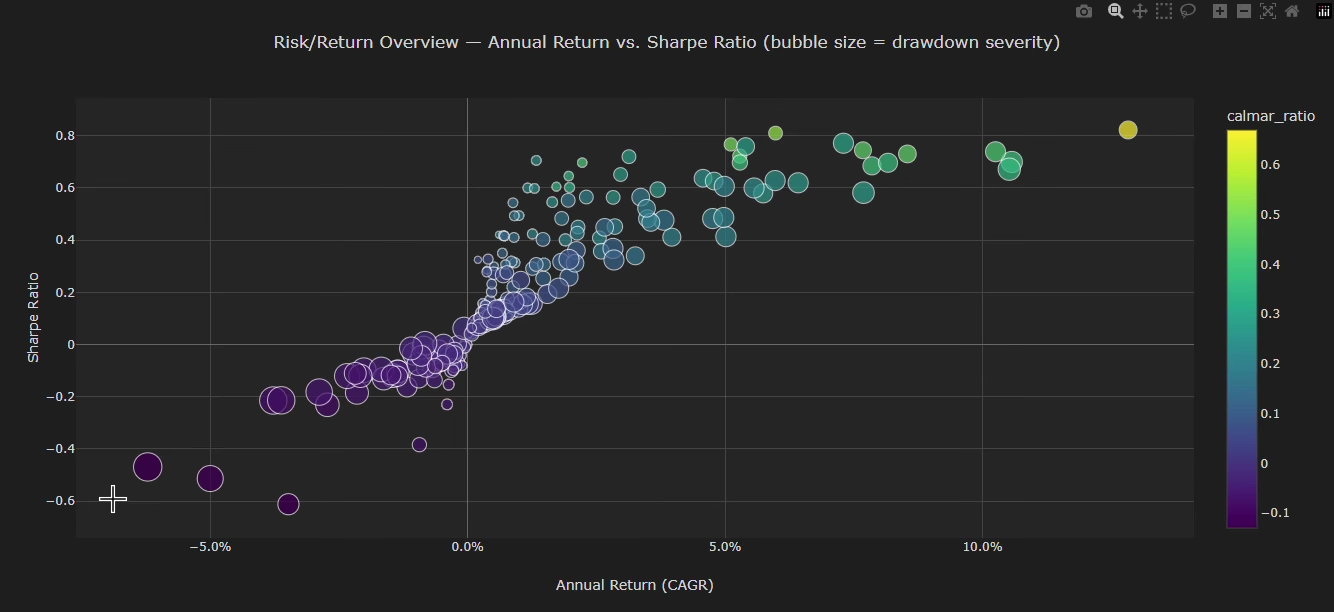
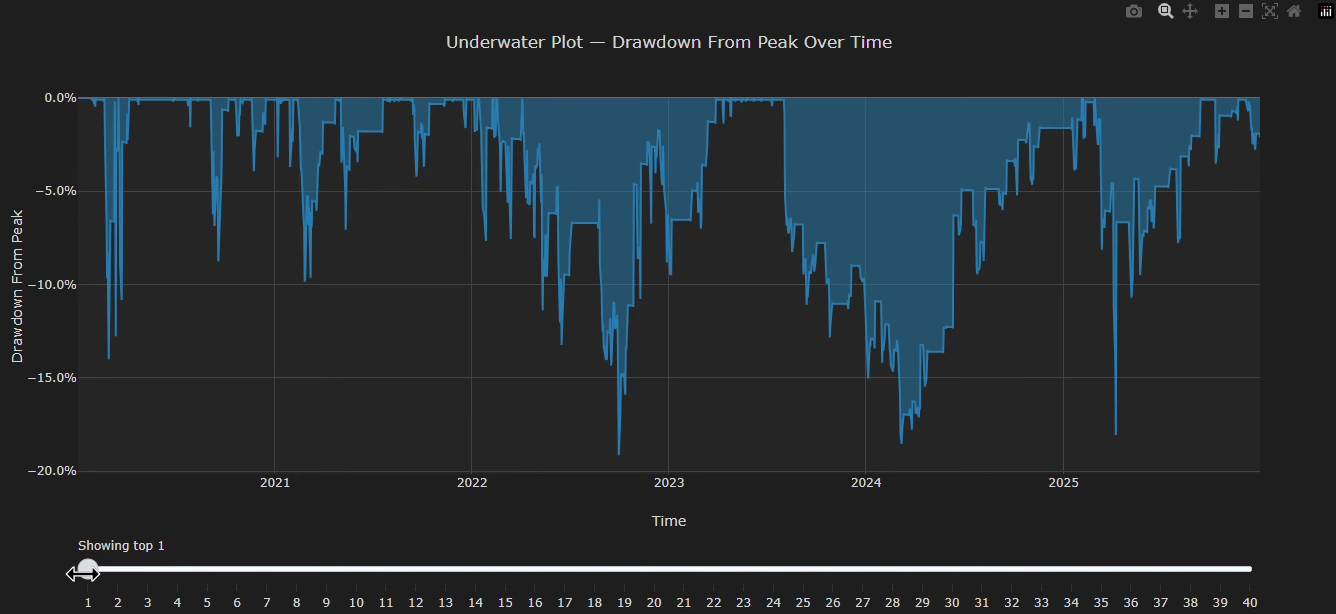
- An entire metrics & graphing suite (equity curves, drawdown/underwater plots) to evaluate large amounts of strategy results at once.
This is not meant to be an extensive list, so see the documentation for everything not covered above.
Installation
Requires: Python 3.11+
pip install contango
See developer installation docs to build the project without pip.
Quickstart
Run the demo
python -m contango.research.demo_strategies.cartesian_bollinger_strategy.runner
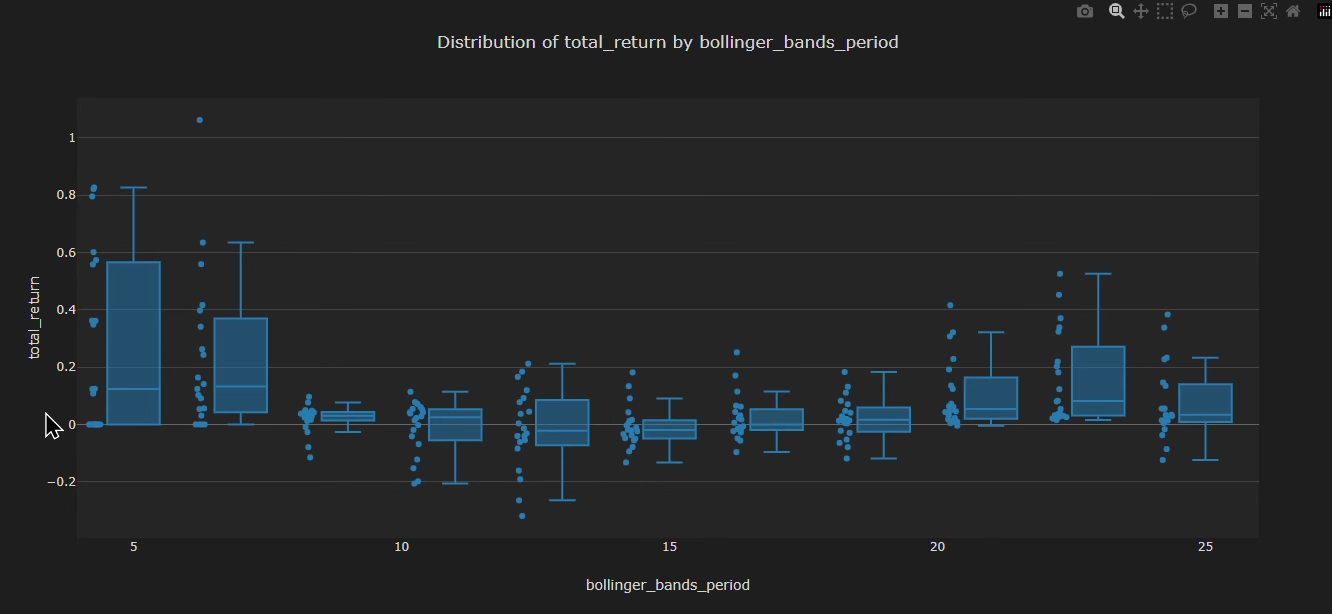
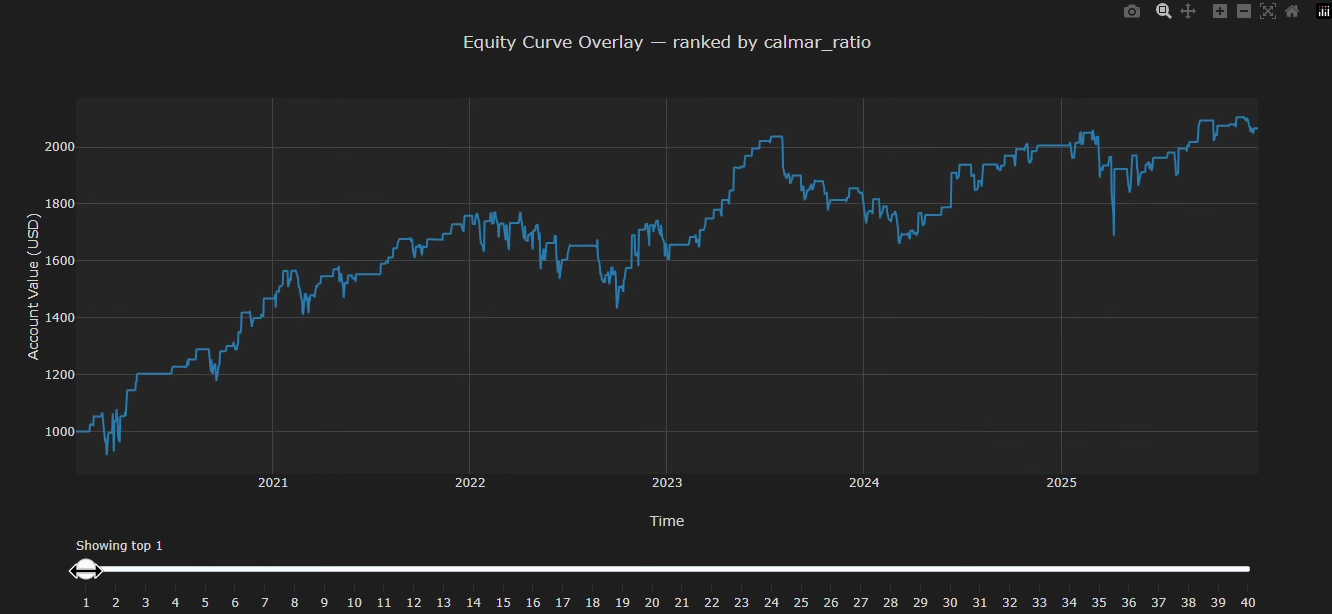
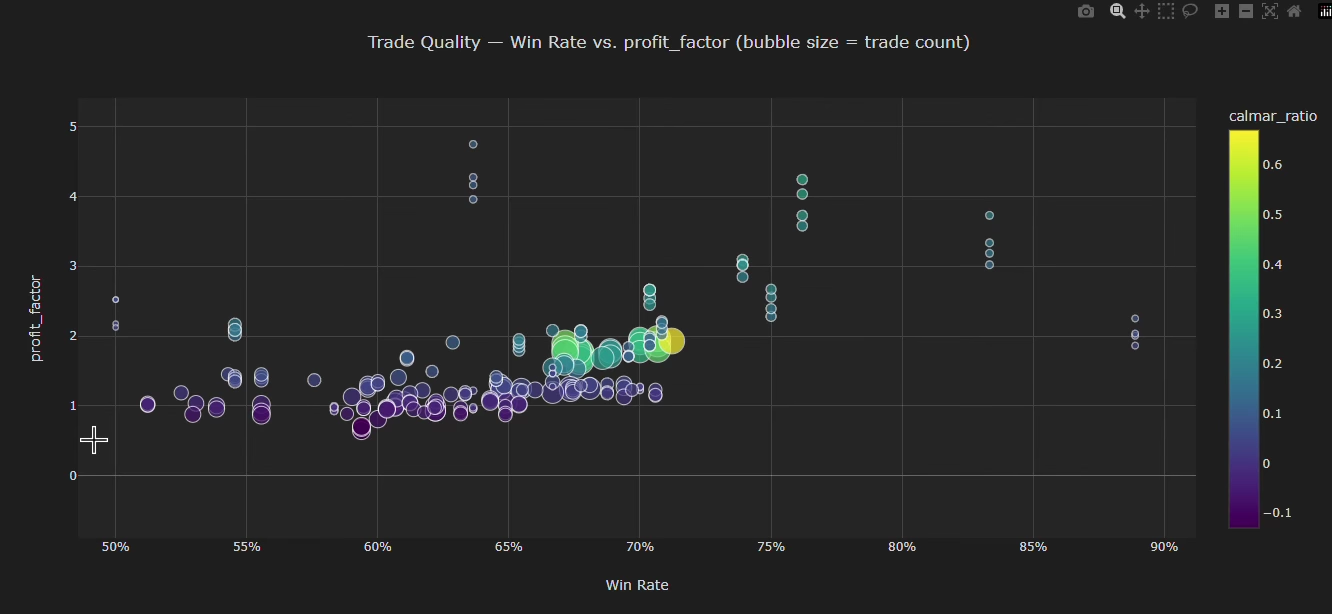
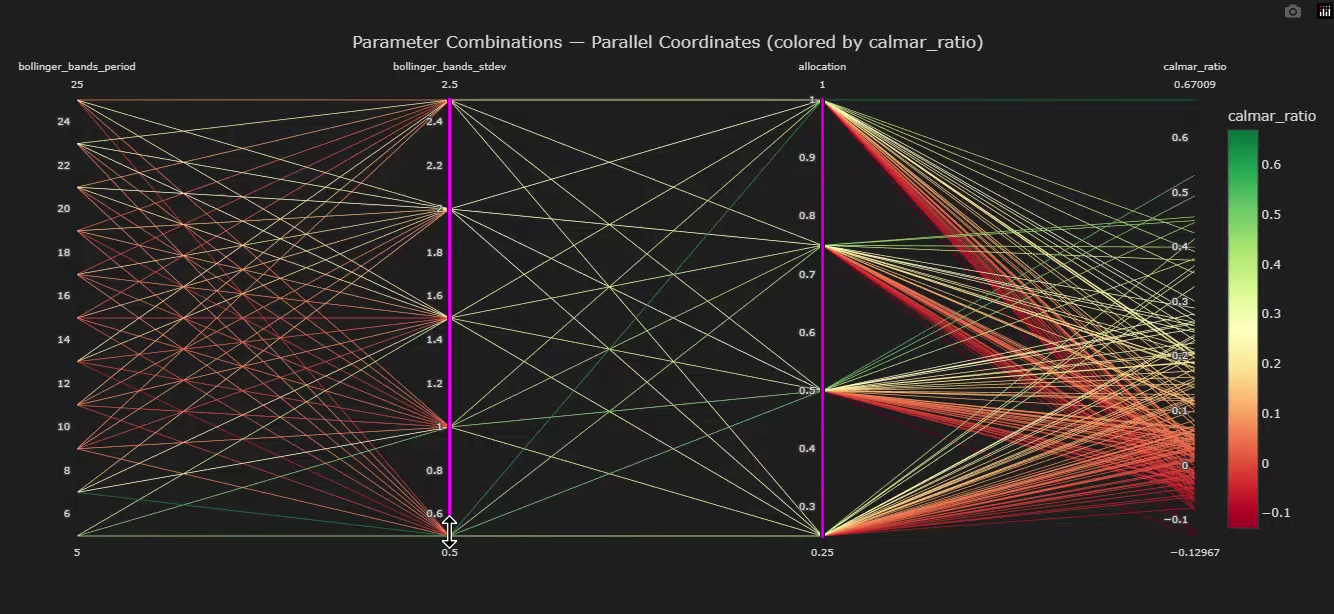
The demo runs a Bollinger Band strategy across a Cartesian grid of parameters and generates performance and parameter-analysis graphs. The generated graphs (as HTML files) are saved to the root directory. To see the graphs, open the generated files in a browser.
The demo strategy itself is written as a RuleBasedStrategy.
Create a Strategy
The framework has two ways to create strategies. Subclassing RuleBasedStrategy allows for less boilerplate with the cost of implicitness, but is generally easier to comprehend at scale. If you would rather have more control (but generally more code to write), subclassing Strategy is the best way to do so:
class MyStrategy(Strategy):
    """
    A simplified strategy outline - not all logic is included.
    """
    def on_market_event(self, event: MarketDataEvent) -> None:
        # Strategy market logic here
        if should_buy:
            self.order_api.submit_order(event, "AAPL", quantity=3)
            self.order_api.submit_stoploss_order(event, "AAPL", quantity=-3, stoploss_price=...)
        elif should_sell:
            self.order_api.submit_order(event, "AAPL", quantity=-3)
Usage
See the documentation for an extensive breakdown on how to use the framework.
Credits
- Historical data is sourced from Yahoo Finance.
Developers:

License
See LICENSE
1 maintainer

Metadata
1 maintainer
Release files for contango 0.1.1
For a detailed explanation of source distributions (sdists) and built distributions (wheels), please see the package formats documentation.
Source distribution (sdist)
| File | Size | Uploaded | Provenance | Actions |
|---|---|---|---|---|
| contango-0.1.1.tar.gz | 93.2 kB | Without provenance | Details for contango-0.1.1.tar.gz |
Built distribution (wheel)
| File | Interpreter | ABI | Platform | Actions Reset |
|---|---|---|---|---|
| contango-0.1.1-py3-none-any.whl | Python 3 | none | any | Details for contango-0.1.1-py3-none-any.whl |
Total release size: 223.9 kB
Release files / contango-0.1.1.tar.gz
| Download URL | contango-0.1.1.tar.gz |
|---|---|
| Size | 93.2 kB |
| Tags | Source |
|
SHA-256 checksum How to use checksums |
2ed9ca0b8dfff36ce16530c8895ab616ea122d174af37ff4365dbb3c5fc75802
|
|
BLAKE2b-256 checksum How to use checksums |
0a4c4d9040420e5eaed43808a63a3ba2f0cc0dd16414607cd0802996869fbb24
|
| Upload date | |
|
Uploaded using Trusted Publishing? What is trusted publishing? |
No |
| Uploaded via |
twine/7.0.0 CPython/3.11.15
|
Release files / contango-0.1.1-py3-none-any.whl
| Download URL | contango-0.1.1-py3-none-any.whl |
|---|---|
| Size | 130.7 kB |
| Tags | Python 3 |
|
SHA-256 checksum How to use checksums |
eac75e555544450320d26f8deddb940fbe778ebd99c9dff64abca08b0ea335b6
|
|
BLAKE2b-256 checksum How to use checksums |
1391ef268a427a88ee6724412b185231d30c25eb1873495280db679280511f74
|
| Upload date | |
|
Uploaded using Trusted Publishing? What is trusted publishing? |
No |
| Uploaded via |
twine/7.0.0 CPython/3.11.15
|
Security for contango 0.1.1
Provenance
Provenance describes where a file came from. On PyPI, provenance is shared via attestations, which provide a verifiable record of the build or publishing details. View details, limitations and caveats.
No provenance found
None of the files in this release were uploaded with provenance metadata.
A note on package security
PyPI is a repository for distributing packages, not a service for auditing them. While third-party security researchers and our staff do their best to detect and remove malicious packages, PyPI cannot guarantee the quality, security or suitability of any given package.
To learn more about protecting yourself from malicious actors, visit our package security documentation.














