
Coralsnake



Conventional genomics tools are built around DNA — a linear, double-stranded
reference where each locus lines up 1:1 with the sequence — and often lack
explicit consideration of RNA's structural properties: an abundance
hierarchy (ribosomal rRNA is orders of magnitude more abundant than
mRNA), strand orientation (sense vs. antisense), and splicing (mRNAs
are assembled from exons, so a transcript does not line up with its genomic
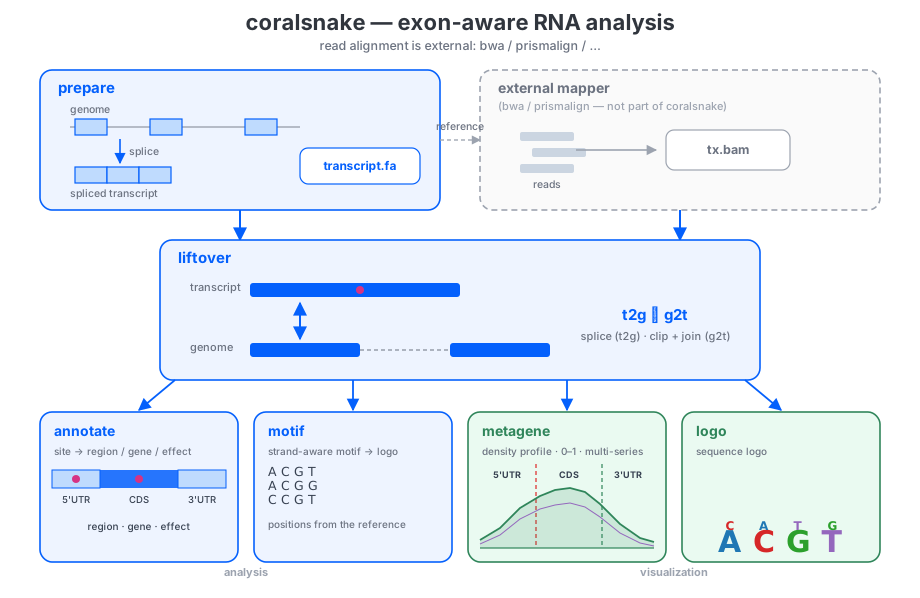
locus). Coralsnake is an exon-aware RNA analysis pipeline built around
exactly these properties: it cleans and normalizes the reference inputs
(refine), turns a GTF/GFF into spliced transcript references (prepare),
splices and joins reads between transcript and genome coordinates in both
directions (liftover), and runs the analyses you do on the results —
annotate places sites/variants on the RNA hierarchy (5'UTR / CDS / 3'UTR /
intronic / intergenic) and calls the variant effect, metagene profiles how
sites distribute across 5'UTR / CDS / 3'UTR, motif fetches the strand-aware
reference motif around each site, and logo renders a DNA/RNA sequence logo.
Installation
Requires Python ≥ 3.12.
pip install coralsnake
The visualization commands (metagene plot, sequence logo) need the lightweight
plot extra, which only pulls in matplotlib when you need it:
pip install "coralsnake[plot]"
Commands
| Command | What it does |
|---|---|
refine |
Clean/normalize the genome FASTA + GTF before prepare (rename seqnames, normalize names/biotypes, flag canonical transcripts). |
prepare |
Extract the spliced primary transcript reference from GTF/GFF. |
liftover |
Splice/join reads between genome/transcript BAMs (-d t2g default, -d g2t inverts). |
annotate |
Unified site/variant annotation: region on the RNA hierarchy + gene/transcript + variant effect. |
qc |
RNA-seq QC from a genome-aligned BAM + GTF: mapping stats + exonic/intronic/intergenic rates + gene counts/TPM (rnaseqc-style). |
metagene |
Exon-aware metagene profiling across 5'UTR/CDS/3'UTR (profile plot needs coralsnake[plot]). |
motif |
Strand-aware genomic motif fetch around variant sites. |
coordinate |
Map chromosome names between coordinate systems (UCSC↔Ensembl). |
group |
Group genes and build a consensus sequence. |
logo |
Plot a DNA/RNA sequence logo, or export its score matrix via --matrix (plotting needs coralsnake[plot]). |
annotateis the single annotation tool — one command, one schema, two input modes:--reference-gtf(region + gene/transcript, and the full variant effect when given a genome FASTA + ref/alt) or--annotation <table>(fast precomputed-table site labeling).
Quick example
A typical end-to-end run (read alignment is done by any external mapper, e.g.
bwa / prismalign):
# 0. (Optional) Clean/normalize the FASTA + GTF first (rename seqnames,
#    normalize names/biotypes, flag the canonical transcript). When you run
#    this, feed outdir/ref.annotation.gtf / outdir/ref.genome.fasta into the
#    steps below instead of annotation.gtf / genome.fa.
coralsnake refine -f genome.fa -g annotation.gtf -o outdir -n ref

# 1. Build the spliced transcript reference: FASTA to align to (-s) and the
#    annotation table (-o) used by liftover and annotate
coralsnake prepare -g annotation.gtf -f genome.fa \
                   -s transcript.fa -o annotation.tsv --with-codon

# 2. Align reads to transcript.fa with an external mapper  →  tx.bam

# 3. Splice the transcript-aligned BAM back to genome coordinates
coralsnake liftover -d t2g -i tx.bam -o genome.bam -a annotation.tsv -f genome.fai

# 4. Annotate sites to genes/transcripts (RNA hierarchy + variant effect)
coralsnake annotate -i sites.tsv -o annotated.tsv \
                    --reference-gtf annotation.gtf \
                    --reference-transcript genome.fa -s -a

# 5. Exon-aware metagene profile across 5'UTR / CDS / 3'UTR
coralsnake metagene -i sites.tsv -g annotation.gtf -o profile.tsv -p profile.png
Subcommands
refine — reference cleaning (pre-prepare)
Clean and normalize a genome FASTA and/or GTF before building the spliced
reference: seqname renaming/filtering, gene/transcript name and type
normalization, missing gene/transcript/exon row creation, overlapping-exon
merge, canonical-transcript flagging, and coordinate checks. Codon and UTR
features are preserved, so the output stays usable for metagene and
annotate. Indexing uses pysam — no external samtools/bgzip/tabix.
The GTF side is built on the shared coralsnake.genemodel.GeneModel object —
the same read/serialize layer prepare uses — so a refined GTF is a drop-in
replacement for the input: both GENCODE-style (*_type) and Ensembl-style
(*_biotype) biotype attributes are written, and the selected canonical
transcript is tagged Ensembl_canonical so prepare's ranking picks the
transcript refine selected.
coralsnake refine -f genome.fa -g annotation.gtf -o outdir -n hg38 \
                  -m chrom_map.tsv -c canonical.tsv
-f/--fasta-file— the genome FASTA to clean: seqnames are renamed/filtered, headers rewritten as>new_name old_name, and a.fai+.genome.sizesindex is rebuilt with pysam.-g/--gtf-file— the GTF to normalize (the GeneModel pipeline above).-o/--outdir— output directory (default./).-n/--name— output name prefix (default: the outdir's basename).-m/--rename-mapper— TSV mapping old seqname → new seqname.-p/--seqname-pattern— keep only seqnames matching this regex.-c/--canonical-transcripts— TSV of canonical transcript IDs (1st column).- At least one of
-f/-gis required. Pass both to keep the FASTA and the annotation seqnames in sync — the same-m/-papply to both. Outputs land under<outdir>/<name>.{genome.fasta,annotation.gtf}(+.gz,.fai,.genome.sizes, tabix index), plus.skip.gtf(genes that failed checks) and.gene_features_summary.txt.
prepare — spliced transcript reference
Build the spliced transcript reference from a GTF/GFF and a genome FASTA. Two outputs:
-s/--seq-file— the spliced transcript FASTA, the target that reads are aligned to (requires-f).-o/--output-file— the annotation table (TSV: gene/transcript, chrom, strand, spliced exon spans, plus optional codon/genename/biotype/txpos columns), consumed byliftover -a,liftover --table, andannotate --annotation.
coralsnake prepare -g annotation.gtf -f genome.fa \
                   -s transcript.fa -o annotation.tsv \
                   --with-codon --with-genename --filter-biotype protein_coding
liftover — splice-aware BAM conversion
prepare builds the transcript reference; liftover round-trips a BAM between
transcript and genome coordinates, splicing reads at exon boundaries. -a
takes the prepare annotation table; -f (a .fai) is required for t2g:
coralsnake liftover -d t2g(default) — transcript BAM → genome BAM (splices reads at exon boundaries, inserts introns).coralsnake liftover -d g2t— genome BAM → transcript BAM (clips to exons, joins spliced reads contiguously on the transcript).--tablemode converts a tab-separated sites table (instead of a BAM):t2greads a gene column + 1-based transcript position and appendsGenomeChrom/GenomePos;g2treads chrom/position/strand and appendsGene/GenePos.
annotate — exon-aware annotation
Label a site (chrom,pos,strand) with gene/transcript/position + region
(5'UTR/CDS/3'UTR/intronic/intergenic); add a genome FASTA + ref/alt to get the
full variant effect (codon/AA + mut_type). Fast precomputed-table mode via
--annotation <table>.
coralsnake annotate -i sites.tsv -o out.tsv --reference-gtf annotation.gtf -c 1,2,3
coralsnake annotate -i variants.tsv -o effects.tsv \
                    --reference-gtf annotation.gtf \
                    --reference-transcript genome.fa -s -a
# or fast table mode, with the `prepare` annotation table (-o output)
coralsnake annotate -i sites.tsv -o out.tsv --annotation annotation.tsv
metagene — exon-aware metagene profiling
Built on the high-performance polars + ruranges stack. Computes the
distribution of sites relative to gene regions (5'UTR, CDS, 3'UTR) and can emit
binned statistics and a publication-ready profile plot. The -p profile plot
needs the plot extra; the tabular outputs (-o, -s, --export-profile)
work without it. --export-profile FILE writes the machine-readable profile
matrix TSV (feature_type, feature_midpoint, count_*) for downstream tools.
# Using a built-in reference (GRCh38) or a custom GTF:
coralsnake metagene -i sites.tsv.gz -r GRCh38 -H -m 1,2,3 -w 5 \
                    -o output.tsv -s scores.tsv -p plot.png

coralsnake metagene -i sites.bed -g custom.gtf.gz -m 1,2,3 -w 5 \
                    -o output.tsv -s scores.tsv -p plot.png
Manage the built-in references (groups human / mouse are supported;
reference list shows sizes — the metagene --list/--download/--export-*
flags are deprecated aliases):
coralsnake reference list
coralsnake reference download GRCh38        # or: human / mouse / all
One reference download serves every tool — the tools accept the reference
by name and reuse the cached parquet (auto-downloading it if missing);
reference export converts it to text views for external tools:
coralsnake metagene -i sites.tsv -r GRCh38 ...              # uses the parquet directly
coralsnake annotate -i sites.tsv -g GRCh38 -f GRCh38 ...    # cached GTF + linked genome
coralsnake liftover -i tx.bam -o genome.bam -a GRCh38 -f GRCh38 --sort
coralsnake motif -i sites.tsv -f GRCh38 ...
coralsnake reference export GRCh38 --table ref_table.tsv --gtf ref.gtf  # explicit text views
Genome FASTAs are too large to ship in the release, so they are linked:
reference genome <ref> (or reference download <ref> --with-genome)
streams the verified upstream genome (Ensembl/UCSC), decompresses and
indexes it under ~/.cache/coralsnake/genomes/, and cross-checks the FASTA
headers against the reference's contig names.
The reference parquets are served from this repo's fixed data release and
cached in ~/.cache/coralsnake/; rebuild or update them with
scripts/build_references.py
(see scripts/README.md).
Python API — the functions are importable from the flat modules:
from coralsnake.io import load_sites, load_reference
from coralsnake.gtf import load_gtf
from coralsnake.annotation import map_to_transcripts, normalize_positions
from coralsnake.map_to_local import map_to_local
from coralsnake.plotting import plot_profile

sites = load_sites("sites.tsv.gz", with_header=True, meta_col_index=[0, 1, 2])
ref = load_reference("GRCh38")   # or load_gtf("custom.gtf.gz")
annotated = map_to_transcripts(sites, ref)
gene_bins, gene_stats, gene_splits = normalize_positions(
    annotated, split_strategy="median", bin_number=100
)
plot_profile(gene_bins, gene_splits, "metagene_plot.png")

# Map global coordinates to local transcript coordinates (strand-aware):
local = map_to_local(sites, ref, ref_id_col="transcript_id")
qc — RNA-seq quality control
Run the core RNA-seq QC metrics from a genome-aligned BAM + a gene annotation
(ported to lean on coralsnake's GeneModel + ruranges overlap + pysam):
mapping statistics, the exonic / intronic / intergenic / ambiguous / intragenic
read rates, base mismatch, high-quality rates, rRNA rate, sense rates, gene read
counts, TPM, genes detected, 3′ bias, and fragment-size statistics — the last
two derived from the GTF exons + reads, so no BED file is needed.
coralsnake qc -i sample.bam -g GRCh38 -o qc/ -s sample1
# or a custom annotation:
coralsnake qc -i sample.bam -g annotation.gtf -o qc/ -u --stranded RF
-i/--bam— coordinate-sorted SAM/BAM/CRAM.-g/--gtf— gene annotation GTF/GFF, or a built-in reference name (e.g.GRCh38) for the cached GTF.-o/--outdir— output directory;-s/--samplesets the sample name (default: the BAM filename).-u/--unpaired— single-end library (do not require proper pairs).-q/--mapping-quality,--base-mismatch,-d/--detection-threshold— high-quality / detection thresholds (defaults: 255 / 6 / 5, as rnaseqc).--stranded RF|FR— restrict features to the read's strand (strand-specific libraries).--bias-offset/--bias-window/--bias-gene-length— 3′ bias windows (defaults 150 / 100 / 600 bp).--fragment-samples— max fragment-size samples (default 1 000 000).--no-counts— skip the gene/exon count tables.
It writes {sample}.metrics.tsv (Statistic, Value) plus, by default,
{sample}.gene_reads.tsv, {sample}.gene_tpm.tsv, {sample}.exon_reads.tsv,
and — when pairs/mates are present — {sample}.fragmentSizes.txt.
from coralsnake.rnaseqc import run_rnaseqc

metrics = run_rnaseqc("sample.bam", "annotation.gtf", "qc/", sample="s1")
Metrics follow the standard RNA-seq QC definitions. Not ported here: per-gene/per-exon base coverage + CV and GC content (need a FASTA), and the legacy counting rules. 3′ bias and fragment-size statistics are computed from the GTF exons + reads (no BED required).
motif & coordinate
motif— fetch the strand-aware genomic sequence around each site, padded withN(-n left,rightfor asymmetric padding).coordinate— rename chromosome names between reference coordinate systems (built-in UCSC↔Ensembl mappings for hg38/mm39, or a custom-mTSV).
Both migrated from the standalone variant package with unchanged naming and
output format.
# Motif fetch (strand-aware, padded with N)
coralsnake motif -i sites.tsv -o motifs.tsv -f genome.fa -n 2,3 -w

# Chromosome-name mapping (UCSC ↔ Ensembl)
coralsnake coordinate -i sites.tsv -o mapped.tsv -M U2E
from coralsnake.motif import get_motif
from coralsnake.coordinate import run_coordinate
from coralsnake.annotate import run_annotate
group — gene clustering & consensus
Group related genes and build a consensus sequence:
coralsnake group -f genes.fa -g genes.gtf -o grouped.tsv \
                 --output-consensus consensus.fa --threads 8
logo — sequence logo
Builds a DNA/RNA sequence logo from a set of motif sequences. The scoring
engine is pure numpy; only the figure renderer needs matplotlib (plot
extra). --matrix FILE exports the position × base score matrix as TSV
(rows = motif positions, columns = A C G T U + any other symbol present) —
pure numpy, so it works without the plot extra, and the figure is optional
when a matrix is requested.
coralsnake logo -m ACGT -m ACGG -m CCGT -o logo.png
# or with per-motif weights from a file (seq\tcount)
coralsnake logo -i motifs.tsv -o logo.svg
# or export just the position x base score matrix as TSV (no plotting needed)
coralsnake logo -i motifs.tsv --matrix logo_scores.tsv
from coralsnake import Mlogo

m = Mlogo(motifs=["ACGT", "ACGG", "CCGT"], to2bit=True)
m.plot(ax)  # requires matplotlib (plot extra)
Performance
The core is built on the vectorized polars + ruranges stack, using Rust-backed
ruranges primitives instead of slow per-group Python applies:
map_to_transcriptspicks the best transcript per gene with a vectorized sort +group_by().first()(wasgroup_by().map_groups()python apply) — ~20× faster on realistic inputs.map_to_localusesruranges.numpy.group_cumsumfor strand-aware cumulative transcript offsets (was a hand-rolledmap_groupsapply) — ~7× faster.Mlogo(sequence logo) builds its score matrix with vectorizednumpy(bincount+ codepoint lookup) — ~1.5× faster and fixes a0·log2(0)NaN edge case.
Documentation
- Architecture & Design — package layout and design decisions.
- Full docs site: https://coralsnake.yech.science/ (see
docs/).
Mapping is out of scope. Nucleotide-conversion (two-color / three-color) mapping is not part of coralsnake any more: it lives in the dedicated
prismalignpackage (pluggable backends: bwamem, minimap2/mappy, pure-Python), on top of the lightweightbwamemBWA-MEM binding.
1 maintainer

Metadata
1 maintainer
Release files for coralsnake 0.3.2
For a detailed explanation of source distributions (sdists) and built distributions (wheels), please see the package formats documentation.
Source distribution (sdist)
| File | Size | Uploaded | Provenance | |
|---|---|---|---|---|
| coralsnake-0.3.2.tar.gz | 174.8 kB | Without provenance | Details |
Built distributions (wheels)
| File | Interpreter | ABI | Platform | Reset |
|---|---|---|---|---|
| coralsnake-0.3.2-cp313-cp313-manylinux_2_17_x86_64.manylinux2014_x86_64.whl | CPython 3.13 | CPython 3.13 | Linux glibc 2.17+ x86-64 | Details |
| coralsnake-0.3.2-cp312-cp312-manylinux_2_17_x86_64.manylinux2014_x86_64.whl | CPython 3.12 | CPython 3.12 | Linux glibc 2.17+ x86-64 | Details |
Total release size: 478.7 kB
Release files / coralsnake-0.3.2.tar.gz
| Download URL | coralsnake-0.3.2.tar.gz |
|---|---|
| Size | 174.8 kB |
| Tags | Source |
|
SHA-256 checksum How to use checksums |
560abbea9ad15e9b47132512821138b0abea2562838c179e022edd7b7fa4a20b
|
|
BLAKE2b-256 checksum How to use checksums |
710c2e8126ea87e0006098f6e82f7976283549fc5e1fc292c942da159d799546
|
| Upload date | |
|
Uploaded using Trusted Publishing? What is trusted publishing? |
No |
| Uploaded via |
twine/7.0.0 CPython/3.13.14
|
Release files / coralsnake-0.3.2-cp313-cp313-manylinux_2_17_x86_64.manylinux2014_x86_64.whl
| Download URL | coralsnake-0.3.2-cp313-cp313-manylinux_2_17_x86_64.manylinux2014_x86_64.whl |
|---|---|
| Size | 152.0 kB |
| Tags | CPython 3.13 Linux glibc 2.17+ x86-64 |
|
SHA-256 checksum How to use checksums |
a28fc444f93ddc43ca3ad2eabe9022fccbae7ecb220462460b86afe6ad0201d4
|
|
BLAKE2b-256 checksum How to use checksums |
c0ba62a15e69a8638e54c7e7baec27c919ae435f78adb48395e3cd660951475d
|
| Upload date | |
|
Uploaded using Trusted Publishing? What is trusted publishing? |
No |
| Uploaded via |
twine/7.0.0 CPython/3.13.14
|
Release files / coralsnake-0.3.2-cp312-cp312-manylinux_2_17_x86_64.manylinux2014_x86_64.whl
| Download URL | coralsnake-0.3.2-cp312-cp312-manylinux_2_17_x86_64.manylinux2014_x86_64.whl |
|---|---|
| Size | 151.9 kB |
| Tags | CPython 3.12 Linux glibc 2.17+ x86-64 |
|
SHA-256 checksum How to use checksums |
02b4a0071e4b430a5c1d099afc91e67d8b61426eac6de63b33a72b6d105689f6
|
|
BLAKE2b-256 checksum How to use checksums |
b1220a61a004bb36a5be610ae2285ac9c84cc986ba17b8647760252fa7102f7c
|
| Upload date | |
|
Uploaded using Trusted Publishing? What is trusted publishing? |
No |
| Uploaded via |
twine/7.0.0 CPython/3.13.14
|
Security for coralsnake 0.3.2
Provenance
Provenance describes where a file came from. On PyPI, provenance is shared via attestations, which provide a verifiable record of the build or publishing details. View details, limitations and caveats.
No provenance found
None of the files in this release were uploaded with provenance metadata.
A note on package security
PyPI is a repository for distributing packages, not a service for auditing them. While third-party security researchers and our staff do their best to detect and remove malicious packages, PyPI cannot guarantee the quality, security or suitability of any given package.
To learn more about protecting yourself from malicious actors, visit our package security documentation.














