



Causal memory for AI agents.
Structured memory objects + causal trace over durable events — so agents can recall why, not just what.
Quickstart · Features · Supported Clients · Contributing
Core Memory
Give your AI agents persistent memory built for the way conversations actually work. Core Memory is a plug and play, self-hosted conversational memory MCP server that captures each turn as a memory object, builds causal links as the dialogue unfolds, and recalls with full evidence. Works with Claude Code, Cursor, ChatGPT, or any MCP-compatible client.
Transcripts are where most decision making actually happens, across agent conversations, email threads, and Slack. Yet every tool treats them as a noisier version of a document. Core Memory is built specifically for that problem.
Remember every turn: Each turn produces a memory object linked to prior turns by typed causal edges. Claims are tracked and superseded when contradicted, so memory stays truthful as the dialogue develops.
Stored as a causal graph: Memory objects are linked by the relationship between them, like caused_by, contradicts, and supports. When you ask a question, your agent follows the chain of reasoning, not just a ranked vector similarity score. Every result shows you the path of causality between the memory events.
Depth on demand: Tune recall(query, effort="low" | "medium" | "high") for your needs. Fast lookup when that is enough, full causal traversal when the question needs it. The orchestrator decides.
Rolling context injection on a budget: Compacted memory objects carry only their title, type, and causal associations, allowing 10+ sessions of history to be injected for a fraction of the token cost of naive loading. Promoted objects stay full context when active, and the agent can expand any compacted memory on demand with a single tool call.
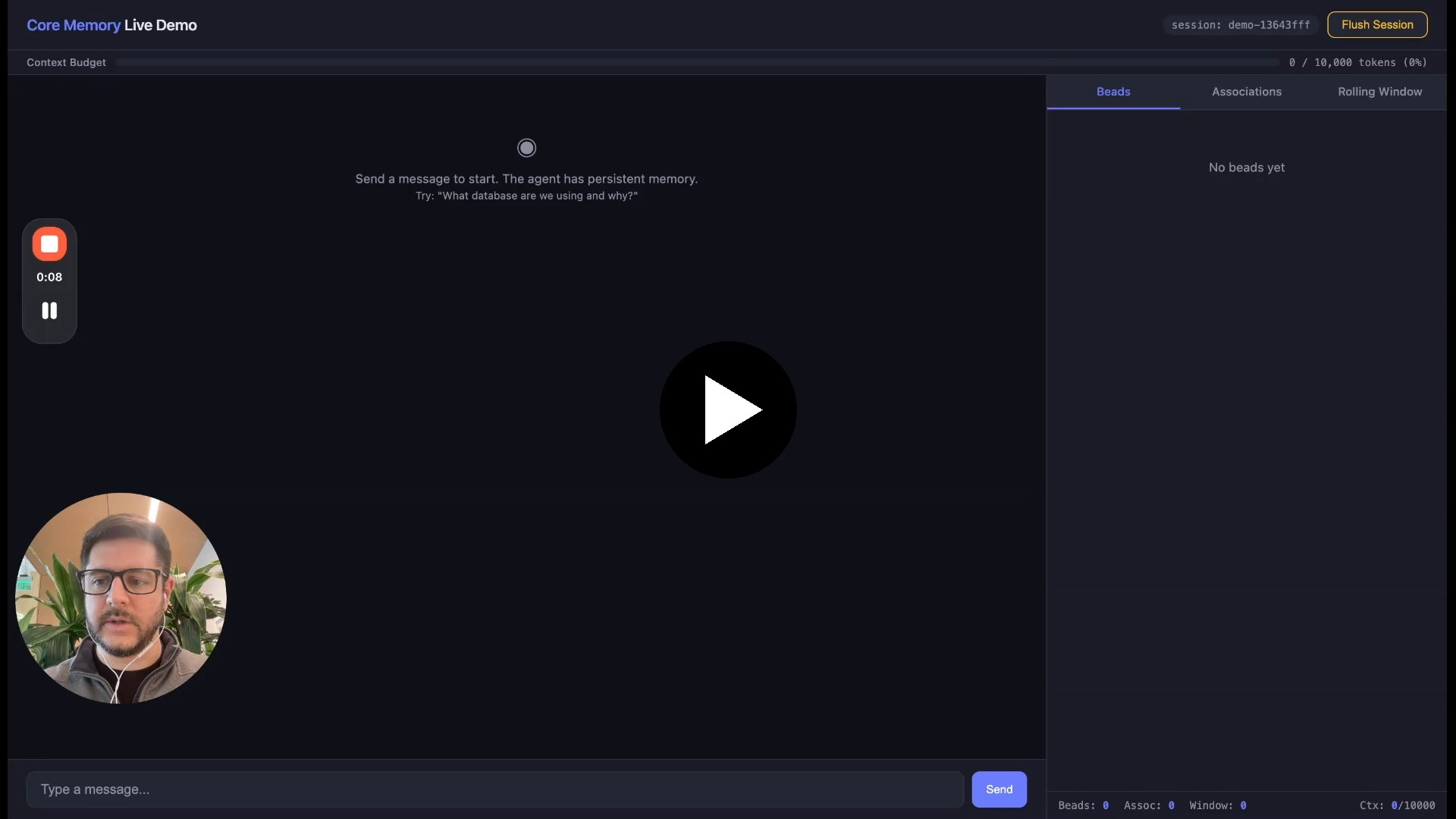
Watch the Core Memory live demo on YouTube
Quick Start
Core Memory auto-detects your embeddings provider from OPENAI_API_KEY, GEMINI_API_KEY, or GOOGLE_API_KEY. No configuration needed.
uvx "core-memory[mcp]" mcp serve
Core Memory starts on http://localhost:8000/mcp and stores data in ~/.core-memory/store.
For Claude Code, add to your MCP config:
{
  "mcpServers": {
    "core-memory": {
      "type": "streamable-http",
      "url": "http://localhost:8000/mcp"
    }
  }
}
Start a new conversation. MCP exposes recall, capture, capture_session, and governed maintain tools the model can call. Per-turn capture requires the model to follow the bundled agent guide; automatic capture for every turn requires a supported client adapter or lifecycle hook.
Or install directly from PyPI for Python SDK use:
pip install "core-memory[mcp]"
To ingest existing transcripts, use the CLI command:
core-memory ingest transcript my-transcript.jsonl
Or call the ingest tool directly from any connected MCP client. Accepts JSONL or JSON with user/assistant, human/ai, or customer/agent roles.
See the full setup guide for MCP client configuration and adapter configurations for OpenClaw, PydanticAI, LangChain, and SpringAI.
Features
Transcript-native storage: Built specifically for conversational data, each turn is normalized into a memory object rather than chunked and indexed alongside authored documents.
Per-turn capture via MCP tools: The MCP server exposes capture and capture_session as tools. When a client adapter or lifecycle hook is configured, every turn is captured automatically. With stock MCP clients (Claude, ChatGPT), the model follows the bundled agent guide to call capture after state-bearing turns. Use capture_session at conversation end as a lossless safety net.
Rolling context injection on a budget: Compacted memory objects carry only their title, type, and causal associations, fitting 10+ sessions of history into a fraction of the token cost of naive loading.
Causal graph, not a flat index: Memory objects are linked by typed relationships (caused_by, contradicts, supports, and more), so recall follows reasoning chains instead of ranking similarity scores.
Claims tracked and superseded: Statements like "user prefers PostgreSQL" are monitored and updated when later turns contradict them. Memory stays truthful, not just full.
Full context is always retrievable: Full transcripts are preserved and linked via turn and session_ID references, so full context is always a tool call away.
Inspectable retrieval with provenance: Every recall() returns the source conversation, the traversal path that found it, and a verifiable hash. Retrieval is never a black box.
Depth on demand: recall(query, effort="low" | "medium" | "high") scales from fast lookup to full causal traversal. The orchestrator decides what the question needs.
Self-hosted MCP: Streamable-HTTP server at /mcp with a canonical agent guide that loads at connection. For stock MCP clients (Claude, ChatGPT), paste the operating-protocol block printed by core-memory mcp install into your custom instructions so the model calls recall/capture/capture_session on every turn. Owned control-plane agents can also use maintain for governed approval, cleanup, and removal workflows.
Auto-detected embedding model: Picks up OPENAI_API_KEY, GEMINI_API_KEY, or GOOGLE_API_KEY from your environment. Runs in degraded mode with one hint if none are set.
Plug and play adoption: Your data stays on your infrastructure. No cloud dependencies. A single MCP server setup works across any MCP-compatible client.
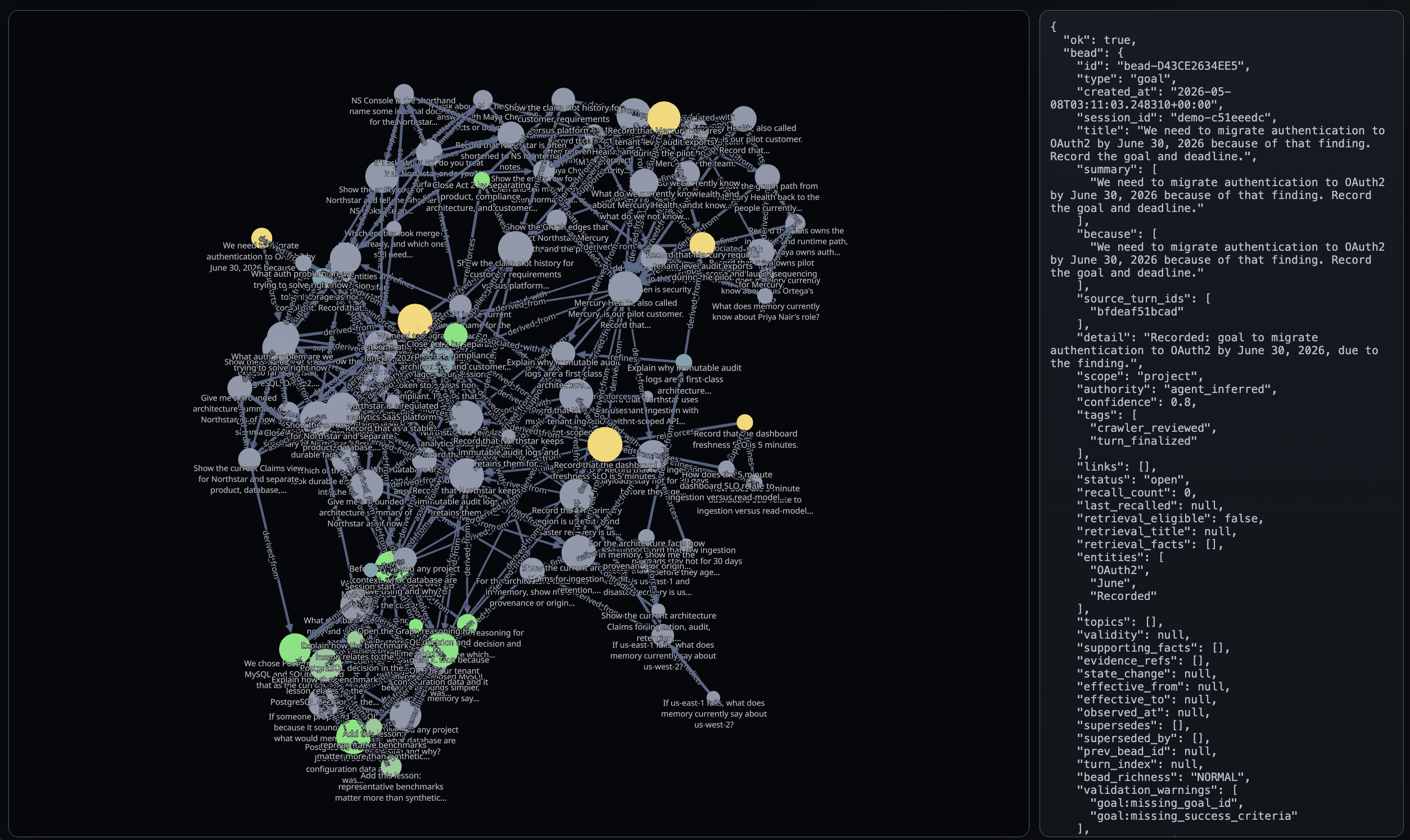
The causal memory graph (left) and the grounded bead JSON returned by recall() (right) — type, entities, session_id, and source_turn_ids make every retrieval inspectable.
Supported Clients
MCP Connection
Any client that can connect to MCP streamable-HTTP servers can use Core Memory through the /mcp endpoint. See the MCP Quickstart for setup instructions and example client configuration.
Adapter Layer Use Core Memory as a memory backend directly within your agent harness:
| Client | Plugin | Quickstart | Integration Guide | API Reference | Adapter Spec |
|---|---|---|---|---|---|
| OpenClaw | Plugin and Skill | Quickstart and Setup Guide | Guide | API Reference | Adapter Spec |
| PydanticAI | — | Quickstart | Guide | API Reference | Adapter Spec |
| SpringAI | — | Quickstart | Guide | API Reference | Adapter Spec |
| LangChain | — | Quickstart | Guide | API Reference | Adapter Spec |
OpenClaw v2026.6.8+ requires plugins.entries.core-memory-bridge.hooks.allowConversationAccess=true; see the runtime install notes.
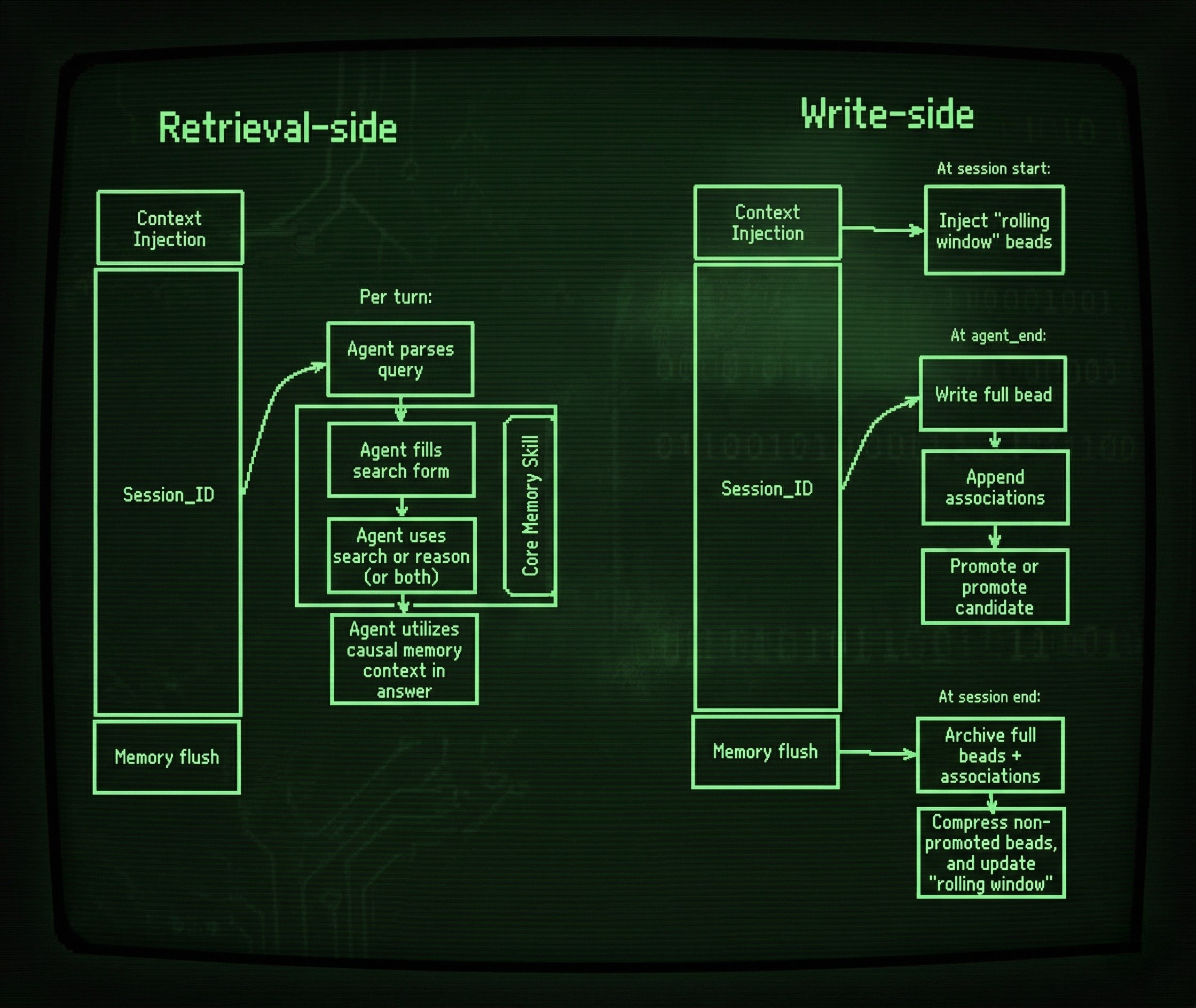
How It Works
Core Memory separates retrieval from writes, connected through session-scoped storage. Each agent turn follows the same loop:
Capture: Call capture() after each turn, or let a client adapter do it automatically. With MCP, the model follows the bundled agent guide to call capture after state-bearing turns; use capture_session at the end of a conversation as a lossless safety net. Each turn becomes a memory object typed as a decision, lesson, outcome, evidence, or context. An agent judge assigns typed causal associations (caused_by, contradicts, supports, and more), and claims are tracked and superseded when later turns update them. Nothing is filtered before storage — the LLM assigns structure, not importance.
Recall: recall(query, effort="low" | "medium" | "high") is the single read verb. Before each agent turn, a bounded context packet is built from the rolling window: promoted memory objects at full context, compacted ones as lightweight stubs. effort="low" runs lexical and semantic anchor search. effort="medium" adds temporal routing. effort="high" runs the full orchestration pipeline: causal traversal, multi-hop chains, goal resolution, and claim-slot enrichment. The orchestrator decides what the question needs.
Grounding: Every recall() returns a RecallResult — not just the memory, but the source conversation it came from, the traversal path that found it, and a verifiable hash. The result carries per-memory evidence records and a planning trace showing exactly which retrieval surfaces fired. Retrieval is deterministic from indexed state.
Maintain: Memory objects are either promoted (full context in the rolling window) or compacted to title, type, and associations only. Compacted objects remain queryable and their associations stay intact — the agent expands any on demand with a single tool call. Myelination (edge strengthening over time) is available as an opt-in feature; rarely-accessed memory compacts naturally.
Core Concepts
Memory Object A memory object is a structured unit of recall typed as a decision, lesson, outcome, evidence, context, or another typed event. Each object is either promoted (full context in the rolling window) or compacted (title, type, and associations only). Promoted objects are immediately available; compacted objects can be expanded on demand via a single tool call.
Rolling Window Before each agent turn, Core Memory builds a bounded context packet from the rolling window — the session-scoped set of memory objects visible to the current conversation. Promoted objects contribute full context; compacted stubs contribute their title, type, and associations. The rolling window allows 10+ sessions of history to fit within a standard token budget.
Associations Associations are typed causal or temporal links between memory objects, assigned by an agent judge from a fixed 28-label taxonomy (caused_by, contradicts, supports, and more). Associations remain queryable even as memory objects compact. Unlike semantic similarity links, associations encode the reason one memory relates to another.
Claims Claims are verifiable statements extracted from conversation turns and tracked across sessions. When a later turn contradicts an existing claim, the association graph is updated — the prior claim is superseded, not deleted. The full history of a changing belief is preserved while the current state remains accurate.
Retrieval Pipeline Three canonical surfaces, exposed through recall(query, effort=...):
search— lexical and semantic anchor retrieval (effort="low")trace— causal traversal from search anchors (effort="medium")execute— full orchestration: search + trace + goal resolution + claim-slot enrichment (effort="high")
Hydration is explicit post-selection source recovery (turn/tools/adjacent) — not a general retrieval mode and not the same as the rolling window. Retrieval is deterministic from indexed state.
RecallResult
Every recall() returns a typed RecallResult with evidence[] (memory objects with grounding hashes), sources[], steps[] (which surfaces fired and in what order), resolved_goals[], and claim_slots{}. Stable across MCP, REST, and Python SDK.
Semantic Readiness
Core Memory auto-detects your embeddings provider from OPENAI_API_KEY, GEMINI_API_KEY, or GOOGLE_API_KEY. If none is set, it runs in degraded lexical mode — BM25 keyword recall, no semantic anchors.
| Profile | How to get there |
|---|---|
| Minimal MCP (degraded) | No API key; set CORE_MEMORY_CANONICAL_SEMANTIC_MODE=degraded_allowed to suppress the warning |
| MCP + semantic recall | Set OPENAI_API_KEY (or Gemini/Google), then run core-memory graph semantic-build |
| Production (Qdrant/pgvector) | Set CORE_MEMORY_VECTOR_BACKEND=qdrant or pgvector; see semantic backend docs |
The CORE_MEMORY_CANONICAL_SEMANTIC_MODE env var controls failure behavior:
| Mode | Behavior |
|---|---|
required (default) |
Fails closed when semantic backend is unavailable |
degraded_allowed |
Lexical fallback with degraded recall markers |
First-run recall quality with no semantic backend: keyword matches only, no similarity-ranked anchors.
Multi-Store Fan-Out (experimental)
Core Memory can fan out recall queries to PipeHouse and merge external evidence:
| Env var | Purpose |
|---|---|
CORE_MEMORY_PIPEHOUSE_URL |
Enables PipeHouse evidence retrieval |
CORE_MEMORY_STORE_WEIGHTS |
Comma-separated weights for core_memory,pipehouse (default 1.0,1.0) |
Fan-out is skipped when none of these are set. Results are normalized, weighted, and merged into the standard RecallResult.
Storage Backend
| Backend | Use case |
|---|---|
local-faiss |
Development, single-process only ([semantic]) |
qdrant |
Production, distributed ([qdrant]) |
pgvector |
Production, Postgres-native ([pgvector]) |
chromadb |
Development alternative ([chromadb]) |
Set via CORE_MEMORY_VECTOR_BACKEND. Avoid local-faiss for multi-worker deployments. See semantic backend docs.
Learn more in the architecture docs.
Recall Example
Request
from core_memory import recall

result = recall(
    "what database did we decide on for Project Heron?",
    effort="high",
    root="~/.core-memory"
)
Response
{
  "contract": "recall_result",
  "schema_version": "recall_result.v1",
  "status": "answered",
  "answer": "PostgreSQL",
  "why": "Decision recorded in session 2026-04-12: PostgreSQL selected for Project Heron tenant config",
  "evidence": [
    {
      "bead_id": "b_a3f9c2",
      "type": "decision",
      "title": "PostgreSQL selected for Project Heron tenant config",
      "content_excerpt": "We decided to use PostgreSQL for the main tenant config database.",
      "score": 0.94,
      "grounding_hash": "sha256:e3b0c44..."
    }
  ],
  "sources": [
    {
      "turn_id": "turn_042",
      "session_id": "session_2026_04_12",
      "bead_id": "b_a3f9c2",
      "speaker": "user",
      "ts": "2026-04-12T14:23:00Z"
    }
  ],
  "steps": [
    { "tier": "semantic", "status": "ok", "result_count": 3, "why": "anchor search" },
    { "tier": "causal",   "status": "ok", "result_count": 1, "why": "causal chains resolved" }
  ],
  "planning": {
    "selected_effort": "high",
    "reason": "full orchestration: search + trace + goal resolution + claim enrichment"
  },
  "claim_slots": {
    "project_heron.database": {
      "subject": "project_heron",
      "slot": "database",
      "current_value": "PostgreSQL",
      "status": "active",
      "current_claim_id": "claim_b3f1a9",
      "chain_seq": 1,
      "grounding_hash": "sha256:e3b0c44..."
    }
  },
  "resolved_goals": [],
  "warnings": []
}
Documentation
Repo Map
core_memory/
├── persistence/
├── schema/
├── retrieval/
├── graph/
├── write_pipeline/
├── runtime/
├── association/
├── integrations/
├── policy/
└── cli.py
Other useful folders:
- examples/ runnable examples
- tests/ behavioral and regression coverage
- docs/ architecture, integration guides, and contracts
- plugins/ OpenClaw bridge assets
- demo/ live demo app and assets
Contributing
git clone https://github.com/JohnnyFiv3r/Core-Memory.git
cd Core-Memory
python3 -m venv .venv
source .venv/bin/activate
pip install -U pip
pip install -e ".[dev]"
core-memory --help
python3 -c "import core_memory; print('core_memory import ok')"
pytest
For a core-deps-only run that matches CI and avoids optional backend/live integration skips:
pytest tests/ -m "not optional_backend and not neo4j_live" -x -q --tb=short
Optional backend coverage is exercised by the all-extras CI job. Live Neo4j
coverage is kept in the explicit neo4j_live workflow lane.
Useful docs:
CONTRIBUTING.md Public Surface Test Suite Index
Maintainers
Core Memory is maintained by:
John Inniger (@JohnnyFiv3r) Chris Dedow (@chrisdedow)
For bugs and feature requests, please open an issue. For anything else related to the project, feel free to reach out to the maintainers directly.
Inspiration
Inspired in part by Steve Yegge's writing on beads and memory systems: https://github.com/steveyegge/beads
1 maintainer

Metadata
1 maintainer
Release files for core-memory 1.1.2
For a detailed explanation of source distributions (sdists) and built distributions (wheels), please see the package formats documentation.
Source distribution (sdist)
| File | Size | Uploaded | Provenance | Actions |
|---|---|---|---|---|
| core_memory-1.1.2.tar.gz | 1.2 MB | With provenance | Details for core_memory-1.1.2.tar.gz |
Built distribution (wheel)
| File | Interpreter | ABI | Platform | Actions Reset |
|---|---|---|---|---|
| core_memory-1.1.2-py3-none-any.whl | Python 3 | none | any | Details for core_memory-1.1.2-py3-none-any.whl |
Total release size: 2.1 MB
Release files / core_memory-1.1.2.tar.gz
| Download URL | core_memory-1.1.2.tar.gz |
|---|---|
| Size | 1.2 MB |
| Tags | Source |
|
SHA-256 checksum How to use checksums |
7619f54558b52301ac11cf5b9ade1ee7d8e4f675e8f34cdf600606b3932236ac
|
|
BLAKE2b-256 checksum How to use checksums |
38306572e1902acb01f733f8ec90305db3beedfd40b95c8d4cede7a51aa1c8ae
|
| Upload date | |
|
Uploaded using Trusted Publishing? What is trusted publishing? |
Yes |
| Uploaded via |
twine/7.0.0 CPython/3.13.16
|
Provenance
Provenance describes where a file came from. On PyPI, provenance is shared via attestations, which provide a verifiable record of the build or publishing details. View details, limitations and caveats.


PyPI Publish Attestation
PyPI verified that this artifact, at this checksum, originated from the publisher listed below.
Signed by GitHub Actions, verified by PyPI on Oct 26, 2026.
Transparency logRelease files / core_memory-1.1.2-py3-none-any.whl
| Download URL | core_memory-1.1.2-py3-none-any.whl |
|---|---|
| Size | 901.9 kB |
| Tags | Python 3 |
|
SHA-256 checksum How to use checksums |
ddc0531be40f217583e00a6bad129c171d3da8a877de1549fa5e97559923f4b8
|
|
BLAKE2b-256 checksum How to use checksums |
1d9d55ab4139c775ede65c64efc9b0d1c60efd24b8c6b30309165c43a9b9c3f5
|
| Upload date | |
|
Uploaded using Trusted Publishing? What is trusted publishing? |
Yes |
| Uploaded via |
twine/7.0.0 CPython/3.13.16
|
Provenance
Provenance describes where a file came from. On PyPI, provenance is shared via attestations, which provide a verifiable record of the build or publishing details. View details, limitations and caveats.
PyPI Publish Attestation
PyPI verified that this artifact, at this checksum, originated from the publisher listed below.
Signed by GitHub Actions, verified by PyPI on Oct 26, 2026.
Transparency logSecurity for core-memory 1.1.2
Provenance
Provenance describes where a file came from. On PyPI, provenance is shared via attestations, which provide a verifiable record of the build or publishing details. View details, limitations and caveats.
Full provenance
Both files in this release have been uploaded with provenance metadata.
Attestation for core_memory-1.1.2.tar.gz
PyPI Publish Attestation
PyPI verified that this artifact, at this checksum, originated from the publisher listed below.
Signed by GitHub Actions, verified by PyPI on Oct 26, 2026.
Transparency logA note on package security
PyPI is a repository for distributing packages, not a service for auditing them. While third-party security researchers and our staff do their best to detect and remove malicious packages, PyPI cannot guarantee the quality, security or suitability of any given package.
To learn more about protecting yourself from malicious actors, visit our package security documentation.














