
Correlation Optimized Warping (COW) algorithm for signal alignment

Project description
📘 Cowarp – Correlation Optimized Warping in Python
Cowarp is a Python implementation of an alignment method called Correlation Optimized Warping (COW). This technique is widely used in spectroscopy, chromatography, and other analytical fields to align signals that may have local time shifts or distortions. COW aligns one signal (sample) to another (reference) by segmenting the signals and warping segments to maximize correlation.
This is the initial release of the package. It currently includes a single implementation of the COW algorithm, in which the sample signal endpoints remain fixed (i.e., not subject to warping).

🛠️ Installation
pip install cowarp
🚀 Basic Usage
import numpy as np
from cowarp import warp

# Example reference and sample signals
reference = np.sin(np.linspace(0, 2 * np.pi, n))
sample = np.sin(np.linspace(0, 2 * np.pi, n) + 0.5)

# Run Correlation Optimized Warping
aligned_sample, corr = warp(reference, sample, num_intervals=5, slack=8)
⚙️ Function Signature
warp(
    reference,
    sample,
    num_intervals=None,
    interval_length=None,
    slack=None,
    min_interval_length=None,
    return_details=False,
    verbose=False
)
📚 Parameters
| Parameter | Type | Description |
|---|---|---|
reference |
array-like | Reference (target) 1D signal to align against. |
sample |
array-like | Sample signal to be warped and aligned to the reference. Currently supports only 1D signals. |
num_intervals |
int, optional | Number of intervals to divide the signal into. Mutually exclusive with interval_length. |
interval_length |
int, optional | Length of each interval. Alternative to num_intervals. |
slack |
int, optional | Maximum allowed deviation (shift) in interval boundary positions. |
min_interval_length |
int, optional | Minimum length allowed for any interval. Default: 3. |
return_details |
bool, default=False | If True, returns additional details (e.g., warp path). |
verbose |
bool, default=False | If True, prints internal decisions and computed values. |
📤 Returns
Depending on return_details:
-
If
Falsereturns a tuple:(warped_sample, correlation)-
warped_sample: np.ndarrayThe warped (aligned ) version of
sample, aligned to the same length asreference. -
correlation: final_correlation : floatPearson correlation coefficient between
referenceandwarped_sample.
-
-
If
Truereturns a dictionary:{ "warped_sample": np.ndarray, "correlation": float, "warping_path": list[int], "boundaries": list[int], }-
warping_pathList of boundary indices in the sample signal defining the intervals that correspond to the fixed reference intervals. The length of this list is equal to num_intervals + 1.
-
boundariesList of fixed interval boundaries in the reference signal. The length of this list is equal to num_intervals + 1.
-
🧠 Example
"""
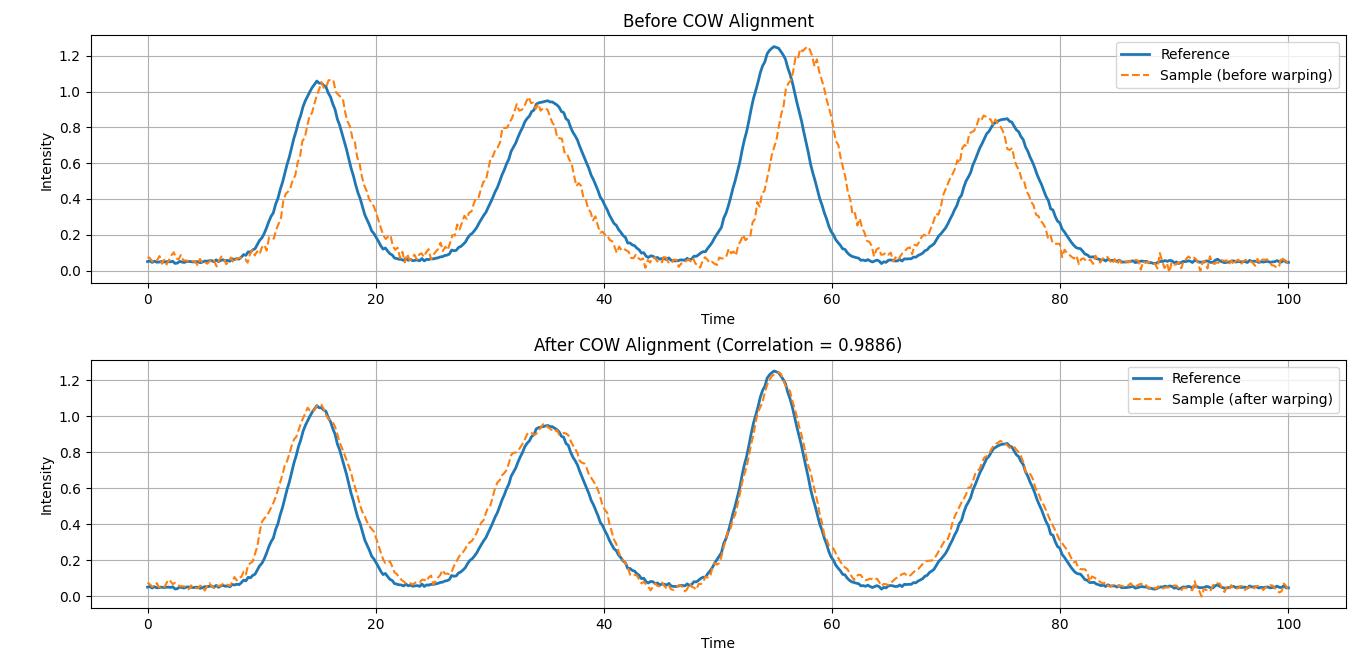
Example: Aligning Chromatographic Signals using COW

This example demonstrates how to use the COW (Correlation Optimized Warping)
algorithm to align two chromatographic signals. The sample chromatogram
contains nonlinear time shifts and noise relative to the reference.

"""

import numpy as np
import matplotlib.pyplot as plt
from cowarp import warp


def generate_chromatogram(num_points=400, random_shift=False, noise_level=0.01):
    x = np.linspace(0, 100, num_points)

    # Define ideal peaks
    peaks = [15, 35, 55, 75]
    widths = [2.5, 3.5, 2.5, 3.0]
    amplitudes = [1.0, 0.9, 1.2, 0.8]

    y = np.zeros_like(x)
    for i, (mu, sigma, amp) in enumerate(zip(peaks, widths, amplitudes)):
        if random_shift:
            mu += np.random.uniform(-3.0, 3.0)  # stronger shift
        y += amp * np.exp(-0.5 * ((x - mu) / sigma) ** 2)

    # Add small baseline and noise
    y += 0.05 + noise_level * np.random.randn(num_points)
    return x, y


# --- Generate reference and sample chromatograms ---

# Reference chromatogram
x_ref, reference = generate_chromatogram(num_points=500, random_shift=False, noise_level=0.005)

# Sample chromatogram (more strongly shifted and noisier)
x_samp, sample = generate_chromatogram(num_points=480, random_shift=True, noise_level=0.02)

# --- Perform COW alignment ---
result_dict = warp(
    reference,
    sample,
    num_intervals=10,
    slack=25,
    min_interval_length=4,
    return_details=True,
    verbose=True
)

warped_sample = result_dict['warped_sample']
final_corr = result_dict['correlation']
warping_path = result_dict['warping_path']
boundaries = result_dict['boundaries']

print(f"Final correlation after warping: {final_corr:.4f}")

# --- Plot results ---
plt.figure(figsize=(10, 7))

plt.subplot(2, 1, 1)
plt.plot(x_ref, reference, label="Reference", linewidth=2)
plt.plot(x_samp, sample, label="Sample (before warping)", linestyle="--")
plt.title("Before COW Alignment")
plt.xlabel("Time")
plt.ylabel("Intensity")
plt.legend()
plt.grid(True)

plt.subplot(2, 1, 2)
plt.plot(x_ref, reference, label="Reference", linewidth=2)
plt.plot(np.linspace(0, 100, len(warped_sample)), warped_sample, label="Sample (after warping)", linestyle="--")
plt.title(f"After COW Alignment (Correlation = {final_corr:.4f})")
plt.xlabel("Time")
plt.ylabel("Intensity")
plt.legend()
plt.grid(True)

plt.tight_layout()
plt.show()
The resulting plot is given below.
🧾 License
This project is licensed under the MIT License.
✍️ Author
Guram Chaganava
Electrical & Electronics Engineer | Machine Learning Enthusiast
Release history Release notifications | RSS feed


Download files
Download the file for your platform. If you're not sure which to choose, learn more about installing packages.
Source Distribution
Built Distribution
Filter files by name, interpreter, ABI, and platform.
If you're not sure about the file name format, learn more about wheel file names.
Copy a direct link to the current filters
File details
Details for the file cowarp-0.1.6.tar.gz.
File metadata
- Download URL: cowarp-0.1.6.tar.gz
- Upload date:
- Size: 16.0 kB
- Tags: Source
- Uploaded using Trusted Publishing? No
- Uploaded via: twine/6.2.0 CPython/3.9.13
File hashes
| Algorithm | Hash digest | |
|---|---|---|
| SHA256 |
43a142c303b6d27ad3317ca11249d8a1ecfb49e25bc52ebf6b572530c1cb4c16
|
|
| MD5 |
9e8a191cbbd79cde4e0591436ad2716f
|
|
| BLAKE2b-256 |
d27142ea688a23575eb422fc65cef0d1aa9ad8354c75a9a9be24e2e0eb9b9ca9
|
File details
Details for the file cowarp-0.1.6-py3-none-any.whl.
File metadata
- Download URL: cowarp-0.1.6-py3-none-any.whl
- Upload date:
- Size: 14.4 kB
- Tags: Python 3
- Uploaded using Trusted Publishing? No
- Uploaded via: twine/6.2.0 CPython/3.9.13
File hashes
| Algorithm | Hash digest | |
|---|---|---|
| SHA256 |
e3899858ef141220d0eac2c94e5e12765f8eb2f533da9beed092b892d036f175
|
|
| MD5 |
0fd4d5636a88831c80166fd2f1fa530b
|
|
| BLAKE2b-256 |
b26b4656784096c62b72b945615f76d16a79cc07254c4ac3287bbe1711ac0c28
|






