
Correlation Optimized Warping (COW) algorithm for signal alignment

Project description
📘 Cowarp – Correlation Optimized Warping in Python
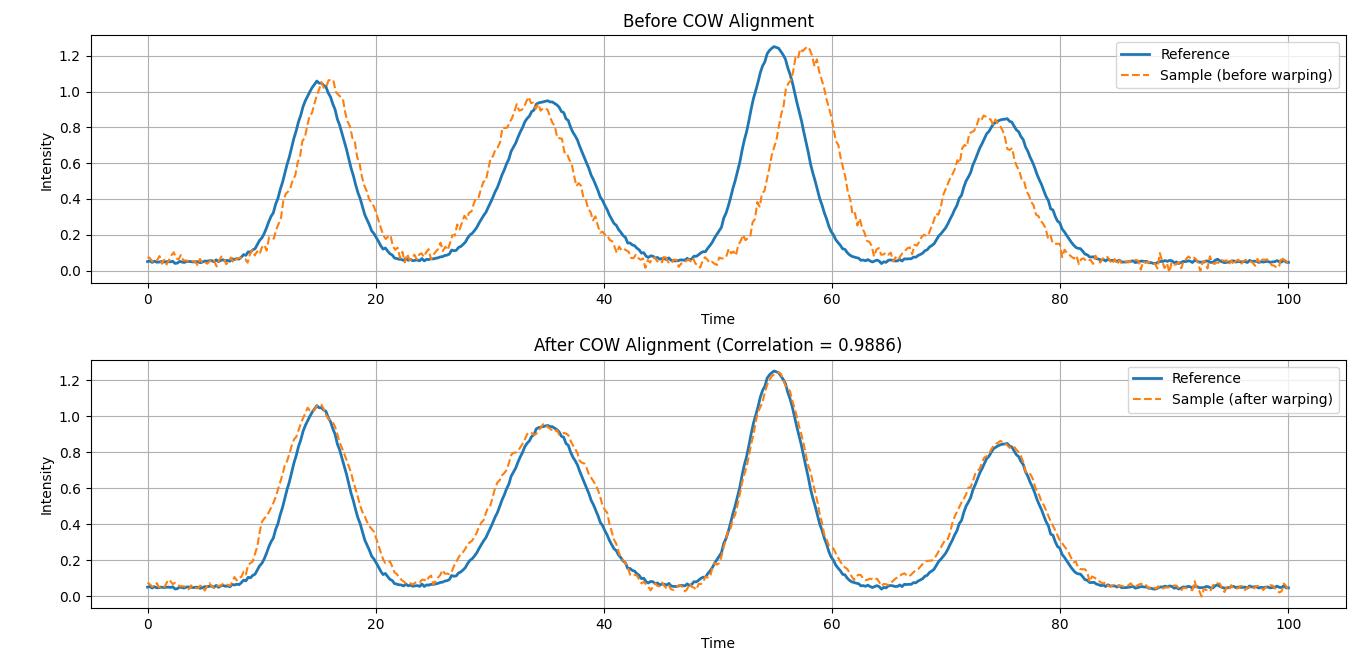
Cowarp is a Python implementation of an alignment method called Correlation Optimized Warping (COW). This technique is widely used in spectroscopy, chromatography, and other analytical fields to align signals that may have local time shifts or distortions. COW aligns one signal (sample) to another (reference) by segmenting the signals and warping segments to maximize correlation.
The package currently includes implementations of the two different COW variants:
- standart COW
- COW with automatic segmentation (ASCOW).
In both implementations the sample signal endpoints remain fixed (i.e., not subject to warping).

🛠️ Installation
pip install cowarp
🚀 Basic Usage
1️⃣ Manual Segmentation (Standard COW)
import numpy as np
from cowarp import warp

# Example reference and sample signals
reference = np.sin(np.linspace(0, 2 * np.pi, n))
sample = np.sin(np.linspace(0, 2 * np.pi, n) + 0.5)

# Run Correlation Optimized Warping
aligned_sample, corr = warp(reference, sample, num_intervals=5, slack=8)
2️⃣ Automatic Segmentation (ASCOW)
aligned_sample, corr = warp(
    reference,
    sample,
    auto_segment=True,
    deformation_coeff=0.3
)
Automatic Segmented COW (ASCOW)
ASCOW extends the standard COW algorithm by automatically determining segment boundaries based on the structural characteristics of the reference signal.
Instead of manually specifying the number of intervals and slack, ASCOW detects boundaries using one of the following segmentation strategies:
-
Stationary points
-
Inflection points
-
Peak boundaries
Segment flexibility is controlled by a deformation coefficient, which determines the allowable boundary movement relative to the lengths of adjacent segments.
For reliable boundary detection, it is recommended to smooth the reference signal prior to segmentation. Cowarp provides built-in filtering options, including:
-
Moving average filter
-
Gaussian filter
Additionally, users may supply a custom filtering function for full flexibility.
⚙️ Function Signature
warp(
    reference,
    sample,
    auto_segment=False,

    # --- Manual segmentation ---
    num_intervals=None,
    interval_length=None,
    slack=None,

    # --- Automatic segmentation ---
    segmentation_type=STATIONARY_POINTS,
    deformation_coeff=None,
    filter_func_code=GAUSSIAN_FILTER,
    filter_func=None,
    filter_func_params=3,
    process_filtered_signals=False,

    # --- Shared ---
    min_interval_length=None,
    return_details=False,
    verbose=False
)
📚 Parameters
Core Inputs
| Parameter | Type | Description |
|---|---|---|
reference |
array-like | Reference (target) 1D signal. |
sample |
array-like | Signal to be warped to match the reference. |
Segmentation Mode
| Parameter | Type | Description |
|---|---|---|
auto_segment |
bool | If False → manual segmentation. If True → automatic segmentation (ASCOW). |
Manual Segmentation Parameters (auto_segment=False)
| Parameter | Type | Description |
|---|---|---|
num_intervals |
int | Number of warping intervals. |
interval_length |
int | Length of each interval (alternative to num_intervals). |
slack |
int | Maximum allowed boundary shift (±). |
Automatic Segmentation Parameters (auto_segment=True)
| Parameter | Type | Description |
|---|---|---|
segmentation_type |
str | Boundary detection strategy ('stationary_points', 'inflection_points', 'peak_boundaries'). |
deformation_coeff |
float | Boundary flexibility coefficient in [0, 1]. |
filter_func_code |
str | Built-in filter identifier ('moving_average', 'gaussian', 'no_filter'). |
filter_func |
callable | Custom filtering function (overrides filter_func_code). |
filter_func_params |
int/float | Filter parameter (e.g., window size, sigma). |
process_filtered_signals |
bool | If True, warping is performed on filtered signals. |
Shared Parameters
| Parameter | Type | Description |
|---|---|---|
min_interval_length |
int | Minimum allowed interval size. |
return_details |
bool | If True, returns detailed warping information. |
verbose |
bool | Enables diagnostic output. |
📤 Returns
Depending on return_details:
-
If
Falsereturns a tuple:(warped_sample, correlation)-
warped_sample: np.ndarrayThe warped (aligned ) version of
sample, aligned to the same length asreference. -
correlation: final_correlation : floatPearson correlation coefficient between
referenceandwarped_sample.
-
-
If
Truereturns a dictionary:{ "warped_sample": np.ndarray, "correlation": float, "warping_path": list[int], "boundaries": list[int], }-
warping_pathList of boundary indices in the sample signal defining the intervals that correspond to the fixed reference intervals. The length of this list is equal to num_intervals + 1.
-
boundariesList of fixed interval boundaries in the reference signal. The length of this list is equal to num_intervals + 1.
-
🧠 Example
"""
Example: Aligning Chromatographic Signals using COW

This example demonstrates how to use the COW (Correlation Optimized Warping)
algorithm to align two chromatographic signals. The sample chromatogram
contains nonlinear time shifts and noise relative to the reference.

"""

import numpy as np
import matplotlib.pyplot as plt
from cowarp import warp


def generate_chromatogram(num_points=400, random_shift=False, noise_level=0.01):
    x = np.linspace(0, 100, num_points)

    # Define ideal peaks
    peaks = [15, 35, 55, 75]
    widths = [2.5, 3.5, 2.5, 3.0]
    amplitudes = [1.0, 0.9, 1.2, 0.8]

    y = np.zeros_like(x)
    for i, (mu, sigma, amp) in enumerate(zip(peaks, widths, amplitudes)):
        if random_shift:
            mu += np.random.uniform(-3.0, 3.0)  # stronger shift
        y += amp * np.exp(-0.5 * ((x - mu) / sigma) ** 2)

    # Add small baseline and noise
    y += 0.05 + noise_level * np.random.randn(num_points)
    return x, y


# --- Generate reference and sample chromatograms ---

# Reference chromatogram
x_ref, reference = generate_chromatogram(num_points=500, random_shift=False, noise_level=0.005)

# Sample chromatogram (more strongly shifted and noisier)
x_samp, sample = generate_chromatogram(num_points=480, random_shift=True, noise_level=0.02)

# --- Perform COW alignment ---
result_dict = warp(
    reference,
    sample,
    auto_segment=False,
    num_intervals=10,
    slack=25,
    min_interval_length=4,
    return_details=True,
    verbose=True
)

warped_sample = result_dict['warped_sample']
final_corr = result_dict['correlation']
warping_path = result_dict['warping_path']
boundaries = result_dict['boundaries']

print(f"Final correlation after warping: {final_corr:.4f}")

# --- Plot results ---
plt.figure(figsize=(10, 7))

plt.subplot(2, 1, 1)
plt.plot(x_ref, reference, label="Reference", linewidth=2)
plt.plot(x_samp, sample, label="Sample (before warping)", linestyle="--")
plt.title("Before COW Alignment")
plt.xlabel("Time")
plt.ylabel("Intensity")
plt.legend()
plt.grid(True)

plt.subplot(2, 1, 2)
plt.plot(x_ref, reference, label="Reference", linewidth=2)
plt.plot(np.linspace(0, 100, len(warped_sample)), warped_sample, label="Sample (after warping)", linestyle="--")
plt.title(f"After COW Alignment (Correlation = {final_corr:.4f})")
plt.xlabel("Time")
plt.ylabel("Intensity")
plt.legend()
plt.grid(True)

plt.tight_layout()
plt.show()
The resulting plot is given below.
🧾 License
This project is licensed under the MIT License.
✍️ Author
Guram Chaganava
Electrical & Electronics Engineer | Machine Learning Enthusiast
Release history Release notifications | RSS feed


Download files
Download the file for your platform. If you're not sure which to choose, learn more about installing packages.
Source Distribution
Built Distribution
Filter files by name, interpreter, ABI, and platform.
If you're not sure about the file name format, learn more about wheel file names.
Copy a direct link to the current filters
File details
Details for the file cowarp-0.2.1.tar.gz.
File metadata
- Download URL: cowarp-0.2.1.tar.gz
- Upload date:
- Size: 28.0 kB
- Tags: Source
- Uploaded using Trusted Publishing? No
- Uploaded via: twine/6.2.0 CPython/3.9.13
File hashes
| Algorithm | Hash digest | |
|---|---|---|
| SHA256 |
3863d26708ca05c58d246c7d0aa4a81122354a8de04c61a4956c919e7b18a36d
|
|
| MD5 |
478e672de7e270d4911e9130570d7e89
|
|
| BLAKE2b-256 |
f19e2b183f06e29297655a89c4f53c0a7c5d6344bdde4d349d39546329f20d40
|
File details
Details for the file cowarp-0.2.1-py3-none-any.whl.
File metadata
- Download URL: cowarp-0.2.1-py3-none-any.whl
- Upload date:
- Size: 27.1 kB
- Tags: Python 3
- Uploaded using Trusted Publishing? No
- Uploaded via: twine/6.2.0 CPython/3.9.13
File hashes
| Algorithm | Hash digest | |
|---|---|---|
| SHA256 |
40df9bd54ac7d1f3f45940aff92bd48b7776ccdf695aabd5620d51e5c6ad1fbe
|
|
| MD5 |
f38b6846ac3cb1abcd0757fbd3d7b511
|
|
| BLAKE2b-256 |
40931f055a37674e7c4e0e26db05c7188fe55bbf9551705d3ea4c12cdca64833
|






