

crit
Agentic toolkit for building and optimizing high-performance inference engines tailored to your GPU and desired LLM.





Summary • Quick start • What crit solves • Case studies •
How crit works • API • CLI • MCP • crit-hub • Limitations • Documentation
Summary
Your coding agent builds the engine; crit gives it the runtime, the techniques, the kernels and the measurements.
Quick start
Give one of these prompts to your coding agent and specify your target LLM or target engine:
Use github.com/crit-labs/crit to build an optimized inference engine for <huggingface_url>.
Use github.com/crit-labs/crit to optimize my own inference engine in <engine_reference>.
What crit solves
The boring stuff has already been built ⏱️
Requests, memory management and cleanup eat up development time before optimization even starts.
critsupplies a clean foundation so you can get to the work that makes your engine fast.
Curated high-impact inference strategies 📊
Don't rebuild inference strategies from scratch. We studied established inference engines and distilled their core speedup strategies into reusable code, so you can apply what works to your model and hardware quickly. Each strategy is a plugin with its own tests, and an ablation switches each one off to measure what it adds to your engine.
Physics-based evaluation suite 🔬
A benchmark score alone doesn't tell you what's still left on the table.
critmeasures your hardware's limits and shows how close your engine gets, with quality and correctness checks along the way.
Case Studies
We gave Claude Opus 5.5 a target LLM along with the crit repository and let it cook autonomously.
| What it shows | Evidence |
|---|---|
| Fast engines | Qwen3.8-27B on one RTX 5090: 199.5 tok/s sampled decode and 7,552 tok/s prefill with 200,000 tokens of context, +20% decode and +26% prefill over its first Eval-measured candidate |
| Quality is your call | The same model built once per quality mode: speed prefills 3.2x faster and decodes 13% faster, preserve drifts a fifth as far from the checkpoint (mean KL divergence 0.018 against 0.087) |
| Hours, not weeks | 5h 28m of active development and five candidates from the run's first command to the selected engine, $34 at API list prices |
| New architectures | crit had no model plugin for Qwen3.8's hybrid gated-delta layout; each agent wrote its own and ran it on crit's library plugins |
| Every step is evidence | Each candidate is sealed with its exact source and its Eval result, so the tables below are a record, not a recollection |
| Honest about what is left | Decode runs at 65% of the ceiling Eval measures for it, prefill at 43%; Eval reports each gap next to the score |
| Next | Gemma 4 31B (dense), and Qwen3.8-Flash-Next and Nemotron 3.5 Super 120B, mixture-of-experts models larger than VRAM |
Dev box details
| Part | Spec |
|---|---|
| GPU | NVIDIA GeForce RTX 5090, 32 GB, 450 W power limit |
| PCIe | Gen 4 x16 (the card supports Gen 5; the board's slot is Gen 4) |
| CPU | AMD Ryzen 5 9600, 6 cores, 12 threads |
| RAM | 96 GB DDR5 (2x 48 GB) at 4,800 MT/s |
| OS | Windows 11 Home (build 26200), engines run in WSL 2 on Ubuntu 24.04 |
| Driver and CUDA | NVIDIA driver 596.49 (CUDA 13.2), CUDA toolkit 13.1 |
📋 Dense LLM, Qwen architecture
Goal: Get to a fast, working engine for a dense model as quickly as possible. Limit: A fixed candidate budget.
|
5h 28m Development time |
199.5 tok/s Sampled decode |
7,552 tok/s Prefill |
204 ms TTFT |
+0.8% Perplexity vs reference |
0.087 Mean KL divergence |
mtp5-nvfp4-drafts
runs Qwen3.8-27B in its stored NVFP4 and FP8 weights on one RTX 5090 with 200,000 tokens of context, in the
speed quality mode: the engine may trade drift from the checkpoint for speed within a budget that only keeps
out a broken engine. One coding agent built it from crit and crit-eval alone, as a plugin package: crit's
library plugins for the projections (the stored 4-bit and 8-bit weights on crit's prompt GEMM and decode GEMV
kernels), FP8 attention pages, the gated-delta recurrence, fused norms and token sampling, plus a model plugin it
wrote for the checkpoint's architecture, which crit's library did not have. Each round drafts 5 tokens with the
model's own MTP layer inside Core's captured rounds, from NVFP4 copies of that layer and of the output head that
only the drafter reads; the verify pass keeps the stored weights and samples with rejection sampling on the
GPU, so sampled requests draft too. Prompts run the gated-delta layers as chunked tensor-core scans.
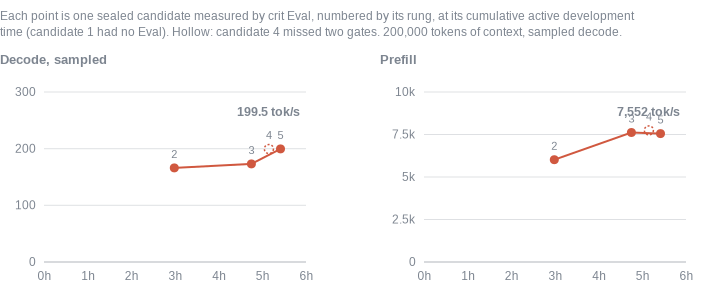
| Candidate | What changed | Sampled decode | Prefill | TTFT | Dev time, cumulative | Agent tokens, cumulative | API equivalent, cumulative |
|---|---|---|---|---|---|---|---|
| 1 | Working engine: its own model plugin on crit's library plugins, drafting 3 tokens with the model's MTP layer in captured rounds (two drafts before it failed checks: short prompt chunks took decode arithmetic, then short prompts' first tokens jittered) | – | – | – | 0h 59m | 41.4M | $12.60 |
| 2 | Plugin round: the ablation kept fused norms (+14% decode) and an NVFP4 copy of the MTP layer (+4%); six other library plugins measured neutral and were dropped | 166 tok/s | 6,015 tok/s | 264 ms | 2h 59m | 61.9M | $21.83 |
| 3 | Chunked tensor-core recurrence for prompts, an NVFP4 copy of the output head for drafting (a draft with crit's native prompt GEMMs failed smoke: it broke causality at 100 to 255 rows) | 173 tok/s | 7,620 tok/s | 202 ms | 4h 45m | 77.2M | $29.75 |
| 4 | Drafts 5 tokens a round, 4,096-token prompt chunks (missed two gates: no device memory left after the long-context curve, one Japanese prompt in generality) | 199 tok/s | 7,742 tok/s | 198 ms | 5h 09m | 85.4M | $31.91 |
| 5 | 2,048-token prompt chunks again for memory headroom; certified, every gate passed | 199.5 tok/s | 7,552 tok/s | 204 ms | 5h 28m | 93.9M | $33.98 |
Each rung's first candidate seals its source and code; a draft that fails a check is fixed as a new candidate of
the same rung, so the run sealed nine candidates on five rungs. Candidate 1 had no Eval, which the first rung
skips. The last three columns are running totals from the run's first command to each rung's last seal, and for
candidate 5 to the run's stop, so its row is the whole run. Development time counts only the time the build was
active: the agent working, or a job it started running while its session was up. The session went offline twice
overnight, from 02:32 to 05:18 and from 06:24 to 07:39 UTC, and those 4h 01m are left out, so the 9h 28m from the
first command to the stop count as 5h 28m. (Kernel sweeps the agent started before the first stretch kept running
in it, but nobody was there to use them, and their tuning later measured neutral.) Candidate 2 was sealed after
the first stretch; its Eval had finished at 1h 50m. Agent tokens and API equivalent count the agent's messages in
that span, from its Claude Code session transcript (crit run cost): Claude Opus 5.5 for every message, priced at
Anthropic's API list prices ($4/MTok input, $20/MTok output, $8/MTok 1-hour cache writes, $0.20/MTok cache reads;
98% of the tokens are cache reads).
Measured with crit-eval (crit-eval-v0.6.0) at 200,000 tokens of context. Decode is sampled at the model's own
settings (temperature 1.0, top-p 0.95, top-k 20), the geometric mean over Eval's speed cases; Eval decodes each
engine's own output.
- Long context: decode runs at 172 tok/s at 32K tokens and 110 tok/s at 200,000; a prompt that fills all 200,000 tokens gets its first token after 100 s. On held-out prompts in 10 languages it decodes at 135 tok/s.
- Quality: the worst path uses 44% of the
speeddrift budget. Greedy decoding reaches 220 tok/s, and drafting never changes the output: it is token for token what plain greedy decoding produces. - Concurrency: four clients together reach 250 tok/s. Each row runs its full 5-token draft chain, so that is less than the 325 tok/s of candidate 2, which drafted 3.
- What is left: a verify pass takes 42.9 ms against the 13.8 ms its weight reads need. The NVFP4 prompt GEMMs run at about 40% of the GPU's FP4 rate on every GEMM structure crit offers, and the long-context prompt reader takes 100 s at 200,000 tokens against a 26 s floor.
📋 Quality modes comparison
Goal: Show what each quality mode buys, on the same model, GPU and agent. Limit: Five candidates per run.
crit judges an engine's quality in one of two modes, chosen per run: how much output drift from the
checkpoint you select the engine may trade for speed, whatever format that checkpoint is stored in.
speed, the default: the engine picks its precision (4-bit and 8-bit
activations, a lower-precision KV cache or head) within a budget that only keeps out a broken engine
(mean KLD 0.4), and output differences that part at near-ties are allowed. preserve holds the output
close to the checkpoint's, within a 5% drift budget (mean KLD 0.05), so the prompt's activations stay in 16 bits,
and a served reply must score exactly as the same text scored as a prompt. Both modes judge against the same
exact reference. We built Qwen3.8-27B on one RTX 5090 once in each mode, each from crit and crit-eval alone:
mtp5-nvfp4-drafts from the case study above, and mtp3-exact-prompt-rows, which drafts 3 tokens a round from
FP8 copies of the MTP layer's matrices and an NVFP4 copy of the output head, and runs prompt rows on the decode
kernels' 16-bit arithmetic so that a prompt's tokens score exactly as the same tokens decoded.
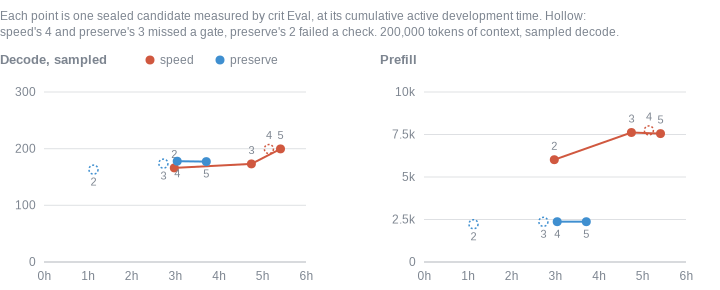
speed |
preserve |
|
|---|---|---|
| Sampled decode | 199.5 tok/s | 177.2 tok/s |
| Greedy decode | 219.7 tok/s | 186.7 tok/s |
| Prefill | 7,552 tok/s | 2,371 tok/s |
| TTFT | 204 ms | 423 ms |
| Decode at 200,000 tokens of context | 110 tok/s | 114 tok/s |
| Four clients together | 250 tok/s | 310 tok/s |
| Perplexity vs reference | +0.8% | +0.6% |
| Mean KL divergence, worst path | 0.087 | 0.018 |
| Share of its mode's drift budget | 44% | 37% |
| Development time, five candidates | 5h 28m | 3h 44m |
| API equivalent | $33.98 | $29.99 |
- Prefill is where the modes split. A long prompt is compute-bound.
speedfeeds 4-bit activations to the GPU's 4-bit tensor cores, as the checkpoint declares;preservemust sum a prompt row exactly like a decode row, so its prompts run on the decode kernels' 16-bit arithmetic. Eval prices each mode's ceiling accordingly:speedreaches 43% of its 17,577 tok/s,preserve47% of the 5,018 tok/s that arithmetic allows. - Decode is close. A decode pass reads every weight once, and both engines read the same stored 4-bit and
8-bit weights.
speedis 13% faster because it drafts 5 tokens a round from NVFP4 copies;preservemeasured widths 2, 4 and 5 and kept 3. At 200,000 tokens and with four clients,preserve's shorter chains come out ahead. - Quality follows the mode. Both stay within 1% of the checkpoint's perplexity, but
preservedrifts a fifth as far by KL divergence, and its served replies score exactly as the same text scored as a prompt. - Both runs were honest about failures.
preserve's candidate 2 was sealed not qualified because its model plugin's own test lacked an MTP layer, and candidate 3 left no device memory after the long-context curve, as didspeed's candidate 4. Each fix became the next candidate.
Pick preserve when answers must stay close to the checkpoint you selected; keep speed, the
default, when speed matters more, as with agents that send long prompts.
preserve candidate |
What changed | Sampled decode | Prefill | TTFT | Dev time, cumulative | Agent tokens, cumulative | API equivalent, cumulative |
|---|---|---|---|---|---|---|---|
| 1 | Working engine: its own model plugin on crit's library plugins, the stored 4-bit and 8-bit weights with 16-bit activations, Core's captured rounds, no drafting (about 67 tok/s in process) | – | – | – | 0h 30m | 40.3M | $12.84 |
| 2 | Drafts 3 tokens a round with the model's MTP layer, from FP8 copies of its matrices (sealed not qualified: the model plugin's own test lacked an MTP layer) | 163 tok/s | 2,226 tok/s | 521 ms | 1h 08m | 55.2M | $16.55 |
| 3 | Captured prompt chunks, kernel tuning for the engine's shapes, neutral plugins pruned, the test fixed (missed the resources gate: no device memory left after the long-context curve) | 174 tok/s | 2,363 tok/s | 425 ms | 2h 44m | 86.0M | $24.27 |
| 4 | An NVFP4 copy of the output head for drafting, in 8 row slices; cached memory released after long prompts | 178 tok/s | 2,370 tok/s | 497 ms | 3h 03m | 94.0M | $26.23 |
| 5 | FP8 KV pages for the MTP layer; certified, every gate passed | 177 tok/s | 2,371 tok/s | 423 ms | 3h 44m | 108.3M | $29.99 |
Measured like the case study above. The preserve run had no idle stretch: every pause of more than a few minutes
in its transcript ended with a job it had started, so its 3h 44m is the whole run from first command to stop.
How crit works
An agent builds the engine as a series of candidates. Each candidate is a complete, servable engine, measured the same way, and each next one is chosen from the last one's numbers. A candidate is assembled from plugins, one per slot (attention, KV cache, drafter, ...). Before Eval measures it, crit smoke checks its quality paths in minutes, and an ablation serves it with each plugin switched off and alone to show what each one adds, costs or breaks.
flowchart LR
    recon["<b>Reconnaissance</b><br/><small>read model spec, hardware config, workload, crit guides and docs</small>"] --> limits["<b>Evaluation</b><br/><small>measure GPU<br/>limits per KPI</small>"]
    limits --> build
    subgraph loop ["Candidate loop"]
        direction LR
        build["<b>Build candidate</b><br/><small>Core foundation<br/>plus Inference plugins</small>"] --> check["<b>Checks</b><br/><small>crit smoke,<br/>ablation per plugin</small>"]
        check --> measure["<b>Evaluation</b><br/><small>scores vs limits,<br/>quality gates</small>"]
        measure --> decide{"<b>Decision<br/>algorithm</b><br/><small>prioritize biggest<br/>gap first</small>"}
        decide -- "decision:<br/>new candidate needed" --> build
    end
    decide -- "decision:<br/>exit condition met" --> final["<b>Final candidate</b><br/><small>sealed and served<br/>by crit serve</small>"]
📗 Core → Full guide
Core is the plumbing every engine needs, distilled by studying multiple inference engines.
We took apart how each engine handles requests, memory, text and model files, kept the base features they all rebuild, and turned them into one native SDK. Your engine keeps what makes it fast: the model, its kernels, its layouts and its execution strategy.
| Part | What it does |
|---|---|
| Runtime | Admits, schedules, cancels and retires requests, and publishes their output |
| Engine ABI | Core's engine C ABI, which crit_core_steps exports for the engines Core's loader assembles |
| Memory | Resource budgets and reservations |
| Text | Tokenizer and chat template loading, stop strings and streamed reply text |
| Sampling | The seeded draw and the sampling rules every sampler follows |
| Model files | Safetensors and GGUF checkpoints, config.json, generation defaults and stop tokens |
| Files | Strict JSON, read-only, chunked and mapped file reads |
| Structured output | Token masks for choices, JSON schemas and grammars |
| CUDA backend | The launcher of an engine's captured decode rounds |
| Contracts | Who owns what between Core and your engine |
| Plugins | Slots and their interfaces, plugin manifests and the checked assembly an engine built from plugins loads with |
Try the plugin engine walkthrough.
📕 Inference → Full guide
Inference is a curated collection of high-performance strategies.
We studied bespoke inference engines and what makes them fast and turned every strategy that holds beyond one model or GPU into an entry. Your agent picks the entries that match its engine's bottleneck and builds them into the engine on Core, each in its slot as a plugin.
Examples:
| Bottleneck | Example entries |
|---|---|
| One token per pass | Speculative decoding, draft trees, device-side rounds, EAGLE-3 and DFlash drafters |
| Weight bytes per pass | Quantized projections, on crit's GEMM and GEMV kernels |
| Long context | Attention state, prefix checkpoints, session scheduling |
| Model larger than VRAM | Recon names the placement scenario. Sparse models: a device expert cache with expert residency and the checkpoint's drafter from the first candidate, misses computed on the CPU or copied by measured dispatch; dense models: dense layer offload |
| Embedding and n-gram tables | Lookup table rows: rows read on demand from disk, no read-ahead |
| Hybrid recurrent layers | Recurrent state recovery |
All entries are in the full guide, or run crit inference search <query>.
Every entry has the same layout:
| Part | What it holds |
|---|---|
README.md |
When to use it, how it works, a worked example, how to adapt it, its costs and how to validate it |
code/ |
Real implementation code, C++, CUDA or Python, with runnable examples |
entry.json |
When to use and avoid it, what the code provides, what the engine must supply and what it must preserve |
plugin.json, plugin.py, tests/ |
For an entry that fills an engine slot: the entry as a plugin, a host reference with tests against the slot's base plugin, which crit plugins add copies into an engine |
What gets in: contribution criteria
| Criterion | Means |
|---|---|
| Shown value | A measured gain, a reproduced and fixed bug, or a capability engines had to rebuild themselves |
| No overfitting | Nothing in it is true only for the model or GPU where it was found |
| Broad use | Dense, MoE, hybrid and multimodal models and other GPUs and backends use it unchanged or are unaffected |
📘 Kernels → Full guide
crit ships its own GPU kernels, built and tuned on your machine for your GPU and model.
crit's kernels cover the operations that decide an engine's speed: projections, attention, recurrent scans, experts
and norms. Each one is a template built from a shared kernel core; crit kernels sweep tunes its knobs on the
model's own shapes, checks every configuration against an FP64 reference and times it against the best library.
Nothing is downloaded or shipped prebuilt. Wherever one of these kernels covers an operation, your agent uses it.
| Family | Kernels |
|---|---|
| Projections | decode-gemv, mma-rows, pinned-gemm, fixed-tile-gemm, fp8-block-rows |
| Attention | paged-kv-attention |
| Recurrence | recurrent-scans |
| Experts | grouped-experts, int-block-experts, topk-routing |
| Norms | fused-norms |
Every kernel has the same layout:
| Part | What it holds |
|---|---|
kernel.json |
Operations, sources, GPU architectures, structures, knobs and the library yardstick |
bench.py |
The sweep's shapes, inputs, reference check and timing |
torch-ext/, <id>_cuda/ |
The kernel's Triton and CUDA source, built from the kernel core |
tests/, README.md |
Tests against the FP64 reference; design, measured speed against the yardstick, what is left |
If no crit kernel covers an operation, your agent takes it from one of these libraries:
| Library | Covers |
|---|---|
| Hugging Face Kernel Hub | Community kernels for attention, GEMMs, activations, normalization, MoE and more, built per framework version and backend (CUDA, ROCm, Metal, XPU, CPU) |
| cuBLASLt | GEMMs in BF16/FP16, FP8 (per-tensor and per-row scales), block-scaled NVFP4 and MXFP8 on the GPUs that have them; epilogues |
| CUTLASS | GEMM and convolution templates for layouts and fusions cuBLASLt does not take, grouped GEMMs, mixed-input GEMMs |
| cuDNN | Fused attention (SDPA), normalization |
| FlashAttention | Prompt and decode attention, paged KV, sliding windows, softcap |
| FlashInfer | Paged and ragged attention, FP8 KV, MLA, cascade attention, top-k / top-p / min-p sampling, some GEMMs |
| flash-linear-attention | Chunked prefill and recurrent decode for gated delta, Mamba-style, RWKV and other linear attention |
| Marlin | Mixed-input GEMMs: 4-bit weights (GPTQ-style groups) against 16-bit activations |
| ggml | GGUF block formats (Q4_0 .. Q8_0, K-quants, IQ) on CUDA, Metal, Vulkan, ROCm and CPU |
| OpenBLAS, oneDNN | CPU GEMMs and fused CPU operators |
| Composable Kernel, hipBLASLt | GEMMs and attention on AMD GPUs |
| MLX, Metal Performance Shaders | GEMMs, attention and quantized matmuls on Apple GPUs |
If no library fits either, your agent builds the kernel itself in the
kernel workbench:
crit kernels new scaffolds a folder with the checkpoint's own shapes, an FP64 reference and a library yardstick,
and crit eval workbench check, bench and profile check it, time it and break it down. A kernel that holds
beyond one model and GPU is a welcome contribution as a crit kernel.
📚 Eval → Full guide
crit-eval is a speed and quality measurement tool to compare inference engines honestly.
There is no shared way to measure a bespoke inference engine.
Different bespoke inference engines report vastly different types of numbers. An honest comparison requires downloading and running the engines yourself.
crit-evalfinally makes apples-to-apples comparison possible.
Physics-based evaluation lets you see what performance is left on the table.
crit-evalmeasures your GPU's memory bandwidth and matrix-multiply rates and turns them into a limit for each score. Its evaluation report can tell your coding agent how much performance can still be squeezed out of your inference engine.
Speed that can't hide a quality loss.
Many inference engines push decode and prefill speed with no regard for quality.
crit-evaltreats quality as a first-class KPI. It measures not only inference speed but also quality regressions.
A hardware report rounds out the evaluation.
The same model on the same inference engine but on two different machines can also lead to different inference speeds, even if the GPU is the same. We make this transparent by also reporting the runner's hardware configuration.
🔌 API → Overview · Full guide
crit serve loads a sealed candidate, keeps it resident and answers OpenAI-compatible
chat requests, including streaming, tool calls, stop strings and structured output. The same engine
also speaks the Anthropic Messages, OpenAI Responses and /api/chat APIs,
so Claude Code, Codex and local chat UIs need only a base URL, and GET /metrics serves
Prometheus metrics. Eval measures every candidate through this same
server, so the numbers you read are the numbers you get. Engines implement the
Core's resident adapter.
📓 CLI → Overview
One crit command drives everything: crit run keeps the run's records (plans, candidates,
measurements, ablations, selection, cost), crit eval runs the common suite, crit smoke checks a served
engine in minutes, crit plugins checks and tests an engine's plugins, crit serve serves an engine,
crit pull installs a crit-hub engine, crit bench and crit hub report measure it on your machine and add the
result to its card, and crit kernels, crit models and crit inference reach the other parts. Records are written only
through it, so each plan, candidate, Eval and seal is checked as it is recorded.
🧩 MCP → Full guide
crit mcp offers crit's command line to an agent as MCP tools, so an agent whose
harness speaks MCP (Claude Code, Codex, Cline and most others) drives a run through typed tools instead of shell
commands, and waits on builds and Eval through jobs the server owns.
claude mcp add crit -- crit mcp --root /path/to/runs
| Tool | What it does |
|---|---|
crit_run_* |
A run's records: next, create, plan, candidate, build, package, eval, serve, seal, ... |
crit_eval_* |
crit Eval: probe, prepare, reference, run, status, kernels, workbench, ab, ... |
crit_kernels_* |
List, build and sweep crit's kernels; scaffold a workbench |
crit_models_*, crit_inference_* |
Weight transforms and drafters; the Inference techniques |
crit_pull, crit_serve, crit_serve_status |
Install a crit-hub engine, serve it, check a running server |
crit_job_*, crit_jobs |
Wait on, read and stop the commands' jobs |
Every tool's inputs come from the command's own parser, and its annotations mark it read-only, destructive or open-world, so a client can run the read-only ones without asking. See the full guide for hosts, jobs and privacy.
Miscellaneous
🔭 crit-hub → Repository
crit-hub collects bespoke inference engines in one repository
to make discovery super easy. Each engine pins its runnable source, the exact checkpoint it was built on, what
was measured, its known limits and a link to the repository of whoever contributed it.
Use them as jump-off point for further optimization.
crit pull OWNER/NAME installs one: it checks the card's requirements against your GPU and CUDA,
fetches the source at its pinned commit, builds it, fetches and checks the checkpoint, and then
crit serve --engine OWNER/NAME serves it (Installed engines).
crit bench measures it on your machine beside its card's numbers, and crit hub report adds your result to the
card for a pull request (Benchmark your machine).
🚫 Limitations
| Area | Current status |
|---|---|
| Multi-GPU setups | Core's device sets (peer access, copies, ordering, barrier), crit eval probe --devices and Eval's floors for weights split across GPUs are in; partitioning and collectives are the engine's. Tested on one GPU only, not end to end on two. |
| macOS | Not yet tested. Current CI covers Windows and Linux. |
| AMD and Apple GPUs | No bundled ROCm or Metal backend. The current GPU backend uses CUDA. |
| Model formats | Hugging Face safetensors, PyTorch state dicts (.bin, .pt) and Optimum ONNX exports, unquantized or quantized as FP8, NVFP4, compressed-tensors int, AWQ, GPTQ, MLX, bitsandbytes or MatMulNBits, and GGUF, a lone .gguf included: its config, tokenizer and chat template are derived from its metadata for the llama, qwen2, qwen3, qwen3moe, qwen35, qwen35moe, deepseek4 and qwen4exp architectures (the config by the rules crit Eval gives Core) and byte-level BPE tokenizers (others need the base model's files beside it), and Eval's reference reads those architectures. A new format is one ModelFormat in crit_core.model. Core's C++ model library reads safetensors only; engines read a GGUF's tensors through crit_core.model's offsets. |
Documentation
| To… | Read |
|---|---|
| Build and compare engines | Building engines · Agent instructions · Run records |
| Integrate the native runtime | Core · Contracts · Plugin engine walkthrough |
| Choose or adapt a technique | Inference |
| Build an engine from plugins and measure each one | Plugins · Smoke tests |
| Find and adapt kernels | Kernels |
| Quantize weights and record the transform | Models |
| Compare speed, quality and speculative output | Eval |
Serve an engine through the OpenAI, Anthropic or /api/chat API |
API · Serving · Core's resident adapter |
Find a crit command |
CLI |
Change crit or run its tests |
What belongs in crit · Contributing · Licensing |
| See release history | Changelog |
1 maintainer

Metadata
1 maintainer
Release files for crit 0.20.0
For a detailed explanation of source distributions (sdists) and built distributions (wheels), please see the package formats documentation.
Source distribution (sdist)
| File | Size | Uploaded | Provenance | Actions |
|---|---|---|---|---|
| crit-0.20.0.tar.gz | 2.9 MB | With provenance | Details for crit-0.20.0.tar.gz |
Built distribution (wheel)
| File | Interpreter | ABI | Platform | Actions Reset |
|---|---|---|---|---|
| crit-0.20.0-py3-none-any.whl | Python 3 | none | any | Details for crit-0.20.0-py3-none-any.whl |
Total release size: 5.6 MB
Release files / crit-0.20.0.tar.gz
| Download URL | crit-0.20.0.tar.gz |
|---|---|
| Size | 2.9 MB |
| Tags | Source |
|
SHA-256 checksum How to use checksums |
c967970da4cf21a7a2f1816e6c365392236c9b4e1ad2b569ebb8d690752692ca
|
|
BLAKE2b-256 checksum How to use checksums |
6da06e7af7183a8544e999002ddd48fd40b90bbffeff6748cc017af4693f6863
|
| Upload date | |
|
Uploaded using Trusted Publishing? What is trusted publishing? |
Yes |
| Uploaded via |
twine/7.0.0 CPython/3.13.16
|
Provenance
Provenance describes where a file came from. On PyPI, provenance is shared via attestations, which provide a verifiable record of the build or publishing details. View details, limitations and caveats.


PyPI Publish Attestation
PyPI verified that this artifact, at this checksum, originated from the publisher listed below.
Signed by GitHub Actions, verified by PyPI on Nov 18, 2026.
Transparency logRelease files / crit-0.20.0-py3-none-any.whl
| Download URL | crit-0.20.0-py3-none-any.whl |
|---|---|
| Size | 2.7 MB |
| Tags | Python 3 |
|
SHA-256 checksum How to use checksums |
14f64e5bbc20f9ab4d35f6887d0a36815a4fa8abf62fd781302c904ea14c2f57
|
|
BLAKE2b-256 checksum How to use checksums |
b91eb7e527a768ed606f19aa0c0dd778d2feeb13b1ac153e50c1536dade3b82a
|
| Upload date | |
|
Uploaded using Trusted Publishing? What is trusted publishing? |
Yes |
| Uploaded via |
twine/7.0.0 CPython/3.13.16
|
Provenance
Provenance describes where a file came from. On PyPI, provenance is shared via attestations, which provide a verifiable record of the build or publishing details. View details, limitations and caveats.
PyPI Publish Attestation
PyPI verified that this artifact, at this checksum, originated from the publisher listed below.
Signed by GitHub Actions, verified by PyPI on Nov 18, 2026.
Transparency logSecurity for crit 0.20.0
Provenance
Provenance describes where a file came from. On PyPI, provenance is shared via attestations, which provide a verifiable record of the build or publishing details. View details, limitations and caveats.
Full provenance
Both files in this release have been uploaded with provenance metadata.
Attestation for crit-0.20.0.tar.gz
PyPI Publish Attestation
PyPI verified that this artifact, at this checksum, originated from the publisher listed below.
Signed by GitHub Actions, verified by PyPI on Nov 18, 2026.
Transparency logA note on package security
PyPI is a repository for distributing packages, not a service for auditing them. While third-party security researchers and our staff do their best to detect and remove malicious packages, PyPI cannot guarantee the quality, security or suitability of any given package.
To learn more about protecting yourself from malicious actors, visit our package security documentation.














