
crossbasis
Python implementation of Distributed Lag Non-linear Models (DLNMs) based on Gasparrini, Armstrong & Kenward (2010), Statistics in Medicine 29:2224–2234.
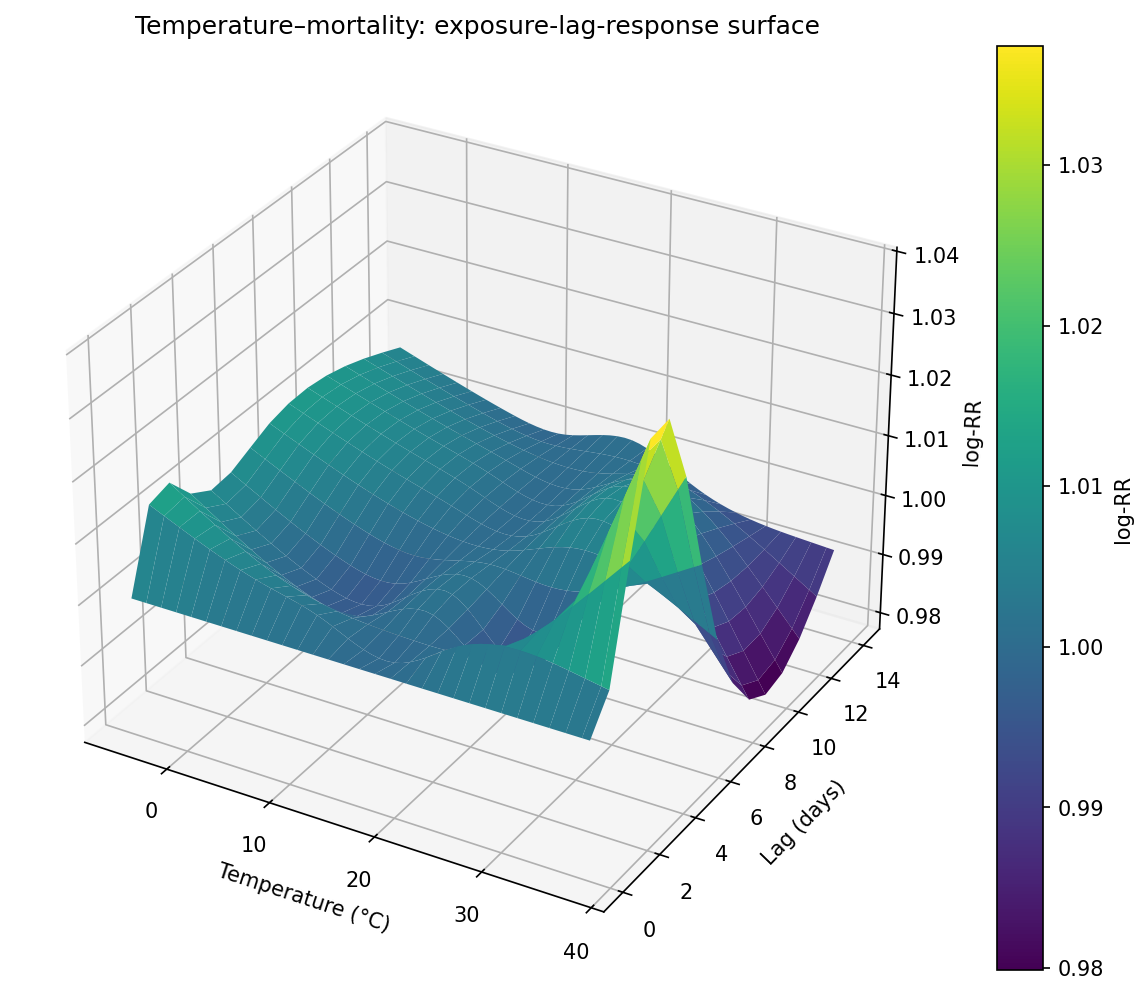
DLNMs model simultaneously non-linear and delayed effects of an exposure (e.g. temperature) on an outcome (e.g. daily deaths) — the standard approach in environmental epidemiology.
Installation
pip install crossbasis
Quick start
import numpy as np
import statsmodels.api as sm
from crossbasis import CrossPred

# Daily exposure and outcome (e.g. temperature and deaths)
temperature = np.random.randn(365) * 10 + 15
deaths = np.random.poisson(40, 365)

# 1. Fit: returns the cross-basis matrix W for use in your GLM
cp = CrossPred(
    var_basis="ns", var_df=5,   # exposure dimension: natural cubic spline
    lag_basis="ns", lag_df=4,   # lag dimension: natural cubic spline
    max_lag=21,                  # model effects up to 21 days after exposure
    cen="median",                # reference value for relative risk
)
W = cp.fit(temperature)

# 2. Fit a Poisson GLM (add any confounders alongside W)
X = sm.add_constant(W)
model = sm.GLM(deaths, X, family=sm.families.Poisson()).fit()

# 3. Predict the full exposure-lag-response surface
result = cp.predict(model, at=np.arange(-5, 36))

# 4. Visualise
result.plot_overall()       # cumulative effect across all lags
result.plot_slice(lag=0)    # exposure-response at lag 0
result.plot_slice(var=30)   # lag-response at 30 °C
result.plot_3d()            # full 3D surface
Confounders in the model? When you include extra terms (seasonal splines,
day-of-week, etc.), extract only the cross-basis coefficients before calling
predict:
n_cb = W.shape[1]
result = cp.predict(
    coef=model.params.values[1:n_cb + 1],
    vcov=model.cov_params().values[1:n_cb + 1, 1:n_cb + 1],
    at=np.arange(-5, 36),
)
Core API
CrossPred — high-level interface
CrossPred(
    var_basis="ns",      # "ns" | "bs" | "poly" | "linear" | callable
    var_df=5,
    lag_basis="ns",
    lag_df=4,
    max_lag=21,          # required
    na_action="drop",    # "drop" | "fill_zero" | "fill_mean" | float
    cen="median",        # float | "median" | "mean" | "minimum_risk"
)
| Method | Returns |
|---|---|
cp.fit(X) |
Cross-basis matrix W — include in your GLM design matrix |
cp.predict(model, at=..., cen=...) |
PredictionResult |
cp.predict(coef=..., vcov=..., at=...) |
PredictionResult (no statsmodels needed) |
PredictionResult
| Attribute | Shape | Description |
|---|---|---|
matfit |
(m, L+1) |
log-RR at each (exposure, lag) |
matse |
(m, L+1) |
SE of matfit |
RR / RR_low / RR_high |
(m, L+1) |
Relative risk with 95% CI |
allfit |
(m,) |
Cumulative log-RR over all lags |
allRR / allRR_low / allRR_high |
(m,) |
Cumulative RR with 95% CI |
result.to_frame()           # long-format DataFrame (exposure, lag, logRR, se, RR, …)
result.plot_overall()       # cumulative effect curve
result.plot_slice(lag=7)    # exposure-response at a specific lag
result.plot_slice(var=25)   # lag-response at a specific exposure value
result.plot_3d()            # 3D surface
CrossBasis — power-user transformer
Use this directly when you need the cross-basis matrix outside statsmodels (e.g. in scikit-learn, PyMC, or JAX).
from crossbasis import CrossBasis

cb = CrossBasis(var_basis="ns", var_df=5, lag_basis="ns", lag_df=4, max_lag=21)
W = cb.fit_transform(exposure_data)   # (n, v_x * v_l) numpy array
Custom basis functions
Any callable that returns an (n, df) float64 array works:
def my_basis(x: np.ndarray, df: int, **kwargs) -> np.ndarray:
    ...

cp = CrossPred(var_basis=my_basis, var_df=3, lag_basis="ns", lag_df=3, max_lag=14)
Centering
All relative risks are expressed relative to a reference exposure value (cen).
cen= |
Behaviour |
|---|---|
float |
Fixed reference value |
"median" (default) |
Median of training exposure |
"mean" |
Mean of training exposure |
"minimum_risk" |
Approximate minimum of the cumulative RR curve (experimental) |
References
Gasparrini A, Armstrong B, Kenward MG (2010). Distributed lag non-linear models. Statistics in Medicine 29:2224–2234. doi:10.1002/sim.3940
License
MIT
1 maintainer

Metadata
1 maintainer
Release files for crossbasis 0.1.0
For a detailed explanation of source distributions (sdists) and built distributions (wheels), please see the package formats documentation.
Source distribution (sdist)
| File | Size | Uploaded | |
|---|---|---|---|
| crossbasis-0.1.0.tar.gz | 23.6 kB | Details |
Built distribution (wheel)
| File | Interpreter | ABI | Platform | Reset |
|---|---|---|---|---|
| crossbasis-0.1.0-py3-none-any.whl | Python 3 | none | any | Details |
Total release size: 40.1 kB
Release files / crossbasis-0.1.0.tar.gz
| Download URL | crossbasis-0.1.0.tar.gz |
|---|---|
| Size | 23.6 kB |
| Tags | Source |
|
SHA-256 checksum How to use checksums |
7f3d443f66fe0e1b178eb5a9a753ae0271cf054df7180a635dbf48ee8dcd5b65
|
|
BLAKE2b-256 checksum How to use checksums |
94327c9f2ab8528e014633df96981bf8631ae645364fdb7fe48975e43a6911f4
|
| Upload date | |
|
Uploaded using Trusted Publishing? What is trusted publishing? |
No |
| Uploaded via |
twine/6.2.0 CPython/3.12.13
|
Release files / crossbasis-0.1.0-py3-none-any.whl
| Download URL | crossbasis-0.1.0-py3-none-any.whl |
|---|---|
| Size | 16.5 kB |
| Tags | Python 3 |
|
SHA-256 checksum How to use checksums |
560066a62669616e4e1430b023de78c979e9a0e93b95cac2ed22173308ab9430
|
|
BLAKE2b-256 checksum How to use checksums |
4e42e4044608dc05d4db8729d42f9efe74961b681f575ea49716c4fc188da504
|
| Upload date | |
|
Uploaded using Trusted Publishing? What is trusted publishing? |
No |
| Uploaded via |
twine/6.2.0 CPython/3.12.13
|













