
AI context engine for Python — cuts LLM tokens 97% via code knowledge graphs. Build, query, and generate compact context capsules for Claude, OpenAI, Ollama.

Project description
ctxgraph — AI Context Engine for Python
Slash your LLM token costs by 97%. ctxgraph builds a multi-layer knowledge graph from your Python codebase, then generates compact context capsules — delivering only what your AI needs, not every line of code.
pip install ctxgraph

ctx build                          # Build knowledge graph
ctx capsule "fix JWT expiry"       # 92-99% fewer tokens vs raw code
ccg "fix the login redirect bug"   # Launch Claude with context pre-loaded
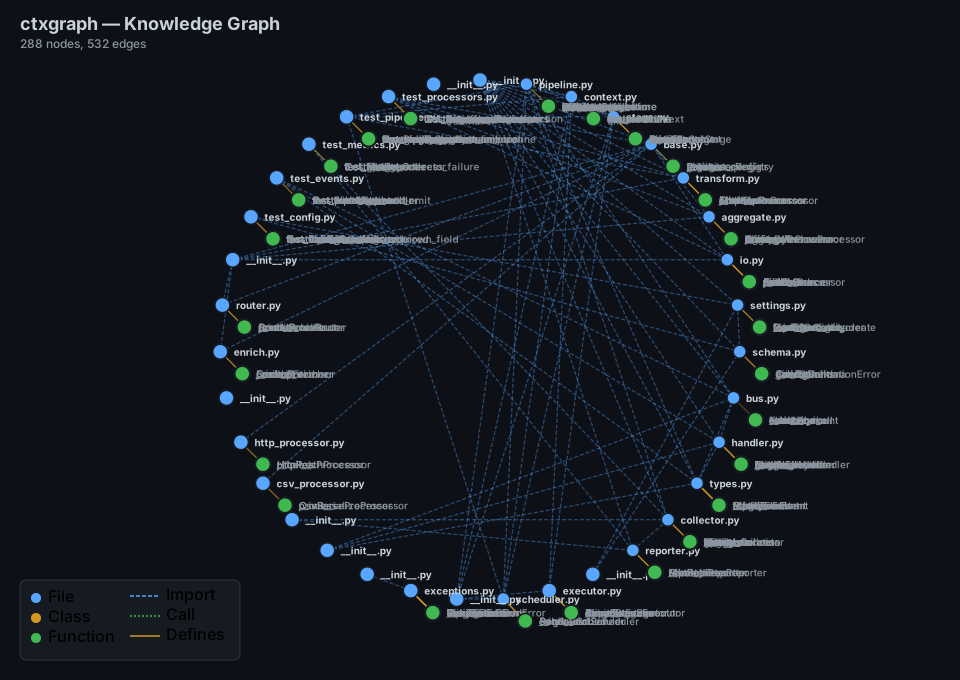
ctx view                           # Interactive D3.js visualization (or --svg for static)
Why ctxgraph?
Sending entire files to an AI is wasteful. ctxgraph analyzes your code with AST-based static analysis, stores the result in a queryable SQLite graph, and retrieves only the relevant nodes — compressed into a token-efficient DSL format.
| Without ctxgraph | With ctxgraph | Savings |
|---|---|---|
| All files dumped to context | Targeted capsule (10-40 nodes) | 97% fewer tokens |
| JSON-formatted metadata | Custom DSL format | 4.7× less than JSON |
| Model guesses filenames | Graph provides exact paths | +16.7pp answer coverage |
How It Works
Repository (.py files)
    │
    ▼
┌─────────────────────────────────────────────────────────┐
│  ctx build                                               │
│                                                          │
│  1. importer.py (AST)  →  import edges (file→file)       │
│  2. symbols.py (AST)   →  classes, functions, methods    │
│  3. semantic.py        →  docstring summaries            │
│                                                          │
│  Store: SQLite (nodes + edges)                           │
└────────────────────────┬────────────────────────────────┘
                         │
                         ▼
┌─────────────────────────────────────────────────────────┐
│  ctx capsule "<query>"                                  │
│                                                          │
│  1. Tokenize query → keyword search                      │
│  2. Score: name matches (2x), text (0.5x)                │
│  3. BFS neighborhood expansion (depth=1-3)               │
│  4. Render token-efficient DSL → AI-ready capsule        │
└─────────────────────────────────────────────────────────┘
Architecture
┌─────────┐    ┌──────────────┐    ┌──────────────┐    ┌─────────────┐
│   CLI   │───▶│  Analyzers   │───▶│   SQLite DB  │───▶│ Skills/Hist │
│  typer  │    │  AST-based   │    │  .ctxgraph/  │    │ .ctxgraph/  │
└────┬────┘    └──────────────┘    └──────┬───────┘    └─────────────┘
     │                                    │
     ├── ctx build ──────────────────────▶│  Graph build
     │                                    │
     ├── ctx capsule ◀───────────────────│  Query + BFS
     │                                    │
     ├── ctx query ◀─────────────────────│  Keyword search
     │                                    │
      ├── ctx ask ◀──────────────────────│  LLM query + savings
      │                                    │
      ├── ctx view ◀──────────────────────│  D3.js viz
      │                                    │
      ├── ctx serve ◀─────────────────────│  MCP server
      │                                    │
      ├── ctx init ───────────────────────│  Scaffold project
      │                                    │
      ├── ctx history ◀───────────────────│  Query log
      │                                    │
      └── ctx skill ◀─────────────────────│  Skill management
     │                                    │
     └── ccg wrapper ───▶ Claude Code ───┘  AI tool
Token Efficiency
The DSL Advantage
ctxgraph's compact format uses 79% fewer tokens than JSON for the same data:
JSON: 426 tokens                        DSL: 143 tokens
─────                                     ────
{                                         [CTX]calculator expression parsing
  "nodes": [
    {                                     [F]calc/parser.py
      "id": "file:calc/parser.py",         D:Tokenize and parse math expressions
      "type": "file",                      S:tokenize, parse, Expression
      "name": "parser.py",               [F]calc/core.py
      ...                                  D:Core math operations
    }                                     [C]Calculator
  ],                                       D:Main calculator class
  "edges": [...]                          [DEP]
}                                           parser.py → core.py
                                            parser.py → plugins.py
4.7× compression ratio vs equivalent JSON — tested across all benchmark projects.
Capsule vs Raw Files
| Project | Files | Raw Tokens | Avg Capsule | Savings | Build Time |
|---|---|---|---|---|---|
| tiny_app | 7 | 1,558 | ~112 | 92.8% | ~82ms |
| web_api | 23 | 6,567 | ~136 | 97.9% | ~474ms |
| microsvc | 22 | 10,587 | ~63 | 99.4% | ~916ms |
| dataflow | 35 | ~12,500 | ~78 | ~99.4% | ~560ms |
97.0% average token reduction across 4 projects, 42 benchmark runs. The larger the project, the greater the savings.
With Graph vs Without (Ollama)
| Query | No Context | With ctxgraph | Δ |
|---|---|---|---|
| Calculator expression parsing | 100% | 100% | — |
| Plugin registration system | 33% | 100% | +67pp |
| JWT authentication (web_api) | 75% | 100% | +25pp |
| Middleware pipeline (web_api) | 100% | 100% | — |
| Circuit breaker (microsvc) | 75% | 75% | — |
| Services & communication | 50% | 100% | +50pp |
| PipelineBuilder pattern | 100% | 75% | -25pp* |
| Processor registration | 33% | 67% | +34pp |
| Event bus & error handling | 100% | 100% | — |
* Without context the model gave a generic answer matching all keywords; with context it focused on actual code — more honest, more useful.
+16.7pp average coverage improvement — better answers, concrete file names, real code structure.
Token Savings Display
Use --savings to see how many tokens each capsule saves:
ctx capsule "user authentication" --savings
# ┌──────────────────────────┬──────────────┐
# │ Metric                   │ Value        │
# ├──────────────────────────┼──────────────┤
# │ Raw Project .py Files    │ 10,587 tokens│
# │ Capsule DSL              │ 132 tokens   │
# │ JSON Equivalent          │ 490 tokens   │
# │ Savings vs Raw           │ 98.8%        │
# │ DSL vs JSON              │ 73.1%        │
# └──────────────────────────┴──────────────┘
ctx ask shows this automatically on every query.
Commands
ctx init — Scaffold project
ctx init
# Creates: .ctxgraph/config.toml, .ctxgraph/skills/, .ctxgraph/history.jsonl
Sets up a fresh .ctxgraph/ directory with default config and built-in skills. Idempotent — safe to run on existing projects.
ctx build — Build knowledge graph
ctx build                        # Current directory
ctx build /path/to/project       # Specific repo
ctx build --exclude "vendor/*"   # Custom exclude patterns
ctx ask <query> — Ask questions via LLM
ctx ask "how does JWT auth work"                            # Uses configured provider
ctx ask "fix login bug" --provider claude --model claude-sonnet-4-20250514
ctx ask "refactor payment flow" --skill project-style       # Activate a skill
ctx ask "find auth code" --graph                            # Show graph search results
ctx ask "deep dive" --mode deep                             # Deep graph context
Shows token savings automatically. Requires a running Ollama instance (or other configured provider).
ctx capsule <query> — Generate context
ctx capsule "fix JWT token validation"              # Balanced (default: 20 nodes, depth 2)
ctx capsule "fix JWT token validation" --mode fast  # Fast (10 nodes, depth 1)
ctx capsule "fix JWT token validation" --mode deep  # Deep (40 nodes, depth 3)
ctx capsule --overview                              # Project architecture overview
ctx capsule "fix auth" --savings                    # Show token savings table
ctx capsule "fix auth" --skill project-style         # Prepends skill context
| Mode | Max Nodes | BFS Depth | When to Use |
|---|---|---|---|
fast |
10 | 1 | Quick questions, small fixes |
balanced (default) |
20 | 2 | General development |
deep |
40 | 3 | Complex refactoring, architecture |
ctx query <search> — Search graph
ctx query "user auth"
ctx query "payment gateway" --mode deep
Returns ranked nodes with relevance scores.
ctx view — Visualize graph
ctx view
ctx view --output graph.html
ctx view --port 8080 --no-open
Interactive D3.js force-directed HTML — no JS build tools needed.
ctx serve — MCP server
pip install ctxgraph[mcp]
ctx serve
Claude Desktop config:
{
  "mcpServers": {
    "ctxgraph": {
      "command": "ctx",
      "args": ["serve"]
    }
  }
}
Tools: search_graph, get_context_capsule, get_file_dependencies, get_project_overview.
ctx history — Query history
ctx history                          # Last 10 queries
ctx history -n 20                    # Last 20
ctx history --filter "auth"          # Filter by keyword
ctx history --stats                  # Aggregate statistics
History stored in JSONL format at .ctxgraph/history.jsonl. Auto-prunes to 1000 entries.
ctx skill — Manage skills
ctx skill list                       # Show all available skills
ctx skill show project-style         # Display skill contents
Skills are TOML files in .ctxgraph/skills/. Activate with ctx ask --skill <name> or ctx capsule --skill <name>.
ctx info — Graph statistics
ctx info
# ┌────────────────────┬───────┐
# │ Total Nodes        │ 1090  │
# │ Total Edges        │ 1565  │
# │   files            │ 147   │
# │   classes          │ 45    │
# │   functions        │ 312   │
# └────────────────────┴───────┘
Claude Wrapper (ccg)
ccg "fix the JWT expiry bug in auth module"          # Single-shot
ccg --chat "refactor the payment flow"               # Interactive session
ccg --overview                                        # Project overview
ccg --mode deep "redesign the database schema"        # Deep mode
Configuration
.ctxgraph/config.toml:
[graph]
exclude = ["legacy/*", "vendor/*"]

[ai]
provider = "ollama"           # ollama, claude, openai, azure, custom
model = "qwen2.5-coder:7b"
endpoint = "http://localhost:11434"

[context]
mode = "balanced"
max_nodes = 20
max_depth = 2
| Environment Variable | Overrides |
|---|---|
CTXGRAPH_PROVIDER |
ai.provider |
CTXGRAPH_MODEL |
ai.model |
CTXGRAPH_ENDPOINT |
ai.endpoint |
ANTHROPIC_API_KEY |
Claude API |
OPENAI_API_KEY |
OpenAI API |
AZURE_OPENAI_API_KEY |
Azure OpenAI API |
# Ollama (default — no env vars needed)
ctx capsule "query"

# Claude
CTXGRAPH_PROVIDER=claude CTXGRAPH_MODEL=claude-sonnet-4-20250514 ctx capsule "query"

# OpenAI
CTXGRAPH_PROVIDER=openai CTXGRAPH_MODEL=gpt-4o ctx capsule "query"

# Azure OpenAI
CTXGRAPH_PROVIDER=azure \
  CTXGRAPH_MODEL=gpt-4o \
  CTXGRAPH_ENDPOINT=https://my-resource.openai.azure.com \
  AZURE_OPENAI_API_KEY=sk-... \
  ctx capsule "query"

# Custom (OpenAI-compatible)
CTXGRAPH_PROVIDER=custom CTXGRAPH_ENDPOINT=http://my-api/v1 ctx capsule "query"
Windows (PowerShell): Use
$env:prefix instead:$env:CTXGRAPH_PROVIDER = "azure"; $env:CTXGRAPH_MODEL = "gpt-4o"; ctx capsule "query"Or set them once per session:
$env:CTXGRAPH_PROVIDER = "azure"
$env:AZURE_OPENAI_API_KEY = "sk-..."
ctx capsule "query"
Use Cases
Debug a failing test
ctx build
ctx capsule "test_user_login is failing with auth error" --mode deep
# → [F]tests/test_auth.py
#   [F]src/auth/login.py
#   [C]AuthService
#   [DEP] auth/login.py → core/database.py, auth/session.py
Understand a new codebase
ctx capsule "project architecture" --overview
ccg --chat "explain the overall architecture and data flow"
Refactor across modules
ctx capsule "extract payment processing into separate module" --mode deep
Framework Integrations
ctxgraph is a Python library first — the CLI is just a wrapper. This makes it easy to feed code context into LangChain, LangGraph, OpenAI Agents, or any LLM pipeline.
How the Python API works
The flow is always the same:
build_graph(path)→ scans your code, stores a knowledge graph inpath/.ctxgraph/graph.dbget_storage(path)→ opens that SQLite database for queries (fast, no re-scanning)render_capsule(storage, query)→ searches the graph, returns a compact text capsule
from pathlib import Path
from ctxgraph.graph.builder import build_graph, get_storage
from ctxgraph.capsule.renderer import render_capsule
from ctxgraph.graph.query import search_relevant_nodes

# --- Step 1: Build (one-time, ~0.1-1s per project) ---
stats = build_graph(Path("/path/to/my_project"))
print(f"Built: {stats['total_nodes']} nodes, {stats['total_edges']} edges")

# --- Step 2: Use (instant — reads the .db file) ---
storage = get_storage(Path("/path/to/my_project"))

# Generate a capsule — a token-efficient DSL string
capsule = render_capsule(storage, "fix JWT token validation", max_nodes=20)
print(capsule)
# → [CTX]fix JWT token validation
#   [F]src/auth/jwt.py
#     D:JWT token creation and validation
#   [F]src/auth/middleware.py
#     D:Auth middleware for request validation
#   ...

# Or search for nodes programmatically
results = search_relevant_nodes(storage, "auth login", max_nodes=10, max_depth=2)
for node, score in results:
    print(f"  {node.type}:{node.name}  (score={score})")
Tip:
build_graphis a one-time setup. In production, runctx buildduring CI/deployment and let your app code only callget_storage+render_capsule.
LangChain
Pass the capsule as context in your prompt template. The LLM gets exactly the files, classes, and dependencies it needs — no token waste.
from pathlib import Path
from langchain_openai import ChatOpenAI
from langchain_core.prompts import ChatPromptTemplate
from ctxgraph.graph.builder import get_storage          # graph already built
from ctxgraph.capsule.renderer import render_capsule

# Load existing graph (zero build time)
storage = get_storage(Path("./my_project"))

# Generate capsule for the question
context = render_capsule(storage, "login rate limiter", max_nodes=15)

prompt = ChatPromptTemplate.from_messages([
    ("system", "You are a senior Python dev. Answer using the code context below.\n\n{context}"),
    ("user", "{question}"),
])

llm = ChatOpenAI(model="gpt-4o")
response = prompt | llm | (lambda msg: msg.content)

print(response.invoke({
    "context": context,
    "question": "Where is the rate limiter applied in the login flow?",
}))
# → "The rate limiter is in src/auth/middleware.py at line 42.
#    It wraps the login endpoint with a 5req/min limit per IP."
LangGraph
Expose ctxgraph as a tool the agent calls on-demand. The agent fetches context only when it hits a code-related question.
from pathlib import Path
from langgraph.graph import StateGraph, MessagesState
from langgraph.prebuilt import ToolNode
from langchain_openai import ChatOpenAI
from langchain_core.tools import tool
from ctxgraph.graph.builder import get_storage
from ctxgraph.capsule.renderer import render_capsule

# Pre-built graph — loaded instantly
_storage = get_storage(Path("./my_project"))

@tool
def code_context(task: str) -> str:
    """Fetch relevant source code for a development task.
    Use this whenever the user asks about implementation details,
    bug fixes, or architecture in the codebase."""
    return render_capsule(_storage, task, max_nodes=20)

# --- Build LangGraph ---
tools = [code_context]
model = ChatOpenAI(model="gpt-4o", temperature=0).bind_tools(tools)

def agent_node(state: MessagesState):
    return {"messages": [model.invoke(state["messages"])]}

graph = StateGraph(MessagesState)
graph.add_node("agent", agent_node)
graph.add_node("tools", ToolNode(tools))
graph.set_entry_point("agent")
graph.add_conditional_edges(
    "agent",
    lambda s: "tools" if s["messages"][-1].tool_calls else "__end__",
)
graph.add_edge("tools", "agent")

app = graph.compile()

# --- Run ---
for chunk in app.stream({"messages": [("user", "How does payment retry work?")]}):
    for node, vals in chunk.items():
        msg = vals["messages"][0]
        if hasattr(msg, "content") and msg.content:
            print(f"[{node}]: {msg.content[:300]}")
When the user asks about code, the agent calls code_context("payment retry"), gets back a capsule with [F]src/payment/retry.py, [F]src/payment/processor.py, and their dependency edges, then answers with those files in context.
OpenAI Agents SDK
Same pattern — ctxgraph is a function tool the agent invokes.
from pathlib import Path
from agents import Agent, Runner, function_tool
from ctxgraph.graph.builder import get_storage
from ctxgraph.capsule.renderer import render_capsule

_storage = get_storage(Path("./my_project"))

@function_tool
def fetch_code_context(task_description: str) -> str:
    """Retrieve code context from the project's knowledge graph.
    Provide a task description like 'JWT auth middleware' or 'payment processor'."""
    return render_capsule(_storage, task_description, max_nodes=20)

agent = Agent(
    name="Code Assistant",
    instructions="You help developers understand their codebase. Use fetch_code_context to get relevant files before answering.",
    model="gpt-4o",
    tools=[fetch_code_context],
)

result = Runner.run_sync(agent, "How does the notification system handle email vs SMS?")
print(result.final_output)
Azure OpenAI (direct client)
For Azure OpenAI or any OpenAI-compatible endpoint, inject the capsule directly into the system message.
import os
from openai import AzureOpenAI
from pathlib import Path
from ctxgraph.graph.builder import get_storage
from ctxgraph.capsule.renderer import render_capsule

storage = get_storage(Path("./my_project"))
context = render_capsule(storage, "event bus architecture", max_nodes=25)

client = AzureOpenAI(
    api_version="2024-08-01-preview",
    azure_endpoint=os.environ["AZURE_OPENAI_ENDPOINT"],
    api_key=os.environ["AZURE_OPENAI_API_KEY"],
)

response = client.chat.completions.create(
    model="gpt-4o",  # deployment name
    messages=[
        {"role": "system", "content": f"You are a senior developer. Code context:\n\n{context}"},
        {"role": "user", "content": "How do I add a new event handler?"},
    ],
)
print(response.choices[0].message.content)
Development
git clone https://github.com/shashi3070/ctxgraph.git
cd ctxgraph
pip install -e ".[dev]"
pytest
python benchmarks/run_benchmarks.py
python benchmarks/run_ollama_comparison.py   # Requires local Ollama
Project Structure
src/ctxgraph/
├── cli/main.py              — Typer CLI (9 commands)
├── graph/
│   ├── models.py            — Node, Edge, Graph dataclasses
│   ├── storage.py           — SQLite persistence
│   ├── builder.py           — Graph build orchestrator
│   └── query.py             — Tokenizer + BFS + relevance scoring
├── capsule/
│   ├── renderer.py          — DSL context generation
│   └── savings.py           — Token savings computation
├── analyzers/python/
│   ├── importer.py          — AST import extraction
│   ├── symbols.py           — AST class/function/method analysis
│   └── semantic.py          — Docstring summarization
├── config/
│   ├── __init__.py
│   ├── init.py              — Project scaffold (.ctxgraph dir)
│   ├── settings.py          — TOML/JSON/env config loading
│   └── providers.py         — Ollama, Claude, OpenAI clients
├── clients/models.py        — Mode enum (fast/balanced/deep)
├── exclude/patterns.py      — Exclusion pattern matching
├── view/visualizer.py       — D3.js HTML graph generator
├── wrapper/claude.py        — ccg Claude wrapper
├── mcp/server.py            — MCP protocol server
├── skills/
│   ├── __init__.py          — Skill discovery + loading
│   ├── project-style.toml   — Default skill: project conventions
│   └── field-guide.toml     — Default skill: field guide
└── history.py               — JSONL history append/query/stats
Limitations
- Python-only analysis — other languages get file-level nodes only
- Keyword-based search — no semantic/embedding matching (planned)
- No incremental rebuild — full rebuild on every
ctx build(planned) - MCP server — stdio mode only, SSE not yet supported
License
MIT
Release history Release notifications | RSS feed


Download files
Download the file for your platform. If you're not sure which to choose, learn more about installing packages.
Source Distribution
Built Distribution
Filter files by name, interpreter, ABI, and platform.
If you're not sure about the file name format, learn more about wheel file names.
Copy a direct link to the current filters
File details
Details for the file ctxgraph-0.3.0.tar.gz.
File metadata
- Download URL: ctxgraph-0.3.0.tar.gz
- Upload date:
- Size: 53.0 kB
- Tags: Source
- Uploaded using Trusted Publishing? No
- Uploaded via: twine/6.2.0 CPython/3.11.3
File hashes
| Algorithm | Hash digest | |
|---|---|---|
| SHA256 |
761e642aaa42eb2abe421942006671e5073d5f37244fbe1cab6625b5f76f4aec
|
|
| MD5 |
265c01702e09425550ae84ba8e041a46
|
|
| BLAKE2b-256 |
057127bf9ee5d00a72f6146562d0e7b5de211fee3bac0d12d4dfa7afb496f4df
|
File details
Details for the file ctxgraph-0.3.0-py3-none-any.whl.
File metadata
- Download URL: ctxgraph-0.3.0-py3-none-any.whl
- Upload date:
- Size: 42.9 kB
- Tags: Python 3
- Uploaded using Trusted Publishing? No
- Uploaded via: twine/6.2.0 CPython/3.11.3
File hashes
| Algorithm | Hash digest | |
|---|---|---|
| SHA256 |
fba289ac6340a66f370b0dd99dee283fed4f34cfa96bf837144e5713fd3c8a86
|
|
| MD5 |
721285f4de564d3f6195a27f6a02ccdb
|
|
| BLAKE2b-256 |
14fa102436f531d0fb7116c0917a6bdab2949d831a5b79828f4a1105c2fb573e
|






