

Cyberwave Python SDK
Making the physical world programmable.
Connect, control, and simulate any robot. The same code runs in simulation and on real hardware.







Cyberwave is an all-in-one platform for building and deploying intelligent physical AI agents. Connect a physical robot or sensor, test it in simulation, and run AI models; all through one Python SDK. This package is the official client.
Installation
pip install cyberwave
Optional features install via extras, e.g. cyberwave[camera] (video streaming),
cyberwave[ml] (vision models), or cyberwave[zenoh] (edge data bus). See the
installation docs for the full list.
Quick Start
Get an API key from your Cyberwave instance (Profile → API Tokens) and export it:
export CYBERWAVE_API_KEY="your_api_key_here"
A token scoped to more than one workspace also needs to know which one you mean. Set it once and every request carries it:
export CYBERWAVE_WORKSPACE_ID="your_workspace_uuid" # or Cyberwave(workspace_id=...)
You can skip this for a token scoped to a single workspace — there is nothing to
disambiguate. Without it, a multi-workspace token gets back
400 workspace_required, listing the workspaces the token holds.
Then create and control your first digital twin:
from cyberwave import Cyberwave

cw = Cyberwave()  # reads CYBERWAVE_API_KEY from the environment

# Create a digital twin from a catalog asset.
# Pin it with canonical slugs. UUID values remain accepted for compatibility.
# Omit both and Cyberwave creates a "Quickstart Environment" for you automatically.
arm = cw.twin(
    "the-robot-studio/so101",
    twin_id="acme/twins/arm-station-1",
    environment_id="acme/envs/production-floor",
)

# Place it in the scene (editor layout)
arm.edit_position(x=1.0, y=0.0, z=0.5)
arm.edit_rotation(yaw=90)  # degrees

# Move a joint by name
joint_names = arm.joints.list()
if joint_names:
    arm.set_joints({joint_names[0]: -0.2})  # radians
    print(arm.get_joints())

# Drive a locomotion twin in simulation
cw.affect("simulation")          # or cw.affect("live") for the real robot
rover = cw.twin("unitree/go2")
rover.move_forward(0.3)

cw.disconnect()
The same script targets real hardware by switching cw.affect("live"), no other changes.
Core Concepts
- Twins — virtual representations of robots and sensors. You develop and test against a twin, then deploy to hardware with identical code. Instantiate any catalog asset with
cw.twin("vendor/slug"). - Environments — scenes your twins live in. Validate quickly in the browser-based Playground, or use MuJoCo for high-fidelity physics and RL.
- Simulation vs. live —
cw.affect("simulation")andcw.affect("live")switch where commands and state go. The same code drives both. - Edge & cloud — stream camera/sensor data and run AI models on the edge or in the cloud, without managing the infrastructure in between.
- Aerial twins —
takeoff(),land(), andhover()record the flight state Cyberwave gates on, so a secondtakeoff()on an airborne aircraft is refused rather than sent. If you fly a drone without those helpers, record the intent withtwin.set_hovering_status(hovering=True, hovering_altitude=2.0)(orclient.twins.set_flight_request(twin_uuid, hovering=True)) — not withtwins.update(metadata=...), which overwrites the state the aircraft itself reports. See the Drone commands docs. - GPS positioning — a twin with a GNSS receiver can be placed in a georeferenced environment from its own fixes. Publish them with
client.mqtt.update_twin_gps(...)(orpublish_gps()from an edge node) and read them withtwin.gps.get_fix(). Live only:get_fix()raises in simulation, because no simulation backend produces GPS. Set the environment's geo reference first — see the Geo reference docs. - Drivers — subclass
BaseDriver(or shipcw-driver.yml) so the dashboard Keyboard (Driver) controller lists this twin's commands. Discrete commands fire once; mark locomotioncontinuousif a held key should repeat. See the Keyboard (Driver) docs. - Calibration — when a camera is mounted on an arm,
cyberwave.calibrationmeasures where it actually sits instead of you entering the offset by eye. See the hand-eye calibration guide.
Demos
Watch the SDK in action with our demos.
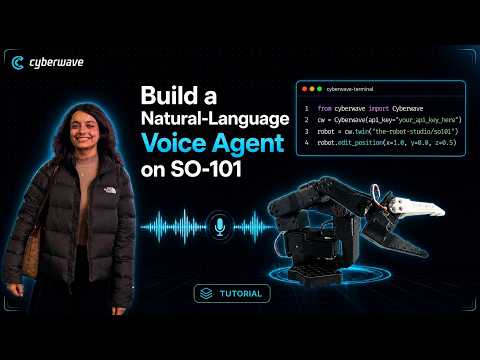
Build a natural language voice agent on SO101 |
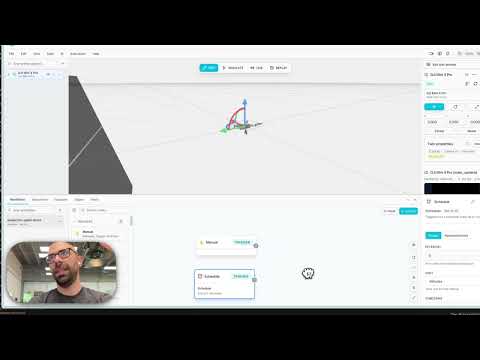
Controlling a DJI Mini 4 Pro with the Cyberwave Python SDK |
Examples
Runnable scripts live in examples/ and see the examples index for the full list.
| Example | Shows |
|---|---|
| quickstart.py | Create a twin, scene layout, joints, locomotion |
| joints.py | Read and write joint positions by name |
| locomotion.py | Velocity-style locomotion commands |
| capture_frame.py | Grab a single camera frame from a twin |
| handeye_calibration.py | Measure where a wrist camera sits on an arm |
| notebooks/hand_eye_calibration.ipynb | The same, as a runnable notebook — works in Colab with no robot attached |
| camera_stream.py | Stream a camera feed over WebRTC |
| drone_hovering.py | Takeoff, hover, and land a flying twin |
| workflows.py | List, trigger, and monitor workflows |
| ai/yolo.ipynb | Run YOLO vision models (Colab) |
Documentation
Full guides and the complete API reference are at docs.cyberwave.com (overview · API reference).
Listing recordings
recordings.list() is paged. With no start/end it lists the most recent day
that has recordings instead of the environment's whole history, and it returns
at most limit rows (default 200, fetched 50 per request). Pass limit=0 to
follow every page.
Like the replay picker, listing excludes materializing or failed recordings by
default. Pass include_unready=True only when a caller needs those rows — it
requires elevated access, and the server rejects the call with HTTP 403 rather
than silently returning ready rows.
items = cw.environments.recordings.list(environment_id="acme/envs/floor")
items = cw.environments.recordings.list(
    environment_id="acme/envs/floor",
    start="2026-07-01",
    end="2026-07-05",
    limit=0,
)
Whenever the result is partial — scoped to one day, or cut short by limit
while the server still had pages — list() logs a warning naming the window and
telling you which argument widens it, so a truncated list never looks complete.
If Cloud Run rejects a catalog response at its payload-size boundary, the SDK
raises RecordingPayloadTooLargeError with the affected window, cloud trace,
and a concrete retry hint. Restrict start/end or lower limit and retry.
Migrating to 0.7.0
recordings.list() with no arguments returns the most recent day that has
recordings, rather than the environment's whole history. An unbounded listing
could exceed the API gateway's response ceiling on a busy environment and fail
with an opaque HTTP 500. It affects twin.recordings.list() and
cw.environments.recordings.list() equally.
The behavior itself shipped in 0.6.6. 0.7.0 adds no further change to it —
the version is bumped to a minor purely to label the break, which 0.6.6 should
have done. If you are pinned to 0.6.6 you already have the new behavior; if
you are on <= 0.6.5, the table below is your upgrade.
| Argument | <= 0.6.5 |
>= 0.6.6 |
|---|---|---|
start / end omitted |
Every day in the environment's history | Only the most recent day that has recordings |
include_unready |
Materializing and failed rows included by default | False — ready rows only |
limit |
One response, server-capped at 100 rows | 200, fetched 50 per request |
To widen the window again, name it explicitly and lift the cap. limit=0 alone
is not enough, because the implicit single-day window is applied first, and both
bounds are required together:
items = cw.environments.recordings.list(
    environment_id="acme/envs/floor",
    start="2026-01-01",           # both bounds are required together
    end="2026-07-05",
    limit=0,                      # follow every page in that window
)
There is no argument that means "all history": pick a start early enough to
cover the range you care about. Callers that only need "the latest recordings"
need no change — that is the default.
include_unready=True requires elevated access. Without it the server rejects
the call with HTTP 403 rather than quietly returning ready rows, so do not add
it speculatively.
Recording readiness
Recording list items expose the server's playback assessment when it is
available. Use is_playback_ready before downloading artifacts, or request
unready entries explicitly while building a retry UI:
items = cw.environments.recordings.list(
    environment_id="acme/envs/floor",
    include_unready=True,
)

for item in items:
    print(item.uuid, item.readiness, item.is_playback_ready)
item.readiness is None when connected to a server that predates this
feature. If get() receives a materializing response, it raises CyberwaveError
with the server's suggested retry interval instead of returning an empty
recording.
Timestamped virtual camera sources
VirtualCameraStreamer accepts RGB arrays as before. For an asynchronous
renderer or camera, return a CapturedVideoFrame from get_frame so pixels
retain their acquisition time when the stream sends the same image again:
from cyberwave.sensor import CapturedVideoFrame

# In your acquisition callback, with the source's measured clocks:
latest = CapturedVideoFrame(rgb, capture_wall_time, capture_monotonic, acquisition_id)

# Pass this callback as get_frame to VirtualCameraStreamer.
def get_frame():
    return latest
Create the sample once per acquisition and increase acquisition_id even when
the scene is stationary. Use Unix seconds for capture_wall_time and monotonic
seconds for capture_monotonic, measured when the source state is acquired,
not when rendering or encoding finishes. The sample owns a read-only RGB copy.
Return the same sample until a new acquisition, or None while unavailable.
Repeated sends are not fresh captures; placeholders have no capture timestamp.
This preserves source timing, but does not by itself verify recording/Replay
synchronization.
Fetching a recording
get() downloads a recording's artifacts into a temp directory. A long recording
is stored as many parts; they are fetched in parallel and handed back in timeline
order whenever the server labels each part's position:
with cw.environments.recordings.get(items[0]) as rec:
    rec.local_paths          # downloaded parts per stream, in playback order

# Fetch serially, or fetch less
rec = cw.environments.recordings.get(items[0], max_workers=1)
rec = cw.environments.recordings.get(items[0], path=".parquet")
max_workers defaults to 8 and is capped at 32; pass 1 for a strictly serial
fetch. The gain scales with how many parts a recording has — one stored as a
single large file gains nothing from extra workers.
path keeps only the artifacts whose signed URL or filename contains the given
text, so it selects by file extension rather than by stream: ".parquet" fetches
the tables and skips .mp4 video, which is usually most of a camera recording's
bytes. A reader whose artifact was filtered out raises rather than returning
empty.
Compatibility notes for the next release
depth_to_colored_pointcloud now checks its declared encoded-depth input: with
output_mode="normalized_uint16" (the default) or "metric_mm", the array must
have NumPy uint16 storage. Implicit conversion from an integer list or another
dtype is no longer accepted. Validate the encoded values and convert them to
uint16 before calling; do not reinterpret metre-valued floats as encoded depth.
depth_array_to_meters accepts metre-valued float arrays with output_mode=None.
The encoding alone does not establish metric calibration or a world-space pose.
Host ZENOH_MODE settings are validated only when Zenoh is selected and enabled.
An unused host value no longer prevents filesystem or MQTT-only drivers from
starting. Active Zenoh sessions still require a supported peer or client mode.
Contributing
Contributions are welcome. Please open an issue or a pull request.
Support
- Documentation: docs.cyberwave.com
- Issues: GitHub Issues
- Community: Discord
License
Released under the MIT License.
Asset kits
Create reusable robot/accessory assemblies with client.assets.create_kit(name, components, workspace_uuid=...). Components specify key, asset_uuid, optional
parent_key and attach_to_link, position in metres [x,y,z], and quaternion
rotation [w,x,y,z]. List parents before children, with exactly one root and
2–50 individual assets. Use get_kit(uuid) or update_kit(...) to inspect or
replace the definition. instantiate_kit(uuid, environment_uuid) atomically
creates and returns all docked twins; edits do not affect existing deployments.
When updating, omit description or visibility to preserve its current value.
See Asset kits.
2 maintainers


Metadata
2 maintainers
Release files for cyberwave 0.7.3
For a detailed explanation of source distributions (sdists) and built distributions (wheels), please see the package formats documentation.
Source distribution (sdist)
| File | Size | Uploaded | |
|---|---|---|---|
| cyberwave-0.7.3.tar.gz | 1.4 MB | Details |
Built distribution (wheel)
| File | Interpreter | ABI | Platform | Reset |
|---|---|---|---|---|
| cyberwave-0.7.3-py3-none-any.whl | Python 3 | none | any | Details |
Total release size: 3.8 MB
Release files / cyberwave-0.7.3.tar.gz
| Download URL | cyberwave-0.7.3.tar.gz |
|---|---|
| Size | 1.4 MB |
| Tags | Source |
|
SHA-256 checksum How to use checksums |
6356992eb7806b8638cf3da73a7bc4b460e3c490743de451c2995c22fdf19b1d
|
|
BLAKE2b-256 checksum How to use checksums |
f6f80748c58131adb6c4ac1178f3df13b65d23061dfe4fa584f79d87fc1fd33f
|
| Upload date | |
|
Uploaded using Trusted Publishing? What is trusted publishing? |
No |
| Uploaded via |
poetry/2.4.3 CPython/3.10.21 Linux/6.17.0-1022-azure
|
Release files / cyberwave-0.7.3-py3-none-any.whl
| Download URL | cyberwave-0.7.3-py3-none-any.whl |
|---|---|
| Size | 2.4 MB |
| Tags | Python 3 |
|
SHA-256 checksum How to use checksums |
3abf09c98e0e7c0dfe1d96e9b56409b25155d9c71a44d837170f562c54f9295b
|
|
BLAKE2b-256 checksum How to use checksums |
a32e6bf9fd6bed99ae14f5804080281d732bc10dd677e40e81ddb50f969b5ab8
|
| Upload date | |
|
Uploaded using Trusted Publishing? What is trusted publishing? |
No |
| Uploaded via |
poetry/2.4.3 CPython/3.10.21 Linux/6.17.0-1022-azure
|














