
MCP server for SSH remote server management
Verified details
These details have been verified by PyPIProject links
GitHub Statistics
Maintainers

Project description

cygnus-ssh-mcp
The most powerful SSH MCP server for AI assistants




Give Claude full control of your Linux, macOS, and Windows servers with 46 specialized tools
Prerequisites · Installation · Quick Start · Features · Documentation
Why cygnus-ssh-mcp?
Most SSH MCP servers let you run commands. cygnus-ssh-mcp lets you manage servers.
| What you get | Basic SSH MCP | cygnus-ssh-mcp |
|---|---|---|
| Run commands | ✅ | ✅ |
| Pre-configured hosts with aliases | ❌ | ✅ |
| Sudo support (Linux/macOS) | Limited | ✅ |
| Windows Server support | ❌ | ✅ |
| Background task management | ❌ | ✅ |
| Line-level file editing | ❌ | ✅ |
| Command history with output | ❌ | ✅ |
| Recursive directory operations | ❌ | ✅ |
| Archive create/extract | ❌ | ✅ |
| Full Unicode support | Varies | ✅ |
Prerequisites: SSH on Your Target Servers
cygnus-ssh-mcp connects over standard SSH - it doesn't provide SSH itself, so each server you want to manage needs an SSH server already installed and running.
Linux - usually pre-installed on server distros; if not:
sudo apt install openssh-server   # Debian/Ubuntu
sudo systemctl enable --now ssh
macOS - enable Remote Login in System Preferences → Sharing, or from the terminal:
sudo systemsetup -setremotelogin on
Windows (Server 2019+, or Windows 10/11) - OpenSSH Server is an optional feature:
Add-WindowsCapability -Online -Name OpenSSH.Server~~~~0.0.1.0
Start-Service sshd
Set-Service -Name sshd -StartupType 'Automatic'
See Windows Support for Windows Server 2016 and other edge cases.
Installation
Pick one of the two options below - they're independent tools that don't share storage, so commands from one won't see or affect what the other did.
Option A: pip (a persistent install)
pip install cygnus-ssh-mcp
Uninstalling or upgrading:
pip uninstall cygnus-ssh-mcp
pip install --upgrade cygnus-ssh-mcp
Option B: uvx (no install at all)
[!NOTE] What's
uvx? It's part ofuv(a fast Python package manager) -uvx <package>downloads a package into a disposable, isolated cache and runs it immediately, without installing it into your system Python, a project, or anywherepipcan see. Nothing lingers afterward for you to manage. It's the easiest option if you just want Claude Desktop to launch this server without thinking about Python environments at all.
uvx cygnus-ssh-mcp
There's nothing to "uninstall" - uvx re-resolves and re-fetches the latest
version on every run anyway. To force a fresh fetch or clear its cache instead:
uvx --refresh cygnus-ssh-mcp   # force this run to ignore the cache
uv cache clean                 # clear uv's entire package cache
If you want a uvx-style setup that does persist (so it doesn't re-fetch every
time) and can be upgraded deliberately, use uv tool install cygnus-ssh-mcp
instead - manage that with uv tool uninstall cygnus-ssh-mcp / uv tool upgrade cygnus-ssh-mcp. This is still separate from pip (Option A) - don't mix pip
commands with anything set up via uv/uvx, they can't see each other.
Quick Start
1. Add your hosts
You don't need to create anything by hand - the first time the server starts, it
automatically creates an empty host config file at ~/.mcp_ssh_hosts.toml (secure
0o600 permissions) if nothing is there yet. Just open that file (or use
ssh_conn_add_host from within Claude) and add entries like:
# Minimal (password auth) - only required fields
["user@server.example.com"]
password = "your_password"
port = 22

# With alias and sudo (most common setup)
["admin@production.example.com"]
password = "your_password"
port = 22
sudo_password = "sudo_pass"        # optional: for use_sudo operations
alias = "prod"                     # optional: connect by alias
description = "Production server"  # optional: for documentation

# SSH key authentication
["deploy@staging.example.com"]
keyfile = "~/.ssh/id_ed25519"
port = 22
alias = "staging"

# Windows Server (requires OpenSSH)
["administrator@winserver.example.com"]
password = "your_password"
port = 22
alias = "win-prod"
Required fields: port + (password OR keyfile)
Optional fields: alias, description, sudo_password, key_passphrase
sudo_password is optional if your account uses password auth - when omitted, the
regular password is reused for use_sudo operations too. It's only required if
your sudo password differs from your login password, or if you're using SSH key
auth (keyfile) with no password field at all - in that case, either set
sudo_password explicitly or configure passwordless sudo on the server.
[!TIP] Host file locations: Default is
~/.mcp_ssh_hosts.toml. Falls back to./mcp_ssh_hosts.tomlif not found. Use--config /path/to/hosts.tomlfor a custom location. If a file already exists at whichever path is used, it is never overwritten or reset - auto-creation only ever happens when nothing is there yet.
[!WARNING] Watch for hidden file extensions. If you create this file yourself in Notepad or TextEdit, Windows and macOS both hide known extensions by default - a file you named
mcp_ssh_hosts.tomlcan silently actually be saved asmcp_ssh_hosts.toml.txt, and the server will never find it. Turn on "show file extensions" in Explorer/Finder, or verify from a terminal:ls -la ~/.mcp_ssh_hosts.toml*(macOS/Linux) ordir %USERPROFILE%\.mcp_ssh_hosts.toml*(Windows) - either should show exactly one file, with no extra extension after.toml.
2. Add to Claude Desktop
[!WARNING] Python must be on
PATHfor"command": "cygnus-ssh-mcp"(below) to work at all. This is the most common reason Claude Desktop fails to start the server (or the tool list never appears) - and with Python often installed in several different places on one machine, it's easy to hit. Check first with:python --version # Windows/macOS/Linux python3 --version # macOS/Linux, if the above isn't foundIf that fails with "not recognized"/"command not found", Python isn't on
PATH- fix that first (reinstall Python with "Add to PATH" checked on Windows, or add it to your shell profile), or work around it entirely by finding the full path to the installed executable instead:where cygnus-ssh-mcp(Windows) orwhich cygnus-ssh-mcp(macOS/Linux), then use that directly ascommand:{ "mcpServers": { "ssh": { "command": "C:\\Users\\yourname\\AppData\\Local\\Programs\\Python\\Python312\\Scripts\\cygnus-ssh-mcp.exe", "args": ["--config", "C:\\Users\\yourname\\.mcp_ssh_hosts.toml"] } } }
Edit your claude_desktop_config.json:
{
  "mcpServers": {
    "ssh": {
      "command": "cygnus-ssh-mcp"
    }
  }
}
Or with a custom hosts file location:
{
  "mcpServers": {
    "ssh": {
      "command": "cygnus-ssh-mcp",
      "args": ["--config", "/path/to/my_hosts.toml"]
    }
  }
}
On Windows, use an absolute path with escaped backslashes (JSON needs \\, not
a single \):
{
  "mcpServers": {
    "ssh": {
      "command": "cygnus-ssh-mcp",
      "args": ["--config", "C:\\Users\\yourname\\.mcp_ssh_hosts.toml"]
    }
  }
}
Using Claude Code instead of Claude Desktop?
It reads its own project-level .mcp.json file (in your project root) rather than
claude_desktop_config.json, and its schema supports a couple of extra fields
Desktop doesn't have:
{
  "mcpServers": {
    "cygnus_ssh": {
      "command": "cygnus-ssh-mcp",
      "args": ["--config", "/path/to/.mcp_ssh_hosts.toml"],
      "working_dir": "/path/to/your/project",
      "auto_start": true
    }
  }
}
working_dir- the directory the server process runs from. Claude Desktop has no equivalent - it doesn't expose a configurable working directory at all, which is exactly why the Desktop examples above always use absolute paths.auto_start- whether Claude Code starts this server automatically. Claude Desktop always auto-starts every configured server; there's no toggle for it.
Everything else - the --config argument, and the PATH/backslash caveats from the
warning above - applies the same way to both clients.
3. Start managing servers
[!NOTE]
PRODin the examples below is just an example alias (alias = "prod"in the hosts file from step 1) - it's not a magic name. If a host doesn't have an alias configured, refer to it by its fulluser@hostkey instead, e.g. "Connect to admin@203.0.113.10 and..." or "Connect to deploy@myserver.example.com and...".Depending on which LLM/client you're using, it may not automatically realize it should reach for this MCP server - if it tries to answer without connecting, or claims it can't access remote servers, explicitly tell it to use the SSH MCP tools (e.g. "use the ssh MCP to connect to PROD and...").
In Claude, just say:
"Connect to PROD and tell me about the machine - hardware, status, everything"
"Connect to the GPU box and tell me how many graphics cards it has and how much total VRAM"
"Edit /etc/nginx/nginx.conf and change worker_connections to 2048"
"Find all .log files larger than 100MB in /var/log"
It handles multi-step jobs just as easily - install packages, edit configs, open firewall ports, and restart services, all in one request:
"Install PostgreSQL, set it to listen on all interfaces, add a pg_hba.conf rule for remote connections, open port 5432 in the firewall, and create a database called analytics"
"Set up a full LAMP stack, download the latest WordPress, configure wp-config.php with a new database, and get the site running at /var/www/wordpress"
"Get a Let's Encrypt certificate for example.com, configure nginx to serve it over HTTPS, and redirect all HTTP traffic to it"
"My Node app in /opt/api keeps crashing - check the logs, find out why, and set it up as a systemd service that restarts automatically"
"Audit PROD's security - check what ports are open, what's actually listening on them, whether the firewall rules match, and flag anything that looks like it shouldn't be exposed to the internet"
Platform Support
cygnus-ssh-mcp works from any client (Windows, Linux, macOS) to any target server:
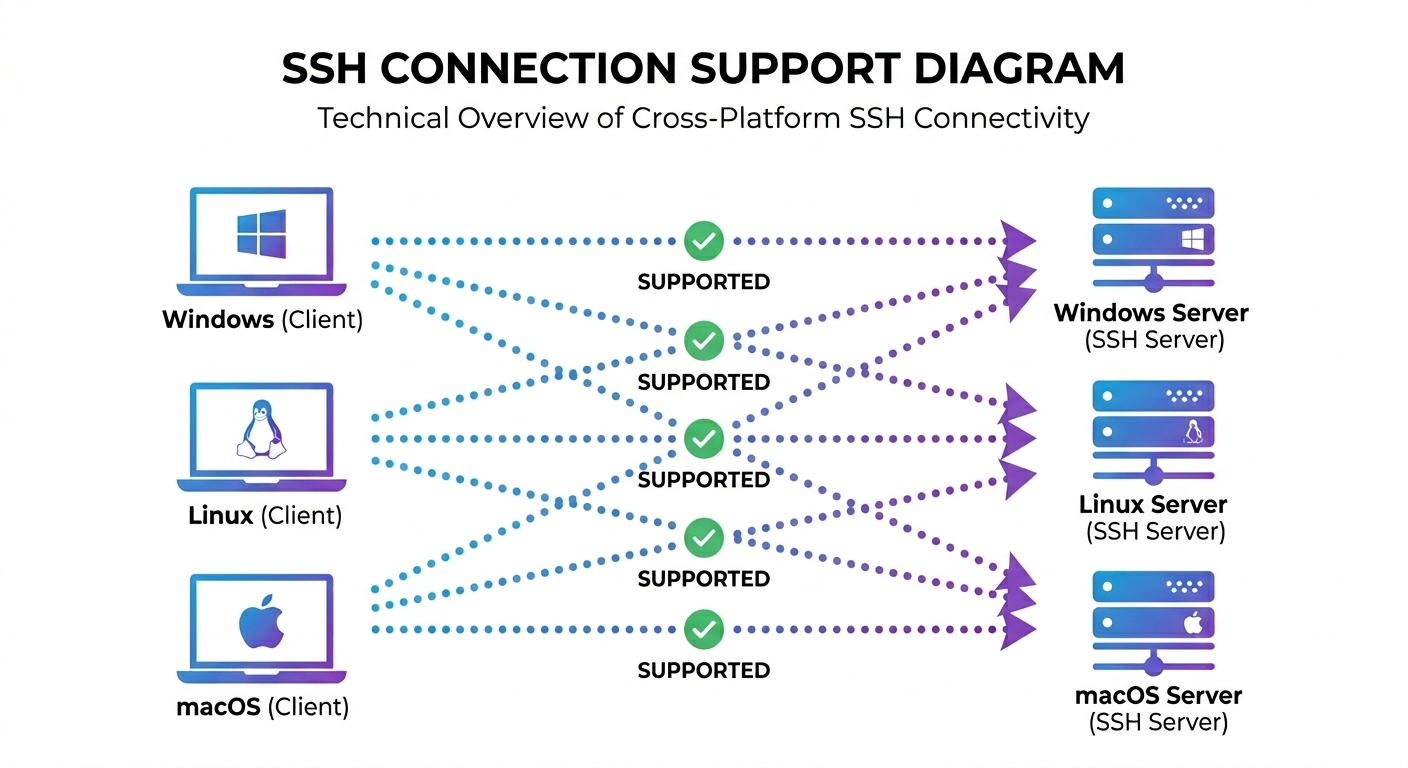
| From (Client) | To (Target) | Status |
|---|---|---|
| Windows | Linux | ✅ Tested |
| Windows | Windows | ✅ Tested |
| Linux | Linux | ✅ Tested |
| Linux | Windows | ✅ Tested |
| macOS | Any | ✅ Supported |
Windows targets require OpenSSH Server installed and running.
Features
Host Configuration
Stop typing credentials. Connect by alias.
["admin@server.com"]
password = "secret"
port = 22
alias = "web"
Then just: "Connect to WEB"
Supports password, SSH key, and encrypted keys with passphrase.
Update a field on an existing host without losing the rest (ssh_host_update), or
switch every host tool to an alternate config file for the session
(ssh_host_use_config) - handy for keeping separate host lists per project or
environment.
Line-Level File Editing
Edit config files with surgical precision—no download/upload needed.
# Replace a single line
ssh_file_replace_line(
    file_path="/etc/nginx/nginx.conf",
    match_line="worker_connections 1024;",
    new_line="worker_connections 4096;"
)

# Insert lines after a match
ssh_file_insert_lines_after_match(
    file_path="/etc/hosts",
    match_line="# Custom entries",
    lines_to_insert=["192.168.1.10 app.local", "192.168.1.11 db.local"]
)
Safety built-in: Operations fail if the match isn't unique—no accidental mass edits.
Background Task Management
Launch long-running processes and check back later.
# Start a backup (returns immediately)
ssh_task_launch(command="./backup.sh", stdout_log="/var/log/backup.log")

# Check status anytime
ssh_task_status(pid=12345)  # → 'running' or 'exited'

# Kill if needed
ssh_task_kill(pid=12345, force=True)
Comprehensive Sudo Support
Every tool supports use_sudo. Password is handled automatically.
ssh_file_write(file_path="/etc/app/config.yaml", content="...", use_sudo=True)
ssh_dir_mkdir(path="/opt/myapp", use_sudo=True)
ssh_archive_extract(archive_path="/backup.tar.gz", destination_path="/", use_sudo=True)
Three-Way Timeout System
Never get stuck on a hanging command - and never lose track of a long one either.
ssh_cmd_run(
    command="./long_script.sh",
    io_timeout=60.0,        # Check back in if silent for 60s (does NOT kill it)
    wait_timeout=20.0,      # Or check back in every 20s regardless of activity
    runtime_timeout=3600.0  # Hard safety cap - the only one that actually kills it
)
io_timeout and wait_timeout never kill the remote command - they hand off to
background monitoring so you can check back later (ssh_cmd_check_status), read
output collected so far (ssh_cmd_output), or decide to end it early
(ssh_cmd_kill). Only runtime_timeout ever terminates anything.
Full Unicode Support
Write and read files with emojis, international text, and special characters—on all platforms.
✅ ❌ 🎉 • → ≥ ∞ │ ┌ ─ 你好 مرحبا Привет café naïve
How it works: ssh_file_read and ssh_file_write use SFTP for direct binary transfer, completely bypassing shell encoding issues. This means Unicode works perfectly even on Windows targets where PowerShell's console encoding would normally corrupt special characters.
Windows Server Support
Full support for Windows targets with OpenSSH Server:
- PowerShell & CMD command execution
- Windows path handling (backslashes, drive letters, UNC paths)
- Administrator detection — shows if session has elevated privileges
- SFTP-based file operations — Unicode-safe, no encoding issues
Note: use_sudo is ignored on Windows (no sudo equivalent). For elevated operations, connect with an Administrator account.
And Much More...
- Command history with output retention and pattern filtering
- Recursive directory operations: search, copy, delete with dry-run
- Archive operations: create and extract tar.gz
- System info: OS version, memory, disk, CPU, uptime
- Pattern search: regex and plain text in files
- Alternate host config files: switch host lists per project/environment without restarting
All 46 Tools
Connection & Host Management (12 tools)
| Tool | Description |
|---|---|
ssh_conn_connect |
Connect using pre-configured host (by key or alias) |
ssh_conn_is_connected |
Check if SSH connection is active |
ssh_conn_status |
Get connection status (user, host, OS, cwd) |
ssh_conn_host_info |
Get detailed system information |
ssh_conn_verify_sudo |
Verify sudo access |
ssh_conn_add_host |
Add new host to configuration |
ssh_host_list |
List all configured hosts |
ssh_host_update |
Update fields on an existing host (rotate password, change port, etc.) in place |
ssh_host_remove |
Remove host from configuration |
ssh_host_use_config |
Switch to an alternate host config file for the session |
ssh_host_disconnect |
Disconnect current session |
list_tools |
List all available tools |
Command Execution (6 tools)
| Tool | Description |
|---|---|
ssh_cmd_run |
Execute command with I/O, wait, and runtime timeouts |
ssh_cmd_kill |
Terminate running command |
ssh_cmd_check_status |
Check command status |
ssh_cmd_output |
Retrieve output from command |
ssh_cmd_history |
Get command history with filtering |
ssh_cmd_clear_history |
Clear command history |
Background Tasks (3 tools)
| Tool | Description |
|---|---|
ssh_task_launch |
Launch command in background |
ssh_task_status |
Check if task is running |
ssh_task_kill |
Send signal to task |
File Operations (12 tools)
| Tool | Description |
|---|---|
ssh_file_stat |
Get file metadata |
ssh_file_read |
Read file contents via SFTP (Unicode-safe) |
ssh_file_write |
Create/overwrite/append file |
ssh_file_copy |
Copy file |
ssh_file_move |
Move or rename file |
ssh_file_transfer |
Upload or download files |
ssh_file_find_lines_with_pattern |
Search for pattern in file |
ssh_file_get_context_around_line |
Get context around match |
ssh_file_replace_line |
Replace single line |
ssh_file_replace_line_multi |
Replace with multiple lines |
ssh_file_insert_lines_after_match |
Insert lines after match |
ssh_file_delete_line_by_content |
Delete line by content |
Directory Operations (11 tools)
| Tool | Description |
|---|---|
ssh_dir_mkdir |
Create directory |
ssh_dir_remove |
Remove directory |
ssh_dir_list_files_basic |
Basic directory listing |
ssh_dir_list_advanced |
Recursive listing with metadata |
ssh_dir_search_glob |
Search files by pattern |
ssh_dir_search_files_content |
Search text in files |
ssh_dir_calc_size |
Calculate directory size |
ssh_dir_delete |
Delete with dry-run support |
ssh_dir_batch_delete_files |
Batch delete by pattern |
ssh_dir_copy |
Copy directory recursively |
ssh_dir_transfer |
Upload or download whole directories (archive-based) |
Archive Operations (2 tools)
| Tool | Description |
|---|---|
ssh_archive_create |
Create tar.gz archive |
ssh_archive_extract |
Extract archive |
Documentation
Full docs site: cygnussystems.github.io/cygnus-ssh-mcp — searchable, with navigation. Or browse the raw files directly in docs/:
- Overview
- Installation
- Platform Compatibility
- Windows Support
- Host Configuration
- Tools Reference
- Command Execution
- Process Management
- Logging
- Claude Desktop Setup
Use Cases
- DevOps Automation — Deploy, configure, and manage servers via AI
- Log Analysis — Search and analyze logs across multiple servers
- Configuration Management — Edit configs with precision line operations
- Backup & Recovery — Create archives, transfer files, restore backups
- System Monitoring — Check status, verify services, monitor processes
- Security Auditing — Search for sensitive patterns, verify configurations
License
GPL-3.0 — Free and open source.
Built by Cygnus Systems
Star this repo if you find it useful!
Project details
Verified details
These details have been verified by PyPIProject links
GitHub Statistics
Maintainers
Release history Release notifications | RSS feed


Download files
Download the file for your platform. If you're not sure which to choose, learn more about installing packages.
Source Distribution
Built Distribution
Filter files by name, interpreter, ABI, and platform.
If you're not sure about the file name format, learn more about wheel file names.
Copy a direct link to the current filters
File details
Details for the file cygnus_ssh_mcp-1.4.1.tar.gz.
File metadata
- Download URL: cygnus_ssh_mcp-1.4.1.tar.gz
- Upload date:
- Size: 145.9 kB
- Tags: Source
- Uploaded using Trusted Publishing? Yes
- Uploaded via: twine/6.1.0 CPython/3.13.12
File hashes
| Algorithm | Hash digest | |
|---|---|---|
| SHA256 |
e9927f76e123233a7513033696025fd0a5c2cb240bff53b7358bc6085df36ddf
|
|
| MD5 |
a297a756215891c3edd893ce164f7158
|
|
| BLAKE2b-256 |
f5bba5f454e981a3b961af4ca48dc90abc0c09d264c54d99e41f648191310424
|
Provenance
The following attestation bundles were made for cygnus_ssh_mcp-1.4.1.tar.gz:
Publisher:
publish.yml on cygnussystems/cygnus-ssh-mcp
-
Statement:
-
Statement type:
https://in-toto.io/Statement/v1 -
Predicate type:
https://docs.pypi.org/attestations/publish/v1 -
Subject name:
cygnus_ssh_mcp-1.4.1.tar.gz -
Subject digest:
e9927f76e123233a7513033696025fd0a5c2cb240bff53b7358bc6085df36ddf - Sigstore transparency entry: 2082316121
- Sigstore integration time:
-
Permalink:
cygnussystems/cygnus-ssh-mcp@9c2c42238e36590806746578f1721c045a8c6a02 -
Branch / Tag:
refs/tags/v1.4.1 - Owner: https://github.com/cygnussystems
-
Access:
public
-
Token Issuer:
https://token.actions.githubusercontent.com -
Runner Environment:
github-hosted -
Publication workflow:
publish.yml@9c2c42238e36590806746578f1721c045a8c6a02 -
Trigger Event:
push
-
Statement type:
File details
Details for the file cygnus_ssh_mcp-1.4.1-py3-none-any.whl.
File metadata
- Download URL: cygnus_ssh_mcp-1.4.1-py3-none-any.whl
- Upload date:
- Size: 122.6 kB
- Tags: Python 3
- Uploaded using Trusted Publishing? Yes
- Uploaded via: twine/6.1.0 CPython/3.13.12
File hashes
| Algorithm | Hash digest | |
|---|---|---|
| SHA256 |
98a0f1a987ee285c081cb98b7d94c3cad16720104d619f22b5c5b17b67ae6fb2
|
|
| MD5 |
2e57bbe6e94648cef4907e0df1f1ab5c
|
|
| BLAKE2b-256 |
e5e9141fa098a8621e2822ea306a5c9674f5a21617cc12c47f2863010b408bb3
|
Provenance
The following attestation bundles were made for cygnus_ssh_mcp-1.4.1-py3-none-any.whl:
Publisher:
publish.yml on cygnussystems/cygnus-ssh-mcp
-
Statement:
-
Statement type:
https://in-toto.io/Statement/v1 -
Predicate type:
https://docs.pypi.org/attestations/publish/v1 -
Subject name:
cygnus_ssh_mcp-1.4.1-py3-none-any.whl -
Subject digest:
98a0f1a987ee285c081cb98b7d94c3cad16720104d619f22b5c5b17b67ae6fb2 - Sigstore transparency entry: 2082316231
- Sigstore integration time:
-
Permalink:
cygnussystems/cygnus-ssh-mcp@9c2c42238e36590806746578f1721c045a8c6a02 -
Branch / Tag:
refs/tags/v1.4.1 - Owner: https://github.com/cygnussystems
-
Access:
public
-
Token Issuer:
https://token.actions.githubusercontent.com -
Runner Environment:
github-hosted -
Publication workflow:
publish.yml@9c2c42238e36590806746578f1721c045a8c6a02 -
Trigger Event:
push
-
Statement type:






