
CyteType
Agentic, Evidence-Based Cell Type Annotation for Single-Cell RNA-seq


CyteType is an end-to-end cell type annotation system for single-cell RNA sequencing (scRNA-seq), designed for repeatable analysis pipelines rather than one-off prompting. It combines cluster-level marker genes, expression context, study metadata, ontology mapping, and a dedicated review step in a structured workflow that operates directly on AnnData.
For Seurat workflows, use CyteTypeR.
📚 Documentation: docs.nygen.io/CyteType covers the Python and R clients, the report, the dashboard, Chat and the MCP connector.
Quick Start
1. Install
pip install cytetype
2. Set up your API key
cytetype setup
This opens passwordless CyteType sign-in in your browser and saves the API key locally for automatic use from Python. You can also create or manage API keys in the dashboard.
Already have an API key? Save and validate it locally once:
cytetype login
3. Annotate with Scanpy
import scanpy as sc
from cytetype import CyteType

# Assumes log-normalized AnnData with clusters in adata.obs["clusters"]
group_key = "clusters"
sc.tl.rank_genes_groups(adata, groupby=group_key, key_added=f"rank_genes_{group_key}")
annotator = CyteType(
    adata,
    group_key=group_key,
    rank_key=f"rank_genes_{group_key}",
    n_top_genes=100,
)
adata = annotator.run(study_context="Human PBMC from a healthy donor")
sc.pl.umap(adata, color="cytetype_annotation_clusters")
Follow the full quickstart, or try CyteType in Google Colab.
What You Get
- Annotations: Cell type, subtype, and activation state for every cluster
- Cell Ontology mapping: Standardized CL IDs for comparison across studies
- Confidence and quality control: Reviewer confidence (High, Moderate, Low) and heterogeneity flags, plus match scores against your existing labels
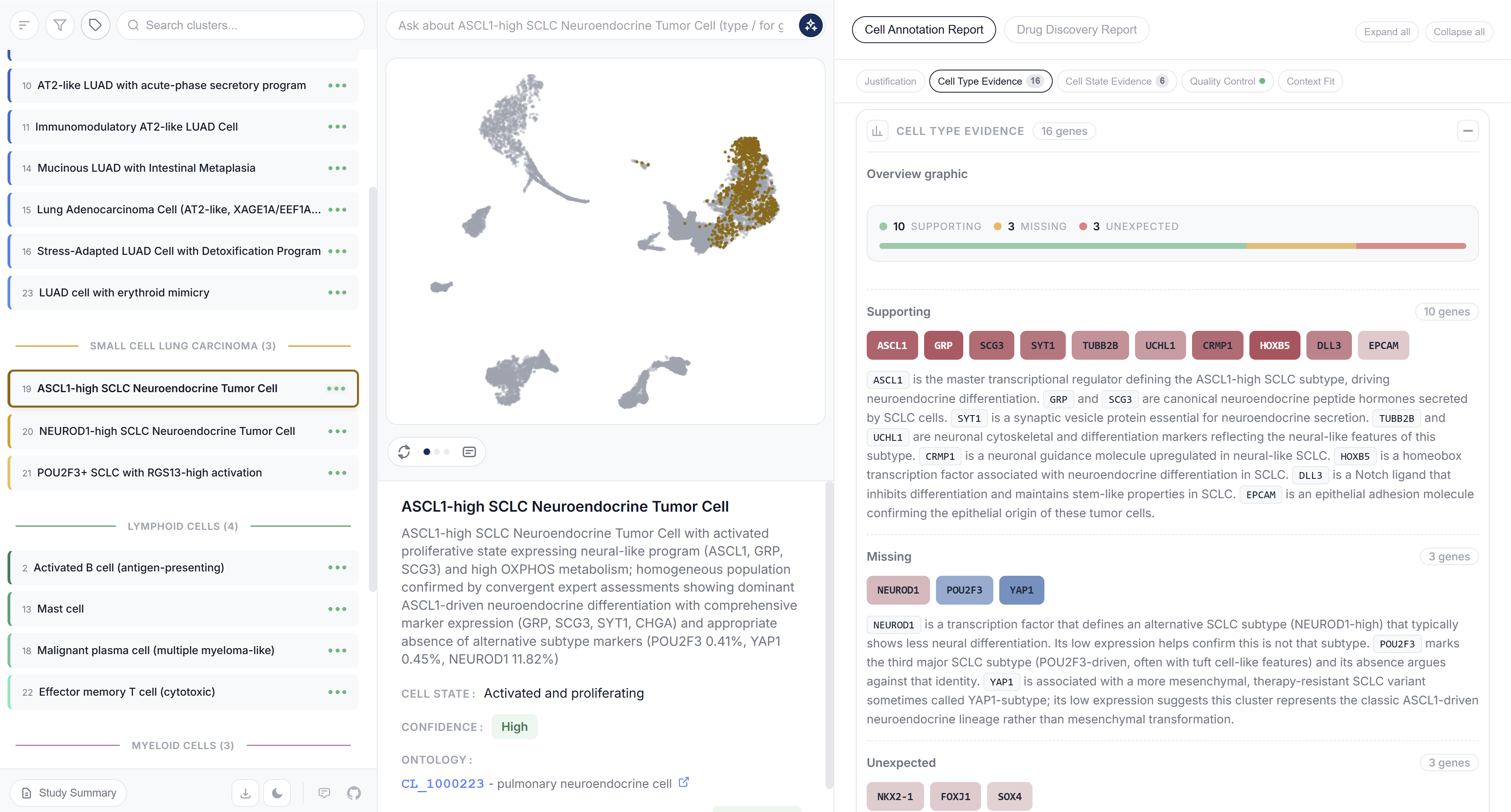
- Supporting evidence: Supporting, missing and unexpected marker genes, pathways, and the reasoning behind each call
Example Report
Each analysis generates an interactive report with annotation decisions, reviewer assessments and supporting evidence. From the report, open Chat to ask follow-up questions about your data.
Benchmarks
Across PBMC, bone marrow, tumor microenvironment, and cross-species datasets, the multi-agent approach outperforms existing annotation methods:
| Compared with | Improvement |
|---|---|
| GPTCellType | +388% |
| CellTypist | +268% |
| SingleR | +101% |
Methods and full results are in the preprint. You can also browse results on atlas-scale datasets.
Resources
- 📚 Documentation: Guides for the Python and R clients, the report, the dashboard, Chat and the MCP connector.
- 🔐 Sign in and API keys: Set up API keys and manage saved credentials.
- 🧬 Prepare your data: Clusters, marker genes, gene symbols and other inputs.
- ⚙️ Run, monitor and rerun jobs: Annotation settings, timeouts, reruns and upload files.
- 🤖 Use your own LLM: LLM providers, including local models.
- 📋 Results in AnnData: Columns and keys added to AnnData.
- 🛠️ Troubleshooting: Resolve sign-in, data, upload and job issues.
- 🐍 Python API reference: Every public class and function.
- 🧑💻 Development: Configure a local environment and contribute.
- 🎥 Introduction video: Watch a quick overview of CyteType.
- 💬 Discord community: Ask questions and get support.
Citation
Ahuja G, Antill A, Su Y, Dall'Olio GM, Basnayake S, Karlsson G, Dhapola P. Multi-agent AI enables evidence-based cell annotation in single-cell transcriptomics. bioRxiv 2025. doi: 10.1101/2025.11.06.686964
@article{cytetype2025,
  title={Multi-agent AI enables evidence-based cell annotation in single-cell transcriptomics},
  author={Gautam Ahuja, Alex Antill, Yi Su, Giovanni Marco Dall'Olio, Sukhitha Basnayake, Göran Karlsson, Parashar Dhapola},
  journal={bioRxiv},
  year={2025},
  doi={10.1101/2025.11.06.686964},
  url={https://www.biorxiv.org/content/10.1101/2025.11.06.686964v1}
}
License
The CyteType Python client is open source software released under the BSD 3-Clause License and maintained by Nygen.
CyteType service terms
Annotation runs on the CyteType service, which requires an API key.
- Academic and non-commercial use is free within the usage limits. Data generated under academic use is licensed under CC BY-NC-SA 4.0.
- Commercial use and higher limits require a commercial license from Nygen Analytics AB, which includes commercial rights to the generated data.
For licensing, contact contact@nygen.io.
1 maintainer

Metadata
1 maintainer
Release files for cytetype 0.21.0
For a detailed explanation of source distributions (sdists) and built distributions (wheels), please see the package formats documentation.
Source distribution (sdist)
| File | Size | Uploaded | Provenance | Actions |
|---|---|---|---|---|
| cytetype-0.21.0.tar.gz | 799.6 kB | With provenance | Details for cytetype-0.21.0.tar.gz |
Built distribution (wheel)
| File | Interpreter | ABI | Platform | Actions Reset |
|---|---|---|---|---|
| cytetype-0.21.0-py3-none-any.whl | Python 3 | none | any | Details for cytetype-0.21.0-py3-none-any.whl |
Total release size: 868.6 kB
Release files / cytetype-0.21.0.tar.gz
| Download URL | cytetype-0.21.0.tar.gz |
|---|---|
| Size | 799.6 kB |
| Tags | Source |
|
SHA-256 checksum How to use checksums |
6e196bb431b77be67c86ba8319695a636fc4a6941a56dbca09270d386e473fff
|
|
BLAKE2b-256 checksum How to use checksums |
6d4b96ac7a81390674a259c37202fa697548f2ebe00ee89c7d48e98cfb9fff2a
|
| Upload date | |
|
Uploaded using Trusted Publishing? What is trusted publishing? |
Yes |
| Uploaded via |
twine/7.0.0 CPython/3.13.14
|
Provenance
Provenance describes where a file came from. On PyPI, provenance is shared via attestations, which provide a verifiable record of the build or publishing details. View details, limitations and caveats.


PyPI Publish Attestation
PyPI verified that this artifact, at this checksum, originated from the publisher listed below.
Signed by GitHub Actions, verified by PyPI on Oct 18, 2026.
Transparency logRelease files / cytetype-0.21.0-py3-none-any.whl
| Download URL | cytetype-0.21.0-py3-none-any.whl |
|---|---|
| Size | 68.9 kB |
| Tags | Python 3 |
|
SHA-256 checksum How to use checksums |
20f836702e723c3ad6b679ffc114552b71be2fe98e251c910531ee4987101898
|
|
BLAKE2b-256 checksum How to use checksums |
d9897fb465d99f4717c3bfc91107e0920b751d5ba0b72919dc49e82234660c48
|
| Upload date | |
|
Uploaded using Trusted Publishing? What is trusted publishing? |
Yes |
| Uploaded via |
twine/7.0.0 CPython/3.13.14
|
Provenance
Provenance describes where a file came from. On PyPI, provenance is shared via attestations, which provide a verifiable record of the build or publishing details. View details, limitations and caveats.
PyPI Publish Attestation
PyPI verified that this artifact, at this checksum, originated from the publisher listed below.
Signed by GitHub Actions, verified by PyPI on Oct 18, 2026.
Transparency logSecurity for cytetype 0.21.0
Provenance
Provenance describes where a file came from. On PyPI, provenance is shared via attestations, which provide a verifiable record of the build or publishing details. View details, limitations and caveats.
Full provenance
Both files in this release have been uploaded with provenance metadata.
Attestation for cytetype-0.21.0.tar.gz
PyPI Publish Attestation
PyPI verified that this artifact, at this checksum, originated from the publisher listed below.
Signed by GitHub Actions, verified by PyPI on Oct 18, 2026.
Transparency logA note on package security
PyPI is a repository for distributing packages, not a service for auditing them. While third-party security researchers and our staff do their best to detect and remove malicious packages, PyPI cannot guarantee the quality, security or suitability of any given package.
To learn more about protecting yourself from malicious actors, visit our package security documentation.














