
daylogs
I only get real control of my weight and my spending when I type the numbers in myself — not when something syncs them for me, but when I deliberately type them. The typing is what makes me notice, and noticing is what changes the next decision. A number that arrives on its own gets read once and forgotten.
So daylogs has no bank integration and no health-app import, deliberately. The manual entry isn't friction waiting to be automated away; it is the mechanism. Everything here exists to make that daily typing fast enough that I keep doing it — a grammar that takes a whole entry on one line, and one keystroke per view.
Three things, in a terminal: what you weigh, what you eat, and what you spend — plus one short daily read of all of it, written by Claude.
One command. One process. No server, no browser, no ports.
What it is, and what it isn't
Three things, deliberately. There is no income tracking, no net worth, no cash projection, no investments, no journal, no sync, no server and no web UI. Money answers one question: where did it go this period, and am I inside the budget.
The design rule: anything that doesn't survive daily use doesn't ship.
Install
uv tool install git+https://github.com/IngTian/daylogs
or, equivalently, pipx install git+https://github.com/IngTian/daylogs. Either
one puts day on your PATH in its own isolated environment — no environment to
activate, nothing added to whatever Python you use for other work. If you have
neither tool, uv installs in one line:
curl -LsSf https://astral.sh/uv/install.sh | sh
Upgrade with uv tool upgrade daylogs, remove with uv tool uninstall daylogs. Working on daylogs itself is a different setup — see
Development.
Requirements. Python 3.12+ and any terminal with truecolour. macOS and Linux; not tested on Windows.
The Claude Code CLI on PATH is needed for
calorie estimation and the daily summary — everything else works without it, and
the app degrades to plain messages rather than failing.
Pasting a photo from the clipboard uses osascript, so that one path is macOS
only. The inbox folder and a pasted file path work anywhere.
Use
day                            # the TUI
day summary                    # generate yesterday's summary, print to stdout
day summary --date 2026-08-20  # a specific day
day backup ~/Drive/daylogs     # consistent DB copy (cron-friendly)
day export ~/Drive/daylogs     # one CSV per table, readable anywhere
day --version
uv tool install already puts day on your PATH, so there is no environment to
activate. If you installed into an environment by hand instead, symlink the
console script:
ln -sf "$(command -v day)" ~/.local/bin/day
build_binary.sh produces a standalone PyInstaller executable for a machine with
no Python at all — but it starts in ~4,770 ms against ~60 ms for an installed
console script, because --onefile unpacks 15 MB on every launch. Prefer a real
install unless you genuinely have no Python.
Keys
Press ? for the full map at any time — it's generated from the same table the
bindings and the footer come from, so it can't be out of date.
The footer is two rows: what you're looking at on top (range, sort, filters), and
the keys below, grouped into actions, view controls and navigation and coloured by
group. On a narrow terminal it sheds navigation keys first and never ? or q.
Everywhere
| Key | Does |
|---|---|
1 2 3 |
Day / Body / Money |
← → |
previous / next tab — stops at the ends rather than wrapping |
tab shift+tab |
next / previous sub-view within the tab (Body, Money) |
[ ] |
previous / next period — report on Day, day on Body, month on Money |
t |
jump to now — today, this month, newest report |
g |
go to a date (2026-06-15 or 2026-06) |
+ - |
widen / narrow the time horizon (Body, Money): 1w 1m MTD 3m YTD 1y all |
? |
the full keymap |
u |
undo the last delete or edit |
esc |
back out one step — never quits |
q |
quit |
t and g are why [ / ] stepping one period at a time is fine: you're
never more than two keystrokes from anywhere.
Day — 1 · r regenerates the daily read. [ ] browse earlier ones; the
figures above them are always today's.
Body — 2
| Key | Does |
|---|---|
w |
weigh in |
f |
log food |
p |
log food from a photo |
h |
set height, sex and birthday (for BMR) |
enter |
edit the selected row |
x |
delete the selected row (confirm with y) |
Money — 3
| Key | Does |
|---|---|
e |
log an expense |
b |
set a budget line |
s |
add or update a recurring item |
r |
roll active recurring items into the month's budget |
d c k |
sort by date / cost / category — press again to flip direction |
/ |
filter by text |
G |
group the expense list by category |
enter |
drill into a category, fold a group, or edit the selected row |
x |
delete the selected row (confirm with y) |
What you type
| Prompt | Type | Result |
|---|---|---|
weigh › |
78.2 |
logged now |
weigh › |
78.2 post-run @07:30 |
with a note, at a time |
food › |
chicken salad =610 |
labelled — no LLM call |
food › |
chicken salad |
Claude estimates; review and accept |
expense › |
12.40 lunch !restaurant |
amount, description, category |
expense › |
127 Grocery Item X !grocery ~receipt in wallet |
with a note |
expense › |
-24.99 returned shoes !grocery |
a refund |
budget › |
500 !grocery |
named after the category |
recurring › |
20.99 Streaming !subscriptions #monthly |
monthly |
Sigils mark the fields, so nothing is ever taken out of your own words:
!  a category                   tab completes
#  a cycle                      tab completes
@  a date and/or a time         @2026-08-24  @08-24  @14:30  @08-24/14:30
~  a note (may contain spaces)
=  calories
Everything unsigiled is the description. The first token is the amount. \ escapes
a leading sigil, so \!important is just a word.
Every prompt shows what it wants, in three places and no extra screen rows:
╭─ profile › ───────────────────────────────────────╮
│ 180 male 1990-01-01                               │   the example, greyed
╰─ height · m/f · birthday — any order, partial ok ─╯   the grammar, persistent
The example is the placeholder, so it gets out of the way as soon as you type. The grammar stays, because that's the part you still want halfway through a line. Every example is a line the parser actually accepts — a test parses all of them.
Every write answers with its consequence, not just an acknowledgement —
78.2 kg logged · ▼0.4 vs 7d, or 12.40 lunch → restaurant 289.50 of 200.00 ⚠.
A rejected entry keeps your text and shows why on the bottom border, so one wrong character costs one correction rather than a retype.
Amounts take $ and thousands separators ($1,240.50), but a comma is never a
decimal point — 12,40 is rejected with a suggestion rather than quietly becoming
1240.
Editing
enter acts on whatever is under the cursor: a weight, food, expense or recurring
row opens for editing, a category drills in, a group folds.
Editing prefills the same grammar you used for entry. The submitted line is
authoritative: drop the note words and the note is cleared; submit unchanged and
the note survives. Food entries always require =kcal — dropping it is rejected
rather than silently zeroing the calories. Each line carries exactly the columns
that row's table shows, so what you can see is what you can edit.
u undoes an edit as well as a delete.
Time horizons
One list serves both tabs, so + and - mean the same thing everywhere:
1w · 1m · MTD · 3m · YTD · 1y · all
1w/1m/3m/1y look back from the day you're on; MTD and YTD run from the
start of that month or year. [ and ] then step by one whole horizon — on MTD
that's a calendar month, so you compare the same elapsed slice of the previous
month rather than a ragged window.
g 2026-06 lands on the last day of June, so under MTD you get all of it.
Reading money
Over several months the budget column is the sum of those months' lines.
Green means inside the budget, amber means within 10% of a cap, red means over —
alongside the ⚠ glyph, never instead of it. On Body, a falling weight is green and
a rising one red; there's no goal weight to compare against, so that's an
assumption, and the arrow carries the direction either way.
A month nobody has rolled yet has no budget at all, and the header says so and names the key rather than reporting a meaningless "0.00 budget".
The burn bar's ┃ marker is how far through the month you are — 84% of budget
spent on day 27 of 31 is fine, the same number on day 12 is not. It only appears
for the current single month, because burn-against-elapsed means nothing across a
quarter; the bar says so when it's hidden.
Panels
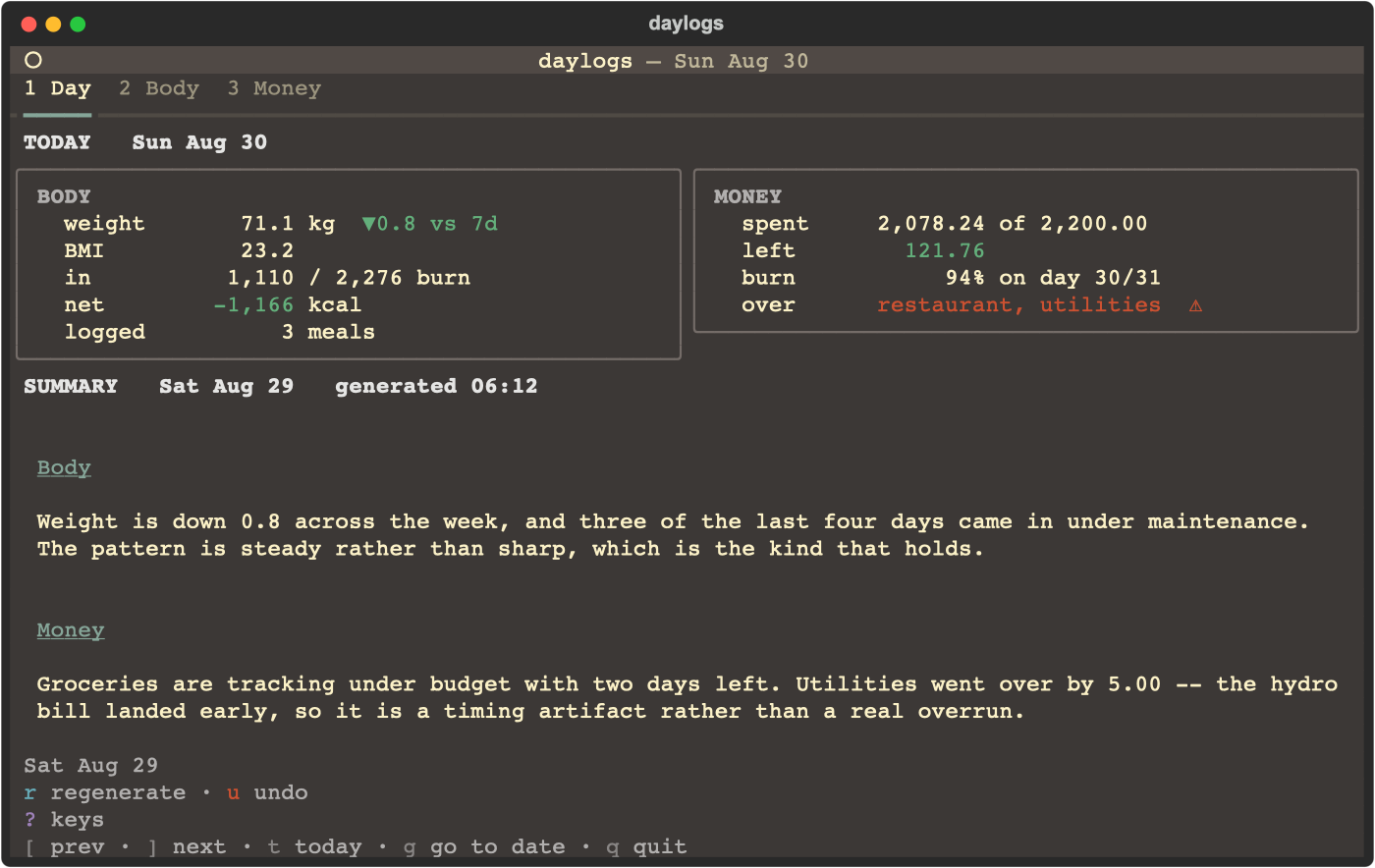
Day shows BODY beside MONEY — today's weight and trend, intake against BMR, this month's spend against its budget and how far through the month you are — with the generated daily read scrolling underneath. The figures are always today's; the read is dated by the day it describes, which is why each half carries its own date.
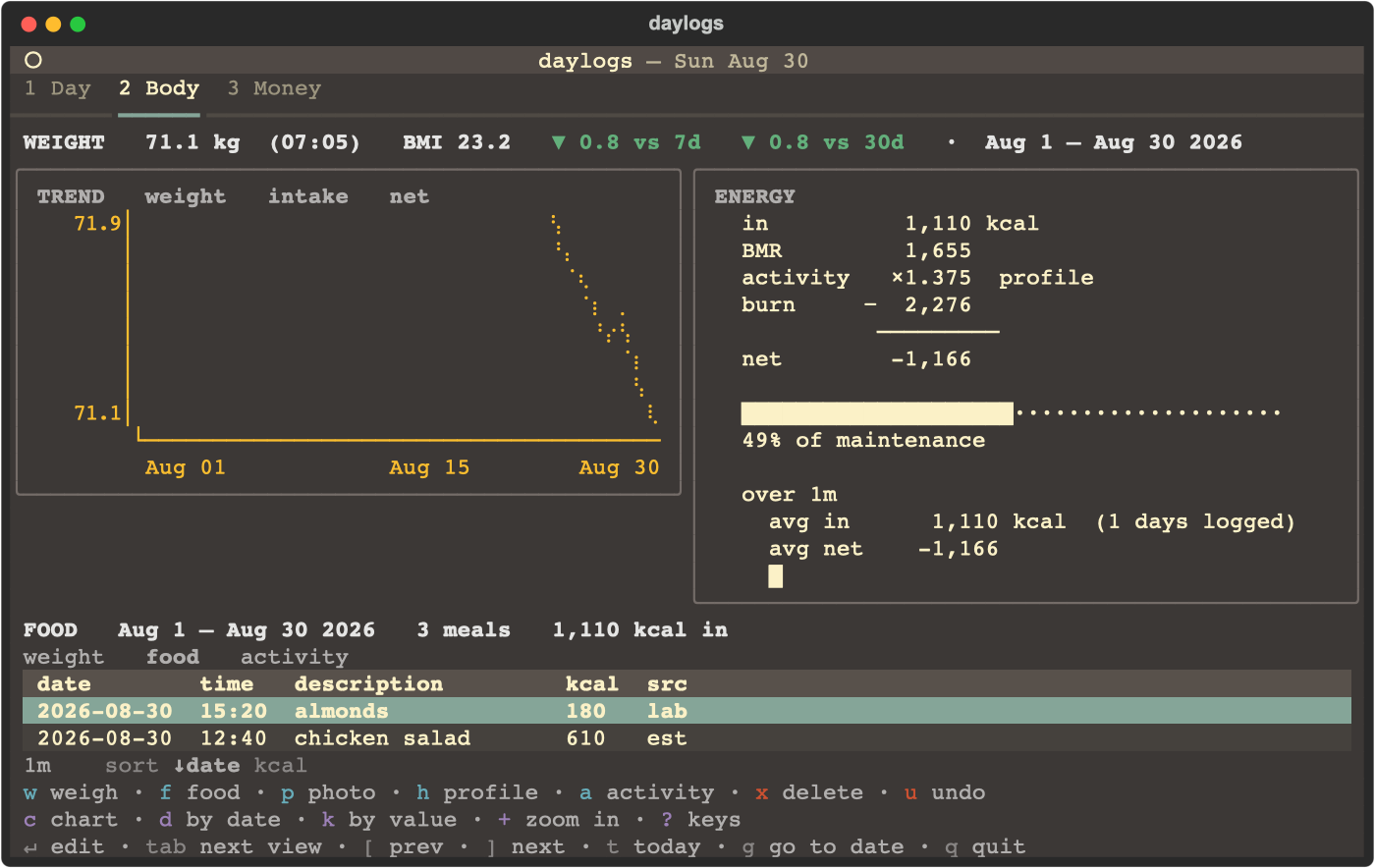
Body shows TREND (the braille chart) beside ENERGY — intake against BMR for the day, then the average and a sparkline over the horizon.
Money shows BUDGET vs SPENT beside WHERE IT WENT. The first scales each bar to that category's own cap, so "how close to this limit" is readable per row; the second is a ranked share list.
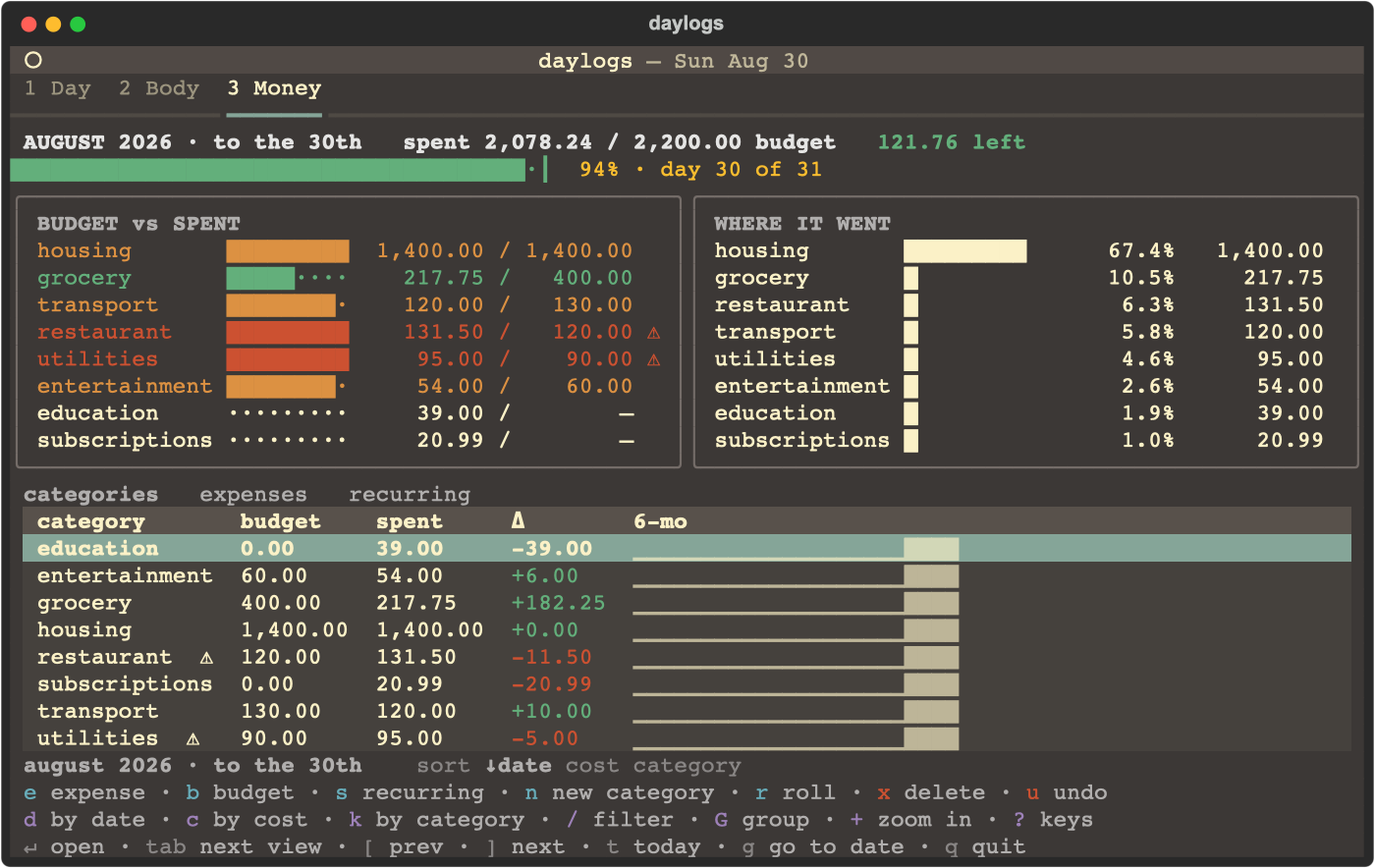
Ranked bars rather than pie charts, deliberately: a terminal has about eight distinguishable fill glyphs and there are nine categories, so a pie collides — and you still need a legend to read any amount.
Shares are of gross spend. A refund can push a category below zero for the window — a reimbursed bill, a returned order — and such a row keeps its amount but shows no share, because a part-to-whole has no negative slice. It still appears on both panels, so the rows and the header total reconcile.
The weight chart
A braille line chart: 2×4 dots per cell, so an 8-row by 48-column chart carries 96×32 dot resolution. The width follows the panel, so a wider terminal buys more horizontal detail.
Points sit at their real dates, not spread evenly across the panel. Two weigh-ins a day apart show up as two weigh-ins a day apart, with the weeks you didn't step on the scale visibly empty — a gap is information.
It's a line rather than bars deliberately. Weight sits in a narrow band, and a bar or filled area implies a meaningful zero baseline — anchored at your minimum it would render as a solid block whose only readable feature is its top edge. Spend is a magnitude from zero, so bars stay correct there.
The daily summary
One claude -p call, once a day, over whatever the other two tabs recorded. It
runs unattended the first time you open the app after summary_after_hour, and r
regenerates it.
A report is dated by the day it describes, not the day it runs — a summary of today would be reading a half-finished day, so the target is yesterday.
Anything you put in memory.md (see Configuration) is passed along as context for
who you are, so the summary can be about you rather than about a table of numbers.
Any entry prompt
In the weigh / food / expense prompts, @2026-08-25 or @08-25 sets the date
and @13:05 sets the time, wherever you put them in the line.
Everywhere: esc cancels, ↑ / ↓ walk that prompt's history.
Configuration
Optional. ~/Documents/daylogs/config.toml; every key has a default.
timezone             = "America/Toronto"
height_cm            = 170          # BMR input
sex                  = "female"     # BMR constant term only
birthday             = "1990-01-01" # age, for BMR
claude_model         = ""           # empty = CLI default
summary_after_hour   = 6
summary_timeout_sec  = 120
estimate_timeout_sec = 60

# Paths. Relative values resolve against the data root above.
db_path              = "daylogs.db"
inbox_dir            = "inbox"      # phone photos land here
memory_path          = "memory.md"  # free text passed to the daily summary

[[category]]
slug    = "gym"
display = "Gym"
color   = "#9ba068"
Built-in categories: grocery, restaurant, transport, housing,
utilities, subscriptions, entertainment, education, other. Adding
one needs no code change — just a [[category]] block.
Height, sex and birthday only feed the Mifflin-St Jeor BMR line. Leave them
out and the Body tab shows calories without a maintenance baseline. You don't have
to edit the file for those three — h on the Body tab writes them here for you,
keeping your comments and [[category]] blocks intact.
Photos from a phone
Three ways in, tried in that order when you press p:
- Clipboard — screenshot or Continuity Camera, then
p. - Inbox — on the phone: Photos → Share → Save to Files →
daylogs/inbox. The Body tab shows a pending count;ptakes the oldest and moves it toinbox/processed/once the row is written. Shoot at lunch, log at night. - Path — paste or drag a file into the prompt.
A failed estimate leaves the file pending rather than silently consuming it.
Data
SQLite, six tables, at ~/Documents/daylogs/daylogs.db. Logs at
~/.daylogs/logs/. Override the data root with DAYLOGS_HOME.
This project was called daybook until 0.2.0, and the data root moved with the
rename. If a ~/Documents/daybook/ is still there, day refuses to start and
prints the two mv commands that move it — rather than quietly opening a new,
empty database beside your old one.
The connection runs PRAGMA journal_mode=DELETE on purpose. WAL's -wal and
-shm sidecars can sync independently of the main file under iCloud Drive and
corrupt the database on the receiving device; rollback-journal keeps SQLite to
one file. daylogs is read-heavy, so the write cost is noise.
Back it up. A synced folder is not a backup: it replicates a deletion or a
corruption as faithfully as it replicates a write. day backup <dir> writes a
consistent copy via VACUUM INTO; point it somewhere else you own and run it
from cron.
And get it out. A backup only daylogs can open is a weaker promise than a file
anything can read, so day export <dir> writes one CSV per table into a dated
subdirectory — weight, food, expense, recurring, budget, report, with
the schema's own column names as headers. The table list comes from the database
rather than a hand-kept list, so nothing is silently left out. It prints the
directory on stdout and per-table row counts on stderr, so cd "$(day export ~/Drive/daylogs)" works and cron logs stay readable.
CSV, because every table is flat and "open it in a spreadsheet" is the point. The one cost: CSV cannot tell an empty note from an absent one — both come out blank. It is an export, not an import; loading it back in is not supported.
Development
Working on daylogs wants an editable install with the dev extras, which is a different thing from the isolated tool install above. Any environment manager does; this is conda because that's what I use:
conda create -n daylogs python=3.12
conda activate daylogs
pip install -e '.[dev]'
pytest
ruff check .
Runtime dependency: textual. Everything else is the standard library.
The README's three screenshots are generated, not drawn:
python tools/screenshots.py # rewrites assets/{day,body,money}.{svg,png}
Run it after anything that moves the layout and commit the result. The seed data is synthetic and the clock is pinned, so two runs produce byte-identical files — a diff means the UI actually changed. The previous hand-drawn ASCII had drifted out of alignment and had once advertised a key that was never bound; an illustration nobody can verify against the app is an illustration that lies eventually.
Design notes:
- Business logic never lives in
daylogs/tui/. Tabs render and handle keys; arithmetic lives inbody.py/money.py/summary.pywith tests. - The
claude -prunners are always injected, so no test spawns a subprocess. - Parsers in
parse.pyare pure functions withnowpassed in — no test depends on when it runs. - Deletes are hard, with a session-scoped undo ring. That drops a
deleted_atcolumn from every table, the active/in-use query wrappers, a trash service, and a partial unique index.
Contributing
See CONTRIBUTING.md. Short version: improvements to the three existing features are welcome; a fourth feature needs an issue first, because staying small is the point.
Licence
MIT — see LICENSE.
1 maintainer

Metadata
1 maintainer
Release files for daylogs 0.2.0
For a detailed explanation of source distributions (sdists) and built distributions (wheels), please see the package formats documentation.
Source distribution (sdist)
| File | Size | Uploaded | |
|---|---|---|---|
| daylogs-0.2.0.tar.gz | 169.6 kB | Details |
Built distribution (wheel)
| File | Interpreter | ABI | Platform | Reset |
|---|---|---|---|---|
| daylogs-0.2.0-py3-none-any.whl | Python 3 | none | any | Details |
Total release size: 269.1 kB
Release files / daylogs-0.2.0.tar.gz
| Download URL | daylogs-0.2.0.tar.gz |
|---|---|
| Size | 169.6 kB |
| Tags | Source |
|
SHA-256 checksum How to use checksums |
4983e6a741ddeaa5201ec598c444723979751890d87d33e6b45c9fbb4685256d
|
|
BLAKE2b-256 checksum How to use checksums |
077051588763ca50deffac3fd62cd3a700a127645924c7b27009e64a029bca01
|
| Upload date | |
|
Uploaded using Trusted Publishing? What is trusted publishing? |
Yes |
| Uploaded via |
twine/7.0.0 CPython/3.13.14
|
Provenance
Provenance describes where a file came from. On PyPI, provenance is shared via attestations, which provide a verifiable record of the build or publishing details. View details, limitations and caveats.


PyPI Publish Attestation
PyPI verified that this artifact, at this checksum, originated from the publisher listed below.
Signed by GitHub Actions, verified by PyPI on Aug 31, 2026.
Transparency logRelease files / daylogs-0.2.0-py3-none-any.whl
| Download URL | daylogs-0.2.0-py3-none-any.whl |
|---|---|
| Size | 99.5 kB |
| Tags | Python 3 |
|
SHA-256 checksum How to use checksums |
7bbcfd8e53de304fee2c9fbc2f3fd5ed8c3321b169b771db153f8183de736150
|
|
BLAKE2b-256 checksum How to use checksums |
725c25447b1944779604f990705aeccaa192df7c463c9801cea38d49caa7c263
|
| Upload date | |
|
Uploaded using Trusted Publishing? What is trusted publishing? |
Yes |
| Uploaded via |
twine/7.0.0 CPython/3.13.14
|
Provenance
Provenance describes where a file came from. On PyPI, provenance is shared via attestations, which provide a verifiable record of the build or publishing details. View details, limitations and caveats.
PyPI Publish Attestation
PyPI verified that this artifact, at this checksum, originated from the publisher listed below.
Signed by GitHub Actions, verified by PyPI on Aug 31, 2026.
Transparency log













