
A CLI tool to monitor individual dbt Cloud run jobs and receive OS notifications when they complete.

Project description
dbt-heartbeat
A CLI tool to monitor individual dbt Cloud run jobs and receive OS/Slack notifications when they complete.
Why This Exists
When working with large dbt projects that utilize a merge queue, developers often need to wait for long-running CI jobs to complete after syncing their branches with main before pushing changes. This tool solves two key problems:
- Manual Monitoring: Instead of repeatedly checking job status or working on other things and forgetting about your dbt job and holding up the merge queue, automatically get notified when your specific run job completes.
- Notification Control: AFAIK, dbt Cloud does not have notifications for job-specific runs. You can get notifications for all jobs of a specific environment/deployment, but not for specific runs within those environment/deployment jobs (i.e your own CI jobs in a staging environment).
All you need is a dbt Cloud developer PAT, dbt Cloud account ID, and a specific job run ID, and you'll be able to watch the status of the job run in your terminal and get notified when the job finishes.
Features
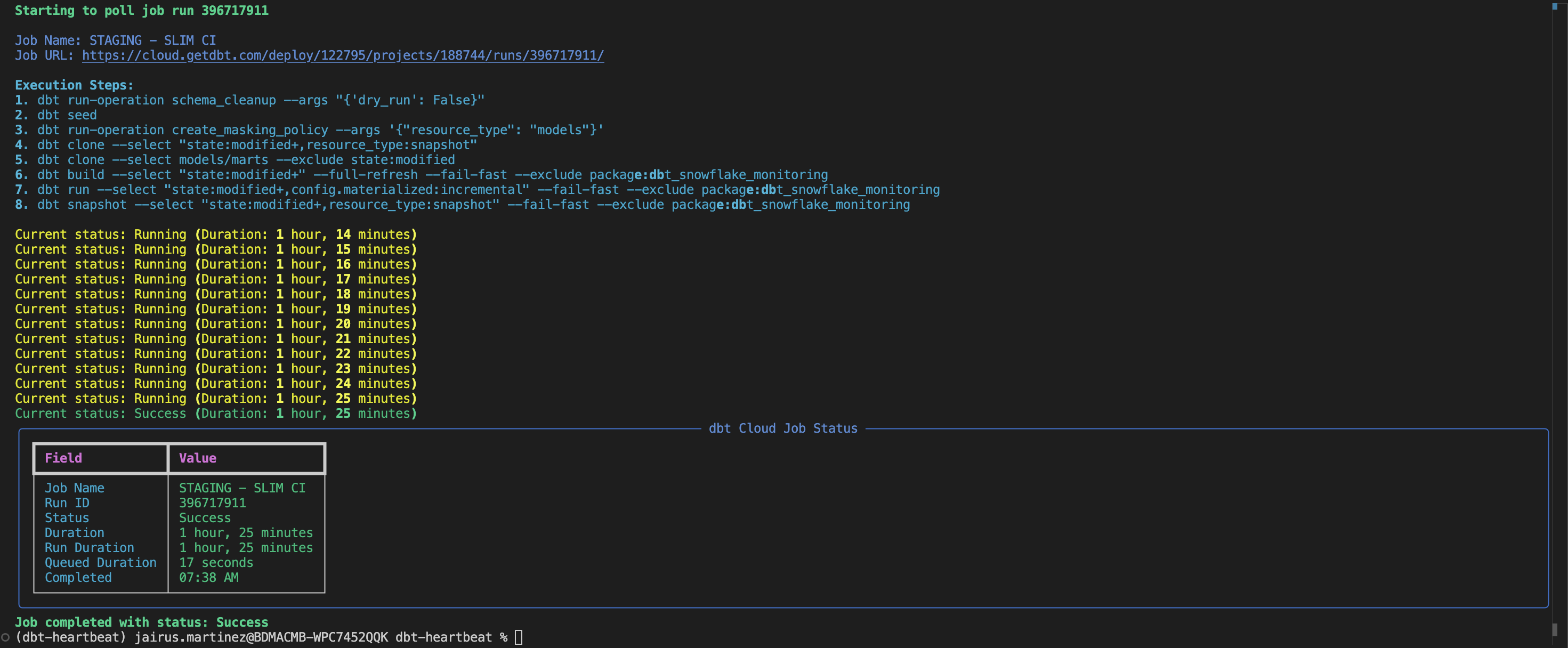
- Poll dbt Cloud job runs and monitor their status
- Terminal output with color-coded status updates
- Can control the log level of the CLI output
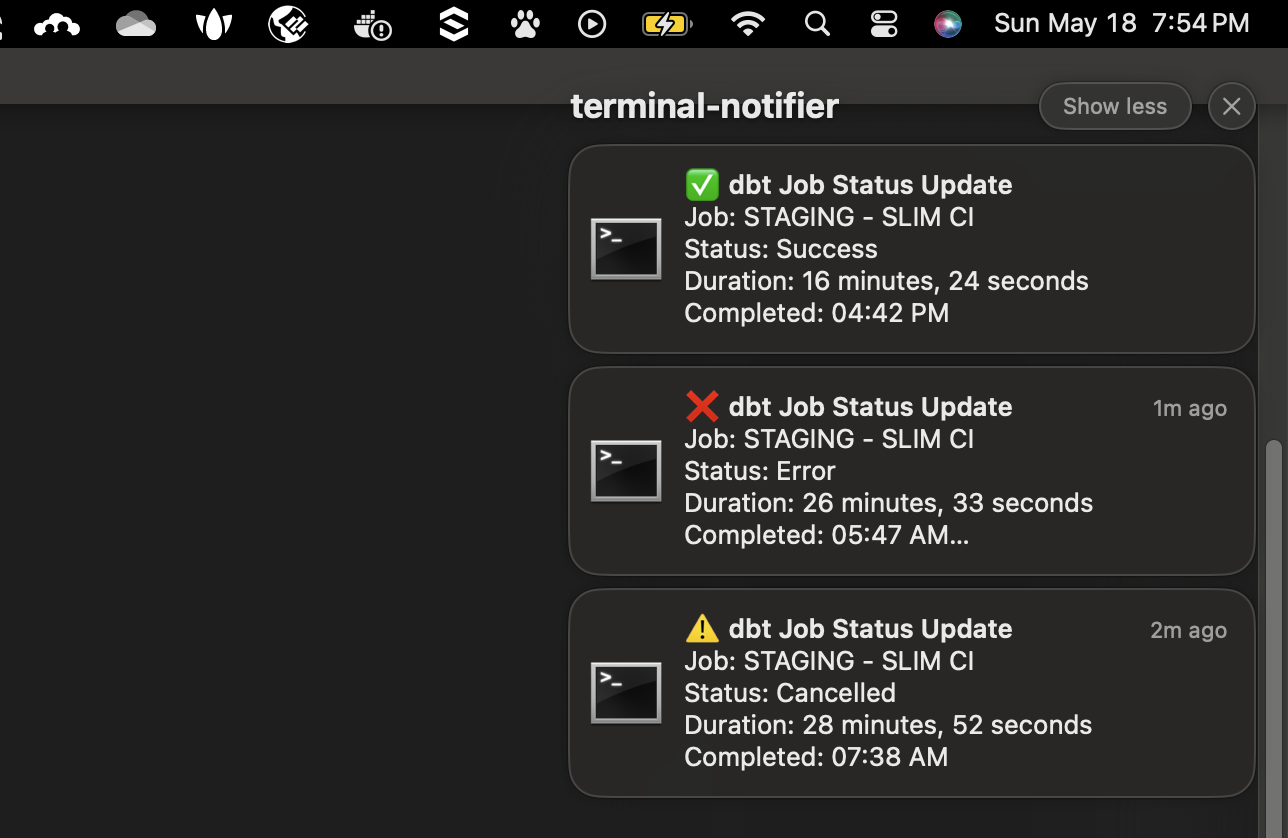
- Detailed job run status information once complete in the CLI + System/Slack notifications
Prerequisites
- Python 3.8 or higher
- dbt Cloud account with API access (via the dbt developer PAT)
- A Python package manager such as:
uv>=0.6.11pip>=25.1.1
NOTE: While uv is the recommended method for installing dbt-heartbeat, you can also install it using pip install. However, when installing with pip, you are responsible for managing your Python virtual environment and ensuring that the directory containing the executable is included in your system's PATH. In contrast, when using uv (particularly as described in the For General Use section below) no additional environment configuration is required, and the executable is automatically made available in your PATH for immediate use.
Installation - For General Use
- Add dbt environment variables to your shell configuration file (macOS defaults to
~/.zshrc)- Refer to the guide below for global export of environment variables for all terminal sessions
- Other options are noted as well for non-global export of environment variables
- Install uv
- Check the installation with
uv --version
- Check the installation with
- Global installation:
- Run
uv tools install dbt-heartbeat - This will make
dbt-heartbeatglobally available on all terminal sessions
- Run
- Check the installation with
dh --version - Poll a job run!
dh <job_run_id>
Upgrading:
uv tool upgrade dbt-heartbeat
Configuration Guide for Environment Variables
The following environment variables are required and must be properly set:
DBT_CLOUD_API_KEY: Your dbt Cloud API key (must be non-empty)DBT_CLOUD_ACCOUNT_ID: Your dbt Cloud account ID (must be non-empty)
The tool will validate these variables before starting and will notify you if any are missing or invalid.
Setting up Slack Notifications
To receive Slack notifications, you'll need to create your own Slack App and configure an Incoming Webhook URL. Here's the process:
- Go to api.slack.com/apps
- Click "Create New App"
- Choose "From scratch"
- Name the app (e.g., "dbt-heartbeat") and select the workspace
- Under "Features" → "Incoming Webhooks":
- Turn on "Activate Incoming Webhooks"
- Click "Add New Webhook to Workspace"
- Choose a specific channel (or a DM with yourslef) where notifications should appear
- Copy the Webhook URL provided
- Set up a
SLACK_WEBHOOK_URLenvironment variable in your terminal session or shell configuration file:SLACK_WEBHOOK_URL="https://hooks.slack.com/services/YOUR/WEBHOOK/URL"
Once configured, you can use the --slack flag when running dh to send notifications to your specified Slack channel and/or DMs.
For global export
If you want to persist the environment variables in all terminal sessions without having to utilize a .env file or manually exporting the variables in your terminal session, you can add the export commands to your shell configuration file. (persisted)
# in shell configuration file (i.e `~/.zshrc` or `~/.bashrc`)
export DBT_CLOUD_API_KEY=your_dbt_cloud_api_key
export DBT_CLOUD_ACCOUNT_ID=your_dbt_cloud_account_id
For exporting manually in the terminal
Or export environment variables directly in your terminal session:
- Exporting is scoped to the specific terminal session you are in (ephemeral)
# run these in the terminal
export DBT_CLOUD_API_KEY=your_dbt_cloud_api_key
export DBT_CLOUD_ACCOUNT_ID=your_dbt_cloud_account_id
Usage
For help:
dh --help
Poll a dbt Cloud run job:
dh <job_run_id> [--log-level LEVEL] [--poll-interval SECONDS]
Note: You can find the <job_run_id> in the dbt Cloud UI:
- In the job run details page, look for
Run #<job_run_id>in the header of each run - Or from the URL when viewing a job run:
https://cloud.getdbt.com/deploy/<account_id>/projects/<project_id>/runs/<job_run_id>
Arguments
job_run_id: The ID of the dbt Cloud job run to monitor--log-level: Set the logging level (default: INFO)- Choices: DEBUG, INFO, WARNING, ERROR, CRITICAL
--poll-interval: Time in seconds between polls (default: 30)--slack: Send notifications to Slack (requires SLACK_WEBHOOK_URL environment variable)
Example
# Poll run job with default settings (system OS notifications)
dh 123456

# Poll run job with default settings and send message to slack
dh 123456 --slack

# Poll run job with debug logging and 15-second interval
dh 123456 --log-level DEBUG --poll-interval 15
Terminal Output
macOS Notification
Future Work & Limitations
The dbt CLoud API has a runs endpoint that's supposed to have a run_steps key within the data JSON object.
- This would allow for dynamic output of which dbt command is currently running
- Unfortunately, with dbt Cloud API v2, that endpoint has been unstable and is no longer populated leading to missing functionality for an enhanced CLI status output
Release history Release notifications | RSS feed


Download files
Download the file for your platform. If you're not sure which to choose, learn more about installing packages.
Source Distribution
Built Distribution
Filter files by name, interpreter, ABI, and platform.
If you're not sure about the file name format, learn more about wheel file names.
Copy a direct link to the current filters
File details
Details for the file dbt_heartbeat-0.2.2.tar.gz.
File metadata
- Download URL: dbt_heartbeat-0.2.2.tar.gz
- Upload date:
- Size: 17.6 kB
- Tags: Source
- Uploaded using Trusted Publishing? No
- Uploaded via: uv/0.7.6
File hashes
| Algorithm | Hash digest | |
|---|---|---|
| SHA256 |
a45847c7eb81de9dba5577bc470e92bd2a869654b6925eb8294cfc408850094e
|
|
| MD5 |
2d4f62d591ab36fb2d7a76c7b0b5345d
|
|
| BLAKE2b-256 |
b438aec1b4ef7e21988e6cdbd8d78515141a11487b60f1ab4062eafe98f94041
|
File details
Details for the file dbt_heartbeat-0.2.2-py3-none-any.whl.
File metadata
- Download URL: dbt_heartbeat-0.2.2-py3-none-any.whl
- Upload date:
- Size: 17.1 kB
- Tags: Python 3
- Uploaded using Trusted Publishing? No
- Uploaded via: uv/0.7.6
File hashes
| Algorithm | Hash digest | |
|---|---|---|
| SHA256 |
2afada40f0c117c84f807ba95737835a512858ee012391b452814cee352e8ad7
|
|
| MD5 |
370adb4f6479060714bfe96c4649e941
|
|
| BLAKE2b-256 |
45fa29aef7289994fb49428e08b058c0fa6023ac61c3e261d1a5d7c4b4dc051d
|






