
dddesign


Building blocks for Domain-Driven Design on top of pydantic: applications, repositories, adapters, entities, aggregates and errors
Installation
Install the library using pip:
pip install dddesign
Development
The project runs entirely in Docker. Requires Docker and Fabric on the host:
fab build      # build the dev image
fab tests      # run pytest
fab linters    # run ruff (with --fix), ty and complexipy
fab shell      # IPython inside the container
fab bash       # bash inside the container
This project was generated from dd-lib-stub;
run uvx copier update to pull in template updates.
Compatibility
Python 3.11 to 3.14. What changed in each release, breaking changes included, is in the GitHub releases.
Depends on pydantic>=2.1,<2.14 and ddutils>=0.3.0,<0.5.0. The tests need no external services.
DDD Components
Every component is a pydantic model. The structural ones are frozen, so an instance declared at module level
(profile_app_impl = ProfileApp()) is shared safely; the domain ones are mutable with validation on assignment.
| Component | Import | Config |
|---|---|---|
Application |
dddesign.structure.applications |
frozen |
InternalAdapter |
dddesign.structure.infrastructure.adapters.internal |
frozen |
ExternalAdapter |
dddesign.structure.infrastructure.adapters.external |
frozen |
Repository |
dddesign.structure.infrastructure.repositories |
frozen, method names restricted |
Service |
dddesign.structure.services |
frozen, abstract handle() |
DataTransferObject |
dddesign.structure.domains.dto |
frozen |
ValueObject |
dddesign.structure.domains.value_objects |
frozen |
Entity |
dddesign.structure.domains.entities |
validate_assignment |
Aggregate |
dddesign.structure.domains.aggregates |
validate_assignment |
All of them allow arbitrary field types. A default value of a field is shared between instances when it is hashable, which a frozen component is; a mutable default is deep-copied by pydantic for every instance.
Application
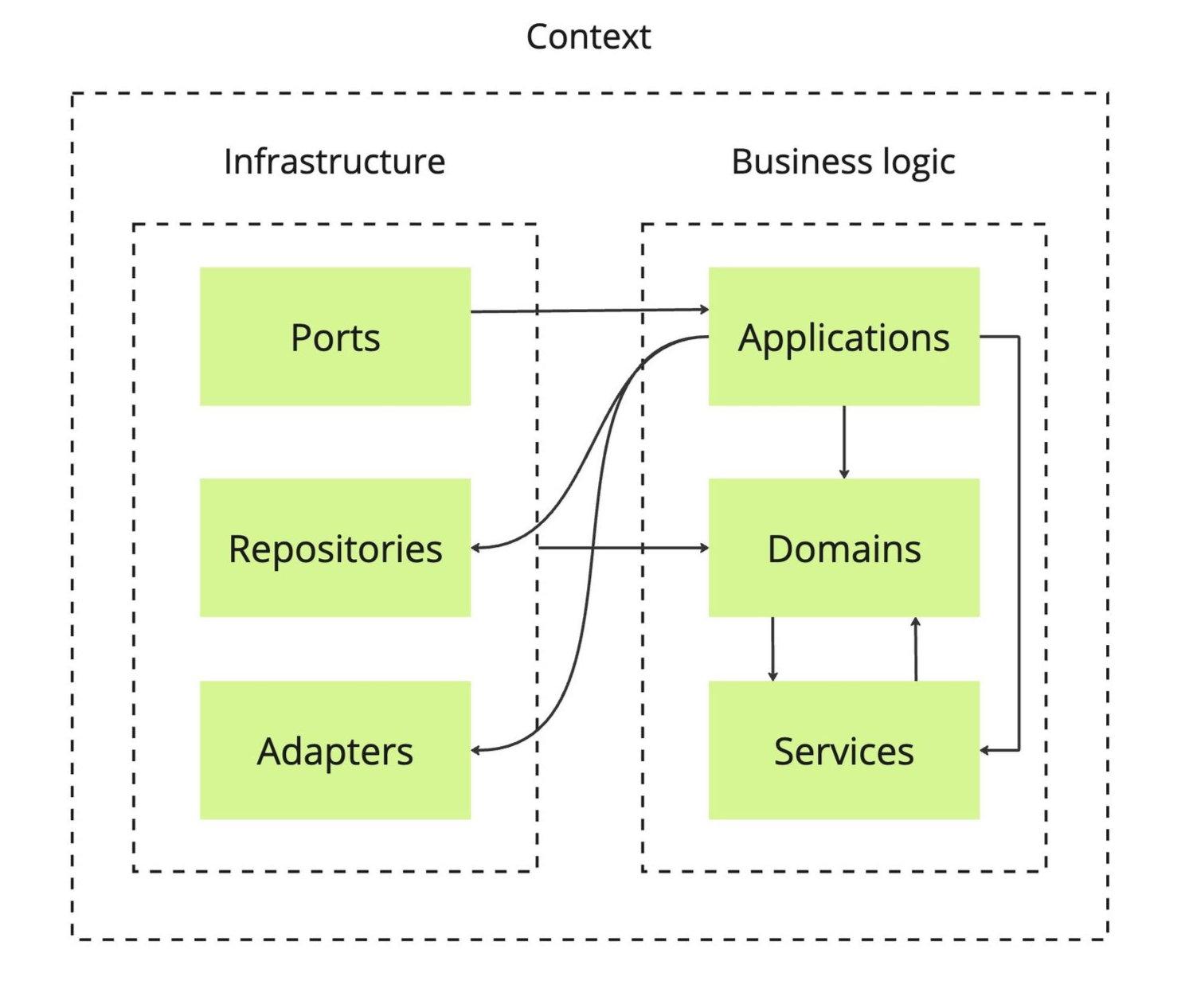
Application is a programmatic interface for accessing business logic. It serves as the primary entry point for all domain operations.
Entry points:
- Ports: HTTP interfaces, background tasks, CLI commands, and other interaction points.
- Other Applications: Within the same Context, leading and subordinate Applications may coexist, creating a layered structure. Leading Applications manage core business logic, while subordinate Applications handle narrower delegated tasks.
This approach ensures clear separation of responsibilities and helps maintain a well-organized architecture.
Adapter
Adapter is a component designed to retrieve data from external sources. Based on the Adapter Pattern described in "Gang of Four" (GoF), it bridges the interface of a system with the one expected by another.
Characteristics:
- Belongs to the infrastructure layer and isolates interactions with external interfaces.
- Divided into integration with internal (
InternalAdapter) and third-party (ExternalAdapter) services.
By encapsulating external dependencies, Adapter keeps the core application logic decoupled and modular.
Repository
Repository, a subtype of Adapter, is a specialized infrastructure layer component introduced in "Domain-Driven Design" by Eric Evans. It isolates interactions with data storage systems (e.g., PostgreSQL, ClickHouse, Redis, and others) and provides an abstraction for managing persistence.
Characteristics:
- Single Responsibility: Each Repository is typically designed to work with a single table (Entity).
- Separation of Concerns: Keeps domain logic independent of storage implementations.
- Application Usage: If an Application uses more than one Repository, this indicates a design issue. In such cases, consider creating another Application.
This abstraction ensures that persistence logic is modular and aligns with DDD principles.
Method names
A Repository subclass may only define methods from BASE_ALLOWED_METHODS: get, get_by_filters, get_list,
get_map, create, update, delete, bulk_create, bulk_update, bulk_delete, update_by_filters,
delete_by_filters, exists, count. Any other function, static or class method, private helpers included, raises
TypeError at class definition; dunder methods are exempt. Extra names are opened with EXTERNAL_ALLOWED_METHODS,
declared as a field, not a ClassVar:
from dddesign.structure.infrastructure.repositories import Repository


class ProfileRepository(Repository):
    EXTERNAL_ALLOWED_METHODS: set[str] | None = {'get_by_email'}

    async def get(self, profile_id: ProfileId) -> Profile | None: ...
    async def get_by_email(self, email: str) -> Profile | None: ...
Service
Service is used to handle business logic not tied to a specific domain object.
Characteristics:
- Purpose: Used when a method spans multiple domain objects.
- Clear Naming: The name should clearly describe its purpose, as it always implements a single
handlemethod. - Input / Output: Can return a new object or modify an input object in place.
- Dependency Management: Relies only on provided inputs, avoiding direct infrastructure dependencies, ensuring easy unit testing.
Data Transfer Object (DTO)
Data Transfer Object is a simple, immutable data structure used for transferring data between application layers. Introduced by Martin Fowler in "Patterns of Enterprise Application Architecture", it acts as a data contract.
Characteristics:
- Data Contracts: Defines clear structures for exchanging data between layers.
- Immutability: DTOs cannot be modified after creation.
- Application Access: Any additional data fetching required to fulfill a contract should be handled by the Application, as it has access to Repositories or subordinate Applications.
Value Object
Value Object is an object defined solely by its properties and has no unique identifier. Originating in object-oriented programming, it was refined by Eric Evans in "Domain-Driven Design" to reduce domain model complexity.
Characteristics:
- No Identity: Identified by attributes, not a unique identifier.
- Immutability: Cannot be modified after creation, ensuring consistency.
- Equality: Two Value Objects are equal if all their properties match.
Examples:
- Address: street, city, postal code, country.
- Money: amount, currency.
Entity
Entity is a domain object identified by a unique property (typically a primary key in the database). It represents a single record in a table and encapsulates related data and behavior.
Characteristics:
- Unique Identity: Ensures one-to-one correspondence with a database record.
- Field Consistency: Fields in the Entity should align with the database schema.
Notes:
- Fields such as
created_atandupdated_at, often managed by ORMs, can be omitted from the Entity if they are not required in the business logic. - Ideally, each Entity should have a dedicated Repository and possibly its own Application.
entity.update(data, exclude_fields=None)copies the fields set on another model (model_dump(exclude_unset=True)) onto the entity, assigning only the ones it has and whose value differs, so a DTO from a request can be applied in one call.
Aggregate
Aggregate is a collection of related Entity objects that work together within a single bounded context.
By exposing controlled methods for interaction, it ensures consistency and atomicity of operations under shared rules.
Characteristics:
- Consistency: Ensures domain rules are followed by exposing public methods for interaction, ensuring all internal Entities remain in valid states.
- Atomicity: Treats operations on the aggregate as a single unit, ensuring consistent changes across all entities.
Usage:
- Ports create a DTO, which is passed to the Application. The Application builds Entities and groups them into an Aggregate, validating rules and contracts.
- Aggregates can also act as simple containers for related Entities within a single HTTP request, avoiding the need for multiple REST calls, thereby reducing network overhead.
Component Interaction Flowchart
Factories
ApplicationFactory
Facilitates creating application instances with specific dependencies. Useful when multiple interfaces with different dependencies share the same application logic.
ApplicationFactory(application_class, dependency_mappers=(), reuse_implementations=True). Each
ApplicationDependencyMapper(application_attribute_name, request_attribute_value_map, request_attribute_name=None)
maps the members of one BaseEnum to the dependency the application attribute receives: an instance or a class of
Application, InternalAdapter, ExternalAdapter, Repository or Service. The request attribute defaults to the
snake_case of the enum class name (SocialDriver → social_driver). The factory validates at construction that
every enum member is mapped, the values are dependencies and not all the same, the mappers use distinct enums,
attribute names and request names, and every required attribute of the application is covered.
get(**kwargs) takes the request attributes as enum members or their raw values and builds the application, or
returns the one built before for the same combination (reuse_implementations). A missing attribute raises
RequestAttributeNotProvideError (400), a value outside of the enum RequestAttributeValueError (404); both are
BaseErrors. request_attributes lists the names and enums the factory expects.
Example:
from dddesign.structure.applications import Application, ApplicationDependencyMapper, ApplicationFactory

from app.account_context.applications.account import AccountApp, account_app_impl
from app.account_context.applications.social_account import SocialAccountApp, social_account_app_impl
from app.account_context.domains.constants import SocialDriver
from app.account_context.infrastructure.adapters.external import social


class AuthSocialApp(Application):
    account_app: AccountApp = account_app_impl
    social_account_app: SocialAccountApp = social_account_app_impl
    social_adapter: social.SocialAdapterInterface

    ...


auth_social_app_factory = ApplicationFactory[AuthSocialApp](
    application_class=AuthSocialApp,
    dependency_mappers=(
        ApplicationDependencyMapper(
            application_attribute_name='social_adapter',
            request_attribute_value_map={
                SocialDriver.APPLE: social.apple_id_adapter_impl,
                SocialDriver.GOOGLE: social.google_adapter_impl,
                SocialDriver.FACEBOOK: social.facebook_adapter_impl,
            },
        ),
    ),
)

# the argument name is the snake_case of the enum class name unless `request_attribute_name` says otherwise
auth_apple_app_impl = auth_social_app_factory.get(social_driver=SocialDriver.APPLE)
AggregateListFactory
Converts a list of Entity into Aggregate objects: loads the related objects of every entity through the getters of the dependency mappers, in bulk where the getter accepts a sequence, and builds one aggregate per entity.
AggregateDependencyMapper(method_getter, entity_attribute_name, aggregate_attribute_name, method_extra_arguments={})
reads the related id from entity.<entity_attribute_name> and puts what the getter returns into
aggregate.<aggregate_attribute_name>. The getter is introspected through its annotations, so:
- it must be a plain
defwith annotations,create_listis synchronous and calls it directly; - besides the keys of
method_extra_argumentsit takes exactly one argument, the related id: a plain type for a one-by-one getter, a sequence of it (tuple[MediaId, ...]) for a bulk getter, neverOptionalor another union; - a bulk getter returns
dict[K, V]withKthe sequence element type; the return annotation is required; - the aggregate attribute is annotated with the getter's return type,
Optionalon either side is ignored; entity_attribute_nameandaggregate_attribute_namemust be declared in the__annotations__of the entity and aggregate class themselves, not inherited.
A bulk getter is called once with the set of distinct ids; ids that are None or falsy are skipped and the aggregate
attribute is left None, so annotate it Optional.
from dddesign.structure.infrastructure.adapters.internal import InternalAdapter

from app.account_context.domains.dto.media import Media, MediaId
from app.media_context.applications.media import MediaApp, media_app_impl


class MediaAdapter(InternalAdapter):
    media_app: MediaApp = media_app_impl

    def get(self, media_id: MediaId) -> Media | None:
        medias = self.get_map((media_id,))
        return next(iter(medias.values()), None)

    def get_map(self, media_ids: tuple[MediaId, ...]) -> dict[MediaId, Media]:
        if not media_ids:
            return {}

        medias = self.media_app.get_list(media_ids=media_ids)
        return {MediaId(media.media_id): Media(**media.model_dump()) for media in medias}


media_adapter_impl = MediaAdapter()
from dddesign.structure.domains.aggregates import Aggregate
from pydantic import model_validator

from app.account_context.domains.dto.media import Media
from app.account_context.domains.entities.profile import Profile


class ProfileAggregate(Aggregate):
    profile: Profile
    icon: Media | None = None

    @model_validator(mode='after')
    def validate_consistency(self):
        if self.profile.icon_id:
            if self.icon is None:
                raise ValueError('`icon` field is required when `profile` has `icon_id`')
            if self.profile.icon_id != self.icon.media_id:
                raise ValueError('`profile.icon_id` is not equal to `icon.media_id`')
        elif self.icon is not None:
            raise ValueError('`icon` field is not allowed when `profile` has no `icon_id`')

        return self
Example 1: Retrieving multiple related objects
from dddesign.structure.domains.aggregates import AggregateDependencyMapper, AggregateListFactory

from app.account_context.domains.aggregates.profile import ProfileAggregate
from app.account_context.infrastructure.adapters.internal.media import media_adapter_impl


aggregate_list_factory = AggregateListFactory[ProfileAggregate](
    aggregate_class=ProfileAggregate,
    aggregate_entity_attribute_name='profile',
    dependency_mappers=(
        AggregateDependencyMapper(
            method_getter=media_adapter_impl.get_map,
            entity_attribute_name='icon_id',
            aggregate_attribute_name='icon',
        ),
    ),
)

aggregates: list[ProfileAggregate] = aggregate_list_factory.create_list([...])  # list of Profile Entity
Example 2: Retrieving a single related object
from dddesign.structure.domains.aggregates import AggregateDependencyMapper, AggregateListFactory

from app.account_context.domains.aggregates.profile import ProfileAggregate
from app.account_context.infrastructure.adapters.internal.media import media_adapter_impl


aggregate_list_factory = AggregateListFactory[ProfileAggregate](
    aggregate_class=ProfileAggregate,
    aggregate_entity_attribute_name='profile',
    dependency_mappers=(
        AggregateDependencyMapper(
            method_getter=media_adapter_impl.get,
            entity_attribute_name='icon_id',
            aggregate_attribute_name='icon',
        ),
    ),
)

aggregates: list[ProfileAggregate] = aggregate_list_factory.create_list([...])  # list of Profile Entity
Enums
BaseEnum
BaseEnum (dddesign.structure.domains.constants) is a foundational enum class that should be used across the application.
It extends the standard Python Enum and provides additional functionality:
__str__returnsstr(member.value), so a member formats as its value in logs and responses rather than asKind.A.has_value(value)class method: Allows you to check whether a specific value is defined in the enum. This is particularly useful for validation purposes.
ChoiceEnum
ChoiceEnum is an extension of BaseEnum designed for scenarios where enumerations need both a machine-readable value
and a human-readable title: member.get_title() is the member name with underscores replaced by spaces, in title case
(NOT_FOUND → Not Found), and get_choices() returns ((value, title), ...) for every member.
Error Handling
BaseError
BaseError (dddesign.structure.domains.errors) is a foundational exception class that standardizes error handling by providing structured information for errors.
It simplifies the creation of domain-specific exceptions and ensures consistency across the application.
An error carries message, error_code, status_code and field_name. A subclass declares them as class
attributes and __init__(message=None, error_code=None, status_code=None, field_name=None, **kwargs) falls back
to them: message is required one way or the other (ValueError otherwise), error_code defaults to the
snake_case of the class name, status_code to 400. The {name} placeholders of the message are filled from
kwargs, every placeholder must be provided (ValueError), and the kwargs are not stored otherwise. str(error)
is its repr with the four attributes.
from dddesign.structure.domains.errors import BaseError


class ProfileNotFoundError(BaseError):
    message = 'Profile `{profile_id}` not found'
    status_code = 404


raise ProfileNotFoundError(profile_id=profile_id)  # error_code 'profile_not_found_error'
CollectionError
CollectionError is an exception class designed to aggregate multiple instances of BaseError.
It simplifies error handling in scenarios where multiple errors need to be captured and processed together:
add(error) appends a BaseError (TypeError for anything else), errors is the list, iterating the collection
iterates the list, and bool(collection) tells whether anything was added, so validation code can collect and
raise only when if errors:.
Errors
Errors (dddesign.components.domains.dto) is a Data Transfer Object that transforms a CollectionError into a structured format for 4XX HTTP responses.
It ensures domain-level errors are serialized and returned to the client in a meaningful way, avoiding 500 responses.
Errors.factory(collection_error) builds it from a non-empty collection, errors is a list of Error value
objects (dddesign.components.domains.value_objects) with the four attributes of a BaseError, and status_code
is the status of the single error or 400 when there are several.
AutoUUID
AutoUUID (dddesign.components.domains.value_objects) is a uuid.UUID that generates a random UUID4 when
constructed without arguments and accepts another UUID instance; otherwise identical to UUID. Pydantic validates
it from a UUID, a string, bytes or an int. The pattern for typed identifiers:
from pydantic import Field

from dddesign.components.domains.value_objects import AutoUUID
from dddesign.structure.domains.entities import Entity


class ProfileId(AutoUUID): ...


class Profile(Entity):
    profile_id: ProfileId = Field(default_factory=ProfileId)
wrap_error
wrap_error(error: ValidationError) -> CollectionError (dddesign.utils.base_model) converts a Pydantic ValidationError into a CollectionError,
enabling a standardized way of handling and aggregating validation errors. Every pydantic error becomes a BaseError
with field_name the dotted location (address.city) and message the pydantic message, or the messages an error
created with create_pydantic_error_instance carries.
create_pydantic_error_instance
create_pydantic_error_instance(base_error, message, code=None, context=None) (dddesign.utils.base_model) is a utility function for dynamically creating custom PydanticErrorMixin instances,
allowing to define detailed and context-aware Pydantic validation errors to raise from validators. message is
formatted with context; a context['__messages__'] list (CONTEXT_MESSAGES_PARAM) is what wrap_error reports
instead of the single message.
flatten_model_dump
flatten_model_dump(model, separator='.', **model_dump_kwargs) (dddesign.utils.base_model) is model_dump with
nested dicts flattened into dotted keys: {'address': {'city': 'Oslo'}} becomes {'address.city': 'Oslo'}.
Testing and State Management
MagicMock
MagicMock (dddesign.unittest.magic_mock) is an enhanced version of unittest.mock.MagicMock that adds compatibility with BaseModel.
When the spec or spec_set is a pydantic model it makes _copy_and_set_values return the mock itself, so
model_copy and validation on assignment do not replace the mock with a copy.
TrackChangesMixin
TrackChangesMixin (dddesign.utils.base_model) is a mixin for BaseModel that tracks changes made to model fields.
It takes a deep copy of every field in __init__ and compares against it: has_changed, changed_fields,
changed_data (field to current value), diffs (field to (initial, current)), initial_state;
update_initial_state(fields=None) takes a new snapshot of the given fields or of all of them, for example after
a save. Meant for mutable models such as an Entity; on a frozen model nothing ever changes.
1 maintainer

Metadata
1 maintainer
Release files for dddesign 2.1.2
For a detailed explanation of source distributions (sdists) and built distributions (wheels), please see the package formats documentation.
Source distribution (sdist)
| File | Size | Uploaded | |
|---|---|---|---|
| dddesign-2.1.2.tar.gz | 20.1 kB | Details |
Built distribution (wheel)
| File | Interpreter | ABI | Platform | Reset |
|---|---|---|---|---|
| dddesign-2.1.2-py3-none-any.whl | Python 3 | none | any | Details |
Total release size: 55.8 kB
Release files / dddesign-2.1.2.tar.gz
| Download URL | dddesign-2.1.2.tar.gz |
|---|---|
| Size | 20.1 kB |
| Tags | Source |
|
SHA-256 checksum How to use checksums |
604b208125039bfa62ec7ebf47cccaa64a16bdad363c26d01e8618a2076a3a06
|
|
BLAKE2b-256 checksum How to use checksums |
69051221aaaf8923c199fdf12417f2d4fb0d0cde23fd651567f6de470b2d34a8
|
| Upload date | |
|
Uploaded using Trusted Publishing? What is trusted publishing? |
Yes |
| Uploaded via |
twine/7.0.0 CPython/3.13.14
|
Provenance
Provenance describes where a file came from. On PyPI, provenance is shared via attestations, which provide a verifiable record of the build or publishing details. View details, limitations and caveats.


PyPI Publish Attestation
PyPI verified that this artifact, at this checksum, originated from the publisher listed below.
Signed by GitHub Actions, verified by PyPI on Oct 19, 2026.
Transparency logRelease files / dddesign-2.1.2-py3-none-any.whl
| Download URL | dddesign-2.1.2-py3-none-any.whl |
|---|---|
| Size | 35.7 kB |
| Tags | Python 3 |
|
SHA-256 checksum How to use checksums |
80f83a89259d63dd58dd3a9cd3547a2e2d418cde544cf7144fa0311f3631d265
|
|
BLAKE2b-256 checksum How to use checksums |
ad1a4ce2a03b1c14875a7019bdc15c982d7f7fa17c2af12d1c75c7179f724a29
|
| Upload date | |
|
Uploaded using Trusted Publishing? What is trusted publishing? |
Yes |
| Uploaded via |
twine/7.0.0 CPython/3.13.14
|
Provenance
Provenance describes where a file came from. On PyPI, provenance is shared via attestations, which provide a verifiable record of the build or publishing details. View details, limitations and caveats.
PyPI Publish Attestation
PyPI verified that this artifact, at this checksum, originated from the publisher listed below.
Signed by GitHub Actions, verified by PyPI on Oct 19, 2026.
Transparency log













