

decisis
Check work against the decisions your team already made, in a throwaway graph, offline.





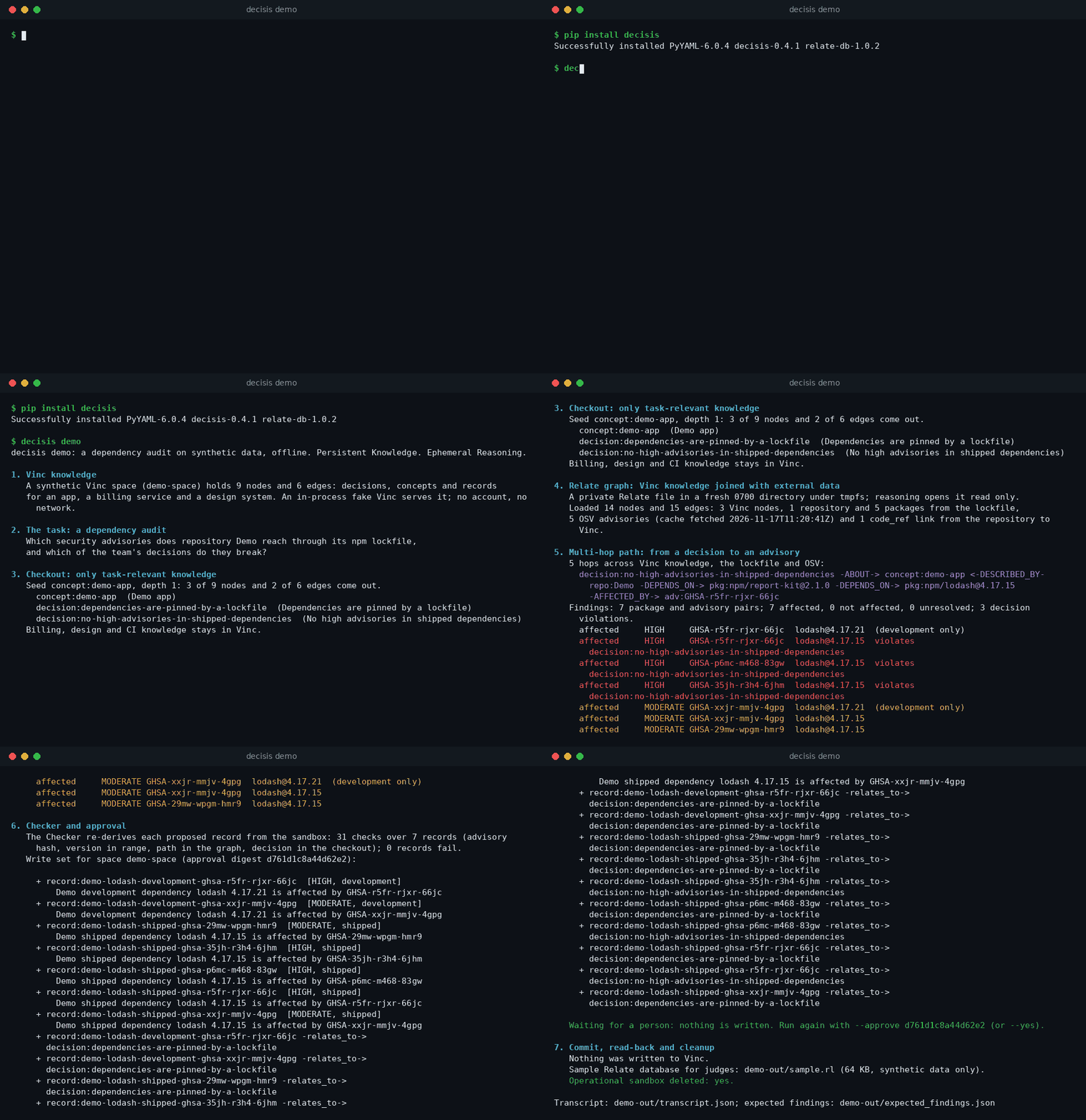
decisis (from stare decisis, "stand by what was decided") is a command-line tool and Python package. It takes the decisions a task needs, joins them with code paths and outside facts (a lockfile or SBOM and OSV advisories) in a throwaway Relate graph, and finds the multi-hop path from a decision to the thing that breaks it. Every finding carries that path and its sources. The graph lives in a private temporary directory and is deleted when the task ends.
It needs no account and no model. Decisions come from a plain JSON snapshot: init builds one from the
repository's ADRs, CODEOWNERS, postmortems and pull requests, you can write one by hand, or checkout
exports one from a Vinc space if you connect one. Nothing is written back anywhere unless a
person approves the exact write set by its digest.
What it is not: a linter (check reads import statements and nothing else in the code), a vulnerability
scanner for every ecosystem, or a place to store decisions. It reads the lockfiles and SBOMs listed under
Inventory formats, and the two benchmarks below are small: nine synthetic tasks, and
30 tasks on five open-source repositories.
What is proven, and what is not built yet has the full list.
Install
Python 3.11 or newer on macOS, Linux or Windows (x86-64; arm64 on macOS and Linux).
pip install decisis
As an isolated command-line tool:
uv tool install decisis # or: pipx install decisis
The install fetches relate-db and PyYAML from PyPI once; every command after it runs offline, except audit and
propose asking api.osv.dev when you give them no --osv-cache, and init --github reading api.github.com. The npm package
only points here.
Check the install on synthetic data (under a second, writes nothing):
decisis demo
It checks out 3 of 9 nodes from a synthetic team graph, joins them with a lockfile and cached OSV advisories in a Relate graph (14 nodes, 15 edges), finds the five-hop path below, has a Checker re-derive each proposed record (31 checks over 7 records), and stops at the write set and its digest:
decision:no-high-advisories-in-shipped-dependencies -ABOUT-> concept:demo-app <-DESCRIBED_BY- repo:Demo
  -DEPENDS_ON-> pkg:npm/report-kit@2.1.0 -DEPENDS_ON-> pkg:npm/lodash@4.17.15 -AFFECTED_BY-> adv:GHSA-r5fr-rjxr-66jc
The rule lives in the team's decisions, the dependency chain in the lockfile and the advisory in OSV; no single source holds the connection.
Quick start
Four commands on your own repository: init builds a snapshot of its decisions, impact lists what
governs a file, check judges a change against the decisions' rules, and audit joins a lockfile and
OSV advisories with them.
1. Build a snapshot of your decisions. If the repository keeps ADRs (MADR or Nygard), a CODEOWNERS file
or postmortems, init reads them:
decisis init --repo-dir . --repo Shop --out snapshot.json
To add decisions made in pull requests, give init the GitHub repository. It reads merged pull requests
that carry the decision label (or --label NAME) or a ## Decision section, through the GitHub REST API
with GITHUB_TOKEN when it is set (a public repository needs no token), and merges them with the files:
decisis init --repo-dir . --repo Shop --github acme/shop --since 2026-01-01 --out snapshot.json
init prints what it could not read and why; docs/data-model.md
lists the front matter keys and headings it reads. Or write a snapshot by hand: one JSON file of nodes and edges. This one has an app,
a checkout flow, one decision and one incident record (docs/data-model.md has
every field):
{
 "nodes": [
  {"id": "concept:shop-web", "kind": "concept", "title": "Shop web app", "props": {"code_ref": "Shop:src/"}},
  {"id": "concept:checkout-flow", "kind": "concept", "title": "Checkout flow", "props": {"code_ref": "Shop:src/checkout/"}},
  {"id": "decision:no-high-advisories-when-shipped", "kind": "decision", "title": "No high advisories in what we ship",
   "props": {"rule": {"advisory_severity_at_least": "HIGH", "dependencies": "shipped"}}},
  {"id": "record:checkout-timeout-october", "kind": "record", "title": "Checkout timed out under load"}
 ],
 "edges": [
  {"source": "decision:no-high-advisories-when-shipped", "target": "concept:shop-web", "type": "ABOUT", "evidence": "applies to the whole app"},
  {"source": "concept:checkout-flow", "target": "concept:shop-web", "type": "RELATED_TO", "evidence": "part of the app"},
  {"source": "record:checkout-timeout-october", "target": "concept:checkout-flow", "type": "RELATED_TO", "evidence": "the timeout was in this flow"}
 ]
}
2. Ask what governs a file before you change it. With the hand-written snapshot above saved as
my-snapshot.json:
$ decisis impact my-snapshot.json src/checkout/pay.py --format text
src/checkout/pay.py: 4 node(s) within 3 hop(s)
  [0] concept  concept:checkout-flow  code_ref Shop:src/checkout/ (encloses)
  [0] concept  concept:shop-web  code_ref Shop:src/ (encloses)
  [1] decision decision:no-high-advisories-when-shipped  via concept:shop-web
        decision:no-high-advisories-when-shipped -ABOUT-> concept:shop-web  (applies to the whole app)
  [1] record   record:checkout-timeout-october  via concept:checkout-flow
        record:checkout-timeout-october -RELATED_TO-> concept:checkout-flow  (the timeout was in this flow)
3. Check a change against the review and import rules of those decisions. A decision's rule can
name the reviewers a path needs (review_required) and the imports one part of the code must not make
(imports_forbidden). check lists the decisions that govern each changed file, judges both kinds, and
exits 1 when a rule is violated:
$ decisis check fixtures/check/vinc.json --repo-dir fixtures/check/repo --changed src/shop/ui/view.py src/payments/charge.py --reviewers @bob --format text
2 changed file(s); reviewers: @bob
governing decisions: 2
  decision:payments-need-a-payments-review  Payment changes need a review from the payments team  (src/payments/charge.py)
  decision:ui-does-not-import-db  The user interface reads data through the API, never the database layer  (src/shop/ui/view.py)
superseded, not judged:
  decision:payments-reviewed-by-carol  superseded by decision:payments-need-a-payments-review
rules that cover a changed file: 2
violations: 3
  src/payments/charge.py  decision:payments-need-a-payments-review  review_required: src/payments/** needs a review from @alice or @shop/payments; none of them is among the reviewers given
  src/shop/ui/view.py:4  decision:ui-does-not-import-db  imports_forbidden: src/shop/ui/** must not import src/shop/db/**; from shop.db import models is src/shop/db/models.py
  src/shop/ui/view.py:5  decision:ui-does-not-import-db  imports_forbidden: src/shop/ui/** must not import src/shop/db/**; from ..db.session import open_session is src/shop/db/session.py
cannot be judged: 1
  src/shop/ui/view.py:10  decision:ui-does-not-import-db  imports_forbidden: import_module() with a computed name: the specifier is computed at run time; it cannot be judged
In CI, give it the base branch instead of a file list: decisis check snapshot.json --base origin/main --reviewers @alice. It reads the changed files with git diff --name-only origin/main...HEAD, with the
repository's hooks, fsmonitor and pager turned off. Imports are parsed, never run: Python with ast,
JavaScript and TypeScript with a scanner that skips comments and strings. An import whose target is
computed at run time, or that the scanner and a plain text search read differently, is listed as
unresolved, not as a violation; add --fail-on-unresolved to make those fail the check too. The rule format, the glob rules and
the JSON report are in docs/data-model.md.
4. Audit a lockfile against those decisions:
decisis audit my-snapshot.json package-lock.json --repo Shop --out report.json
report.json lists each advisory the repository reaches, the dependency path to it, and the decisions
it breaks. With the demo lockfile and its cached advisories, three findings on shipped lodash break the
decision above.
audit reads 15 inventory formats, from npm and pnpm lockfiles to go.mod, pom.xml, GitHub Actions
workflows and Terraform lock files; Inventory formats lists them, and
Decision rules lists what a decision's rule can forbid. To turn the findings into
records for Vinc, propose re-checks each one and prints the write set a person approves
(How it works).
Use it as a GitHub Action
action.yml at the root of this repository is a composite action. On a pull request it installs decisis,
reads a snapshot (or builds one with init: true), runs check on the files the pull request changes and
audit when you give an inventory, and keeps one comment on the pull request up to date: the decisions the
change touches, the violations, and a Mermaid path graph. The action is not on the Marketplace; refer to it
by repository and commit.
name: decisis
on:
  pull_request:
permissions: {}
concurrency:
  group: decisis-${{ github.event.pull_request.number }}
  cancel-in-progress: true
jobs:
  decisis:
    runs-on: ubuntu-latest
    permissions:
      contents: read
      pull-requests: write
    steps:
      - uses: actions/checkout@3d3c42e5aac5ba805825da76410c181273ba90b1 # v7.0.1
        with:
          fetch-depth: 0
          persist-credentials: false
      - uses: Vinculums/decisis@<commit SHA>
        with:
          snapshot: decisions.json        # or init: true
          inventory: package-lock.json    # optional: also run audit
          fail-on-violation: false
| Input | Default | What it does |
|---|---|---|
snapshot |
none | a snapshot file, relative to the workspace; give this or init |
init |
false |
true builds the snapshot from the repository's ADRs, CODEOWNERS and postmortems |
github-token |
github.token |
reads the reviews and writes the comment |
inventory |
none | a lockfile or SBOM; when given, audit runs too (with osv-cache, offline) |
fail-on-violation |
false |
true fails the step when check or audit finds a violation, after the comment is written |
decisis-version |
the action's own checkout | a version to install from PyPI instead |
repo, working-directory, osv-cache, comment-author, python-version |
see action.yml |
- The changed files are
git diff BASE...HEAD, with the base commit from the event payload. Check out withfetch-depth: 0; on a shallow checkout the action fetches the history it needs. - The reviewers that count for
review_requiredare the users other than the author whose latest review approves the pull request; past 1,000 reviews the rest are not read, and the comment says so. Requested reviewers and teams are listed in the comment and do not count until they approve; a team handle in a rule matches only a team handle, so an approval by a team member does not satisfy it. - The action needs only
contents: readandpull-requests: write. Inputs reach Python as environment variables, never through${{ }}in a shell script, and Python runs with-I, so a module in the pull request's checkout cannot shadow decisis. Every title, path and reason in the comment is escaped, and mentions are broken so a title cannot notify anyone. - On a pull request from a fork the token is read-only: the result goes to the job summary instead of a comment. The job summary always holds a copy.
- A pull request is a fork when its head repository is not the base repository; a pull request inside a repository that is itself a fork still gets a comment.
- Keep the
concurrencyblock, so two runs on one pull request cannot both create a comment. Past 3,000 comments on a pull request the action stops looking for its own and writes only the job summary. - The comment stays under GitHub's 65,536-character limit: the graph is left out first, then the lists are cut, and the comment says what was cut.
- The outputs
violationsandcomment-urlare set for later steps.
.github/workflows/decisis.yml runs the action from this checkout on this repository's own pull requests,
with fixtures/action/vinc.json (synthetic decisions about decisis's own files) and the audit fixtures.
Use it from an AI agent: the skill and MCP
skills/decisis/SKILL.md is a skill for a coding agent such as Claude Code. It
covers when to reach for audit, impact or paths, how to check out only what the task names, how to
read a finding, and the rule that the agent shows the write set and digest to the person and stops. The
agent never approves its own write. To use it, copy the directory to where your agent loads skills (for
Claude Code, .claude/skills/decisis/) and put decisis on the agent's PATH.
decisis itself calls no language model. The agent is the reasoner that chooses seeds, runs the bounded queries and explains the paths; the tool gives it a graph it cannot write to, findings that carry their evidence, and a write path that needs a person's digest.
Serve it over MCP
decisis serve --mcp gives an agent the same impact, paths, audit and query as MCP tools over stdio, on
one snapshot fixed when the server starts. It needs the optional mcp extra; the base install keeps
relate-db and PyYAML as its only dependencies. For Claude Code:
pip install "decisis[mcp]"
claude mcp add decisis -- decisis serve --mcp --snapshot snapshot.json --osv-cache osv-cache.json
claude mcp add --scope project ... writes the same entry to .mcp.json in the project, to share it
with the team:
{
  "mcpServers": {
    "decisis": {
      "command": "decisis",
      "args": ["serve", "--mcp", "--snapshot", "snapshot.json", "--osv-cache", "osv-cache.json"]
    }
  }
}
Relative paths are read from the directory the server starts in; use absolute paths if you are not sure
which one that is. The server has no tool that writes, proposes or commits. The tools take the same
bounds as the commands (hops 0 to 6 for impact, 1 to 6 for paths, limit 1 to 100; audit takes
depth 1 to 16), refuse a code path outside the repository, and build and delete a sandbox for each call.
audit takes the lockfile path as an argument and reads it only under --root (default: the current
directory), after following symlinks. It reads advisories from --osv-cache; without a cache it asks
api.osv.dev only when the server was started with --allow-network, and otherwise returns an error.
Each tool takes detail: "summary", the default over MCP, gives counts, ids, titles and the first 10
items of each list with a note on how to get the rest; "full" gives the whole report, the same JSON the
command prints. The commands always print the whole report.
When to use query and when the fixed tools
Ask the fixed tools first. impact answers which decisions and records govern a code path, and follows
only the edges that carry governance, in their governing direction; paths lists the routes between two
ids; audit joins a lockfile and advisories with the snapshot and judges each decision's rule. Their
answers carry the evidence on each edge, and the same question gets the same report every time.
Use query for a question they do not answer: which decisions have no ABOUT edge, how many records
each concept has, which nodes name a field, a path that must pass through a given kind. It runs one
read-only Cypher statement on a fresh sandbox of the server's snapshot and returns the rows:
decisis query fixtures/impact/vinc.json 'MATCH p = (g)-[*1..3]->(c) WHERE c.code_ref CONTAINS $path AND (g:Decision OR g:Record) RETURN DISTINCT g.id AS id ORDER BY id' --param path=storage/page_store.py
The tool's description carries the snapshot's schema, made when the server starts: each label (a node
kind with the first letter in upper case) with its count and property keys, each edge type with its
count and the labels it joins, and two example queries. A query must be one statement that starts with
MATCH, OPTIONAL MATCH, WITH, UNWIND, RETURN or CALL. The text is checked before anything
runs: CREATE, MERGE, SET, DELETE, REMOVE, FOREACH, LOAD CSV, DROP, SHOW, USE and the
other admin clauses are refused in any case, after comments and inside subqueries, and only the
db.labels, db.relationshipTypes, db.propertyKeys and db.schema.* procedures may be called. Clause
words inside strings, comments and backticked names do not count; a label, type or key named like a clause
goes in backticks. Relate plans every CALL { } subquery as read-write, so those are refused too; use
COLLECT { }, COUNT { }, EXISTS { } or UNION. Then the query process plans the statement with
EXPLAIN on a read-only connection and runs it only when Relate plans it as a read, and the read-only
connection refuses any write on its own. Results stop at 500 rows and 1 MiB with a note that says how many
rows there were, and every MCP reply, as the server sends it, stays under 1 MiB: in full detail the
longest list is shortened and a cut note says so. The schema names come from the snapshot: names that
are not plain ASCII identifiers are shown in backticks, and long or unprintable ones are left out.
The node, edge and time limits are the ones above. Nodes, edges and paths come back as
labels or type and properties; return ids and properties to keep the rows small.
Inventory formats
audit tells the format from the file's content and name:
| Format | File | Development dependencies |
|---|---|---|
| npm lockfile v2 or v3 | package-lock.json, npm-shrinkwrap.json |
reached only through devDependencies or entries the lockfile marks dev; the root's optionalDependencies and peerDependencies count as shipped |
| CycloneDX JSON 1.4, 1.5, 1.6 | any name | a component with scope excluded or cdx:npm:package:development |
| SPDX JSON 2.3 | any name | DEV_DEPENDENCY_OF, TEST_DEPENDENCY_OF, BUILD_DEPENDENCY_OF, DEV_TOOL_OF |
| uv | uv.lock |
dependency groups (dev-dependencies) |
| Cargo | Cargo.lock |
not marked in the lockfile; every crate counts as shipped |
| Go modules | go.mod, with go.sum in the same directory |
not marked; every module counts as shipped |
| Gradle lockfile | gradle.lockfile, settings-gradle.lockfile |
every configuration that locks it is a test, compile-only or annotation processor one |
| Maven POM | pom.xml |
scope test or provided |
| Poetry, lock-version 1.x and 2.x | poetry.lock, with pyproject.toml in the same directory when present |
category = "dev" (1.x), groups without main (2.1), or the non-main groups in pyproject.toml |
| pip requirements | requirements*.txt |
not marked; every package counts as shipped |
| pnpm lockfile v6 or v9 | pnpm-lock.yaml |
an importer's devDependencies; v6 also dev: true |
| Yarn v1 and Yarn Berry (2 and later) | yarn.lock, with the root package.json and the workspaces' package.json files next to it |
devDependencies in the package.json files |
| Bun text lockfile | bun.lock |
a workspace's devDependencies |
| GitHub Actions workflows | any .github/workflows/*.yml (the other workflows beside it are read too), or an action.yml |
not marked; every action counts as shipped |
| Terraform lock file | .terraform.lock.hcl |
not marked; every provider counts as shipped |
For Go, pass go.mod; audit reads the go.sum next to it and stops when a required module has no
line there. In a pnpm, Yarn or Bun monorepo each workspace package (a pnpm importer, a Yarn or Bun
workspace) is a Workspace node between the repository and its dependencies, so a path reads
repo:<name> -> workspace:<name>:<path> -> pkg:npm/... -> pkg:npm/...; the root package's dependencies hang
from the repository. Peer and optional dependencies are edges with (peer) or (optional) in the evidence.
For every format, a package is development when each route from the repository to it passes through a
development dependency or a development package, whatever the inventory's own flag says; one route that
passes through none makes it shipped.
For yarn.lock, audit reads the root package.json and the package.json of each directory its
workspaces globs match; without them the packages are linked straight from the repository. A binary
bun.lockb is refused: run bun install --save-text-lockfile and audit the bun.lock it writes. Each package is queried at OSV under its own ecosystem (npm, PyPI, crates.io, Go, Maven, GitHub Actions, and for
SBOMs also NuGet, RubyGems, Packagist, Debian and Alpine). An SBOM component
without a purl, or whose purl type has no OSV ecosystem, stays in the graph and is listed under
unresolved_packages in the report; it is not queried. An inventory with no packages, or none that can
be queried, is refused. fixtures/inventory/ holds one small example of each format and an OSV cache
that covers them all; the Gradle and Maven examples and their cache are in fixtures/inventory/jvm/, and the
workflows and Terraform lock file with theirs in fixtures/inventory/ci/.
A Gradle lockfile pins every resolved version but not which dependency brings in which, and a pom.xml
declares direct dependencies only. audit reads pom.xml versions that are literals or properties
defined in the same file, and lists a version from a parent, an imported BOM, a range, LATEST or
RELEASE, or a missing one under unresolved_packages. For both formats the report's inventory_notes has a line
saying that transitive dependencies are not resolved. For the full graph, generate CycloneDX JSON with
cyclonedx-gradle-plugin or cyclonedx-maven-plugin and audit that instead; the HTML view shows the
notes above the findings.
For Poetry, a poetry.lock that marks no package as development and has no pyproject.toml next to it
is read with every package shipped, and the report says the dev split is unknown. A requirements file
gives packages only for name==version pins; every other line (a range, no version, a URL) is listed
under unresolved_packages with the line and the reason, and no version is guessed. -r includes are
followed only inside the repository, and each file is read once. A requirements file
lists direct dependencies only, so the report says the packages they depend on were not seen and
recommends a lockfile or an SBOM. Such notes are in the report's inventory_notes. Python names are
normalized as in PEP 503 and queried under the PyPI ecosystem.
For GitHub Actions, pass one workflow file, such as .github/workflows/ci.yml; audit also reads every
other *.yml and *.yaml workflow in the same directory through the same bounded reader as other
sibling files (serve --mcp reads only the file it is given). Each uses: of a step, and of a job that
calls a reusable workflow, becomes a package in the OSV GitHub Actions ecosystem named owner/repo
(owner/repo/path@ref too) in lower case, since GitHub does not tell case apart, with its ref as written:
a tag, a branch or a commit SHA. OSV does tell case apart and stores some names in mixed case
(Azure/setup-kubectl), so when the inventory has actions audit also downloads OSV's own list of
GitHub Actions records, https://osv-vulnerabilities.storage.googleapis.com/GitHub%20Actions/all.zip
(once per run, at most 64 MiB), and asks OSV for each action under the spelling OSV stores; an action
that is not in that list has no advisories and is not queried. --osv-cache carries that list as
names, and a cached run with actions refuses without it. A local ./ action, a docker:// image, a uses: built from an
expression and one that is not a name (../x@v1) are listed under unresolved_packages with the reason
and not queried, and so is a workflow file that is not valid YAML or cannot be read (not UTF-8, or a link
that leads outside the repository). YAML anchors and aliases are
allowed in workflows, up to 100,000 expanded nodes. OSV does not match GitHub Actions versions itself, so
audit asks OSV for every advisory of each action and compares the ref with the ranges: a tag such as
v4.1.0 is a version, a major or minor tag such as v4 covers every release under it and is unresolved
when a range starts or ends inside it, and a branch or a commit SHA cannot be ordered, so its advisories
are unresolved unless the record lists that ref. An action.yml is read for the uses: of its
composite runs.steps.
A .terraform.lock.hcl is read by a small strict parser: provider "<address>" { ... } blocks with
quoted strings and lists of quoted strings, and comments; anything else stops the run with the line.
Each provider is a package in the ecosystem Terraform with its full address as the name and its locked
version. OSV has no Terraform ecosystem (checked 2026-11-24), so providers are not queried: they are
checked against decision rules only (package_denied, package_allowed), each is listed under
unresolved_packages with that reason, and inventory_notes says so.
Files next to the inventory (go.sum, pyproject.toml, -r includes, the package.json files of Yarn
workspaces) are read only inside the repository: the nearest directory above the inventory that holds a
.git entry, found without running git, or the inventory's own directory when there is none. --root DIR sets it. Paths that lead outside,
symbolic links included, are not read. Includes are followed 64 levels deep, and a leading UTF-8 byte order
mark is dropped from every file.
Decision rules
A decision can carry a machine-checkable rule in its props. audit judges the first six kinds below
against every package in the inventory, and check judges the last two against the changed files; each
command ignores the other's kinds. A decision without a rule is listed as relevant, never violated.
| Kind | Judged by | Violated when |
|---|---|---|
advisory_severity_at_least |
audit |
a package is affected by an advisory at or above the given severity (LOW, MODERATE, MEDIUM, HIGH, CRITICAL) |
license_denied |
audit |
a package's SPDX license expression cannot be met without one of the listed licenses |
license_allowed |
audit |
a package's license expression cannot be met with the listed licenses only |
package_denied |
audit |
a package has a listed ecosystem and name, and one of the listed versions when versions are given |
package_allowed |
audit |
a package of an ecosystem the list names is not in the list |
pinned_to_commit |
audit |
a GitHub action's ref is a tag or a branch, not a full 40-character commit SHA |
review_required |
check |
a changed file matches paths and none of reviewers is among the reviewers given |
imports_forbidden |
check |
a changed file that matches from imports a file that matches to |
A rule is one mapping or a list of them. "dependencies": "shipped" on a mapping makes a package that is
reached only through development dependencies not_violated for that mapping's kinds:
[{"advisory_severity_at_least": "HIGH", "dependencies": "shipped"},
 {"license_denied": ["GPL-3.0-only", "AGPL-3.0-only"], "dependencies": "shipped"},
 {"pinned_to_commit": true}]
A package or import that a rule cannot judge (an unknown license, a docker:// image under
pinned_to_commit, an import computed at run time) is unresolved, not clean. A rule that cannot be read (an unknown kind, a value of
the wrong shape) is listed under rule_problems with the reason, and its decision stays relevant; the
other entries of the same rule are still judged. The globs, the license expression rules and the version
matching are in docs/data-model.md.
Commands
| Command | Needs | What it does |
|---|---|---|
demo |
nothing | the whole procedure on synthetic data, against an in-process fake Vinc |
init --out <file> |
nothing; with --github, the network for api.github.com |
a snapshot from the repository's ADRs, CODEOWNERS and postmortems, and its merged pull requests |
impact <snapshot> <code path>... |
nothing | the decisions and records that govern a file or directory |
check <snapshot> (--changed <file>... | --base <ref>) |
nothing; with --base, git |
the decisions that govern a change set, and the review_required and imports_forbidden rules it breaks; exits 1 on a violation |
paths <snapshot> <from> <to> |
nothing | bounded paths between two ids |
query <snapshot> <cypher> [--param KEY=VALUE] |
nothing | one read-only Cypher statement on a throwaway graph of the snapshot, rows as JSON |
audit <snapshot> <lockfile or SBOM> --repo <name> |
the network for api.osv.dev (and OSV's GitHub Actions export for workflows), unless --osv-cache |
advisories the repository reaches and the decisions they break |
propose <report> <snapshot> <lockfile or SBOM> --repo <name> --space <space> |
the network for api.osv.dev, unless --osv-cache |
re-derives each record, holds back any that fail, and prints the exact write set and its approval digest |
compare [--tasks FILE] |
nothing; the held-out tasks need a checkout of this repository | the benchmarks below |
checkout <seed>... --out <file> |
a read-only Vinc key | exports a bounded subgraph from Vinc |
commit <plan> --approve <digest> |
a full Vinc key | writes an approved write set and reads it back |
gc |
nothing | removes task directories that a killed run left behind, and prints them |
serve --mcp --snapshot <file> |
the mcp extra; the network for api.osv.dev only with --allow-network |
impact, paths, audit and query as read-only MCP tools over stdio (MCP) |
Useful flags: init --repo-dir DIR --repo NAME --adr-dir DIR, init --github OWNER/REPO --label NAME --since DATE --limit N, impact --hops N --format text, check --repo-dir DIR --reviewers HANDLE... --fail-on-unresolved --format text, paths --hops N --limit N,
audit --osv-cache FILE --depth N --root DIR, propose --osv-cache FILE --depth N (give propose the same inputs and depth as the audit),
serve --osv-cache FILE --allow-network --root DIR, gc --root DIR --grace SECONDS.
Limits: paths, impact, check, audit, query and propose refuse a graph over 50,000 nodes or 250,000 edges before writing
anything, and stop any query that runs longer than 60 seconds; the task directory is removed either way
and the command exits with 1. Raise a limit with --max-nodes, --max-edges or --query-timeout, or with
DECISIS_MAX_NODES, DECISIS_MAX_EDGES or DECISIS_QUERY_TIMEOUT, up to 1,000,000 nodes, 5,000,000 edges
and 3,600 seconds. audit --depth and propose --depth are 1 to 16, paths --hops 1 to 6 and paths --limit
1 to 100.
impact, check, paths, audit and query print JSON (impact --format text and check --format text read better for people); demo, propose
and compare print text. decisis <command> --help lists the rest.
impact, check, paths and audit also take --format mermaid and --format html:
impact --format mermaidprints a fenced Mermaid block that GitHub draws: each code path, the nodes that name it and the edges to what governs them.--format htmlprints one page with each node, its edge path and the evidence on each edge.check --format mermaiddraws whatimpactdraws for each changed file, and marks each violation in red: the forbidden import from the file to its target, or the file to the decision whose review it lacks.--format htmllists the violations, the imports that cannot be judged, the governing and superseded decisions, and every import read with its resolution.paths --format mermaiddraws each path between the two ids;--format htmllists each step with the evidence the snapshot gives for its edge, and each node's title andsourcewhen it has one.audit --format mermaiddraws the dependency paths to each advisory and marks the ones that break a decision in red;--format htmllists each finding with its path, its policies and a link to its OSV source. With--out report.jsonthe JSON report still goes to that file and the view to stdout.
The HTML page is one file with inline styles only: no scripts, fonts or network requests, so it opens offline. Its only links are the sources of the findings.
Try them on the fixtures in this repository:
decisis paths fixtures/vinc_subgraph.json record:tls-advisory-example concept:service-api
decisis impact fixtures/impact/vinc.json reports/export.py storage/ --format text
decisis check fixtures/check/vinc.json --repo-dir fixtures/check/repo --changed src/shop/ui/view.py web/src/ui/page.ts --format html > check.html
decisis audit fixtures/audit/vinc.json fixtures/audit/demo-lockfile.json --repo Demo --osv-cache fixtures/audit/osv-cache.json --out report.json --format html > audit.html
decisis propose report.json fixtures/audit/vinc.json fixtures/audit/demo-lockfile.json --repo Demo --space demo-space --osv-cache fixtures/audit/osv-cache.json --out plan.json
How it works
flowchart LR
    V[("decisions<br/>snapshot.json or Vinc")] -- "only what the task names" --> R
    L["lockfile or SBOM"] --> R
    O["OSV advisories<br/>live or --osv-cache"] --> R
    R[("Relate file<br/>private 0700 temp dir<br/>read only while reasoning")] -- "bounded Cypher paths" --> F["findings with<br/>paths and sources"]
    F --> P["write set +<br/>approval digest"]
    P -- "a person approves<br/>the digest" --> W["commit: create_only,<br/>then read back"]
    R -. "deleted after the run" .-> D["nothing left"]
- Check out only the slice of decisions a task names: a snapshot file, or
checkoutfrom Vinc. - Load it with the outside facts into a fresh Relate file in a private directory (under
/dev/shmwhen it is writable). The loader checks that every node and edge landed. - Reason read only with bounded Cypher queries (
src/decisis/queries/*.cypher), so every answer is a path you can follow edge by edge. - Propose and approve.
proposeturns findings into records, re-derives each one in a fresh graph built from the snapshot, the lockfile and OSV, holds back any record that fails, and prints the exact write set with a digest. Nothing is written until a person passes that digest tocommit, which writes withcreate_onlyand reads every node and edge back. - Delete the graph when the task ends.
Connect Vinc (optional)
VINC_API_KEY=<read-only key> VINC_SPACE=<space id> decisis checkout <seed id> ... --out snapshot.json
VINC_API_KEY=<full key> decisis commit plan.json --approve <digest>
VINC_MCP_URL points at another Vinc server. Without VINC_SPACE, checkout reads the key's default
space, and the snapshot's meta.space says personal. Write to a real space only after its owner
approves the printed write set.
Does the graph help? The measured comparison
decisis compare
compare runs nine tasks from bench/tasks.json three ways, offline and without a model:
A answers from the Vinc snapshot alone (nodes whose code_ref, subject_path or also_touches matches the
subject, then one hop; a matching decision or record is reported itself, as impact reports it at zero hops);
B adds the lockfile and the advisories as flat records joined by package name, with the same version
range check and policy rule as C; C loads all three into a Relate graph and queries it. The tasks and
their expected findings were committed before the first run. A path or a policy link counts when it
equals an expected one; any other claim is unsupported; a claim is covered when its evidence is a
connected chain of edges that exist in the inputs.
| Method | Path discovery | Policy links | Findings | Unsupported claims | Evidence coverage | Latency (ms, all tasks) |
|---|---|---|---|---|---|---|
| A | 5/13 | 5/17 | 0/5 | 0/10 | 10/10 | 0.6 |
| B | 9/13 | 15/17 | 5/5 | 1/30 | 27/30 | 0.8 |
| C | 13/13 | 17/17 | 5/5 | 0/35 | 35/35 | 225.9 |
Against B, C is better on 2 tasks, the same on 7 and worse on none. It helped where a connection spans
sources: a vulnerable package reached only through a shared transitive dependency, and a decision two
hops from the code it governs. Per-task numbers are in bench/results.md, every claim with its
coverage in bench/results.json. Latency is the only number that changes between runs; C's includes
building and loading a graph for each task.
Read the numbers with these caveats:
- B's policy-link score is generous. On the shared transitive dependency B claims a wrong chain (through test-kit, which has its own nested copy), yet both of its policy links on that task still count as correct because they name the right decision and advisory. Their evidence chain is the wrong one; the coverage column (27/30) is where that shows.
- "C against B" compares paths, policy links and unsupported claims only. Findings, coverage and latency are not part of that label.
- The impact rule was fitted after seeing the decoy.
impactfollows aRELATED_TOedge only from a concept that names no code of its own. That condition was chosen after the overreach decoy task had been run, because edge type and direction alone cannot tell the expected path from the decoy. The expected findings were not changed, but the rule is fitted on this benchmark; a held-out set is needed to show it generalises. The held-out set below does not exercise that rule, so it is still unshown. - The benchmark is small and synthetic. Nine hand-built tasks show which kinds of connection need a graph, not how often they occur in real repositories. The held-out set below is a first look at that.
Held-out set: five open-source repositories
decisis compare --tasks bench/holdout/tasks.json
Run it from a checkout of this repository; the held-out inputs are not in the wheel. The 30 tasks (20 impact,
10 audit) run on cloudfoundry/cli, rancher/turtles, weaveworks/weave-gitops, supabase-multitenant and
karma-sabarivka-reporter at pinned commits (Apache-2.0 and MIT; sources, licenses and attribution in
bench/holdout/SOURCES.md). Each snapshot is decisis init on the repository, cut to ids, paths, titles and
short statements. ADRs there carry no code_ref, so a hand-made mapping adds the paths each ADR's own text
names, quoting the sentence. Impact expectations were written from the ADR text; audit expectations from an npm
resolution of the lockfile worked out without decisis and the advisories OSV returned. They were committed
before the first run, and the results were committed as they came out. Scoring and the impact carry rules are
the same as for the synthetic set.
| Method | Set | Path discovery | Policy links | Findings | Unsupported claims | Evidence coverage | Latency (ms, all tasks) |
|---|---|---|---|---|---|---|---|
| A | synthetic | 5/13 | 5/17 | 0/5 | 0/10 | 10/10 | 0.6 |
| A | held-out | 19/44 | 19/28 | 0/14 | 4/42 | 4/42 | 1.4 |
| B | synthetic | 9/13 | 15/17 | 5/5 | 1/30 | 27/30 | 0.8 |
| B | held-out | 26/44 | 19/28 | 14/14 | 5/64 | 25/64 | 83.7 |
| C | synthetic | 13/13 | 17/17 | 5/5 | 0/35 | 35/35 | 225.9 |
| C | held-out | 35/44 | 19/28 | 14/14 | 0/68 | 30/68 | 5836.0 |
Against B on the held-out set, C is better on 8 tasks, the same on 22 and worse on none. Per-task numbers are
in bench/holdout/results.md, every claim in bench/holdout/results.json. Where C did not beat A or B, or
won for a reason other than the graph:
- C's lead is the 8 tasks marked in advance as expected to help, and no more. The first run of this set had
C better on 21 tasks. Thirteen of those were not the graph's doing: in an
initsnapshot the ADR's decision is itself the node that names the path, and A (and B, which is A for impact) reported the neighbours of a matching node but not the matching node, so it returned nothing where C listed that decision at zero hops. A now reports the matching decision or record itself, and those 13 tasks are the same for all three methods. Only A's retrieval changed; the inputs, the expectations, the carry rules, the scoring and C's claims are the same as in the first run, which is in the history ofbench/holdout/results.json. - The graph mattered on those 8 tasks. On two weave-gitops tasks A and B return ADR 15 but also ADR 5, which
ADR 15 supersedes (2 unsupported claims each); C does not follow
SUPERSEDES. On six audit tasks the affected package is three to seven hops from the repository, and B's join through a direct parent finds no chain (on one it claims a wrong one); C finds every expected chain. So on impact C beats B on 2 of 20 tasks, on audit on 6 of 10. - C was the same as B on 22 tasks. On 13 impact tasks every method lists the decision that names the path. On four audit tasks the chain is one or two hops, which B's join finds. On five impact tasks a decision governs the path by its text but names no path, and no method found anything.
- Every method missed the same 9 of 28 policy links, and C 9 of 44 paths. All nine are decisions that govern
the path by their text without naming it: the five tasks above, cf-cli ADR 11 (which spells the actor directory
action/where the code is inactor/), and turtles ADR 12 (which names no path for the embedded clusterctl config). - Evidence coverage is low for every method on impact: C 30/68, B 25/64, A 4/42. Each method makes the same 38 zero-hop impact claims, which have no edge to cite, and a claim with no evidence counts as uncovered. The only impact claims A and B have covered are the 4 ADR 5 claims above, which are wrong.
- C is slower: 5.8 s against 0.1 s for B. Each audit task takes 0.4 to 0.7 s to build the graph for a lockfile of 700 to 1,250 packages and query paths up to eight hops. The first run, before the loader built edges by internal id, took 204.6 s, 9 to 28 s per audit task; C's claims are the same in both runs.
- The audit policy logic is untested here. No held-out ADR states a machine-checkable dependency rule or
names an affected package, and an
initsnapshot links no decision to the repository, so the audit tasks expect no policy links and every method returns none. - The carry rules are barely exercised. The five snapshots hold one edge between them: weave-gitops ADR 15
SUPERSEDESADR 5, which two tasks use (none of the repositories has postmortems, and--githubwas not used). TheRELATED_TOrule fitted on the synthetic decoy never comes into play, so this set does not show that it generalises. - The stored snapshots predate a later
initfix. They were built beforeinitread a boldStatusline and theSupercededspelling. Rebuilt with that fix, the three supabase-multitenant ADRs gain a status (two of them a date too), and weave-gitops ADR 3 gains the status superseded and aSUPERSEDESedge from ADR 11; the other three snapshots are unchanged. The stored snapshots were kept so that the change in the numbers above comes from A alone. On the ten impact tasks of those two repositories, the rebuilt snapshots give every method the same scores. - Small and hand-mapped. Five repositories, two of them npm (the Go repositories have impact tasks only, because B and the coverage check read npm lockfiles only), and one person's reading of which ADR governs which path.
What is proven, and what is not built yet
Proven by the tests in tests/ (run offline in CI on Python 3.11 and 3.12) and by the runs above:
- A Vinc subgraph is exported over the Vinc MCP with stable ids, edge direction and evidence, and a snapshot whose counts disagree with its lists is refused.
- The snapshot loads into a Relate file; the loader compares what landed with the snapshot and names a repeated id or an edge with a missing endpoint. A bounded multi-hop query returns the expected path.
- Reasoning opens the file read only and a write is refused; an open writer locks out a second writer and any reader.
- The task directory is private (0700), under
/dev/shmwhen it is writable, and removed after the run. - A graph over the node or edge cap is refused before anything is written, a query over the time limit is stopped, and in both cases the task directory is removed and the command exits non-zero.
- Each task directory, and the parent directory of
decisis serve, records its owner process. On Linux and macOS a new sandbox, a new server ordecisis gcremovesdecisis-*anddecisis-serve-*directories under the same root whose owner is gone, so a server killed with SIGKILL is cleaned up too; it leaves another user's directory, a live run's directory, adecisis-*entry that is a symbolic link, and anything a symbolic link inside a task directory points to. A root that is itself a symbolic link is followed and used as the root. - The audit joins the snapshot, the lockfile or SBOM (nested npm copies resolved) and OSV, checks the installed version against the advisory ranges (semantic versions, and PEP 440 for PyPI), and keeps each advisory's source URL, fetch time and content hash.
proposere-derives each record in a fresh graph built from the snapshot, the lockfile and OSV: the advisory's content hash and severity, each version as a lockfile package inside the advisory's ranges, each dependency path from the repository to the record's own package and advisory, the record's scope against the development flags on its paths, and eachrelates_totarget as a decision in the snapshot. A record that fails is held back with the failed checks, andproposeexits non-zero. The demo runs the same checks.checkjudgesreview_requiredagainst the reviewers given andimports_forbiddenon Python, JavaScript, TypeScript and JSX imports, absolute, relative, from a nested package root and through the nearesttsconfig.jsonand itsextends, without running the repository's code or its git hooks. An import computed at run time, a file the scanner cannot finish, and a specifier a plain text search finds where the scanner did not areunresolved, never clean; a superseded decision is not judged.- The action's comment, against a fake GitHub: a hostile decision title and file path reach it only as escaped text, the body stays under GitHub's limit and says what it cut, the bot's own marked comment is found across pages and updated (a marked comment by anyone else is left alone), only the latest approving review of each user other than the author counts, a pull request inside a repository that is itself a fork still gets a comment, and a fork or a refused write leaves the result in the job summary.
initreads MADR and Nygard ADRs (front matter, a boldStatusline,Superseded bylinks), CODEOWNERS with GitHub's matching rules, and postmortems, and lists each file it skipped with the reason. Against a fake GitHub,init --githubsends only GET requests to api.github.com, refuses a next page or a redirect to another host, and never prints or stores the token.- Each format under Inventory formats is read from a fixture in
fixtures/inventory/into the same nodes and edges, and audited offline against a committed OSV cache; a binarybun.lockb, apom.xmlwith a DOCTYPE and a YAML lockfile with an anchor are refused before they are parsed. - The MCP server lists four tools and no write.
queryis refused a write three separate ways, each tested on its own: by the text check, by Relate'sEXPLAINplan, and by the read-only connection. Every reply stays under 1 MiB, and a server stopped during a call, or killed, leaves no sandbox behind. - The Mermaid and HTML views of
impact,check,pathsandauditmatch committed copies intests/golden/; hostile titles are escaped in both, and the HTML is one offline file whose only links are the findings' sources. decisis comparegives the committed results of both benchmarks (bench/results.json, andbench/holdout/results.jsonin the slow test).commitrefuses a digest that does not match the plan as it stands, writes withcreate_only, and fails when a node, a property or an edge's type or direction does not come back.- A live run against a real Vinc space wrote and read back seven records with
create_only, and a second run with the same approval wrote nothing. That space is not public;decisis demo --approveis the reproducible version.
Future work, not built:
- Removing stale task directories on Windows; there
decisis gcsays so and removes nothing. - Encrypted scratch storage with key destruction for sensitive data (see
docs/threat-model.md). - Transitive dependencies for a Gradle lockfile or a
pom.xml; generate CycloneDX JSON for those. - Advisories for Terraform providers: OSV has no Terraform ecosystem, so providers are checked against
package_deniedandpackage_allowedonly. - Imports in languages other than Python, JavaScript and TypeScript:
checkreads none, so a Go or Java file under animports_forbiddenglob gives no verdict. - A memory limit on the query process (see
docs/threat-model.md). - A listing on the GitHub Marketplace; refer to the action by repository and commit.
- A benchmark that exercises the
RELATED_TOcarry rule and the audit policy rules on real repositories; method B and the coverage check ofcompareread npm lockfiles only.
Development
You need Python 3.11 or newer, git and uv.
git clone https://github.com/Vinculums/decisis.git
cd decisis
uv venv .venv && uv pip install --python .venv/bin/python -e ".[dev,mcp]"
.venv/bin/python -m pytest -q
.venv/bin/decisis demo
Without uv: python3 -m venv .venv && .venv/bin/pip install -e ".[dev,mcp]"; without the mcp extra the
MCP server tests are skipped. On Windows the scripts are
under .venv\Scripts\ instead of .venv/bin/. CI runs the tests offline on Python 3.11 and 3.12 and
checks that the built wheel runs demo and compare outside the repository. The held-out comparison
takes minutes and runs only when asked: DECISIS_SLOW=1 .venv/bin/python -m pytest -q -m slow.
fixtures/ and bench/ hold lockfiles with known advisories on purpose: they are what the tests and the
benchmarks audit. GitHub's Dependabot alerts on those paths are expected, and they were dismissed as test
fixtures. The owner may add a Dependabot auto-triage rule for those paths (Settings, Code security,
Dependabot rules) so that alerts on new fixtures are dismissed automatically; until then, an alert on a
new fixture is dismissed by hand.
To approve the demo, as the person would:
.venv/bin/decisis demo --approve d761d1c8a44d62e2
git diff demo/transcript.json
The records go to the fake Vinc with create_only, every node and edge is read back, and a new
checkout finds the committed edges with their type and direction. The digest is the same on every
run because the records are dated by the OSV cache. Both runs write demo/transcript.json,
demo/expected_findings.json and demo/sample.rl (a copy of the sandbox graph for inspection, synthetic
data only). The committed copies come from the approved run, so git diff demo/transcript.json shows
only its timestamps block changed; sample.rl is rebuilt, so its bytes differ. The sandbox itself is
deleted.
More in docs/architecture.md (modules, the sandbox lifecycle, the queries and
the write path), docs/data-model.md (the snapshot, the Relate graph, the report
and the plan) and docs/threat-model.md (what the sandbox protects and what it
does not). docs/media/make_media.py redraws the demo recording and the social preview.
Name and history
The project was called vinc-relate until 2026-11-24. The vinc-relate command and the vinc_relate
import name stayed as aliases in 0.1.x and were removed in 0.2.0: install decisis, run decisis and
import decisis. It is an entry for the Relate by Neo4j hackathon, "Context, Connected".
License
Apache-2.0. See LICENSE.
1 maintainer

Metadata
1 maintainer
Release files for decisis 0.2.0
For a detailed explanation of source distributions (sdists) and built distributions (wheels), please see the package formats documentation.
Source distribution (sdist)
| File | Size | Uploaded | Provenance | Actions |
|---|---|---|---|---|
| decisis-0.2.0.tar.gz | 306.7 kB | With provenance | Details for decisis-0.2.0.tar.gz |
Built distribution (wheel)
| File | Interpreter | ABI | Platform | Actions Reset |
|---|---|---|---|---|
| decisis-0.2.0-py3-none-any.whl | Python 3 | none | any | Details for decisis-0.2.0-py3-none-any.whl |
Total release size: 511.5 kB
Release files / decisis-0.2.0.tar.gz
| Download URL | decisis-0.2.0.tar.gz |
|---|---|
| Size | 306.7 kB |
| Tags | Source |
|
SHA-256 checksum How to use checksums |
e7ec959ec84215def446de1b1f7f1f50aaef75c47443a8a964d3f7b9ca73f8cd
|
|
BLAKE2b-256 checksum How to use checksums |
b07ed12a8d057bccb92f2f1ef985475aaf58603a7f5d62d7d5d8102e16a6fb37
|
| Upload date | |
|
Uploaded using Trusted Publishing? What is trusted publishing? |
Yes |
| Uploaded via |
twine/7.0.0 CPython/3.13.16
|
Provenance
Provenance describes where a file came from. On PyPI, provenance is shared via attestations, which provide a verifiable record of the build or publishing details. View details, limitations and caveats.


PyPI Publish Attestation
PyPI verified that this artifact, at this checksum, originated from the publisher listed below.
Signed by GitHub Actions, verified by PyPI on Nov 24, 2026.
Transparency logRelease files / decisis-0.2.0-py3-none-any.whl
| Download URL | decisis-0.2.0-py3-none-any.whl |
|---|---|
| Size | 204.8 kB |
| Tags | Python 3 |
|
SHA-256 checksum How to use checksums |
53b8ed8a23c5cbbbc39176dcb671f418c7884ae3c5160a36f14fbf13c39134bb
|
|
BLAKE2b-256 checksum How to use checksums |
75f987f23b17b9130955217d8b5e4e031048f56cc731d68adca4e8c38481871a
|
| Upload date | |
|
Uploaded using Trusted Publishing? What is trusted publishing? |
Yes |
| Uploaded via |
twine/7.0.0 CPython/3.13.16
|
Provenance
Provenance describes where a file came from. On PyPI, provenance is shared via attestations, which provide a verifiable record of the build or publishing details. View details, limitations and caveats.
PyPI Publish Attestation
PyPI verified that this artifact, at this checksum, originated from the publisher listed below.
Signed by GitHub Actions, verified by PyPI on Nov 24, 2026.
Transparency logSecurity for decisis 0.2.0
Provenance
Provenance describes where a file came from. On PyPI, provenance is shared via attestations, which provide a verifiable record of the build or publishing details. View details, limitations and caveats.
Full provenance
Both files in this release have been uploaded with provenance metadata.
Attestation for decisis-0.2.0.tar.gz
PyPI Publish Attestation
PyPI verified that this artifact, at this checksum, originated from the publisher listed below.
Signed by GitHub Actions, verified by PyPI on Nov 24, 2026.
Transparency logA note on package security
PyPI is a repository for distributing packages, not a service for auditing them. While third-party security researchers and our staff do their best to detect and remove malicious packages, PyPI cannot guarantee the quality, security or suitability of any given package.
To learn more about protecting yourself from malicious actors, visit our package security documentation.














