

decisis
Check work against the decisions your team already made, in a throwaway graph, offline.





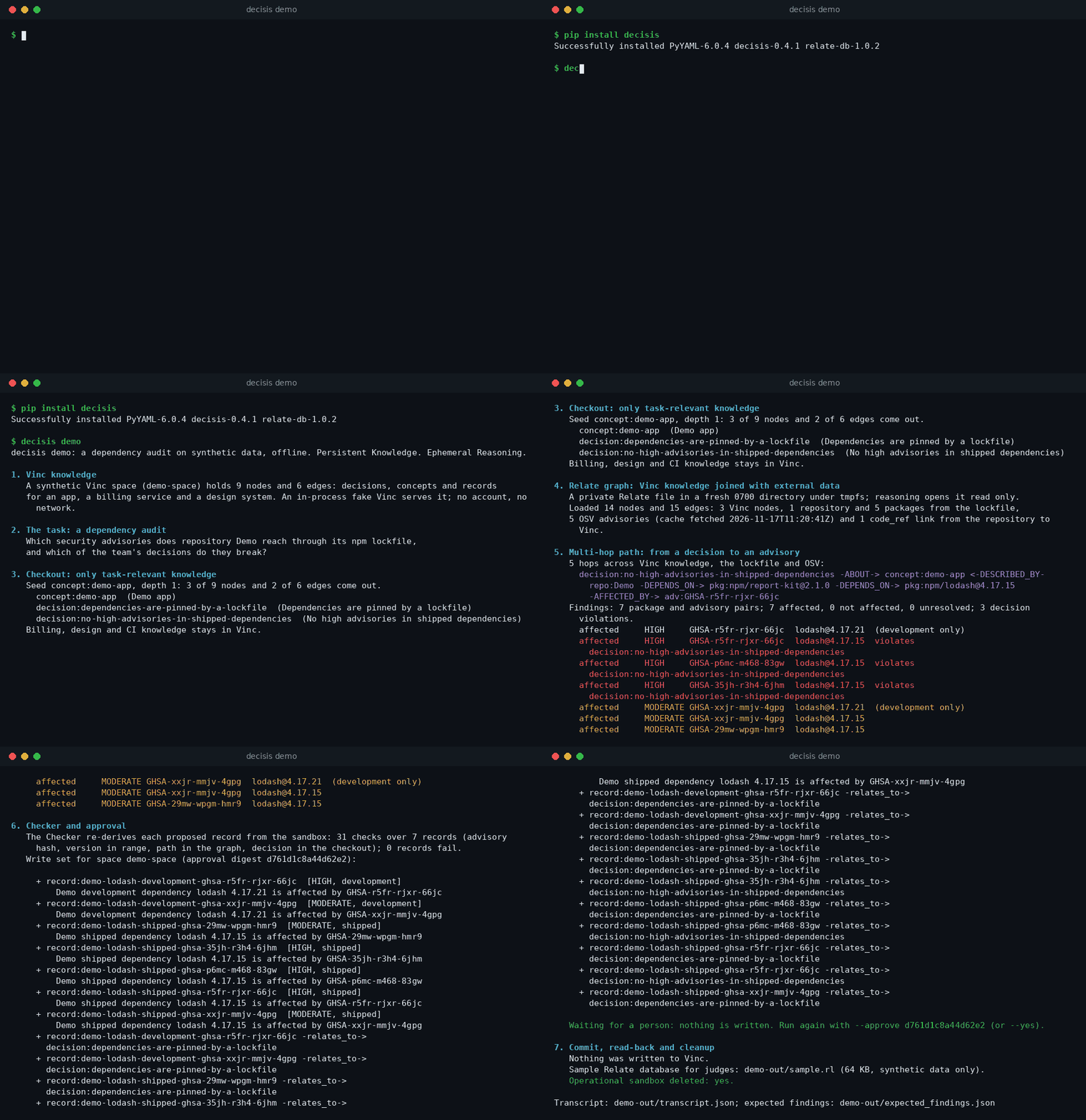
decisis (from stare decisis, "stand by what was decided") checks a change against the decisions your team already made. It joins those decisions with your code paths, a lockfile and OSV advisories in a throwaway Relate graph, and shows the path from a decision to the thing that breaks it. Every finding carries that path and its sources.
- No account, no model, offline. Decisions come from a JSON snapshot that
initbuilds from your ADRs, CODEOWNERS, postmortems and pull requests. - Nothing is written back unless a person approves the exact write set by its digest.
- Not a linter or a full scanner.
checkreads imports only, andauditreads the 15 inventory formats listed below.
Install
pip install decisis          # or: uv tool install decisis / pipx install decisis
decisis demo                 # synthetic data, under a second, writes nothing
Python 3.11 or newer on macOS, Linux or Windows. After the install, every command runs offline, except that
audit and propose ask api.osv.dev when you give it no --osv-cache, and init --github reads api.github.com.
The demo finds a five-hop path that no single source holds: the rule is in the decisions, the chain is in the lockfile and the advisory is in OSV.
decision:no-high-advisories-in-shipped-dependencies -ABOUT-> concept:demo-app <-DESCRIBED_BY- repo:Demo
  -DEPENDS_ON-> pkg:npm/report-kit@2.1.0 -DEPENDS_ON-> pkg:npm/lodash@4.17.15 -AFFECTED_BY-> adv:GHSA-r5fr-rjxr-66jc
Quick start
1. Build a snapshot of your decisions from the repository's ADRs (MADR or Nygard), CODEOWNERS and
postmortems. --github OWNER/REPO also reads merged pull requests labelled decision.
decisis init --repo-dir . --repo Shop --out snapshot.json
You can also write a snapshot by hand: one JSON file of nodes and edges (every field).
{
 "nodes": [
  {"id": "concept:shop-web", "kind": "concept", "title": "Shop web app", "props": {"code_ref": "Shop:src/"}},
  {"id": "concept:checkout-flow", "kind": "concept", "title": "Checkout flow", "props": {"code_ref": "Shop:src/checkout/"}},
  {"id": "decision:no-high-advisories-when-shipped", "kind": "decision", "title": "No high advisories in what we ship",
   "props": {"rule": {"advisory_severity_at_least": "HIGH", "dependencies": "shipped"}}},
  {"id": "record:checkout-timeout-october", "kind": "record", "title": "Checkout timed out under load"}
 ],
 "edges": [
  {"source": "decision:no-high-advisories-when-shipped", "target": "concept:shop-web", "type": "ABOUT", "evidence": "applies to the whole app"},
  {"source": "concept:checkout-flow", "target": "concept:shop-web", "type": "RELATED_TO", "evidence": "part of the app"},
  {"source": "record:checkout-timeout-october", "target": "concept:checkout-flow", "type": "RELATED_TO", "evidence": "the timeout was in this flow"}
 ]
}
2. Ask what governs a file before you change it. With the snapshot above saved as my-snapshot.json:
$ decisis impact my-snapshot.json src/checkout/pay.py --format text
src/checkout/pay.py: 4 node(s) within 3 hop(s)
  [0] concept  concept:checkout-flow  code_ref Shop:src/checkout/ (encloses)
  [0] concept  concept:shop-web  code_ref Shop:src/ (encloses)
  [1] decision decision:no-high-advisories-when-shipped  via concept:shop-web
        decision:no-high-advisories-when-shipped -ABOUT-> concept:shop-web  (applies to the whole app)
  [1] record   record:checkout-timeout-october  via concept:checkout-flow
        record:checkout-timeout-october -RELATED_TO-> concept:checkout-flow  (the timeout was in this flow)
3. Check a change against the decisions' rules. A decision's rule can name the reviewers a path
needs and the imports a part of the code must not make. check exits 1 on a violation:
$ decisis check fixtures/check/vinc.json --repo-dir fixtures/check/repo --changed src/shop/ui/view.py src/payments/charge.py --reviewers @bob --format text
2 changed file(s); reviewers: @bob
governing decisions: 2
  decision:payments-need-a-payments-review  Payment changes need a review from the payments team  (src/payments/charge.py)
  decision:ui-does-not-import-db  The user interface reads data through the API, never the database layer  (src/shop/ui/view.py)
superseded, not judged:
  decision:payments-reviewed-by-carol  superseded by decision:payments-need-a-payments-review
rules that cover a changed file: 2
violations: 3
  src/payments/charge.py  decision:payments-need-a-payments-review  review_required: src/payments/** needs a review from @alice or @shop/payments; none of them is among the reviewers given
  src/shop/ui/view.py:4  decision:ui-does-not-import-db  imports_forbidden: src/shop/ui/** must not import src/shop/db/**; from shop.db import models is src/shop/db/models.py
  src/shop/ui/view.py:5  decision:ui-does-not-import-db  imports_forbidden: src/shop/ui/** must not import src/shop/db/**; from ..db.session import open_session is src/shop/db/session.py
cannot be judged: 1
  src/shop/ui/view.py:10  decision:ui-does-not-import-db  imports_forbidden: import_module() with a computed name: the specifier is computed at run time; it cannot be judged
In CI, pass the base branch instead of a file list: decisis check snapshot.json --base origin/main --reviewers @alice.
4. Audit a lockfile against the decisions. In the snapshot init built in step 1, each ADR with a
dependency rule (advisory, license, package or pin) governs the repository init read, whatever code it
names, so give audit the same --repo:
decisis audit snapshot.json package-lock.json --repo Shop --out report.json
The example repository in this checkout has ADR 0010, which forbids HIGH advisories in shipped dependencies; its snapshot and the demo lockfile give three violations of it:
decisis init --repo-dir fixtures/init/shop --repo Shop --out shop.json
$ decisis audit shop.json fixtures/audit/demo-lockfile.json --repo Shop --osv-cache fixtures/audit/osv-cache.json --out report.json
{"summary": {"affected": 7, "unresolved": 0, "not_affected": 0}, "violations": 3, "waived": 0, "loaded": {"nodes": 23, "edges": 17}, "unresolved_packages": 0, "inventory_notes": [], "unread_decisions": 1, "out": "report.json"}
The report lists each advisory the repository reaches, the dependency path to it, and the decisions it
breaks. A hand-written snapshot, like the one above, links a decision to the repository through ABOUT a
node whose code_ref names it. A decision with a dependency rule that governs nothing in the audit is
listed under not_governing with the reason, so its rule never drops out unseen
(which decisions an audit judges).
Supported inventories and rules
- Inventories: npm, pnpm, Yarn (v1 and Berry), Bun, uv, Poetry, pip requirements, Cargo, Go modules, Gradle, Maven, CycloneDX, SPDX, GitHub Actions workflows and Terraform lock files. What each one reads.
- Rules:
advisory_severity_at_least,license_denied,license_allowed,package_denied,package_allowedandpinned_to_commitare judged byaudit;review_requiredandimports_forbiddenare judged bycheck. Rule format.
[{"advisory_severity_at_least": "HIGH", "dependencies": "shipped"},
 {"license_denied": ["GPL-3.0-only", "AGPL-3.0-only"], "dependencies": "shipped"},
 {"pinned_to_commit": true}]
A package or import that a rule cannot judge is unresolved, never clean.
A decision's waivers accept a known violation until a date: each names a package (and optionally one
advisory) or a path glob (and optionally an import target), with a reason, an expires date and
approved_by. A covered violation is waived through that date, is not counted as a violation, and is
violated again from the next day. Waiver format.
GitHub Action
On a pull request, the action runs check (and audit when you give it an inventory) and keeps one
comment up to date with the violations and a Mermaid path graph.
name: decisis
on:
  pull_request:
permissions: {}
concurrency:
  group: decisis-${{ github.event.pull_request.number }}
  cancel-in-progress: true
jobs:
  decisis:
    runs-on: ubuntu-latest
    permissions:
      contents: read
      pull-requests: write
    steps:
      - uses: actions/checkout@3d3c42e5aac5ba805825da76410c181273ba90b1 # v7.0.1
        with:
          fetch-depth: 0
          persist-credentials: false
      - uses: Vinculums/decisis@<commit SHA>
        with:
          snapshot: decisions.json        # or init: true
          inventory: package-lock.json    # optional: also run audit
          fail-on-violation: false
The decisions come from the pull request's base commit, so editing a decision file does not change the pull request's own verdict; guard the workflow and the decision files with CODEOWNERS and make the check required. Inputs, permissions, fork handling and the trust model.
AI agents: skill and MCP
pip install "decisis[mcp]"
claude mcp add decisis -- decisis serve --mcp --snapshot snapshot.json --osv-cache osv-cache.json
The server gives an agent impact, paths, audit and a read-only Cypher query as MCP tools. It has no
tool that writes. skills/decisis/SKILL.md
teaches an agent when to use each tool. MCP setup and the query rules.
Commands
| Command | Needs | What it does |
|---|---|---|
demo |
nothing | the whole procedure on synthetic data, against an in-process fake Vinc |
init --out <file> |
nothing; with --github, the network for api.github.com |
a snapshot from the repository's ADRs, CODEOWNERS and postmortems, and its merged pull requests; with --suggest-refs, code refs from the paths each ADR names |
new-adr "<title>" [--code-ref <path>]... [--rule <json>] |
nothing | writes the next-numbered MADR file with status: proposed, after checking the rule as audit and check read it; never overwrites |
impact <snapshot> <code path>... |
nothing | the decisions and records that govern a file or directory |
check <snapshot> (--changed <file>... | --base <ref>) |
nothing; with --base, git |
the decisions that govern a change set, and the review_required and imports_forbidden rules it breaks; exits 1 on a violation |
paths <snapshot> <from> <to> |
nothing | bounded paths between two ids |
query <snapshot> <cypher> [--param KEY=VALUE] |
nothing | one read-only Cypher statement on a throwaway graph of the snapshot, rows as JSON |
audit <snapshot> <lockfile or SBOM> --repo <name> |
the network for api.osv.dev (and OSV's GitHub Actions export for workflows), unless --osv-cache |
advisories the repository reaches and the decisions they break |
propose <report> <snapshot> <lockfile or SBOM> --repo <name> --space <space> |
the network for api.osv.dev, unless --osv-cache |
re-derives each record, holds back any that fail, and prints the exact write set and its approval digest |
compare [--tasks FILE] |
nothing; the held-out tasks need a checkout of this repository | the benchmarks |
checkout <seed>... --out <file> |
a read-only Vinc key | exports a bounded subgraph from Vinc |
commit <plan> --approve <digest> |
a full Vinc key | writes an approved write set and reads it back |
gc |
nothing | removes task directories that a killed run left behind, and prints them |
serve --mcp --snapshot <file> |
the mcp extra; the network for api.osv.dev only with --allow-network |
impact, paths, audit, check and query as read-only MCP tools over stdio (MCP) |
Flags, limits and the Mermaid and HTML views.
How it works
flowchart LR
    V[("decisions<br/>snapshot.json or Vinc")] -- "only what the task names" --> R
    L["lockfile or SBOM"] --> R
    O["OSV advisories<br/>live or --osv-cache"] --> R
    R[("Relate file<br/>private 0700 temp dir<br/>read only while reasoning")] -- "bounded Cypher paths" --> F["findings with<br/>paths and sources"]
    F --> P["write set +<br/>approval digest"]
    P -- "a person approves<br/>the digest" --> W["commit: create_only,<br/>then read back"]
    R -. "deleted after the run" .-> D["nothing left"]
The graph is loaded into a private temporary directory, queried read-only with bounded Cypher, and deleted
when the task ends. propose re-checks each finding in a fresh graph before it prints the write set, and
commit writes only the set whose digest a person approved, then reads every node and edge back.
Architecture and threat model.
Does the graph help?
decisis compare runs each task three ways: A uses the decisions alone, B adds the lockfile and advisories
as flat records, and C queries them in a Relate graph. Against B, C is better on 2 of 9 synthetic tasks and on
8 of 30 tasks from five open-source repositories, and worse on none. The gain is where a connection
spans sources, such as a vulnerable package three to seven hops from the repository.
The numbers and their caveats.
What is tested, and what is not built yet.
Connect Vinc (optional)
checkout exports a snapshot from a Vinc space, and commit writes an approved write
set back:
VINC_API_KEY=<read-only key> VINC_SPACE=<space id> decisis checkout <seed id> ... --out snapshot.json
VINC_API_KEY=<full key> decisis commit plan.json --approve <digest>
Development
git clone https://github.com/Vinculums/decisis.git && cd decisis
uv venv .venv && uv pip install --python .venv/bin/python -e ".[dev,mcp]"
.venv/bin/python -m pytest -q
.venv/bin/decisis demo --approve d761d1c8a44d62e2
The last line approves the demo's write set as a person would. The held-out benchmark is slow and runs only
when asked: DECISIS_SLOW=1 .venv/bin/python -m pytest -q -m slow. fixtures/ and bench/ hold lockfiles
with known advisories on purpose, so Dependabot alerts on those paths are dismissed as test fixtures.
Name and history
The project was called vinc-relate until 2026-11-24. The vinc-relate command and the vinc_relate
import name were removed in 0.2.0. decisis is an entry for the Relate by Neo4j hackathon, "Context, Connected".
License
Apache-2.0. See LICENSE.
1 maintainer

Metadata
1 maintainer
Release files for decisis 0.3.1
For a detailed explanation of source distributions (sdists) and built distributions (wheels), please see the package formats documentation.
Source distribution (sdist)
| File | Size | Uploaded | Provenance | Actions |
|---|---|---|---|---|
| decisis-0.3.1.tar.gz | 341.3 kB | With provenance | Details for decisis-0.3.1.tar.gz |
Built distribution (wheel)
| File | Interpreter | ABI | Platform | Actions Reset |
|---|---|---|---|---|
| decisis-0.3.1-py3-none-any.whl | Python 3 | none | any | Details for decisis-0.3.1-py3-none-any.whl |
Total release size: 568.4 kB
Release files / decisis-0.3.1.tar.gz
| Download URL | decisis-0.3.1.tar.gz |
|---|---|
| Size | 341.3 kB |
| Tags | Source |
|
SHA-256 checksum How to use checksums |
b00f6745745368af7cbed9c60174dae1bfeff8bb4cd2aa638b2b890f943b1182
|
|
BLAKE2b-256 checksum How to use checksums |
a017c5ec8a39362e3a05b0bad9800dac1b7cc895177517c8afd0225b0e83d556
|
| Upload date | |
|
Uploaded using Trusted Publishing? What is trusted publishing? |
Yes |
| Uploaded via |
twine/7.0.0 CPython/3.13.16
|
Provenance
Provenance describes where a file came from. On PyPI, provenance is shared via attestations, which provide a verifiable record of the build or publishing details. View details, limitations and caveats.


PyPI Publish Attestation
PyPI verified that this artifact, at this checksum, originated from the publisher listed below.
Signed by GitHub Actions, verified by PyPI on Nov 25, 2026.
Transparency logRelease files / decisis-0.3.1-py3-none-any.whl
| Download URL | decisis-0.3.1-py3-none-any.whl |
|---|---|
| Size | 227.1 kB |
| Tags | Python 3 |
|
SHA-256 checksum How to use checksums |
818248c0027a9f8a17a4a98935358057a496218b2ffaed8cdb0023b766c01887
|
|
BLAKE2b-256 checksum How to use checksums |
cc1136d6ebb100a5d99cc0d56f62719b525ec56bebfea48985e3e0751e3cda00
|
| Upload date | |
|
Uploaded using Trusted Publishing? What is trusted publishing? |
Yes |
| Uploaded via |
twine/7.0.0 CPython/3.13.16
|
Provenance
Provenance describes where a file came from. On PyPI, provenance is shared via attestations, which provide a verifiable record of the build or publishing details. View details, limitations and caveats.
PyPI Publish Attestation
PyPI verified that this artifact, at this checksum, originated from the publisher listed below.
Signed by GitHub Actions, verified by PyPI on Nov 25, 2026.
Transparency logSecurity for decisis 0.3.1
Provenance
Provenance describes where a file came from. On PyPI, provenance is shared via attestations, which provide a verifiable record of the build or publishing details. View details, limitations and caveats.
Full provenance
Both files in this release have been uploaded with provenance metadata.
Attestation for decisis-0.3.1.tar.gz
PyPI Publish Attestation
PyPI verified that this artifact, at this checksum, originated from the publisher listed below.
Signed by GitHub Actions, verified by PyPI on Nov 25, 2026.
Transparency logA note on package security
PyPI is a repository for distributing packages, not a service for auditing them. While third-party security researchers and our staff do their best to detect and remove malicious packages, PyPI cannot guarantee the quality, security or suitability of any given package.
To learn more about protecting yourself from malicious actors, visit our package security documentation.














