








A pure-Python Sudoku solving library that relies exclusively on human-style logical deduction — 20 named technique families, from naked singles to alternating inference chains, and not a single guess.
About the project
Most Sudoku solvers brute-force the board: try a digit, propagate, undo on contradiction. This library takes the opposite stance. Every digit placed and every candidate eliminated is the conclusion of a named, explainable technique, applied exactly the way a strong human solver would reason. The full solving path is recorded step by step, so any solution can be replayed and audited.
- Zero external dependencies — Python 3.10+ standard library only, tests
included (
unittest). - Fully typed and documented — modern type hints and Sphinx-style reStructuredText docstrings on every module, class, and method.
- Explainable solving — each
Stepreports the technique, a human-readable description, the placements, and the eliminations. - Honestly benchmarked — a reproducible 500-puzzle benchmark against a reference backtracking solver ships with the repo (below).
Solving philosophy
Logic first. Guessing only if you ask for it. By default the solver never
backtracks: if the pipeline of logical techniques cannot finish a puzzle, it
stops and says so (11 puzzles out of 100 on the benchmark's hardest tier).
When you just need the answer, two explicit opt-in modes exist —
method="hybrid" completes the remainder by brute force after the techniques
stall, method="backtracking" skips logic entirely — and anything
brute-forced is recorded as an explicit "Backtracking" step: the solving
path never lies about how a cell was filled.
Installation
pip install dedoku
Or from source:
git clone https://github.com/n36l3c7/Dedoku.git
cd Dedoku
pip install -e .
Either way, no dependencies come with it — the package is pure standard library.
Usage
The one-liner:
import dedoku

result = dedoku.solve("530070000600195000098000060800060003400803001"
                      "700020006060000280000419005000080079")
print(result.solved)   # True
print(result.grid)     # pretty-printed solved board
for step in result.steps:
    print(f"[{step.technique}] {step.description}")

# When you just need the answer, even beyond the logical pipeline:
dedoku.solve(puzzle, method="hybrid")         # logic first, brute force finishes
dedoku.solve(puzzle, method="backtracking")   # brute force directly
Or with full control over the board and the pipeline:
from dedoku import Grid, SudokuSolver

puzzle = (
    "530070000"
    "600195000"
    "098000060"
    "800060003"
    "400803001"
    "700020006"
    "060000280"
    "000419005"
    "000080079"
)

grid = Grid.from_string(puzzle)
result = SudokuSolver().solve(grid)

print(result.solved)          # True
print(grid)                   # pretty-printed solved board
print(grid.to_string())       # 81-character string

for step in result.steps:     # the full, explainable solving path
    print(f"[{step.technique}] {step.description}")
print(result.techniques_used) # distinct techniques, in first-use order
Puzzle strings are 81 characters, read left to right, top to bottom: digits
1–9 are givens, 0 or . mark empty cells; whitespace and the decoration
characters |, -, + are ignored, so pretty-printed boards parse back.
Need a custom pipeline? Pass any sequence of techniques, tried in order:
from dedoku import SudokuSolver
from dedoku.techniques import HiddenSingle, NakedSingle, XYChain

solver = SudokuSolver(techniques=[NakedSingle(), HiddenSingle(), XYChain()])
The board model is fully navigable if you want to build your own techniques:
each Cell knows its row, column, subgrid, candidates, and peers;
the Grid exposes all 27 houses via rows, columns, subgrids, units.
Full guides and API reference: n36l3c7.github.io/Dedoku.
Command line
Installing the package also installs the dedoku command. Add --explain
to watch the whole reasoning, cell by cell:
$ dedoku 530070000600195000098000060800060003400803001700020006060000280000419005000080079 --explain
   1. R5C5 = 5               [Naked Single] R5C5 has 5 as its only candidate
   2. R5C2 = 2               [Naked Single] R5C2 has 2 as its only candidate
   ...
Solved in 51 steps using: Naked Single
Options: puzzle from argument or stdin, --method {logic,hybrid,backtracking}
(logic is the default; the other two finish any puzzle by explicit brute
force), --multi for puzzles without a guaranteed unique solution, exit
codes 0/1/2 (solved / stalled / invalid).
Implemented techniques
The default pipeline applies 28 technique instances from 20 families, always restarting from the simplest after every deduction.
| # | Family | Classes | Module |
|---|---|---|---|
| 1 | Naked Candidates | NakedSingle, NakedPair, NakedTriple, NakedQuad |
naked.py |
| 2 | Hidden Candidates | HiddenSingle, HiddenPair, HiddenTriple, HiddenQuad |
hidden.py |
| 3 | Intersection Removal | PointingCandidates, ClaimingCandidates |
intersections.py |
| 4 | X-Wing | XWing |
fish.py |
| 5 | Chute Remote Pairs | ChuteRemotePairs |
chute.py |
| 6 | Simple Colouring | SimpleColouring |
colouring.py |
| 7 | W-Wing | WWing |
wwing.py |
| 8 | Y-Wing (XY-Wing) | YWing |
wings.py |
| 9 | Unique Rectangles | UniqueRectangle (Type 1) |
rectangles.py |
| 10 | Swordfish | Swordfish |
fish.py |
| 11 | XYZ-Wing | XYZWing |
wings.py |
| 12 | BUG (Bivalue Universal Grave) | BivalueUniversalGrave |
bug.py |
| 13 | Avoidable Rectangles | AvoidableRectangle |
rectangles.py |
| 14 | Unique Rectangles Type 2 | UniqueRectangleType2 |
rectangles.py |
| 15 | Finned Fish | FinnedXWing, FinnedSwordfish |
fish.py |
| 16 | X-Chain (basic X-Cycles) | XChain |
chains.py |
| 17 | XY-Chain | XYChain |
chains.py |
| 18 | 3D Medusa | Medusa3D |
medusa.py |
| 19 | ALS-XZ (Almost Locked Sets) | AlsXz |
als.py |
| 20 | AIC (Alternating Inference Chains) | AIC |
aic.py |
Uniqueness-based techniques (9, 12, 13, 14) assume the puzzle has exactly one
solution — the standard convention for published Sudokus. Solving a puzzle
that might have multiple solutions? Pass assume_unique=False to
dedoku.solve() or SudokuSolver() and they are excluded, keeping every
deduction sound.
Benchmark
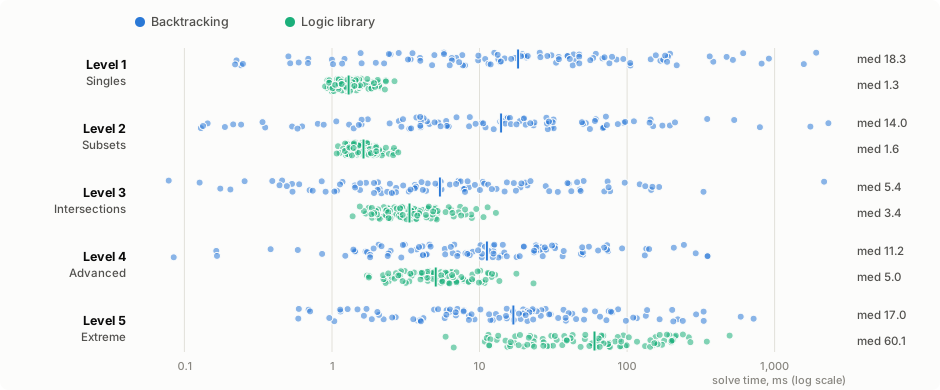
500 unique-solution puzzles (seed 42), 100 for each of five difficulty levels, timed against the lightest classic backtracking solver (bitmask, sequential cells, no heuristics). Same protocol for both solvers: puzzle string in, board out, minimum of 3 runs, parsing included. Python 3.13, Windows 11. Levels are graded by the hardest technique the original 13-family pipeline needs: singles → subsets → intersections → advanced → extreme (beyond that base pipeline).
Solve-time distribution
| Level | Solved by library | BT median | BT p95 | BT max | Library median | Library p95 | Library max |
|---|---|---|---|---|---|---|---|
| 1 · Singles | 100/100 | 18.3 ms | 526 ms | 1,913 ms | 1.3 ms | 2.1 ms | 2.7 ms |
| 2 · Subsets | 100/100 | 14.0 ms | 218 ms | 2,314 ms | 1.6 ms | 2.6 ms | 2.8 ms |
| 3 · Intersections | 100/100 | 5.4 ms | 134 ms | 2,165 ms | 3.4 ms | 8.8 ms | 12.9 ms |
| 4 · Advanced | 100/100 | 11.2 ms | 144 ms | 353 ms | 5.0 ms | 12.1 ms | 23.2 ms |
| 5 · Extreme | 89/100 † | 17.0 ms | 241 ms | 721 ms | 60.1 ms | 215 ms | 495 ms |
| Overall | 489/500 | 12.0 ms | 239 ms | 2,314 ms | 2.8 ms | 104 ms | 495 ms |
† On the 11 extreme puzzles the library cannot crack, its reported time is the time to exhaust every technique and stop — never a guess.
Key findings:
- The logic library wins on the median at every human-graded level up to Advanced (2.8 ms vs 12.0 ms overall) and is far more predictable: naive backtracking's worst case is 2.3 s when the cell order is unlucky, versus 0.50 s for the library's hardest chain solve.
- Brute-force time is uncorrelated with human difficulty — backtracking is fastest on level 3 and slowest on level 1, while the library's times grow monotonically with the level. The two solvers measure different notions of "hard".
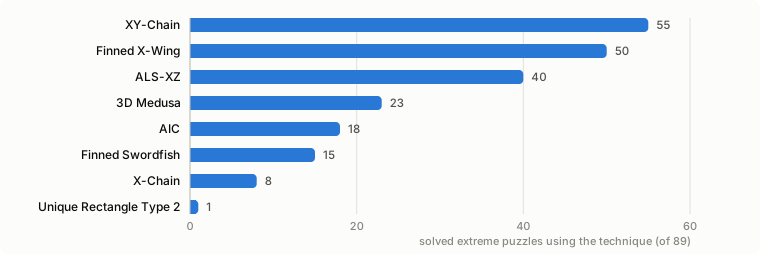
- Level 5 is chain territory: the advanced techniques added in v0.2.0 raised the library's extreme-tier solve rate from 0/100 to 89/100.
Which techniques crack the extreme tier
Reproduce it
python benchmark/generate_puzzles.py   # optional: regenerate the dataset (seeded)
python benchmark/run_benchmark.py      # times both solvers, writes benchmark/results.csv
python benchmark/make_charts.py        # renders the SVG charts into docs/
Architecture
| Class | Responsibility |
|---|---|
Cell |
A single cell: value, candidates, position, given flag, and references to its row, column, and subgrid. |
Unit → Row, Column, Subgrid |
The 27 houses of nine cells, sharing bookkeeping logic. |
Grid |
The full 9×9 board: wiring, parsing, serialisation, validity. |
Technique / Step |
One logical strategy and the immutable record of one applied deduction. |
SudokuSolver / SolveResult |
The engine that chains techniques and the outcome of a session. |
Development
python -m unittest discover -s tests -v   # 100 tests, includes the step oracle
python -m ruff check dedoku tests benchmark
python -m mypy dedoku
python -m coverage run -m unittest discover -s tests && python -m coverage report
CI runs the suite on Linux, Windows, and macOS across Python 3.10–3.14, with ruff, mypy, and a 95% coverage gate. Beyond unit tests, an oracle check verifies that every placement matches an independent backtracking solution and that no elimination ever removes a true digit — the library's core contract, tested directly.
Soundness validation
python benchmark/validate.py --count 100000 --seed 100 --jobs 8
The 1.0.0 release run: 100,000 generated puzzles, every single deduction verified — 98,687 solved by pure logic (98.7%), 1,313 stalled (extreme chain territory), 0 unsound steps.
Versioning and stability
The project follows Semantic Versioning and is
stable as of 1.0.0. The public API is everything importable from
dedoku and dedoku.techniques and documented in this README;
underscore-prefixed names are internal. Breaking changes only happen in
major releases, preceded by a deprecation period, and every change is
listed in the changelog. Note that
SudokuSolver.solve(grid) mutates the grid it receives — use
dedoku.solve(puzzle) if you prefer a fresh board per call.
License
Released under the MIT License.
1 maintainer

Metadata
1 maintainer
Release files for dedoku 1.1.0
For a detailed explanation of source distributions (sdists) and built distributions (wheels), please see the package formats documentation.
Source distribution (sdist)
| File | Size | Uploaded | |
|---|---|---|---|
| dedoku-1.1.0.tar.gz | 58.0 kB | Details |
Built distribution (wheel)
| File | Interpreter | ABI | Platform | Reset |
|---|---|---|---|---|
| dedoku-1.1.0-py3-none-any.whl | Python 3 | none | any | Details |
Total release size: 112.8 kB
Release files / dedoku-1.1.0.tar.gz
| Download URL | dedoku-1.1.0.tar.gz |
|---|---|
| Size | 58.0 kB |
| Tags | Source |
|
SHA-256 checksum How to use checksums |
9795a5fe57656775cafe150237a808cdcb016f8a84f6faa0ab32dd0c2df9a527
|
|
BLAKE2b-256 checksum How to use checksums |
3ef8f2d7568412a25fdbefea8581116f90de4fc58799d5741f150d1c9f179431
|
| Upload date | |
|
Uploaded using Trusted Publishing? What is trusted publishing? |
Yes |
| Uploaded via |
twine/6.1.0 CPython/3.13.12
|
Provenance
Provenance describes where a file came from. On PyPI, provenance is shared via attestations, which provide a verifiable record of the build or publishing details. View details, limitations and caveats.


PyPI Publish Attestation
PyPI verified that this artifact, at this checksum, originated from the publisher listed below.
Signed by GitHub Actions, verified by PyPI on Jul 17, 2026.
Transparency logRelease files / dedoku-1.1.0-py3-none-any.whl
| Download URL | dedoku-1.1.0-py3-none-any.whl |
|---|---|
| Size | 54.8 kB |
| Tags | Python 3 |
|
SHA-256 checksum How to use checksums |
f0f9fb0a3ff0d296acce04181bc50a96d8efc0f8c2785310483eda09c69b2ea7
|
|
BLAKE2b-256 checksum How to use checksums |
fdc28614ba9408fb8d8f29d7ee4f4bb8a2ad9b7699623f029e0e82934deda93c
|
| Upload date | |
|
Uploaded using Trusted Publishing? What is trusted publishing? |
Yes |
| Uploaded via |
twine/6.1.0 CPython/3.13.12
|
Provenance
Provenance describes where a file came from. On PyPI, provenance is shared via attestations, which provide a verifiable record of the build or publishing details. View details, limitations and caveats.
PyPI Publish Attestation
PyPI verified that this artifact, at this checksum, originated from the publisher listed below.
Signed by GitHub Actions, verified by PyPI on Jul 17, 2026.
Transparency log













