
A pure-Python Sudoku solver that uses only human-style logical deduction techniques (no backtracking).
Verified details
These details have been verified by PyPIProject links
GitHub Statistics
Maintainers

Project description
Dedoku






A pure-Python Sudoku solving library that relies exclusively on human-style logical deduction — 20 named technique families, from naked singles to alternating inference chains, and not a single guess.
About the project
Most Sudoku solvers brute-force the board: try a digit, propagate, undo on contradiction. This library takes the opposite stance. Every digit placed and every candidate eliminated is the conclusion of a named, explainable technique, applied exactly the way a strong human solver would reason. The full solving path is recorded step by step, so any solution can be replayed and audited.
- Zero external dependencies — Python 3.10+ standard library only, tests
included (
unittest). - Fully typed and documented — modern type hints and Sphinx-style reStructuredText docstrings on every module, class, and method.
- Explainable solving — each
Stepreports the technique, a human-readable description, the placements, and the eliminations. - Honestly benchmarked — a reproducible 500-puzzle benchmark against a reference backtracking solver ships with the repo (below).
Solving philosophy
No backtracking. No guessing. Ever. If the pipeline of logical techniques cannot finish a puzzle, the solver stops and says so — it never falls back to trial and error. On the benchmark's hardest tier this happens on 11 puzzles out of 100; everything below that tier is solved outright.
Installation
git clone https://github.com/n36l3c7/dedoku.git
cd dedoku
pip install -e .
No dependencies are installed — the package is the code you cloned.
Usage
from dedoku import Grid, SudokuSolver

puzzle = (
    "530070000"
    "600195000"
    "098000060"
    "800060003"
    "400803001"
    "700020006"
    "060000280"
    "000419005"
    "000080079"
)

grid = Grid.from_string(puzzle)
result = SudokuSolver().solve(grid)

print(result.solved)          # True
print(grid)                   # pretty-printed solved board
print(grid.to_string())       # 81-character string

for step in result.steps:     # the full, explainable solving path
    print(f"[{step.technique}] {step.description}")
print(result.techniques_used) # distinct techniques, in first-use order
Puzzle strings are 81 characters, read left to right, top to bottom: digits
1–9 are givens, 0 or . mark empty cells; whitespace and the decoration
characters |, -, + are ignored, so pretty-printed boards parse back.
Need a custom pipeline? Pass any sequence of techniques, tried in order:
from dedoku import SudokuSolver
from dedoku.techniques import HiddenSingle, NakedSingle, XYChain

solver = SudokuSolver(techniques=[NakedSingle(), HiddenSingle(), XYChain()])
The board model is fully navigable if you want to build your own techniques:
each Cell knows its row, column, subgrid, candidates, and peers;
the Grid exposes all 27 houses via rows, columns, subgrids, units.
Implemented techniques
The default pipeline applies 28 technique instances from 20 families, always restarting from the simplest after every deduction.
| # | Family | Classes | Module |
|---|---|---|---|
| 1 | Naked Candidates | NakedSingle, NakedPair, NakedTriple, NakedQuad |
naked.py |
| 2 | Hidden Candidates | HiddenSingle, HiddenPair, HiddenTriple, HiddenQuad |
hidden.py |
| 3 | Intersection Removal | PointingCandidates, ClaimingCandidates |
intersections.py |
| 4 | X-Wing | XWing |
fish.py |
| 5 | Chute Remote Pairs | ChuteRemotePairs |
chute.py |
| 6 | Simple Colouring | SimpleColouring |
colouring.py |
| 7 | W-Wing | WWing |
wwing.py |
| 8 | Y-Wing (XY-Wing) | YWing |
wings.py |
| 9 | Unique Rectangles | UniqueRectangle (Type 1) |
rectangles.py |
| 10 | Swordfish | Swordfish |
fish.py |
| 11 | XYZ-Wing | XYZWing |
wings.py |
| 12 | BUG (Bivalue Universal Grave) | BivalueUniversalGrave |
bug.py |
| 13 | Avoidable Rectangles | AvoidableRectangle |
rectangles.py |
| 14 | Unique Rectangles Type 2 | UniqueRectangleType2 |
rectangles.py |
| 15 | Finned Fish | FinnedXWing, FinnedSwordfish |
fish.py |
| 16 | X-Chain (basic X-Cycles) | XChain |
chains.py |
| 17 | XY-Chain | XYChain |
chains.py |
| 18 | 3D Medusa | Medusa3D |
medusa.py |
| 19 | ALS-XZ (Almost Locked Sets) | AlsXz |
als.py |
| 20 | AIC (Alternating Inference Chains) | AIC |
aic.py |
Uniqueness-based techniques (9, 12, 13, 14) assume the puzzle has exactly one solution — the standard convention for published Sudokus.
Benchmark
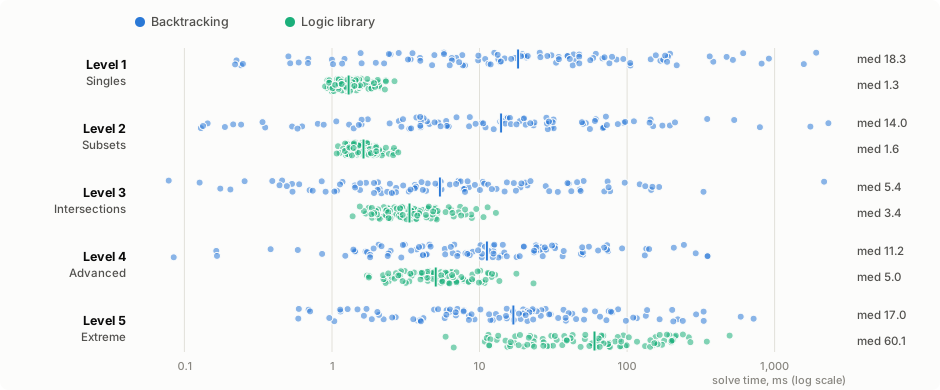
500 unique-solution puzzles (seed 42), 100 for each of five difficulty levels, timed against the lightest classic backtracking solver (bitmask, sequential cells, no heuristics). Same protocol for both solvers: puzzle string in, board out, minimum of 3 runs, parsing included. Python 3.13, Windows 11. Levels are graded by the hardest technique the original 13-family pipeline needs: singles → subsets → intersections → advanced → extreme (beyond that base pipeline).
Solve-time distribution
| Level | Solved by library | BT median | BT p95 | BT max | Library median | Library p95 | Library max |
|---|---|---|---|---|---|---|---|
| 1 · Singles | 100/100 | 15.9 ms | 481 ms | 1,757 ms | 1.1 ms | 1.6 ms | 1.8 ms |
| 2 · Subsets | 100/100 | 13.1 ms | 218 ms | 2,172 ms | 1.6 ms | 2.4 ms | 2.9 ms |
| 3 · Intersections | 100/100 | 5.0 ms | 126 ms | 2,026 ms | 3.1 ms | 7.8 ms | 12.1 ms |
| 4 · Advanced | 100/100 | 15.6 ms | 225 ms | 551 ms | 7.5 ms | 17.7 ms | 31.2 ms |
| 5 · Extreme | 89/100 † | 16.7 ms | 229 ms | 684 ms | 65.4 ms | 306 ms | 720 ms |
| Overall | 489/500 | 12.6 ms | 279 ms | 2,172 ms | 3.0 ms | 158 ms | 720 ms |
† On the 11 extreme puzzles the library cannot crack, its reported time is the time to exhaust every technique and stop — never a guess.
Key findings:
- The logic library wins on the median at every human-graded level up to Advanced (3.0 ms vs 12.6 ms overall) and is far more predictable: naive backtracking's worst case is 2.2 s when the cell order is unlucky, versus 0.72 s for the library's hardest chain solve.
- Brute-force time is uncorrelated with human difficulty — backtracking is fastest on level 3 and slowest on level 1, while the library's times grow monotonically with the level. The two solvers measure different notions of "hard".
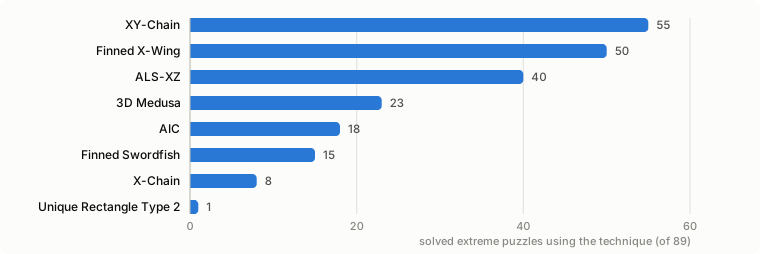
- Level 5 is chain territory: the advanced techniques added in v0.2.0 raised the library's extreme-tier solve rate from 0/100 to 89/100.
Which techniques crack the extreme tier
Reproduce it
python benchmark/generate_puzzles.py   # optional: regenerate the dataset (seeded)
python benchmark/run_benchmark.py      # times both solvers, writes benchmark/results.csv
python benchmark/make_charts.py        # renders the SVG charts into docs/
Architecture
| Class | Responsibility |
|---|---|
Cell |
A single cell: value, candidates, position, given flag, and references to its row, column, and subgrid. |
Unit → Row, Column, Subgrid |
The 27 houses of nine cells, sharing bookkeeping logic. |
Grid |
The full 9×9 board: wiring, parsing, serialisation, validity. |
Technique / Step |
One logical strategy and the immutable record of one applied deduction. |
SudokuSolver / SolveResult |
The engine that chains techniques and the outcome of a session. |
Development
python -m unittest discover -s tests -v
78 tests cover the board model, every technique (positive and negative cases), and end-to-end solving. Chain and ALS implementations were additionally validated by checking every benchmark solution against the backtracking reference — zero mismatches.
License
Released under the MIT License.
Project details
Verified details
These details have been verified by PyPIProject links
GitHub Statistics
Maintainers


Download files
Download the file for your platform. If you're not sure which to choose, learn more about installing packages.
Source Distribution
Built Distribution
Filter files by name, interpreter, ABI, and platform.
If you're not sure about the file name format, learn more about wheel file names.
Copy a direct link to the current filters
File details
Details for the file dedoku-0.3.0.tar.gz.
File metadata
- Download URL: dedoku-0.3.0.tar.gz
- Upload date:
- Size: 46.7 kB
- Tags: Source
- Uploaded using Trusted Publishing? Yes
- Uploaded via: twine/6.1.0 CPython/3.13.12
File hashes
| Algorithm | Hash digest | |
|---|---|---|
| SHA256 |
113219358d3ee1681620bfcab96916297e5edc54fafcc7016a59b00c5fb0eff9
|
|
| MD5 |
14e1fc4f265bab6fcc0c9144189fd351
|
|
| BLAKE2b-256 |
a9930a192b2595161740b89fcc2f29481b8604ce7a3e96011c1faf55a35b7346
|
Provenance
The following attestation bundles were made for dedoku-0.3.0.tar.gz:
Publisher:
publish.yml on n36l3c7/dedoku
-
Statement:
-
Statement type:
https://in-toto.io/Statement/v1 -
Predicate type:
https://docs.pypi.org/attestations/publish/v1 -
Subject name:
dedoku-0.3.0.tar.gz -
Subject digest:
113219358d3ee1681620bfcab96916297e5edc54fafcc7016a59b00c5fb0eff9 - Sigstore transparency entry: 2169380400
- Sigstore integration time:
-
Permalink:
n36l3c7/dedoku@cbf4763ba368d47e8f397cb2fafd0f7f85d5628a -
Branch / Tag:
refs/tags/v0.3.0 - Owner: https://github.com/n36l3c7
-
Access:
public
-
Token Issuer:
https://token.actions.githubusercontent.com -
Runner Environment:
github-hosted -
Publication workflow:
publish.yml@cbf4763ba368d47e8f397cb2fafd0f7f85d5628a -
Trigger Event:
push
-
Statement type:
File details
Details for the file dedoku-0.3.0-py3-none-any.whl.
File metadata
- Download URL: dedoku-0.3.0-py3-none-any.whl
- Upload date:
- Size: 46.8 kB
- Tags: Python 3
- Uploaded using Trusted Publishing? Yes
- Uploaded via: twine/6.1.0 CPython/3.13.12
File hashes
| Algorithm | Hash digest | |
|---|---|---|
| SHA256 |
0a39428ccc9fd254b8f7f17c7f45f5af8db7b1aaa1b7447a667382b376580e0d
|
|
| MD5 |
4e67df61dc0bd04211d5b1912cb97e1e
|
|
| BLAKE2b-256 |
9070630d199cd165dfa6dd2adf100b20abd81184897a02020caba2a1b0160e1a
|
Provenance
The following attestation bundles were made for dedoku-0.3.0-py3-none-any.whl:
Publisher:
publish.yml on n36l3c7/dedoku
-
Statement:
-
Statement type:
https://in-toto.io/Statement/v1 -
Predicate type:
https://docs.pypi.org/attestations/publish/v1 -
Subject name:
dedoku-0.3.0-py3-none-any.whl -
Subject digest:
0a39428ccc9fd254b8f7f17c7f45f5af8db7b1aaa1b7447a667382b376580e0d - Sigstore transparency entry: 2169380410
- Sigstore integration time:
-
Permalink:
n36l3c7/dedoku@cbf4763ba368d47e8f397cb2fafd0f7f85d5628a -
Branch / Tag:
refs/tags/v0.3.0 - Owner: https://github.com/n36l3c7
-
Access:
public
-
Token Issuer:
https://token.actions.githubusercontent.com -
Runner Environment:
github-hosted -
Publication workflow:
publish.yml@cbf4763ba368d47e8f397cb2fafd0f7f85d5628a -
Trigger Event:
push
-
Statement type:






