
Delaunay-Watershed 3D


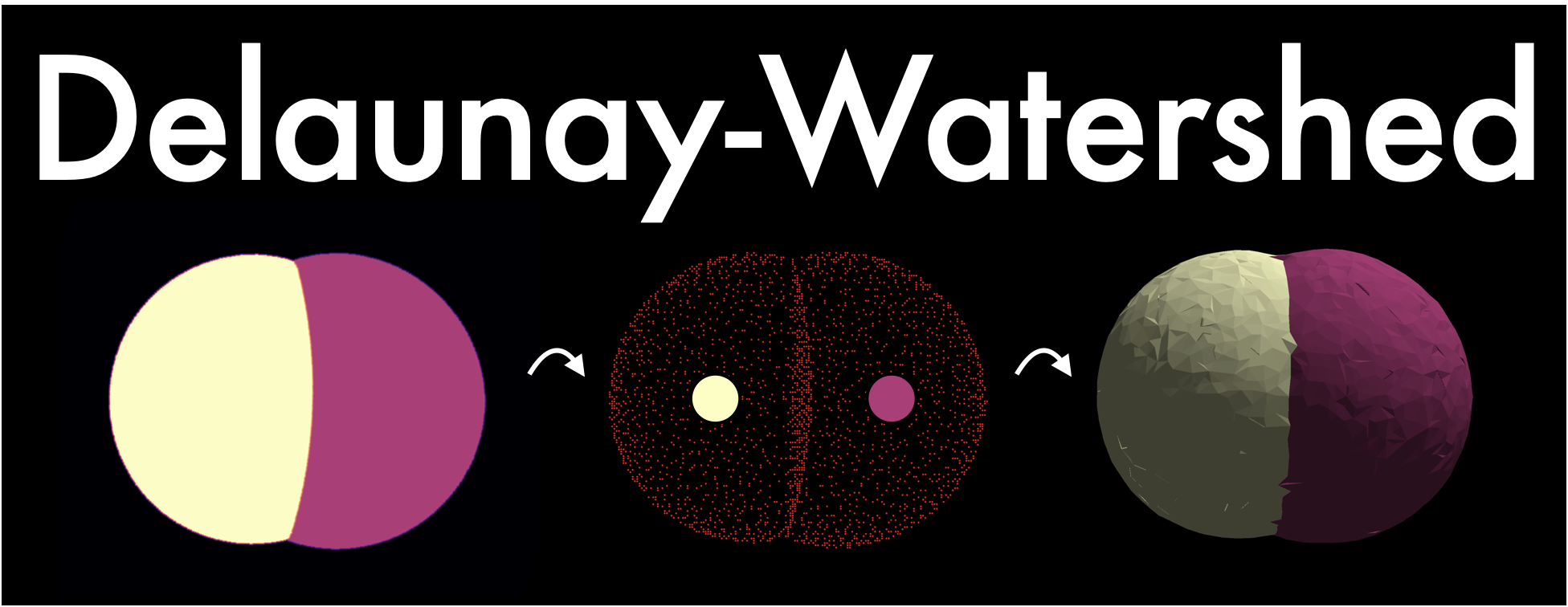
Delaunay-Watershed-3D (package dw3d) reconstructs, from a 3-D instance segmentation of cells or nuclei, a multimaterial surface mesh: one triangle mesh of every interface between two cells, or between a cell and the medium. Such meshes are small, and suited to storage, sharing, geometric analysis and visualisation. It is the reconstruction behind foambryo, which infers surface tensions and cell pressures from these meshes. A viewer based on Polyscope is included.
Delaunay-Watershed was created by Sacha Ichbiah during his PhD in Turlier Lab, and is improved and maintained by Matthieu Perez and Hervé Turlier. For support, please open an issue. If you use it in your work, please cite the article: Ichbiah S., Delbary F., McDougall A., Dumollard R., Turlier H. Embryo mechanics cartography: inference of 3D force atlases from fluorescence microscopy. Nature Methods 20(12), 1989–1999 (2023).
For 2-D images and meshes, see foambryo2D.
The documentation (user guide, examples, API reference) is in docs/; the full list of changes is in the CHANGELOG, and what can mislead you in the release notes.
What's new in 0.7.1
- The mesh no longer depends on the order in which Qhull returns the tetrahedra; meshes change slightly (45 of the 47 benchmark meshes, by a median of 13 faces).
canonical_tetrahedron_order=Falsereproduces 0.7.0's meshes on the same machine. - An enclosed pocket of medium (a lumen) is its own region, flagged as a medium in the
.recfile, instead of part of one cell; every piece of exterior gets its own seed; a region the tesselation cannot hold is named (UnresolvedCellWarning) instead of growing inside a neighbour. A mask with none of these is meshed bit for bit as before. - Mesh surgery no longer leaves abnormal non-manifold edges, and a finished mesh that has some says so (
AbnormalEdgeWarning). - The Polyscope viewer draws the tissue, not its mirror image. No number changes.
- The test suites run on Linux x86-64 CI as well as on macOS; between machines, meshes may differ only at exactly cospherical points.
What's new in 0.7.0
0.7.0 is the first release on PyPI since 0.5.1; it includes everything prepared for 0.6.0, which was not published.
- Masks with voxels longer along z.
algorithm.construct_mesh_in_physical_units(mask, spacing)resamples the mask to cubic voxels before meshing and returns the mesh in physical units; the.recfile records the spacing. - Cropped tissues. Where a cell reaches the image box, the triangles that close it there are marked as crop faces, and the cells they touch as cut cells; the files keep the marks. The mesh itself is unchanged.
- Fixes that change results: cells that touch the image border are closed by correctly wound triangles (they read too small a volume, often a negative one); a few triangles on flat tetrahedra are wound correctly;
set_pixel_sizenow scales column 0 (z) by the z size — it used to swap z and x, so re-run any analysis that called it with different xy and z sizes. - New checks: the cells whose mesh volume disagrees with their mask are listed (
cell_volume_report, with aCellVolumeDisagreementWarning), and junction relocation can no longer turn a very small cell inside out. - Faster and lighter on large tissues (the speed-ups change no mesh; 0.7.0's mesh of this tissue differs from 0.5.1's only by the fixes listed below: 2 vertex positions and 166 triangle windings): on a 1 866-cell tissue meshed on its native grid, from mask to tensions, 9.5 min instead of 47.5 min with 0.5.1, and a peak memory of 30.9 GiB instead of 54.7 GiB. Resampled to cubic voxels first (
construct_mesh_in_physical_units), the same tissue's reconstruction takes about 13.5 min and 38 GiB. - A lighter distance transform and a faster tesselation graph, with bit-for-bit the same meshes. On a 1 866-cell tissue the distance transform's peak memory goes from 21.0 to 14.9 GiB (38.1 to 28.1 GiB when the mask is first resampled to cubic voxels), the tesselation's face table and pairing take 1.8 s instead of 7.8 s and its graph 3.0 s instead of 5.5 s; a 2 000-cell synthetic foam is reconstructed in 186 s instead of 200 s. Contributed by Wenhong Li and Adam L. Taylor.
Installation
Delaunay-Watershed needs Python 3.11 or later. Install it from PyPI, in a virtual environment:
pip install delaunay-watershed-3d               # the library
pip install "delaunay-watershed-3d[viewing]"    # and the Polyscope viewer
For development, clone the repository and pip install -e "./delaunay-watershed[viewing]". Tested for 0.7.1 on macOS 14 on Apple silicon (arm64) and on Linux x86-64 (Ubuntu 24.04), with Python 3.12 and 3.13, with the newest and the lowest supported versions of the dependencies; other systems are expected to work but were not tested for this release.
Quick start
The input is a 3-D array of integer labels, one per cell, 0 for the medium; axis 0 is z. The mesh's points are in the same order, (z, y, x).
import tifffile
from dw3d import get_default_mesh_reconstruction_algorithm
from dw3d.viewing import plot_cells_polyscope

mask = tifffile.imread("segmentation.tif")
algorithm = get_default_mesh_reconstruction_algorithm()

# With the voxel size (dz, dy, dx): resampled to cubic voxels, mesh in um.
points, triangles, labels = algorithm.construct_mesh_in_physical_units(mask, spacing=(1.0, 0.5, 0.5), spacing_unit="um")
# Or on the voxel grid, mesh in voxel units:
# points, triangles, labels = algorithm.construct_mesh_from_segmentation_mask(mask)

algorithm.save_to_rec_mesh("mesh.rec")          # read it in foambryo with dcel_mesh_from_file
plot_cells_polyscope(algorithm)                 # needs [viewing] and a display
points are the vertices, triangles index them, and labels give the two materials on each side of each triangle (the normal points from the first label to the second). The notebooks in Examples/ show the rest.
What the reconstruction does, and its options
- The default reconstruction is the published algorithm (equivalent to dw3d 0.3.6), the more accurate one for tension inference today. Other variants are opt-in, among them the deterministic, link-checked
get_link_checked_mesh_reconstruction_algorithm, cleaner in topology but worse for tension inference. See reconstruction variants. - Junction relocation (on by default since 0.5.0) moves the trijunction vertices onto the junction curves the mask gives, under a guard that can never make the mesh pass through itself; only vertices move.
algorithm.relocate_junctions = Falsegives the 0.4 meshes. See junction relocation. - Cropped tissues.
algorithm.crop_faces(a boolean per triangle),algorithm.cut_cellsandalgorithm.crop_face_report. A tissue that really ends on an image face (a coverslip):algorithm.physical_image_faces = ("axis0_low",). See cropped tissues. - Anisotropic voxels. Measured on simulated tissues whose cells are as small as real ones, down-sampled along z, against the same tissues meshed at full resolution: resampling to cubic voxels first costs +0.83, +0.71 and +1.17 degrees of contact-angle error at a z/xy ratio of 5/3, 2 and 3, against +1.38, +1.97 and +4.10 for meshing the native grid and scaling the mesh (measured on 0.7.0's meshes; not measured again for 0.7.1, whose meshes differ slightly, because some of these runs need 8 to 40 GiB of memory). Above 3 nothing was measured, and
UnmeasuredAnisotropyWarningsays so.min_distancecounts cubic voxels, so the cost is that of a mask acquired at the short spacing. See anisotropic voxels. - Files.
.rec/.arec(text or binary) and.vtk; a.recfile can carry a metadata appendix that records the coordinate frame, the spacing and the crop faces. See the metadata appendix. Files keep the points' columns in the mask's order,(z, y, x): a program that reads them as(x, y, z), as ParaView, MeshLab and other VTK readers do, shows the mirror image of the tissue unless columns 0 and 2 are exchanged (and, to keep the triangles facing the same side, two corners of each triangle). The Polyscope viewer does this for what it draws. - Checks.
cell_volume_reportlists the cells whose mesh volume is outside 0.5–1.5 times their voxel count;count_self_intersections(points, triangles)counts self-intersecting triangle pairs.
Biological examples
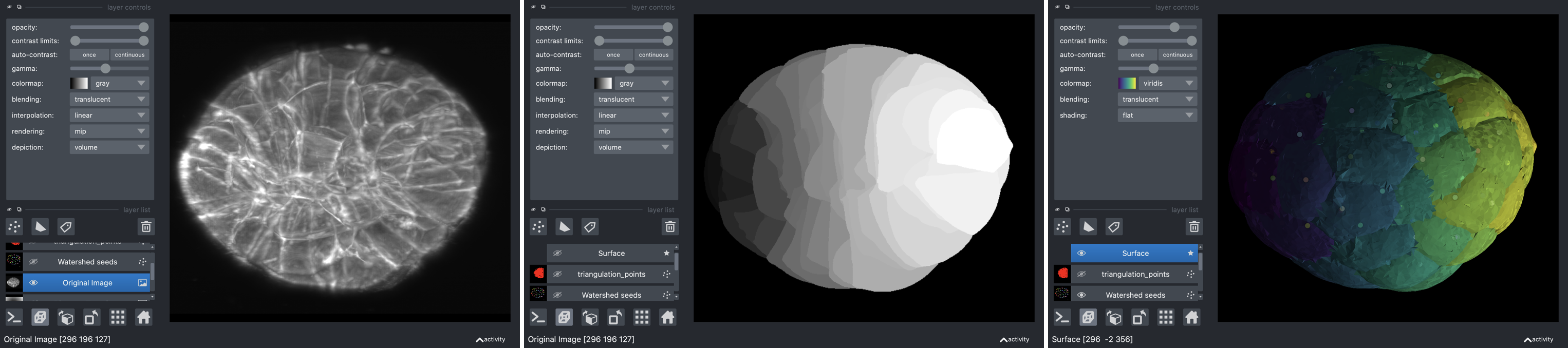
Cell interfaces in the P. mammillata embryo
See the notebook Mesh reconstruction and visualisation. Segmentation masks from Guignard et al.
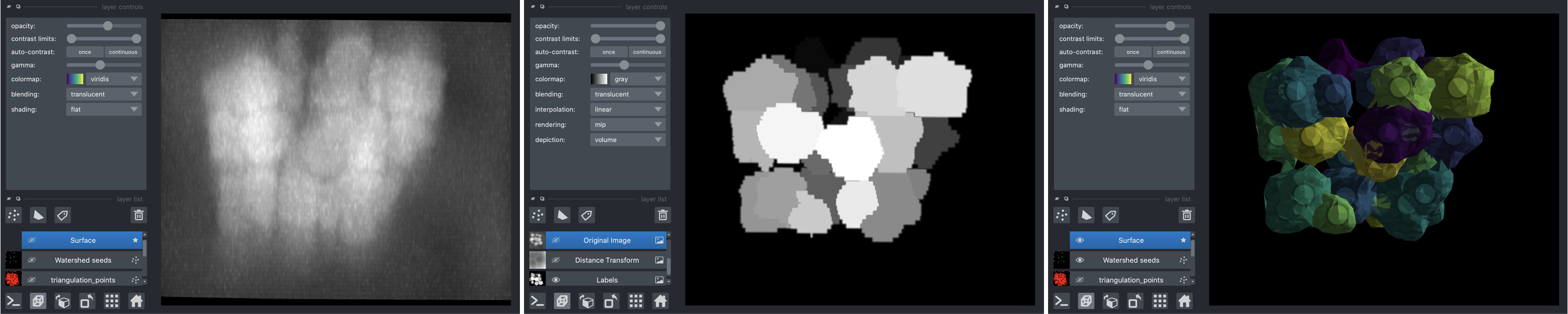
Cell nuclei
See the notebook Mask compression and reconstruction. Segmentation masks from StarDist.
Repository layout
The development repository also holds the project's research record (working notes, exploratory scripts and their results), for provenance. It is not part of the distribution: pip install does not ship it, and nothing under dw3d imports from it.
Credits, contact, citation
If you use this tool, please cite the associated article: Ichbiah S., Delbary F., McDougall A., Dumollard R., Turlier H. Embryo mechanics cartography: inference of 3D force atlases from fluorescence microscopy. Nature Methods 20(12), 1989–1999 (2023), doi:10.1038/s41592-023-02084-7. Contact Matthieu Perez and Hervé Turlier for practical questions and applications.
Recent work on dw3d and foambryo is part of a collaboration with Alejandro Aguilera Castrejon (Janelia Research Campus, Howard Hughes Medical Institute). We thank him and his Janelia colleagues Adam L. Taylor, Wenhong Li and Francesco Roncato. Adam L. Taylor found the border-triangle winding defect fixed in 0.6.0 and pointed us to the seed-extraction and dense tension-solve bottlenecks on large tissues.
@article{Ichbiah2023,
  author    = {Ichbiah, Sacha and Delbary, Fabrice and McDougall, Alex and Dumollard, R{\'e}mi and Turlier, Herv{\'e}},
  title     = {Embryo mechanics cartography: inference of {3D} force atlases from fluorescence microscopy},
  journal   = {Nature Methods},
  volume    = {20},
  number    = {12},
  pages     = {1989--1999},
  year      = {2023},
  month     = dec,
  publisher = {Springer Science and Business Media LLC},
  issn      = {1548-7105},
  doi       = {10.1038/s41592-023-02084-7},
  url       = {https://doi.org/10.1038/s41592-023-02084-7}
}
Licence
Delaunay-Watershed is free software: you can redistribute it and modify it under the terms of the GNU General Public License, version 3 or (at your option) any later version (SPDX GPL-3.0-or-later); the text is in License. This covers versions 0.5.0 and later; earlier releases keep the licence they were published under (CC BY-NC-SA 4.0).

3 maintainers


Metadata
3 maintainers
Release files for delaunay-watershed-3d 0.7.1
For a detailed explanation of source distributions (sdists) and built distributions (wheels), please see the package formats documentation.
Source distribution (sdist)
| File | Size | Uploaded | Provenance | Actions |
|---|---|---|---|---|
| delaunay_watershed_3d-0.7.1.tar.gz | 7.3 MB | Without provenance | Details for delaunay_watershed_3d-0.7.1.tar.gz |
Built distribution (wheel)
| File | Interpreter | ABI | Platform | Actions Reset |
|---|---|---|---|---|
| delaunay_watershed_3d-0.7.1-py3-none-any.whl | Python 3 | none | any | Details for delaunay_watershed_3d-0.7.1-py3-none-any.whl |
Total release size: 7.6 MB
Release files / delaunay_watershed_3d-0.7.1.tar.gz
| Download URL | delaunay_watershed_3d-0.7.1.tar.gz |
|---|---|
| Size | 7.3 MB |
| Tags | Source |
|
SHA-256 checksum How to use checksums |
99fd651df7d92db1215b4e8546aa40ff41bd4bb8715b792af433604315cae489
|
|
BLAKE2b-256 checksum How to use checksums |
602d4848bec811dbe9386845da1f0c09141fb7763482b3c3b1df0f05233ad81b
|
| Upload date | |
|
Uploaded using Trusted Publishing? What is trusted publishing? |
No |
| Uploaded via |
twine/7.0.0 CPython/3.12.13
|
Release files / delaunay_watershed_3d-0.7.1-py3-none-any.whl
| Download URL | delaunay_watershed_3d-0.7.1-py3-none-any.whl |
|---|---|
| Size | 221.6 kB |
| Tags | Python 3 |
|
SHA-256 checksum How to use checksums |
34352115b05fc427b28e87a7c2189726398286ed206d5dec9a8542f3e8abaeca
|
|
BLAKE2b-256 checksum How to use checksums |
d4562301a057debf28c096e386306ab65983a37fd02ac3e1eb41cecc285d9356
|
| Upload date | |
|
Uploaded using Trusted Publishing? What is trusted publishing? |
No |
| Uploaded via |
twine/7.0.0 CPython/3.12.13
|
Security for delaunay-watershed-3d 0.7.1
Provenance
Provenance describes where a file came from. On PyPI, provenance is shared via attestations, which provide a verifiable record of the build or publishing details. View details, limitations and caveats.
No provenance found
None of the files in this release were uploaded with provenance metadata.
A note on package security
PyPI is a repository for distributing packages, not a service for auditing them. While third-party security researchers and our staff do their best to detect and remove malicious packages, PyPI cannot guarantee the quality, security or suitability of any given package.
To learn more about protecting yourself from malicious actors, visit our package security documentation.














