
Python CLI tool for generating depth tracking overlays for your dive footage from exported dive computer logs.

Project description
depthviz: Transform your freediving footage with depth tracking





[!NOTE] This project is in active development. Feel free to open an issue for any feedback or feature requests.
depthviz makes it easy to add dynamic depth tracking, giving your viewers a deeper understanding of your underwater sensation. It is a command-line tool for generating depth overlay videos from the data recorded by your dive computer. It processes your dive log and creates a video that visualizes the depth over time.

This allows you to create more informative and engaging dive videos, enriching the storytelling experience for both yourself and your audience. Click here to watch a sample video.
[!TIP] For performance freedivers, you can incorporate
depthvizinto your dive analysis. By visualizing your dive profile, you can identify areas for improvement and track your progress over time.
Installation
Prerequisites:
Installation:
pipx install depthviz
Usage
1. Download Your Data:
Export your dive log data from your dive computer or diving application. See the source options below for supported formats.
2. Generate the Overlay:
depthviz -i <input_file> -s <source> -o <output_video.mp4>
Arguments:
-i,--input <input_file>: Path to your file containing your dive log.-s,--source <source>: Source of the dive computer data. See the table below for supported sources.-o,--output <output_video.mp4>: Path or filename for the generated video with the depth overlay. The output file format must be.mp4.
Source Options:
| Source | Description | File type | Development Status |
|---|---|---|---|
apnealizer |
Data exported from Apnealizer, logging and analyzing application. | CSV | :white_check_mark: Supported |
shearwater |
Data exported from Shearwater dive computers. | XML | :white_check_mark: Supported |
garmin |
Data exported from Garmin dive computers. | - | :x: Sample data needed :rotating_light: |
suunto |
Data exported from Suunto dive computers. | - | :x: Sample data needed :rotating_light: |
manual |
Manually input the dive data, for those who don't have a dive computer. | - | :construction: Under development |
Example:
Example of generating a depth overlay video named depth_overlay.mp4 using data from my_dive.xml exported from Shearwater dive computers (source: shearwater).
depthviz -i my_dive.xml -s shearwater -o depth_overlay.mp4
3. Integrate with Your Footage:
Import the generated overlay video into your preferred video editing software and combine it with your original dive footage. Adjust the blending and position of the overlay to suit your video style.
Watch this tutorial on how to import an overlay video in CapCut Desktop.
How It Works
depthviz works by parsing dive log data exported from various dive computers and generating an overlay video that displays depth information.
Dive computers typically record either depth directly or pressure data. If the data is recorded as pressure, it is in the form of absolute pressure, which includes both atmospheric pressure and the pressure exerted by the water itself (hydrostatic pressure).
To determine the depth, depthviz uses the following approach:
- If the dive log contains depth data directly:
depthvizuses this data directly. - If the dive log contains pressure data:
- First, the hydrostatic pressure is calculated by subtracting atmospheric pressure (collected during the surface interval or dive start) from the absolute pressure:
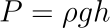
- Then, the fluid pressure formula is used to calculate the depth:
Where:- $
P$ is the fluid pressure, - $
\rho$ is the density of the fluid (water), - $
g$ is the acceleration due to gravity (9.80665 m/s²), - $
h$ is the height (or depth) of the fluid column (what we want to calculate).
- $
- Rearranging the formula to solve for depth ($
h$):
- First, the hydrostatic pressure is calculated by subtracting atmospheric pressure (collected during the surface interval or dive start) from the absolute pressure:


Currently, depthviz uses a water density ($\rho$) according to the EN13319 standard, a European CE standard for dive computers, which assumes a water density of 1019.7 kg/m³.
The water density can vary depending on the type of water (e.g., freshwater, saltwater). Even different locations in the ocean can have varying densities. This variability can affect the accuracy of depth calculations. For more precise measurements, users may need to adjust the density value based on their specific diving environment. Especially for freshwater diving, the water density is lower than the standard value, which can lead to depth overestimation. We will add support for custom water density in future releases.
[!NOTE] The EN13319 standard ensures the accuracy and reliability of depth measurements in dive computers. For more information, you can refer to the EN13319 standard.
The steps involved in generating the depth overlay video are as follows:
- Parse Dive Log Data: The dive log data is parsed to extract time and either depth or pressure information.
- Calculate Depth (if necessary): If the dive log contains pressure data, the depth is calculated using the hydrostatic pressure equation and the fluid pressure formula with the EN13319 water density standard.
- Generate Overlay Video: An overlay video is generated that displays the depth information at the corresponding times.
Contribution
We welcome contributions to the depthviz project! If you have any ideas for improvement, bug fixes, or feature suggestions, feel free to open an issue to discuss or submit a pull request.
Help Us Expand Dive Computer Support!
Missing your dive computer? Help us add support! Submit a Dive Computer Support Request issue with your dive log file and export source.
By providing this information, you'll be helping us understand the specific format of your dive computer's exported data. This allows us to implement the necessary parsing logic and add support for your device in a future release.
License
This project is licensed under the Apache License 2.0. See the LICENSE file for details.
CycloneDX SBOM
This project provides a CycloneDX Software Bill of Materials (SBOM) in JSON format. The SBOM is generated by the GitHub Actions workflow and is available as an artifact for each release. The SBOM is generated using the cyclonedx-python library.
Contact
For any inquiries, please open an issue. We'd love to hear from you!
Release history Release notifications | RSS feed


Download files
Download the file for your platform. If you're not sure which to choose, learn more about installing packages.
Source Distribution
Built Distribution
Filter files by name, interpreter, ABI, and platform.
If you're not sure about the file name format, learn more about wheel file names.
Copy a direct link to the current filters
File details
Details for the file depthviz-0.3.0a1.tar.gz.
File metadata
- Download URL: depthviz-0.3.0a1.tar.gz
- Upload date:
- Size: 3.7 MB
- Tags: Source
- Uploaded using Trusted Publishing? No
- Uploaded via: poetry/2.0.0 CPython/3.10.15 Linux/6.8.0-1017-azure
File hashes
| Algorithm | Hash digest | |
|---|---|---|
| SHA256 |
14d557aaef2d992a68031fe3a5ab62554a9a7842275e021a7da4cacfd7c1e449
|
|
| MD5 |
72c2744d2bdffecc5e37f5b1047cc002
|
|
| BLAKE2b-256 |
ad6095f114c8ca990362ceca880acc80bd5531430d2b67e27adda2e3f2939ceb
|
File details
Details for the file depthviz-0.3.0a1-py3-none-any.whl.
File metadata
- Download URL: depthviz-0.3.0a1-py3-none-any.whl
- Upload date:
- Size: 3.7 MB
- Tags: Python 3
- Uploaded using Trusted Publishing? No
- Uploaded via: poetry/2.0.0 CPython/3.10.15 Linux/6.8.0-1017-azure
File hashes
| Algorithm | Hash digest | |
|---|---|---|
| SHA256 |
cc60c82e92b5fd54663329e6bb5972f6aab60069e5bc3ead7dcce0f614d08344
|
|
| MD5 |
b52908bd8093f4637421125e75b90174
|
|
| BLAKE2b-256 |
082d0c7fce562550eede30fc63e6aec479a06ac872f5cf58730b779befdc86a6
|






