

An API time machine for Python libraries, built for coding agents.






Python libraries rename and remove things between releases. Code that worked last year, or code an AI model learned from, then fails with an ImportError, an AttributeError or "unexpected keyword argument". DepTime tells a coding agent what changed, in which release, and what to use instead, in one call.
- Computed, not remembered. Each answer comes from comparing the library's own source across its releases, not from docs or a model's memory, and it quotes the evidence it found.
- Local and free. Open source (MIT). Your code and errors never leave your machine.
- Says when it doesn't know. For a package it doesn't cover, or a name it can't follow, the answer is "not covered" or
unknown, never a guess.
Status: alpha, in maintenance mode. The tools are complete for the packages they cover, the index rebuilds itself twice a day, and fixes follow reported wrong answers. Known gaps are listed in BACKLOG.md.
Install
Requires uv.
# Claude Code. Cursor, Codex, VS Code and Claude Desktop take the same
# command (uvx deptime mcp) in their MCP config.
claude mcp add deptime -- uvx deptime mcp
On first launch DepTime downloads its prebuilt index (one file from this repo's GitHub Releases) in the background, then checks for a newer one at most once a day. Set DEPTIME_OFFLINE=1 to never touch the network. Each index carries a signed record of the CI run that built it; deptime index pull --verify checks it (SECURITY.md).
Claude Code users can also install the plugin in integrations/claude-code with /plugin marketplace add cschmertz/deptime, then /plugin install deptime@deptime. It adds a skill and a local hook that suggests DepTime when a Python version-change error appears in a command's output.
First launch timing out? uvx installs DepTime the first time a client starts it. On macOS with an x86_64 uv (an Intel Mac, or Intel Homebrew on Apple silicon), one dependency, cryptography, has no prebuilt wheel and is compiled, which can take longer than a client waits for a server to start. Run uvx deptime --help once beforehand.
Client compatibility
Checked 2026-11-05 with deptime 0.1.4 (details):
| Client | Result |
|---|---|
| Claude Code 2.1.318 | ✅ |
| Codex CLI 0.166.0 | ✅ |
MCP Python SDK clients 1.0–1.30 and TypeScript SDK clients 1.0–1.32 (protocols 2024-11-05 to 2025-11-25), over stdio and against deptime serve |
✅ |
| Cursor, VS Code, Claude Desktop | not checked yet; they take the same uvx deptime mcp command |
What an answer looks like
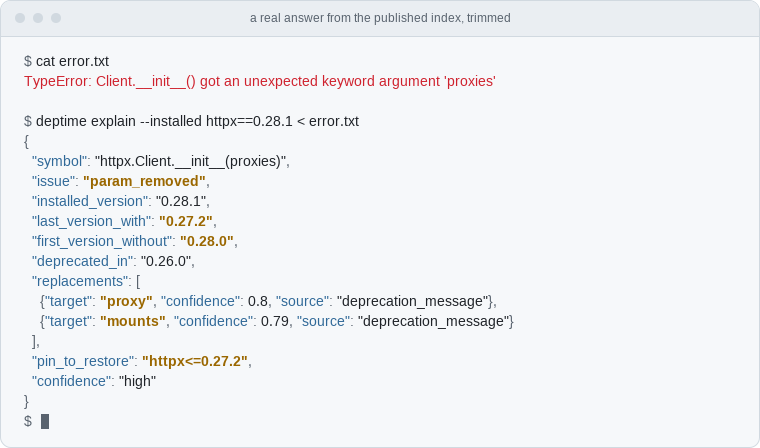
An agent that hits this error:
TypeError: Client.__init__() got an unexpected keyword argument 'proxies'
passes it to explain_error and gets:
{
  "symbol": "httpx.Client.__init__(proxies)",
  "issue": "param_removed",
  "installed_version": "0.28.1",
  "last_version_with": "0.27.2",
  "first_version_without": "0.28.0",
  "deprecated_in": "0.26.0",
  "replacements": [
    {"target": "proxy", "confidence": 0.8, "source": "deprecation_message"},
    {"target": "mounts", "confidence": 0.79, "source": "deprecation_message"}
  ],
  "pin_to_restore": "httpx<=0.27.2",
  "confidence": "high"
}
That's the real answer from the published index, trimmed. The full answer also quotes the deprecation message DepTime found in httpx's own source, and adds a one-sentence explanation for the agent to pass on:
httpx.Client.init accepted
proxiesup to httpx 0.27.2; it is gone from 0.28.0 onward. Deprecated in 0.26.0 ("The 'proxies' argument is now deprecated. Use 'proxy' or 'mounts' instead."). Useproxyormountsinstead, or pin httpx<=0.27.2.
Tools
| Tool | Use it when |
|---|---|
explain_error(traceback, installed_versions?, pip_freeze?) |
An import or call into a library just failed |
symbol_history(package, path) |
Before trusting an API you remember |
check_symbols(package, version, symbols[{path, kwargs}]) |
Pre-flight check of the symbols and kwargs you're about to use |
diff_versions(package, from_version | date, to_version?, used_symbols?) |
Upgrading, or "what changed since my training cutoff?" |
coverage() |
What's indexed (53 fast-moving packages: AI/agent stack + libraries with known breaking changes; list) |
Every answer carries evidence and a confidence level. The contracts are in docs/03-product-spec.md.
How well it works
Every DepTime number in the table is a first run: the cases and their right answers were collected and committed before DepTime ever ran on them.
| How often does it… | First run | Measured on |
|---|---|---|
| find the right package, name and breaking release from a real traceback? | 87% (166 of 191) | Tracebacks from GitHub issues and Stack Overflow, in six sets |
| …and a language model alone, answering the same tracebacks from memory with no tools? | 82% to 84% (Claude Sonnet 5.5 and Opus 5.5), 66% to 69% (Haiku 5.5), 59% (DeepSeek V4.1 Flash), 19% (Qwen3.5 9B) | The same 191, scored the same way. The larger models name the change and its replacement more often than DepTime, and the release less often |
| offer the right replacement among its first three suggestions? | 48% (41 of 85) | The same tracebacks, where a replacement is known |
| flag code that still works after an upgrade? (lower is better) | 0.1% (2 of 2,047) | Uses of covered packages in real projects, labelled by running them. Newest of six sets; the oldest scored 3.8% |
| find the code that an upgrade breaks? | 100% (147 of 147) | The same projects. Newest set; the six range from 95.9% to 100% |
| …and a language model alone, judging the same uses from memory? | Breaks found and working code flagged: 91% and 0.2% (Sonnet 5.5), 74% and 0.3% (Haiku 5.5), 81% and 2.7% (DeepSeek V4.1 Flash), 31% and 15% (Qwen3.5 9B) | The same 2,265 uses, one run per model, scored the same way, counting unknown as not flagged; counted that way, DepTime finds 96.7% |
- The upgrade checks are the strong part. The last two rows are
check_symbols. On the same set,diff_versionsfound 96.7% of the breaks (147 of 152) and flagged 0.1% of working code (2 of 2,113). - The smaller the model, the more DepTime adds. Claude Opus and Sonnet alone come within a few points of it. Haiku, DeepSeek V4.1 Flash and Qwen3.5 9B fall 18 to 68 points behind on the tracebacks, and on the upgrade checks the two cheaper ones flag 2.7% and 15% of working code, against DepTime's 0.1%.
- Replacements are the weak part. On unseen errors the right one is offered about half the time, where the Claude models in the second row offer it 87% to 99% of the time. A suggestion at confidence 0.75 or more is usually right: 11 of 11 on the first run over 50 documented migrations, 42 of 45 now.
- The same cases score higher today (97.2% of all 393 real tracebacks in the benchmark), because fixes were designed from their misses. That is why the first run is the number to trust.
- Where it can't tell, it says so.
check_symbolsansweredunknown, with the reason, for 66 working uses and 5 breaks of the newest set, which are left out of its rates above.
Every set, every later re-run and each miss is in bench/README.md. CI re-scores all of it on every code change and every published index, and fails on a drop of more than 2 points.
What it doesn't do
- It covers the packages on its list, not all of PyPI, and every release of each minor series active since 2023. For anything else the answer is "not covered".
- It reads source without running it. A name that only exists once the library is running (built by compiled code, or computed at import time) can read as
unknown, or occasionally as missing. - It sees names, parameters and deprecations, not behaviour. A function that keeps its signature but changes what it does is invisible to it.
- Python only.
How it works
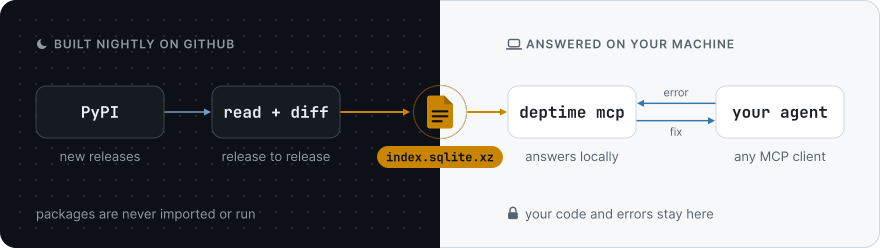
Twice a day, GitHub Actions reads each new release's public API with griffe, which parses the source without running it, diffs it against the previous release, and publishes the result as one file, index.sqlite.xz, on this repo's Releases. On your machine, deptime mcp checks that file's sha256 and schema before swapping it in, then answers every question locally in milliseconds. The full design is in docs/04-architecture.md, and the decisions are in docs/adr/.
CLI
uvx deptime explain --installed httpx==0.28.1 < traceback.txt
uvx deptime history httpx Client.__init__
uvx deptime check httpx 0.28.1 'httpx.Client:proxies,proxy'
uvx deptime diff httpx 0.27.2 0.28.1
uvx deptime diff pydantic 2024-06-01              # everything since a date
uvx deptime index status | pull
Hosting (optional)
Local mode covers coding agents. For web clients that only accept a URL, run deptime serve (MCP at /mcp, JSON at /v1/*) on any container host. The repo includes a Dockerfile and fly.toml, and the server applies anonymous rate limits. See docs/05-self-hosting.md.
Prior art and credits
- griffe does the static analysis.
- since-cutoff diffs your pinned dependencies against a model's training cutoff, locally and on demand. DepTime differs by shipping a prebuilt cross-version index and starting from a traceback.
- Context7 and Ref serve version-specific docs. DepTime answers symbol-level "when and what replaced it" questions.
Contributing
The most useful contributions are wrong-answer reports, which become benchmark cases. See CONTRIBUTING.md. Development setup:
uv sync && uv run pytest
# build a small local index from real PyPI wheels
uv run deptime ingest httpx --versions 0.27.2 0.28.1
Docs
Product spec · Architecture · Self-hosting · Risks & spikes · Privacy & security · Benchmark · Changelog
License
1 maintainer

Metadata
1 maintainer
Release files for deptime 0.1.17
For a detailed explanation of source distributions (sdists) and built distributions (wheels), please see the package formats documentation.
Source distribution (sdist)
| File | Size | Uploaded | Provenance | Actions |
|---|---|---|---|---|
| deptime-0.1.17.tar.gz | 459.7 kB | With provenance | Details for deptime-0.1.17.tar.gz |
Built distribution (wheel)
| File | Interpreter | ABI | Platform | Actions Reset |
|---|---|---|---|---|
| deptime-0.1.17-py3-none-any.whl | Python 3 | none | any | Details for deptime-0.1.17-py3-none-any.whl |
Total release size: 729.4 kB
Release files / deptime-0.1.17.tar.gz
| Download URL | deptime-0.1.17.tar.gz |
|---|---|
| Size | 459.7 kB |
| Tags | Source |
|
SHA-256 checksum How to use checksums |
a179d027d831f8b81248eac1026321f35d0c893944b4e9aba68dea73cced5321
|
|
BLAKE2b-256 checksum How to use checksums |
3c75746a0d9fbc1229a20d5458e2d37c00e59ecac777493496705e34afe03abc
|
| Upload date | |
|
Uploaded using Trusted Publishing? What is trusted publishing? |
Yes |
| Uploaded via |
twine/7.0.0 CPython/3.13.16
|
Provenance
Provenance describes where a file came from. On PyPI, provenance is shared via attestations, which provide a verifiable record of the build or publishing details. View details, limitations and caveats.


PyPI Publish Attestation
PyPI verified that this artifact, at this checksum, originated from the publisher listed below.
Signed by GitHub Actions, verified by PyPI on Nov 15, 2026.
Transparency logRelease files / deptime-0.1.17-py3-none-any.whl
| Download URL | deptime-0.1.17-py3-none-any.whl |
|---|---|
| Size | 269.7 kB |
| Tags | Python 3 |
|
SHA-256 checksum How to use checksums |
fec98811d900d149fa652f2bc88b45ec80cc6a51f3655958acfba372eda9b16d
|
|
BLAKE2b-256 checksum How to use checksums |
e34fa7618f06d48bedcbf355609ed544b0a13ef82e50f5c3fc38291182d71e5c
|
| Upload date | |
|
Uploaded using Trusted Publishing? What is trusted publishing? |
Yes |
| Uploaded via |
twine/7.0.0 CPython/3.13.16
|
Provenance
Provenance describes where a file came from. On PyPI, provenance is shared via attestations, which provide a verifiable record of the build or publishing details. View details, limitations and caveats.
PyPI Publish Attestation
PyPI verified that this artifact, at this checksum, originated from the publisher listed below.
Signed by GitHub Actions, verified by PyPI on Nov 15, 2026.
Transparency logSecurity for deptime 0.1.17
Provenance
Provenance describes where a file came from. On PyPI, provenance is shared via attestations, which provide a verifiable record of the build or publishing details. View details, limitations and caveats.
Full provenance
Both files in this release have been uploaded with provenance metadata.
Attestation for deptime-0.1.17.tar.gz
PyPI Publish Attestation
PyPI verified that this artifact, at this checksum, originated from the publisher listed below.
Signed by GitHub Actions, verified by PyPI on Nov 15, 2026.
Transparency logA note on package security
PyPI is a repository for distributing packages, not a service for auditing them. While third-party security researchers and our staff do their best to detect and remove malicious packages, PyPI cannot guarantee the quality, security or suitability of any given package.
To learn more about protecting yourself from malicious actors, visit our package security documentation.














