
desflow
Realistic event streams from a simulation you can steer while it runs.





desflow is a Python library and a command that simulate a working process, such as a shop that packs orders, and write what happens in it as events. You can change the simulation while it runs, and the events change with it.
The simulation is a discrete-event simulation (DES): the model moves from one event, such as an order arriving or a packer finishing, to the next. desflow builds it on SimPy. Orders queue for the packers, waits grow at busy times, and a backlog builds when orders arrive faster than they can be packed. Each change in the data therefore has a cause in the model, as in a real shop, unlike rows drawn at random.
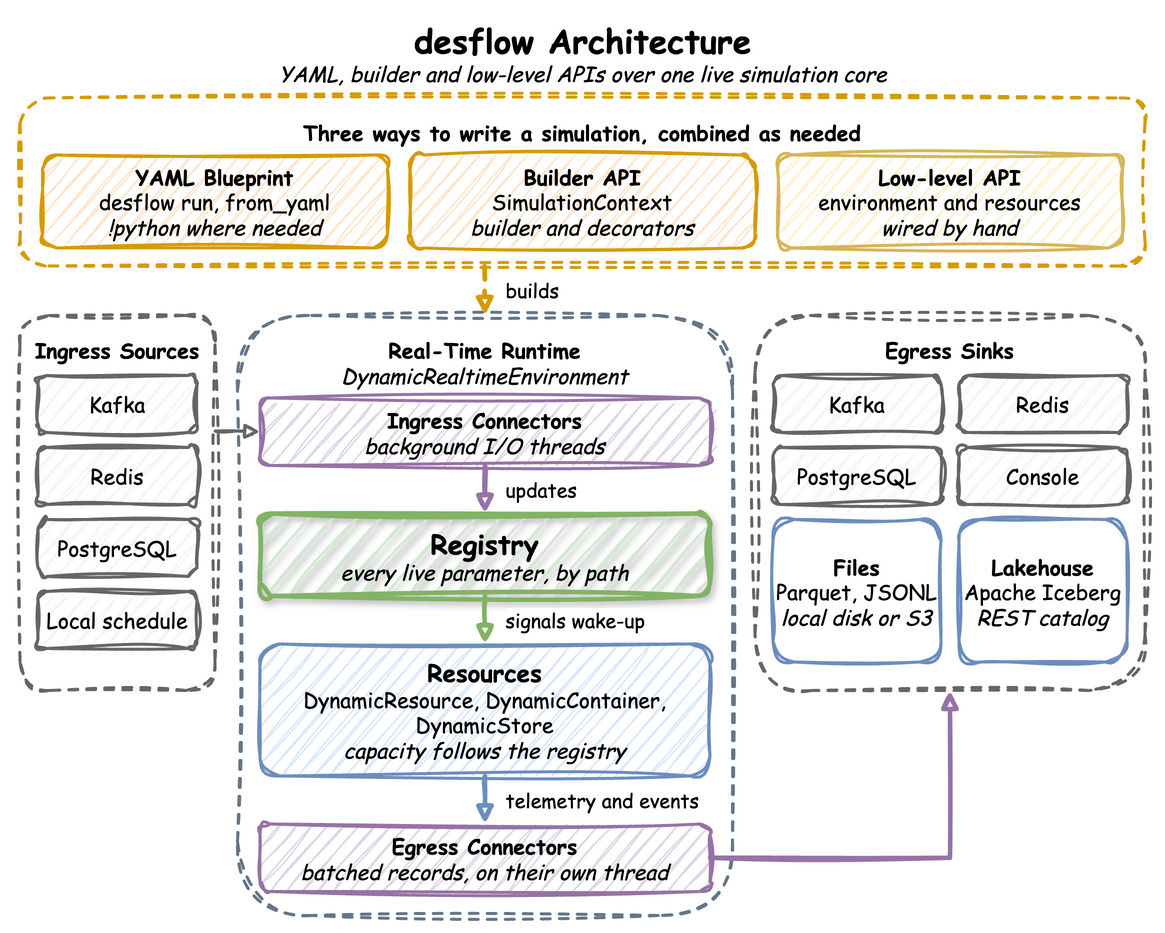
How desflow Works explains each part of this diagram. Why desflow tells how the project started.
What It Is For
- Simulation studies. A question such as how many packers a shop needs is answered from many runs of a model, not from one. desflow repeats the runs, gives each result with its margin of error and compares designs of the shop. Before a long run,
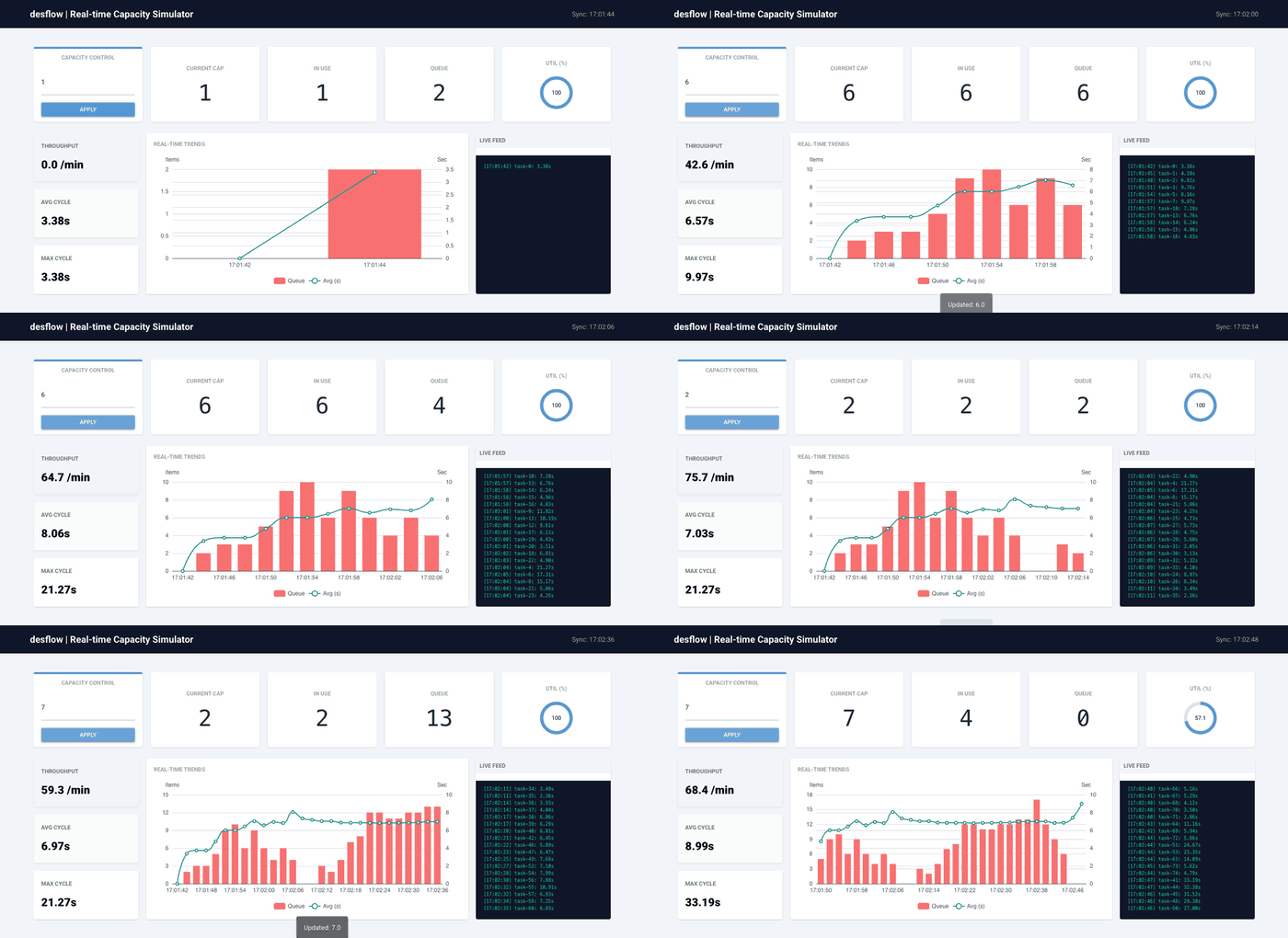
desflow explainnames the busiest resource from the model alone. - Data engineering. Batch and streaming pipelines need test data that behaves like a real system. One run can write a week of history at full speed, then keep streaming in real time. In the Kafka Digital Twin example, a dashboard changes an arrival rate or a capacity during a run, and the data follows without a restart.
- Machine learning and MLOps. A model that predicts delays needs training data in which queues build and clear for a reason. A change made during a run shifts the data at a known time, which is what a drift monitor has to catch.
- AI. An anomaly detector or an AI agent is scored against a known answer. A run can plant a fault, such as a label printer going offline, and record what it planted in separate label records. An AI coding assistant can write and check models with the desflow skill.
Features
| Group | What it covers |
|---|---|
| Ways to write a model | a YAML blueprint with no Python, a Python script with the builder API, or SimPy code with the low-level API. All three build the same model and publish the same records. |
| Model parts | arrivals drawn from a distribution, changed on a schedule or replayed from a file; tasks that run in a flow, with routing, rework and priorities; resources with queues, preemption, breakdowns and queue limits; stores and containers; signals, waits, patience and failures |
| Time | a run in real time or at full speed, history written at full speed and then carried on live, and a run that ends at a time, on an event or once the last work has left |
| Live changes | arrival rates, service times and capacities changed during a run by name, such as Shop.arrival.orders.rate, from a timed scenario, a local schedule, a file you edit, Kafka, Redis or PostgreSQL |
| Records | an event for each step of each entity, telemetry with the statistics, and label records that hold the ground truth of each planned change. Records are JSON, Avro, JSON Schema or Protobuf through the Confluent or AWS Glue Schema Registry, or Pydantic models. |
| Connectors | several sinks in one run, each with its own filter: Kafka, including SASL, mTLS, OAuth and AWS IAM clusters, Redis, PostgreSQL, Parquet or JSONL files on local disk, S3-compatible storage, Google Cloud Storage or Azure Blob Storage, and Iceberg tables. A connector of your own is one class. |
| Studies | built-in statistics with a warm-up, replications with a 95% interval for each statistic, experiments that compare designs with the same random numbers and write a report, a check against the queueing formulas before a long run, and distributions fitted to measured times |
| Tools | the desflow command, a JSON Schema that gives an editor completion for blueprints, and a skill with which an AI coding assistant writes and checks blueprints |
Installation
Install the core library with uv or pip.
With uv:
# desflow command
uv tool install desflow

# Or the library, in a uv project
uv add desflow
With pip:
pip install desflow
Connectors and input fitting are optional extras. For example, uv add "desflow[kafka,parquet]" or pip install "desflow[kafka,parquet]", and uv tool install "desflow[kafka,parquet]" for the desflow command:
| Extra | Adds |
|---|---|
kafka |
Kafka ingress and egress |
confluent |
Avro, JSON Schema and Protobuf with the Confluent Schema Registry (includes kafka) |
glue |
Avro, JSON Schema and Protobuf with the AWS Glue Schema Registry (includes kafka) |
redis |
Redis ingress and egress |
postgres |
PostgreSQL ingress and egress |
parquet |
Parquet and JSONL files on local disk, S3-compatible storage, Google Cloud Storage or Azure Blob Storage |
iceberg |
Apache Iceberg tables through a REST catalog, a SQL catalog on SQLite or PostgreSQL, or the Glue catalog |
fit |
scipy and matplotlib, for input fitting with desflow fit |
fake |
Faker, for the fake generator of realistic names, addresses and dates |
watch |
watchfiles, for desflow run --watch, which runs the file again each time it changes |
all |
Every extra above |
Two cautions apply to the fake extra. A seeded fake field gives the same values again only with the same version of Faker. A Faker method that reads the date, such as date_between, reads the wall clock and not the simulation clock.
Upgrading from dynamic-des. desflow was previously called dynamic-des. Install, import and run desflow. Version 1.0 removed the dynamic_des module and the ddes command, so code that imports dynamic_des and scripts that run ddes must change to desflow. The Changelog says what to change.
Quick Start
This blueprint models the shop: one packer, an order about every 2 seconds and 1.5 seconds of packing, with every record printed to the terminal:
# First Simulation tutorial: the shop as a blueprint.
# Run it with: desflow run first_shop.yaml
simulation:
  sim_id: Shop
  factor: 1.0  # 1 simulated second takes 1 real second
  random_seed: 42  # the same arrival times on every run

resources:
  packers: {current_cap: 1, max_cap: 1}

services:
  # Every order takes exactly 1.5 seconds to pack
  packing: {dist: constant, value: 1.5}

arrivals:
  # One order every 2 seconds on average; each arrival spawns pack_order
  orders: {dist: exponential, rate: 0.5, spawn: pack_order}

tasks:
  pack_order:
    service: packing
    resource: packers
    # The value of the finished event
    payload: {event_type: order_packed}

egress:
  - {type: Console}

run: {until: 20}

tests:
  # Run with: desflow test first_shop.yaml
  - name: seven_orders_in_20_seconds
    expect: {tasks.pack_order.finished: 7}
Save it as first_shop.yaml and run desflow run first_shop.yaml. First Simulation builds this model step by step, with the YAML, builder and low-level code side by side.
Each runnable example is a complete model. The local example needs no container. desflow examples get downloads it at the release you installed, into a folder of its own, and desflow run runs it:
desflow examples get local --api yaml
cd local/yaml
desflow run local.yaml
--api builder or --api low-level downloads the other two versions. Each example page says which odctl service it needs.
Commands
desflow runs a blueprint, and checks, compares and fits models without a line of Python. Command Line uses every command on one shop.
| Command | What you use it for | How to use it | Reference |
|---|---|---|---|
desflow examples |
list the examples, and download one with get |
Get an Example | desflow examples, desflow examples get |
desflow explain |
check a model for bottlenecks before a long run | Check It Before a Long Run | desflow explain |
desflow check |
check that blueprints and builder files build, without running them | Check It Before a Long Run | desflow check |
desflow run |
run a blueprint, or its replications with a 95% interval for each statistic | Run It | desflow run |
desflow test |
run the tests of a blueprint and report the statistics that differ |
Run It | desflow test |
desflow experiment |
compare designs of a model and check them against bounds | Compare Designs | desflow experiment |
desflow report |
build an experiment's report again from its files | Compare Designs | desflow report |
desflow fit |
fit every distribution family to measured times | Fit Measured Times | desflow fit |
desflow dist |
turn a mean and a standard deviation into a family's parameters, and back | Convert Parameters | desflow dist |
desflow schema |
print the blueprint JSON Schema, for an editor | Set Up an Editor | desflow schema |
Projects Using desflow
Six public projects generate their data with desflow: four data engineering and MLOps demos in benchtop, the Agentic Analytics System and a hot strip mill digital twin. Projects Using desflow says what desflow simulates in each.
Learn More
- The documentation covers every part of desflow.
- Learn teaches discrete-event simulation from the start, then builds one shop through a whole study.
- The roadmap page shows what each release adds and what comes next.
- Blog posts about desflow are tagged desflow on jaehyeon.me.
Contributing
CONTRIBUTING.md explains how to set up the repository, run the tests, add a connector or a distribution, and write the docs.
License
MIT
1 maintainer

Metadata
1 maintainer
Release files for desflow 1.0.0
For a detailed explanation of source distributions (sdists) and built distributions (wheels), please see the package formats documentation.
Source distribution (sdist)
| File | Size | Uploaded | Provenance | Actions |
|---|---|---|---|---|
| desflow-1.0.0.tar.gz | 645.8 kB | With provenance | Details for desflow-1.0.0.tar.gz |
Built distribution (wheel)
| File | Interpreter | ABI | Platform | Actions Reset |
|---|---|---|---|---|
| desflow-1.0.0-py3-none-any.whl | Python 3 | none | any | Details for desflow-1.0.0-py3-none-any.whl |
Total release size: 1.3 MB
Release files / desflow-1.0.0.tar.gz
| Download URL | desflow-1.0.0.tar.gz |
|---|---|
| Size | 645.8 kB |
| Tags | Source |
|
SHA-256 checksum How to use checksums |
f18a0c6eff34448ca56b81cfd41d8c2ed59052d6fbf92212d1148a9720b6b67c
|
|
BLAKE2b-256 checksum How to use checksums |
ebd4dd202370022f2f923e83874368d96891f7bb849e212b035e483d3da24753
|
| Upload date | |
|
Uploaded using Trusted Publishing? What is trusted publishing? |
Yes |
| Uploaded via |
twine/7.0.0 CPython/3.13.16
|
Provenance
Provenance describes where a file came from. On PyPI, provenance is shared via attestations, which provide a verifiable record of the build or publishing details. View details, limitations and caveats.


PyPI Publish Attestation
PyPI verified that this artifact, at this checksum, originated from the publisher listed below.
Signed by GitHub Actions, verified by PyPI on Nov 14, 2026.
Transparency logRelease files / desflow-1.0.0-py3-none-any.whl
| Download URL | desflow-1.0.0-py3-none-any.whl |
|---|---|
| Size | 701.6 kB |
| Tags | Python 3 |
|
SHA-256 checksum How to use checksums |
9d8c7214cf32d8f6ccf200b0350b240103584c362d386916f609dc4f30a90159
|
|
BLAKE2b-256 checksum How to use checksums |
061f969f55ea016e209324f4cbe35d1c6bed8d173d2b32d1095749ab629464de
|
| Upload date | |
|
Uploaded using Trusted Publishing? What is trusted publishing? |
Yes |
| Uploaded via |
twine/7.0.0 CPython/3.13.16
|
Provenance
Provenance describes where a file came from. On PyPI, provenance is shared via attestations, which provide a verifiable record of the build or publishing details. View details, limitations and caveats.
PyPI Publish Attestation
PyPI verified that this artifact, at this checksum, originated from the publisher listed below.
Signed by GitHub Actions, verified by PyPI on Nov 14, 2026.
Transparency logSecurity for desflow 1.0.0
Provenance
Provenance describes where a file came from. On PyPI, provenance is shared via attestations, which provide a verifiable record of the build or publishing details. View details, limitations and caveats.
Full provenance
Both files in this release have been uploaded with provenance metadata.
Attestation for desflow-1.0.0.tar.gz
PyPI Publish Attestation
PyPI verified that this artifact, at this checksum, originated from the publisher listed below.
Signed by GitHub Actions, verified by PyPI on Nov 14, 2026.
Transparency logA note on package security
PyPI is a repository for distributing packages, not a service for auditing them. While third-party security researchers and our staff do their best to detect and remove malicious packages, PyPI cannot guarantee the quality, security or suitability of any given package.
To learn more about protecting yourself from malicious actors, visit our package security documentation.














