
Dialectical Framework
Dialectical AI: Achieving Objectivity and Synthesis in LLM Reasoning via Structured Tension Graphs
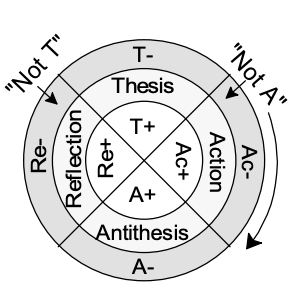
Ask a model a hard question and it tends to collapse the tension into one confident answer — or hedge with a bland "on one hand… on the other." This framework does neither. For every thesis it generates a genuine antithesis, maps precisely where each side overreaches (T-, A-) and where it constructively balances the other (T+, A+), and drives the pair toward a synthesis — not a compromise, but a new quality that emerges from their circular causality and that neither pole held alone.
The reasoning lives in a graph. Every move — surfacing a thesis, finding its opposition, developing its four aspects, arranging them into a Wheel — writes semantic, rule-validated nodes and edges into a graph database. The graph is the state: a persistent, compounding map of how a domain's tensions resolve, that any application can query, visualize, or build on.
And the synthesis is earned, not asserted. Where "think step by step" leaves rigor to chance, formal generative rules define what counts as valid: exactly one antithesis per thesis, modality kept in balance, and positive synthesis (S+) only when T-'s excess transforms into A+ and A-'s into T+. The structure enforces a discipline the prompt alone can't.
Learn More
How It Works
- Input — text or raw ideas from any domain (URLs, uploads and other sources
once you supply an
InputResolver— the default fetches nothing) - Analysis — extract the theses, find each one's true antithesis, develop the four aspects (T+, T-, A+, A-) that say where each side helps and where it overreaches
- Graph curation — commit every insight as content-addressed, rule-validated nodes and edges — nothing is stored until it holds up
- Exploration — combine perspectives into Cycles, arrange them into Wheels, and trace the Transformations whose circular causality yields synthesis
Each pass leaves the graph richer than it found it: new tensions enter an existing web of validated reasoning, so understanding compounds instead of resetting every prompt.
Architecture
Host Application (Chainlit, API, CLI)
        │
        ▼
    Agent: Analyst · Explorer · Advisor (LLM + tools)
        │
        ▼
    Graph Database (Memgraph / Neo4j)
An agent is the entry point — a thin LLM orchestrator that manages a conversation with tools that read and write the graph. There are three (Analyst, Explorer, Advisor); each owns a tool set and a domain-neutral reasoning prompt. The host app controls persona (via the app preamble) and scope identity (sid); the framework handles reasoning and graph curation. See docs/agents.md.
Docs
- What you can build — the four heads, the seven axes, the Advisor's six configurations, and recipes from app idea to construction (start here)
- Agents: Analyst, Explorer, Advisor — the building blocks, their tools, and the UX to build around them
- Graph Data Model
- Scoring & Metrics
- Runnable: examples/advisor_chat.py (console chat),
notebooks/minds.ipynb and
notebooks/seasons.ipynb (building an app with
AppSpec)
Why a Reasoning Graph
Most AI systems treat knowledge as flat context — dump text into the prompt and hope the LLM figures out the structure. The dialectical framework builds a persistent reasoning graph where the structure itself encodes how to think about a domain:
- Oppositions are explicit. The LLM doesn't rediscover the tensions on every call — they persist as typed T/A pairs, so reasoning starts from a mapped conflict instead of a blank page.
- Transformations encode causality. Edges don't just connect — they show how one position's failure becomes another's strength. This is the circular causality that drives synthesis.
- Quality is measurable. Complementarity, modality balance, area metrics tell the LLM which reasoning paths are well-developed and which are thin — no guessing about confidence.
- Knowledge compounds. Each new perspective enters an existing graph of validated reasoning. The LLM builds on prior synthesis rather than re-deriving from scratch.
The result: an LLM with this graph in context doesn't just have facts about a topic — it has the intellectual terrain mapped. What opposes what, where balance was achieved, what assumptions remain untested, and where synthesis is possible.
This is the LLM Wiki pattern realized as a semantic graph rather than a pile of markdown files — knowledge that is structured, rule-validated, and queryable by reasoning topology.
| Simple | Detailed |
|---|---|
 |
 |
Core Graph Structure
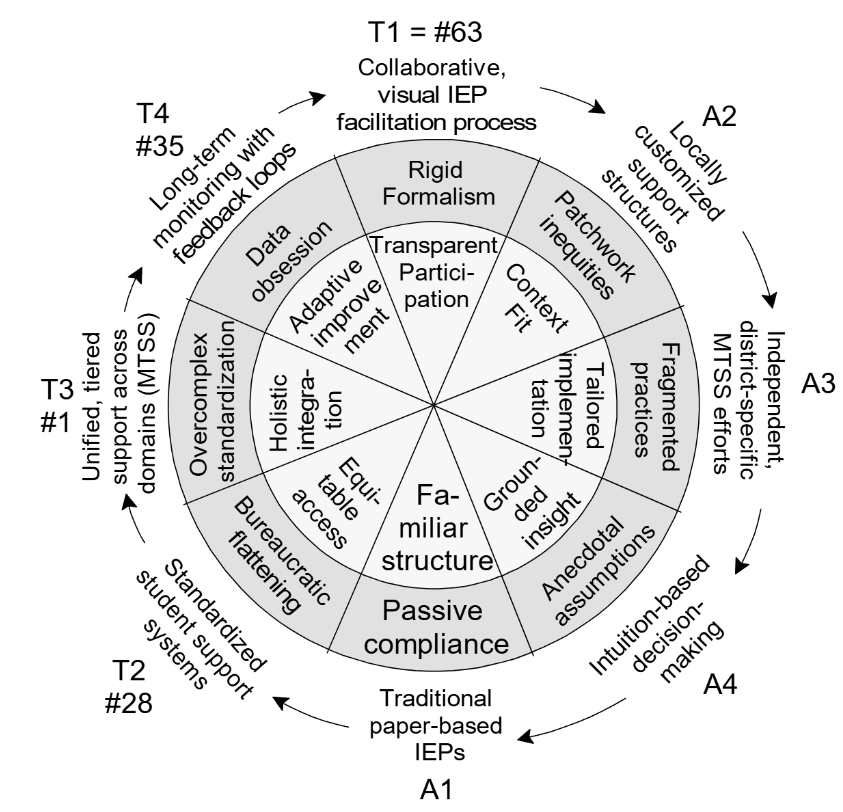
It's all one graph. Statements are the atoms; typed edges carry the dialectical relationships — opposition, complementarity, transformation — and each structure below composes the ones above it into progressively richer reasoning, culminating in the Dialectical Wheel.
| Structure | Role |
|---|---|
| Statement | Atomic unit of meaning — a thesis, position, or claim |
| Polarity | A single T↔A tension (thesis vs. antithesis); reusable across perspectives |
| Perspective | A full tetrad — a Polarity developed with its four aspects (T+, T-, A+, A-) |
| Nexus | A working set of Perspectives grouped for exploration |
| Cycle | An ordered sequence of Perspectives — which tension drives which |
| Wheel | A concrete circular arrangement of a Cycle, with the edges between components |
| Transition | A directed edge between two components — one step around the Wheel |
| Transformation | The Action-Reflection paths on an edge that turn one pole's excess into the other's strength |
| Synthesis | The emergent S+/S- arising from the whole Wheel's circular causality |
Picture the Wheel as a pizza sliced into segments: each segment bundles a component with its plus and minus (e.g. T, T+, T-), a Perspective joins a thesis segment with the antithesis segment directly across from it, and Transitions are the arrows running segment to segment around the rim.
Integration
Wherever the answer is a tension rather than a fact, this drops in as the reasoning engine: decision support that weighs both sides, systems thinking, mediation between opposed positions, ethical modeling. You wire it into your app through three conversational agents — the main building blocks:
- Analyst — turns raw material into structured tensions, up to grouping them into a Nexus (Case-scoped).
- Explorer — takes one Nexus and works out its causal pathways and synthesis (Nexus-scoped).
- Advisor — runs the whole machine silently and returns pure counsel, with no framework vocabulary exposed (Case-scoped). Its sealed configuration (
Advisor(build=BuildPolicy.NEVER)) is the same head over a graph that already exists: it reads, records decisions, and never builds — the fast surface for a return visit.
Analyst + Explorer are the structure-forward "graph navigator" experience; the Advisor is a chat-only product over the same graph, and Consultant is the method alone with no graph at all. See docs/surfaces.md for the map of what can be built and docs/agents.md for full specs, tool lists, and the UX to build around each.
import asyncio
from contextlib import aclosing

from dialectical_framework.dialectical_reasoning import DialecticalReasoning
from dialectical_framework.settings import Settings
from dialectical_framework.graph.nodes.case import Case
from dialectical_framework.graph.scope_context import scope
from dialectical_framework.agents.advisor.advisor import Advisor
from dialectical_framework.agents.stream_events import TextDelta


async def main():
    # Initialize once
    DialecticalReasoning.setup(Settings.from_env())

    # A Case owns the scope id (sid); all graph writes are sid-scoped.
    case = Case(); case.commit()

    with scope(case.sid):
        # `principal="human"` because a real person is on the other end: it is
        # what lets a decision they confirm be recorded as THEIR confirmation.
        # The default attests nobody — see docs/agents.md.
        advisor = Advisor(
            app_preamble="You are a systems thinking coach...", principal="human"
        )
        # `aclosing` because a host that stops MID-TURN must CLOSE the generator
        # — that is what releases the provider connection and records the turn's
        # seconds. Breaking on `ResponseComplete` needs none of it: that event is
        # yielded after the turn's closing work. See docs/agents.md.
        async with aclosing(
            advisor.chat_stream("Analyze the tension between growth and sustainability")
        ) as events:
            async for event in events:
                # ThinkingDelta, TextDelta, ToolStart, ToolResult, ResponseComplete
                if isinstance(event, TextDelta):
                    print(event.text, end="", flush=True)

        # Once, after the last turn: the Advisor weaves a decision's pathway off
        # the turn, and this is where that finishes. See docs/agents.md.
        await advisor.wait_for_deferred_work()


asyncio.run(main())
Runnable versions of the above:
- examples/advisor_chat.py — a console chat, and the
smallest program in which all five host obligations are load-bearing (
poetry run python examples/advisor_chat.py). - notebooks/minds.ipynb — plugging your own domain in
with a single declarative
AppSpec. - notebooks/seasons.ipynb — one
AppSpecacross every agent head (Analyst, Explorer, Advisor, and the advisory toggle).
Setup
Requirements
- Python 3.11+
- Memgraph or Neo4j
- An LLM provider (OpenAI, Anthropic, or Bedrock via a custom Mirascope provider)
Install
Into your own application:
pip install dialectical-framework
To work on the framework itself:
poetry install
Either way, configuration comes from the environment:
cp .env.example .env # then fill in the values (see .env.example for details)
DIALEXITY_DEFAULT_MODEL is the only variable the framework itself requires (plus
whatever credentials your provider's SDK reads). Everything else is commented out in
.env.example, where each commented value is the code default — so the graph
connection works as-is against Memgraph on 127.0.0.1:7687.
Run Tests
poetry run pytest              # All tests (LLM mocked)
poetry run pytest -m llm       # Only LLM-path tests (mocked)
poetry run pytest --real-llm   # Hit real LLM provider
Built With
- Mirascope — LLM abstraction
- GQLAlchemy — Graph ORM
- dependency-injector — DI container
License & Patents
The source code is licensed under the MIT License (copyright only).
The methods for applying dialectical reasoning with AI are patented. The MIT License does not grant patent rights beyond a limited grant for use of this software as distributed — see PATENTS for the patent terms and dialexity.com/patents for the patent listing.
1 maintainer

Metadata
1 maintainer
Release files for dialectical-framework 2.0.6
For a detailed explanation of source distributions (sdists) and built distributions (wheels), please see the package formats documentation.
Source distribution (sdist)
| File | Size | Uploaded | |
|---|---|---|---|
| dialectical_framework-2.0.6.tar.gz | 723.7 kB | Details |
Built distribution (wheel)
| File | Interpreter | ABI | Platform | Reset |
|---|---|---|---|---|
| dialectical_framework-2.0.6-py3-none-any.whl | Python 3 | none | any | Details |
Total release size: 1.6 MB
Release files / dialectical_framework-2.0.6.tar.gz
| Download URL | dialectical_framework-2.0.6.tar.gz |
|---|---|
| Size | 723.7 kB |
| Tags | Source |
|
SHA-256 checksum How to use checksums |
f130e2bf6e86485d490a2341a7ab568d61561a0250f277a5be2786a71ad7cfd6
|
|
BLAKE2b-256 checksum How to use checksums |
f39815d0cdc341b355b4cb6d619ee2e089cad9f9c5d95fc6ffc2a9dddc29e9fc
|
| Upload date | |
|
Uploaded using Trusted Publishing? What is trusted publishing? |
No |
| Uploaded via |
poetry/2.1.1 CPython/3.11.8 Darwin/25.6.0
|
Release files / dialectical_framework-2.0.6-py3-none-any.whl
| Download URL | dialectical_framework-2.0.6-py3-none-any.whl |
|---|---|
| Size | 866.8 kB |
| Tags | Python 3 |
|
SHA-256 checksum How to use checksums |
82582a7608d0391ccefec182ae189f77b3b3a90b15905d59e49a2cf6dffd83a8
|
|
BLAKE2b-256 checksum How to use checksums |
9e599951c868a194517c115ea5a45a2d00e23e3b5cd6b6993085bead9eb79ce2
|
| Upload date | |
|
Uploaded using Trusted Publishing? What is trusted publishing? |
No |
| Uploaded via |
poetry/2.1.1 CPython/3.11.8 Darwin/25.6.0
|














