
A dialectical framework for augmented intelligence. AI reasoning powered with dialectics supports humans in: system optimization (psychology, engineering, business, politics, etc.); dispute resolution (mediation, conflicts, negotiations, etc.); decision-making (dilemmas, challenging situations, win-win, etc.).

Project description
Dialectical Framework
Turn stories, strategies, or systems into insight. Auto-generate Dialectical Wheels (DWs) from any text to reveal blind spots, surface polarities, and trace dynamic paths toward synthesis. DWs are semantic maps that expose tension, transformation, and coherence within a system—whether narrative, ethical, organizational, or technological.
What It Does:
- Converts natural language into Dialectical Wheels (DWs)
- Highlights thesis–antithesis tensions and feedback loops
- Reveals overlooked leverage points and systemic blind-spots
- Maps decisions, ethics, or mindsets across dialectical structures
Built for:
- Systems optimization
- Wisdom mining & decision diagnostics
- Augmented intelligence / narrative AI
- Ethical modeling & polarity navigation
Useful for:
- Consultants, coaches, facilitators, and system designers
- Storytellers, educators, and regenerative thinkers
- Strategists, SDD/BIMA practitioners, values-driven innovators
Learn more:
Development
Contributors Welcome!
We invite developers, philosophers, cognitive scientists, and regenerative ecosystem builders to co-create with us.
Setup
Behind the scenes we heavily rely on Mirascope
Environment Variables
| Variable Name | Description | Example Value |
|---|---|---|
| DIALEXITY_DEFAULT_MODEL | Default model name for the framework | gpt-4 |
| DIALEXITY_DEFAULT_MODEL_PROVIDER | Model provider (required) | openai |
You can store these in a .env file or export them in your environment.
These will specify the default "brain" for your reasoning.
Architecture
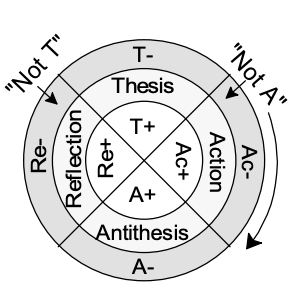
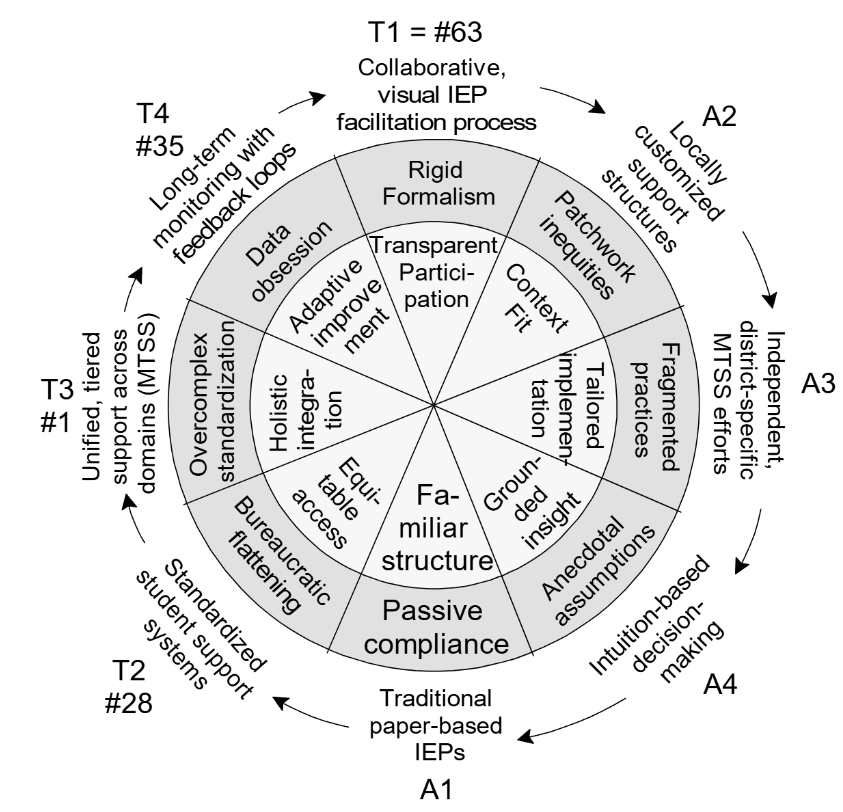
At the core of the dialectical framework is a dialectical wheel. It is a fancy semantic graph where nodes are statements or concepts and edges are relationships such as "opposite of," "complementary to," etc. To make the graph more readable, it's depicted as a 2D wheel.
| Simple | More Complicated |
|---|---|
 |
 |
The main architectural parts are:
- Wheel
- Wheel Segment
- Wisdom Unit
- Dialectical Component
- Transition
Wheel is composed of segments. Think of a dialectical wheel as a pizza, a segment is a slice of pizza. In the simplest case it represents some thesis (a statement, a concept, an action, a thought, an idea, etc.). A thesis can have positive and negative things related to it. Hence, a segment of a wheel is composed of these dialectical components: a thesis (T), positive side of that thesis (T+) and a negative side of that thesis (T-). In more detailed wheels, a segment could have more than 3 layers.
If we take two opposite segments, we get the basic (and the most important) structure: Wisdom Unit (half-wheel, verified by diagonal constraints: control statements). It's composed of:
| Dialectical Component | Description |
|---|---|
| T- | Negative side of the main thesis |
| T | The thesis |
| T+ | Positive side of the main thesis |
| A+ | Positive side of the antithesis |
| A | The antithesis |
| A- | Negative side of the antithesis |
In a Wheel, segments next to each other are related. We wrap that relationship into a Transition. Practically, a Transition is a recipe for how to go from one segment to another in a way that we approach synthesis. Essentially, it shows how the negative side of a given thesis (Tn-) converts into the positive side of the following thesis (T(n+1)+). If we were to look at a wheel as a sliced pizza, the lines that separate the slices would be Transitions.
If we derive Transitions in a Wheel with only 2 segments (aka half-wheel), they are symmetrical and represent a special kind of Wisdom Unit, we call it Action (Ac) and Reflection (Re). As any Wisdom Unit, Action and Reflection must be verified by diagonal constraints as well.
Prototyping & App Ideas
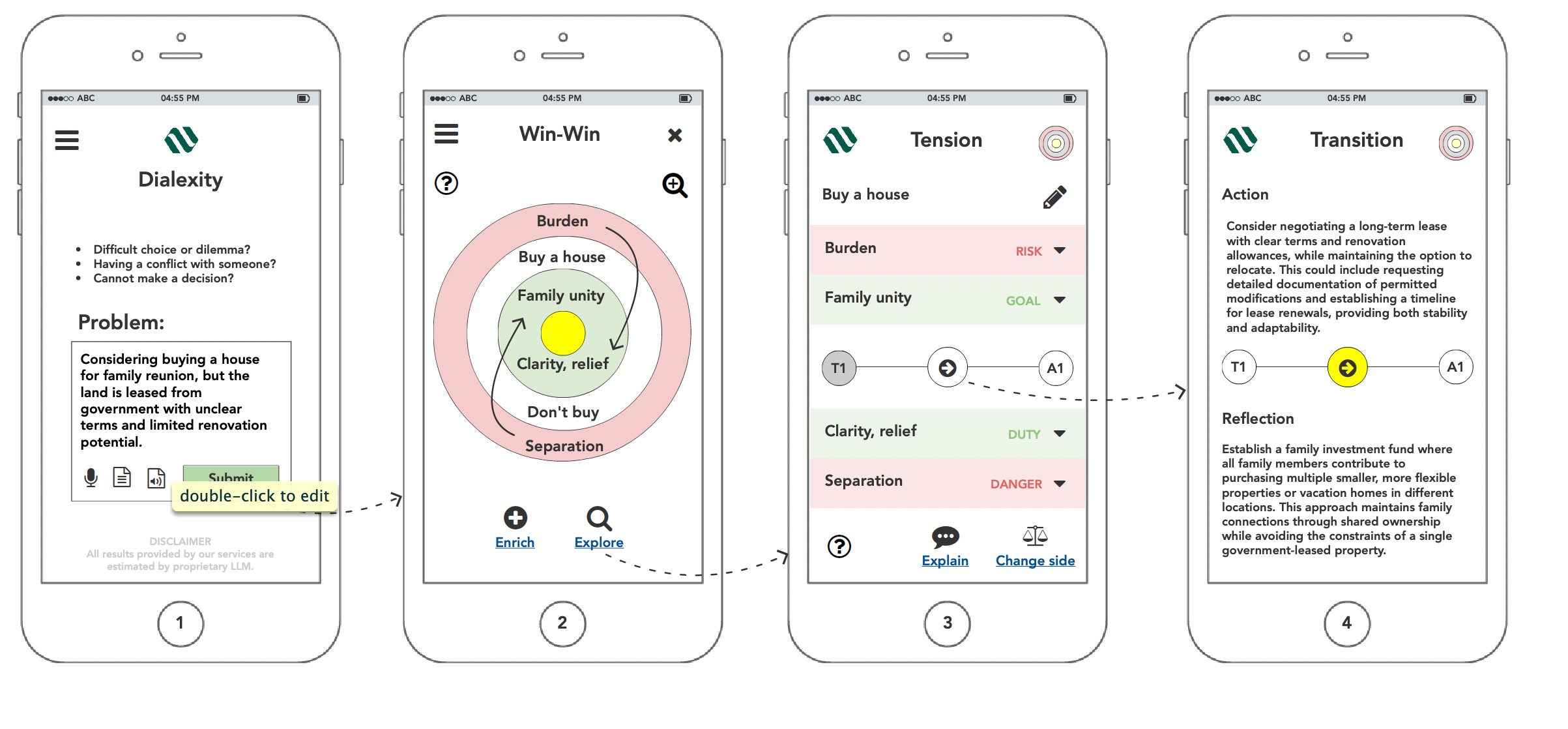
Simple Win-Win Finder
Eye-Opener
Working beta product Eye Opener. It's a tool that analyzes text and generates a visual map of its underlying structure and hidden assumptions. The core feature is a graph-like interface we call the Dialectical Wheel, that shows the delayed dialectical responses ("blind spots").
Argument Inspector
Working beta product Argument Inspector. Useful for analysts and mediators/facilitators to deeper understand the case.
Atlas of Feelings
The Atlas of Feelings is the Plutchik's wheel converted into the „vortex“ model, whereby the most gentle emotions are inside of the wheel, whereas the rudest are outside. As everything is interconnected with dialectical rules, we can understand human nature better.
"Spiral" Lila game
In this blog post we explain how the ancient Lila (Leela) game has been elevated to a new level.
Release history Release notifications | RSS feed


Download files
Download the file for your platform. If you're not sure which to choose, learn more about installing packages.
Source Distribution
Built Distribution
Filter files by name, interpreter, ABI, and platform.
If you're not sure about the file name format, learn more about wheel file names.
Copy a direct link to the current filters
File details
Details for the file dialectical_framework-0.6.2.tar.gz.
File metadata
- Download URL: dialectical_framework-0.6.2.tar.gz
- Upload date:
- Size: 69.5 kB
- Tags: Source
- Uploaded using Trusted Publishing? No
- Uploaded via: poetry/2.1.4 CPython/3.11.8 Darwin/24.6.0
File hashes
| Algorithm | Hash digest | |
|---|---|---|
| SHA256 |
e61db359b26341cdf9a6eb7de3b6a3197a2017cdec7b9a81e8a5c4664634fd53
|
|
| MD5 |
73d842ba101e1d1d196f3aca0d746fc8
|
|
| BLAKE2b-256 |
d4065e66c253e9c897e2adc2cd006c0bc4a64a501e3c1445d95200ebc843de28
|
File details
Details for the file dialectical_framework-0.6.2-py3-none-any.whl.
File metadata
- Download URL: dialectical_framework-0.6.2-py3-none-any.whl
- Upload date:
- Size: 104.4 kB
- Tags: Python 3
- Uploaded using Trusted Publishing? No
- Uploaded via: poetry/2.1.4 CPython/3.11.8 Darwin/24.6.0
File hashes
| Algorithm | Hash digest | |
|---|---|---|
| SHA256 |
f87ab2832d7151e7c02ded347b765c4032d82263214f64b559da0edeea83f35a
|
|
| MD5 |
46ce33aeab5a5b14c886a2808a62c54b
|
|
| BLAKE2b-256 |
e80275a38d69cbd800ed23b7be710c5f6f1397432a6c7170cce3e88fec29c271
|






