
🐕 dingo-pack

Like a tab saver, for your Claude Code sessions.
dingo-pack save          # remember the open sessions (the hooks also do it)
dingo-pack close-all     # remember them, close the idle ones that are waiting / done
dingo-pack restore       # bring the last batch back, one terminal tab each
🌐 English · 中文
The pack eats in order: dingoes share a kill without a scramble. dingo-pack is the pack leader for a dozen coding agents on one machine — it also hands out slots for heavy work and checks what is wrong when the machine struggles.
restore opens a new Windows Terminal tab per session when it runs in WSL, a tmux window
inside tmux, and otherwise prints the commands for you to paste. close-all only closes
sessions that are idle and said they are waiting or done, and it is for humans: inside an
agent it refuses.
🚀 Quick start
pipx install git+https://github.com/liyifreddy/dingo-pack

dingo-pack                                    # one screen: memory, slots, sessions
dingo-pack run --heavy --mem 4G -- pytest     # heavy work waits for a slot and free memory
dingo-pack doctor                             # what's wrong with this machine right now?
dingo-pack list                               # after a crash: which sessions were lost
dingo-pack resume --midway                    # reopen the ones that were mid-task
In Claude Code, install the plugin and the roster saves itself:
/plugin marketplace add liyifreddy/dingo-pack
/plugin install dingo-pack@dingo-pack
One file, Python ≥ 3.8, standard library only. Linux, macOS and WSL.
Release and installation demo
Current release: 0.4.2. Install it from PyPI with pip or pipx:
python3 -m pip install dingo-pack        # or: pipx install dingo-pack
dingo-pack --version
To install from this source tree instead, use a separate environment:
python3 -m venv .venv-demo && .venv-demo/bin/python -m pip install .
.venv-demo/bin/dingo-pack --version
.venv-demo/bin/dingo-pack run --heavy --threads 1 --mem 64M -- python3 -c 'print("hello")'
Expected from either: dingo-pack 0.4.2; the source demo also prints hello
(admission may wait). State and locks must live on a local disk; leave DINGO_HOME
at its default, outside a WSL mounted drive. boxes, tokens, adapter validation
and task/wait columns are included; watch, dispatch and full three-table
crosscheck remain design proposals. See CHANGELOG and
release procedure.
Platforms and agents
| Platform | Support boundary | Tested for this candidate (2026-11-04) |
|---|---|---|
| Linux | POSIX CLI and /proc monitoring |
WSL Linux kernel tested; separate native Linux host not tested |
| WSL2 | Run Python and the CLI inside WSL; state on the Linux disk | Tested: full suite, bounded CSV and install smoke |
| macOS | POSIX CLI, ps/vm_stat fallbacks; Linux-only probes may be unknown |
Not tested; portable CI job added, not yet run |
| Native Windows | Unsupported: requires fcntl, POSIX signals and resource limits; use WSL2 |
Tested with native Windows Python 3.14: actionable unsupported-platform message, exit 2 |
All three agents can use the same run queue on a supported host. No tool-specific
hook is required to wrap a shell command. Configuration examples below are manual
instructions, not enforcement hooks.
- Claude Code: plugin installation above supplies hooks; see REFERENCE
for manual hook configuration. The bundled
skills/dingo-pack/SKILL.mdsupplies guidance. - Codex: add the following rule to the project's
AGENTS.md. Optionally copyskills/dingo-pack/SKILL.mdinto.agents/skills/dingo-pack/SKILL.mdin that project. - OpenCode Go: when using OpenCode with Go, put the same rule in the project's
AGENTS.md. Alternatively reference a rule file inopencode.json:{"$schema":"https://opencode.ai/config.json","instructions":["docs/heavy-work.md"]}. No provider credentials are needed by dingo-pack.
Before heavy shell work, run `dingo-pack who`, then wrap the command:
`dingo-pack run --heavy --mem <estimated peak> -- <command>`.
Use the same local DINGO_HOME for all agents sharing the machine.
Keep the queue and memory limits in force; report failures with the diagnostic line.
Claude Code has a built-in session/token adapter. Codex and OpenCode can share the
queue, but automatic session discovery, token counts, resume and close are not
provided for them. External read-only adapters can extend top/tokens/task columns;
ADAPTERS defines that interface. Roster and ghosts are still Claude-specific.
Agent UI sessions were not launched for this candidate's tests.
Sources: Codex instructions, skills, OpenCode rules.
Reading memory failures
On a failed job, the CLI preserves its exit status and prints configured per-process
and tree limits, sampled RSS, and the exit signal. SIGSEGV/139 and SIGKILL/137 with
a configured cap mean possible memory limit hit, not proof of OOM. A tree-limit
stop is confirmed by the supervisor. An ordinary nonzero exit keeps its cause unknown;
read the child's MemoryError, parser error or application error too.
Without configuration, defaults are --mem 1G, per-process --limit 1.5G, and matching tree limit.
default_mem / DINGO_DEFAULT_MEM overrides the estimate. RLIMIT_DATA
and RLIMIT_AS are not RSS: failed allocations and brief peaks can be missed by RSS
sampling. For large CSVs, prefer chunked reading; if more memory is needed, check
available memory and raise the estimate/caps together. Input file size alone does not
predict peak memory. python3 selftest_release.py --large-csv exercises a 670 MiB
synthetic CSV under bounded memory without loading gigabytes into RAM.
😩 The problem
- 💥 Heavy jobs pile up. Test runs, model loads, builds and reviews from several sessions start at once. In our 16 GB WSL VM, 13 sessions already used 4.4 GB; then the kernel killed a 7.5–11 GB Python job, and work in flight died with it.
- 🪟 WSL drops its Windows drives. When memory runs out,
/mnt/c,/mnt/g, … start returning I/O errors until remounted — for every session at once. - 👻 Closed sessions leave things running. Their python, node and MCP servers keep eating memory until the next big job tips the machine over.
- 🧠 After a crash, who was running? Our laptop went down with 8 sessions open. We pieced the list together from memory.
✨ Five things
- ✅ 🎟️ Slots and memory.
run --heavywaits for a free slot (6 by default) and enough free memory, then runs the job under a memory limit for the whole process tree. On a simulated 350 MB machine, four 150 MB jobs started together hit the OOM killer; through dingo-pack, all four finish. - ✅ 🚚 A lane for slow disks.
run --iogives big copies, archives and scans on a network or 9p drive their own queue (1 at a time), apart from CPU work. - ✅ 📋 Roster: close-all, restore, recall. Before you shut down,
close-allnotes every session and closes the ones that are idle and waiting or done;restorebrings them back. After a crashrestoreworks too: it brings back what the crash lost. - ✅ 👻 Ghosts and sub-agent hints.
ghostsfinds processes whose session is gone. The hint hook tells an agent, before it starts sub-agents or heavy commands, how many slots are free, how much memory is left, and how many jobs it should run in parallel. - ✅ 🩺 One-stop checkup.
doctorreads memory, recent OOM kills, whether each network drive still answers, your WSL settings, stuck slots, lost sessions, ghosts and git lock files (through wombat-gate). It only reports; it never fixes anything for you.
 heavy 0  [###### pytest  (est 2G) ######]
 heavy 1  [######### lease: code review #########]
 io    0  [## tar of the dataset ##]
 queue    C ──> D ──> E      next in line waits for a free slot AND enough memory
🎟️ Heavy work and slow disks
dingo-pack run --heavy --mem 6G -- python train.py       # wait for a slot + 6 GB, then run
dingo-pack run --heavy --mem 2G --timeout 30m -- pytest   # give up after 30 min (exit 75)
dingo-pack run --io -- tar -cf /mnt/g/backup.tar data/    # big copy on a slow disk: its own lane
dingo-pack who                                            # who holds the slots, who is waiting
dingo-pack top                                            # memory by session
--threads N(default 8) setsOMP_NUM_THREADS,MKL_NUM_THREADS,OPENBLAS_NUM_THREADSand friends for the job and takes N of the machine's CPU slots (one per core).doctorand the hint warn when the load is above 1.5 per core.--memis your best guess at the peak. The limit defaults to 1.5 × that; go over it and only your job stops (a single process gets a MemoryError; a whole tree over the limit is stopped with exit 137), not the machine.- Work that isn't a shell command — an agent's own review, a batch of sub-agents — takes
a lease:
dingo-pack lease --mem 3G --for 45m, thendingo-pack release. The lease also ends when its agent exits.
📋 The roster
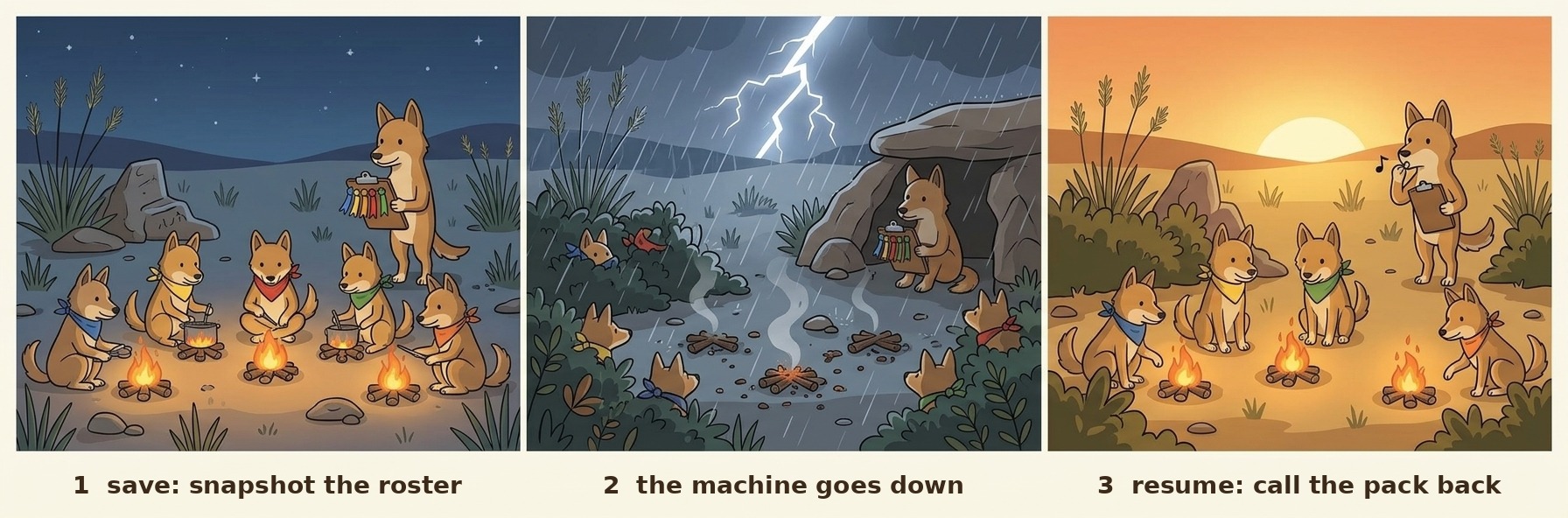
- Save — sessions are snapshotted as they work.
- The machine goes down — the roster is already on disk.
- Resume —
listshows who was lost;resumecalls them back.
Illustrations generated with Google Gemini and edited by the author.
dingo-pack mark running "step 3"           # say what you're doing: running | waiting | blocked | done
dingo-pack mark waiting --until 18:30 "nightly job"
dingo-pack close-all                    # before shutting down: note everyone, close the idle waiting / done ones
dingo-pack restore                         # bring back what close-all closed
dingo-pack resume NAME... --via tmux       # by name; tabs via Windows Terminal, tmux, or just print
close-all never touches a session that is busy, running, blocked, or the one you
type it in, and it checks each session again right before closing it. It is for humans:
inside an agent it refuses.
👻 Ghosts
dingo-pack ghosts                 # process trees whose Claude Code session is gone
dingo-pack ghosts --reap          # stop them, after asking (humans only)
A process belongs to the session whose CLAUDE_PID it carries. Jobs left on purpose
(nohup, setsid, tmux, or a session that said it is waiting) are listed but kept.
📊 Board
dingo-pack board                  # one line per session: state, box, expected finish, flags
dingo-pack board --html board.html --watch 30   # a page that refreshes itself
It reads each session's last status line. "ask now" means the expected finish it wrote
has passed; "may have stopped" means the status line has not changed for 3 hours
(--stale-h). It only understands an expected time after a word like 预计 / 约 … 完 / ETA;
anything else is left blank rather than guessed.
🧰 Team routines (optional)
name (next session name for a letter), card new (next free card number + skeleton),
lint (naming, one session per letter, stale or overdue status lines), queue (prompts
waiting for a condition) and claim (the per-box occupancy file). All are deterministic
and off unless you call them — see the reference.
⚙️ More
The plugin brings the CLI, the roster hooks, the hint hook and a skill that teaches the agent when to use a slot. Hook setup without the plugin, project settings, every option and WSL memory tips are in the reference.
⚠️ Limits
- The agent process itself can't be limited, only counted with a lease.
- Only jobs started through dingo-pack are managed.
- Slots are handed out roughly first come, first served (the kernel decides who wakes first).
- macOS: the per-process limit isn't enforced (the tree limit is), and free memory is an
estimate.
ghosts,topand the WSL checks need Linux. - The roster reads Claude Code's session files, which aren't a documented interface. If they change, it falls back to transcripts and says so.
✅ Self-test
python3 selftest_dingo_pack.py --base /some/local/dir    # 1–3 min, depending on load
python3 selftest_dingo_pack.py --mutants                 # each planted bug must turn a check red
Memory tests run on a simulated machine, never on your real memory.
📄 License
MIT. Sister tool: wombat-gate, a git commit queue for agents sharing one repo.
1 maintainer

Metadata
1 maintainer
Release files for dingo-pack 0.4.2
For a detailed explanation of source distributions (sdists) and built distributions (wheels), please see the package formats documentation.
Source distribution (sdist)
| File | Size | Uploaded | Provenance | Actions |
|---|---|---|---|---|
| dingo_pack-0.4.2.tar.gz | 124.9 kB | With provenance | Details for dingo_pack-0.4.2.tar.gz |
Built distribution (wheel)
| File | Interpreter | ABI | Platform | Actions Reset |
|---|---|---|---|---|
| dingo_pack-0.4.2-py3-none-any.whl | Python 3 | none | any | Details for dingo_pack-0.4.2-py3-none-any.whl |
Total release size: 190.7 kB
Release files / dingo_pack-0.4.2.tar.gz
| Download URL | dingo_pack-0.4.2.tar.gz |
|---|---|
| Size | 124.9 kB |
| Tags | Source |
|
SHA-256 checksum How to use checksums |
2a15687d8a93f4c645e5b95abdf4cd392fcb5a0dbc185e22f97b2a01df6b5926
|
|
BLAKE2b-256 checksum How to use checksums |
13cbed1ef5674e0fc77f858a814897888e97c75ac5b5426b3a0e68678f0737e9
|
| Upload date | |
|
Uploaded using Trusted Publishing? What is trusted publishing? |
Yes |
| Uploaded via |
twine/7.0.0 CPython/3.13.16
|
Provenance
Provenance describes where a file came from. On PyPI, provenance is shared via attestations, which provide a verifiable record of the build or publishing details. View details, limitations and caveats.


PyPI Publish Attestation
PyPI verified that this artifact, at this checksum, originated from the publisher listed below.
Signed by GitHub Actions, verified by PyPI on Nov 4, 2026.
Transparency logRelease files / dingo_pack-0.4.2-py3-none-any.whl
| Download URL | dingo_pack-0.4.2-py3-none-any.whl |
|---|---|
| Size | 65.8 kB |
| Tags | Python 3 |
|
SHA-256 checksum How to use checksums |
673b2512a5a6b57689378ddb43d463d1c49eef443be11274966e60c4443991a4
|
|
BLAKE2b-256 checksum How to use checksums |
8e6f1345d7241deb39f208a452d6b2b14233f35843cd59fc0e3ed4fe4c63c099
|
| Upload date | |
|
Uploaded using Trusted Publishing? What is trusted publishing? |
Yes |
| Uploaded via |
twine/7.0.0 CPython/3.13.16
|
Provenance
Provenance describes where a file came from. On PyPI, provenance is shared via attestations, which provide a verifiable record of the build or publishing details. View details, limitations and caveats.
PyPI Publish Attestation
PyPI verified that this artifact, at this checksum, originated from the publisher listed below.
Signed by GitHub Actions, verified by PyPI on Nov 4, 2026.
Transparency logSecurity for dingo-pack 0.4.2
Provenance
Provenance describes where a file came from. On PyPI, provenance is shared via attestations, which provide a verifiable record of the build or publishing details. View details, limitations and caveats.
Full provenance
Both files in this release have been uploaded with provenance metadata.
Attestation for dingo_pack-0.4.2.tar.gz
PyPI Publish Attestation
PyPI verified that this artifact, at this checksum, originated from the publisher listed below.
Signed by GitHub Actions, verified by PyPI on Nov 4, 2026.
Transparency logA note on package security
PyPI is a repository for distributing packages, not a service for auditing them. While third-party security researchers and our staff do their best to detect and remove malicious packages, PyPI cannot guarantee the quality, security or suitability of any given package.
To learn more about protecting yourself from malicious actors, visit our package security documentation.














