
Dirichlet Regularization (dreg)
Spatial Smoothness in Neural Weight Manifolds for 2D-DCT Spectral Compression





The Core Idea
Standard neural networks treat weight matrices as unstructured, permutation-invariant point clouds. After training with isotropic $L_2$ weight decay, their 2D spatial frequency spectrum resembles flat white noise — variance is spread uniformly across all frequencies, making frequency-domain compression ineffective.
Dirichlet Regularization (dreg) introduces a simple inductive bias during training: neighboring entries on a 2D weight lattice should vary smoothly, analogous to topographic organization in biological cortex.
Penalizing discrete 2D spatial differences breaks permutation symmetry and concentrates spectral energy in the low-frequency harmonics of the orthonormal 2D-DCT — up to ~72% of Frobenius energy below $\rho \le 0.40$ on square Attention projections (256×256) and 52.8% on MNIST MLPs — enabling hierarchical Base-3 Trit spectral quantization (.tritq) across a configurable 0.43–3.77 bpp rate–distortion frontier.
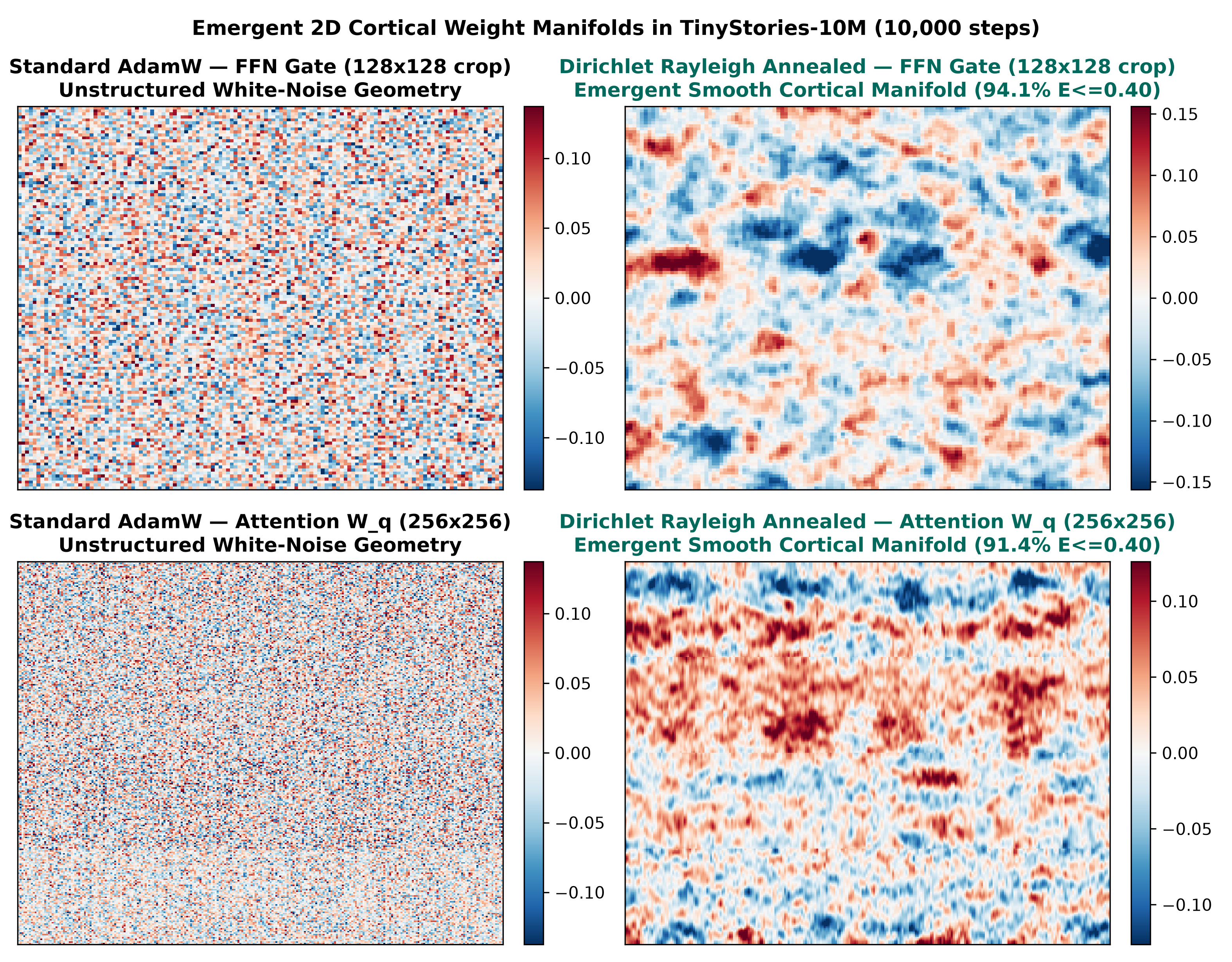
Figure 1: Illustrative Spatial Weight Structures (MNIST MLP, 64×64 top-left patches). 3-epoch MNIST MLP (
fc1top,fc2bottom, unnormalized $\epsilon = 2 \times 10^{-3}$). Left: Standard AdamW yields high-frequency unstructured weights (edge-normalized $E_D = 0.0016$ onfc1). Right: 2D Dirichlet regularization induces smooth spatial manifolds ($E_D = 0.0001$, $-94%$ roughness). On full TinyStories-10M Transformers (Table 2 of the preprint), mean $E_D$ drops by $-72.1%$ ($0.0123 \to 0.0034$numel; $0.0062 \to 0.0017$edges).
The Mathematics
Standard $L_2$ weight decay penalizes magnitude and is strictly invariant to row/column permutations:
$$\mathcal{L}_{L_2}(W) = \frac{\gamma}{2} |W|_F^2$$
Dirichlet Regularization penalizes 2D discrete spatial differences across the $M \times N$ weight lattice via the separable Neumann graph Laplacians $L_M \in \mathbb{R}^{M \times M}$ and $L_N \in \mathbb{R}^{N \times N}$:
$$\mathcal{E}D^{\text{var}}(W) = \frac{1}{2MN}!\left(\sum{i=1}^{M-1}\sum_{j=1}^N (W_{i+1,j}-W_{i,j})^2 + \sum_{i=1}^M\sum_{j=1}^{N-1} (W_{i,j+1}-W_{i,j})^2\right) = \frac{1}{2MN}\Big(\operatorname{Tr}(W^\top L_M W) + \operatorname{Tr}(W L_N W^\top)\Big)$$
Because the eigenvectors of the 1D Neumann path-graph Laplacian are exactly the orthonormal Type-II DCT basis vectors, $\mathcal{E}_D$ diagonalizes in the 2D-DCT domain $S = D_M W D_N^\top$ (numel convention $= 2,\mathcal{E}_D^{\text{var}}$):
$$\mathcal{E}D^{\text{numel}}(W) = \frac{1}{MN} \sum{k=0}^{M-1}\sum_{l=0}^{N-1} 4!\left[\sin^2!\left(\frac{\pi k}{2M}\right) + \sin^2!\left(\frac{\pi l}{2N}\right)\right] S_{k,l}^2$$
High-frequency modes $(k, l)$ are penalized quadratically, concentrating weight energy into the lowest 2D-DCT harmonics.
Normalization note:
dregprovidesnormalization="numel"($\frac{1}{MN}\sum \Delta^2 = 2,\mathcal{E}_D^{\text{var}}$, default),normalization="edges"($\approx \mathcal{E}_D^{\text{var}}$), and scale-invariantnormalization="rayleigh"($\frac{\sum \Delta^2}{2|W|_F^2} \in [0, 4]$, immune to $L_2$ magnitude shrinkage), pluslayer_weighting="param_weighted"to balance gradient strength equally across square Attention and wide FFN layers. See dreg/topology.py and §3.1 of the preprint.
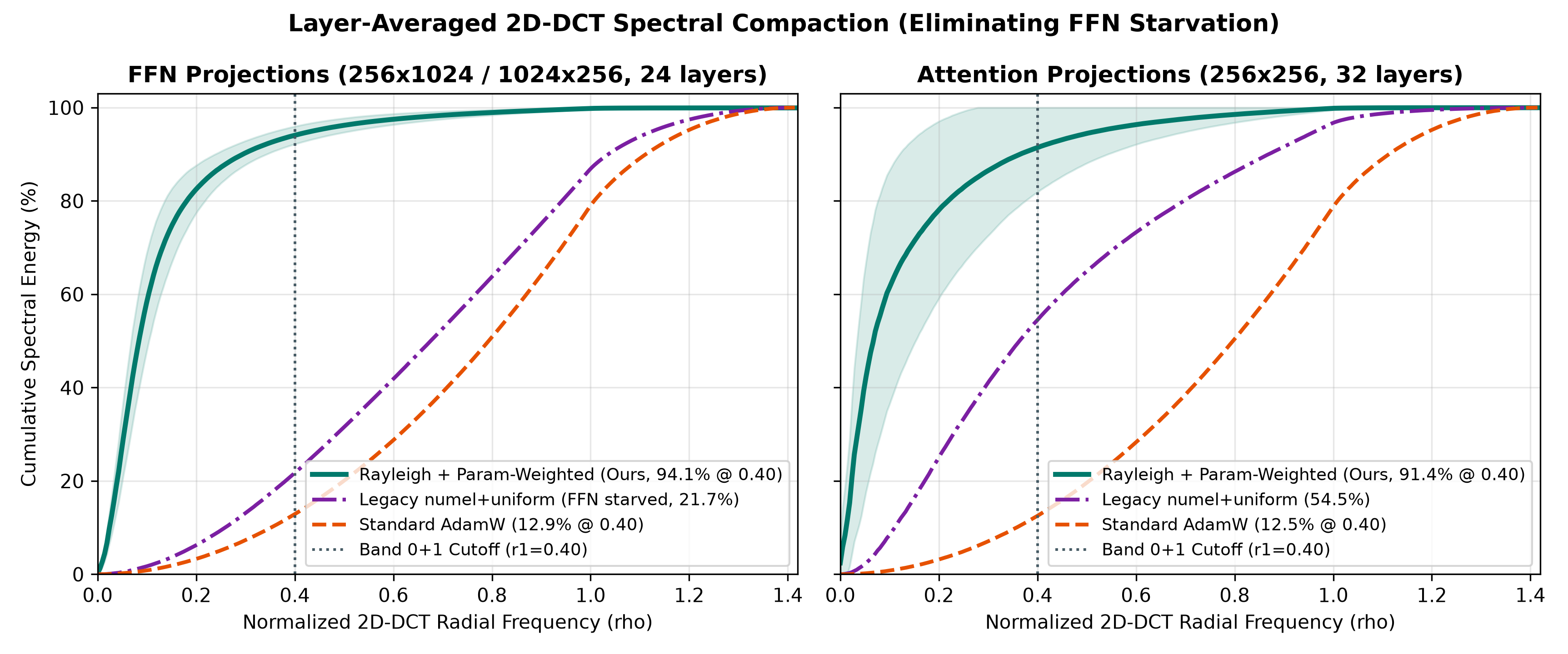
Figure 2: 2D-DCT Cumulative Spectral Energy (TinyStories-10M, Layer 3). Cumulative Frobenius energy vs. normalized radius $\rho \in [0, \sqrt{2}]$. Standard AdamW stays flat ($\sim 13\text{--}14%$ below $\rho = 0.40$). Dirichlet regularization concentrates ~72% of energy below $\rho = 0.40$ in Attention $W_q$ (
256×256), and ~25% in the $4\times$ larger FFN gate projection (256×1024) due to $1/(MN)$ per-weight gradient scaling.
Quick Start
Installation
pip install dirichlet-regularization
Or from source:
git clone https://github.com/mcarbonell/dirichlet-regularization.git
cd dirichlet-regularization
pip install -e .
Optional extras:
pip install -e ".[examples]"    # torchvision + matplotlib for examples
pip install -e ".[dev]"         # pytest, pytest-cov, ruff
Apply to Any PyTorch Model (2 lines of code)
Option A: Universal loss wrapper (zero model modifications)
from dreg import DirichletLoss

# Automatically skips nn.Embedding, lm_head, frozen weights, and deduplicates tied weights.
# Use normalization="rayleigh" + layer_weighting="param_weighted" for scale-invariant,
# FFN-balanced smoothing (recommended: weight_decay=0.25–0.50), or classic normalization="numel"
# with weight_decay=15.0–30.0.
topo_reg = DirichletLoss(
    weight_decay=0.50,
    normalization="rayleigh",
    layer_weighting="param_weighted",
)

# Inside your training loop:
task_loss = criterion(model(inputs), targets)
total_loss = task_loss + topo_reg(model)
total_loss.backward()
Option B: Drop-in replacement for nn.Linear
import torch.nn as nn
from dreg import TopographicLinear

class MyModel(nn.Module):
    def __init__(self):
        super().__init__()
        self.fc1 = TopographicLinear(512, 2048)
        self.fc2 = TopographicLinear(2048, 10)
        self.act = nn.GELU()

    def forward(self, x):
        return self.fc2(self.act(self.fc1(x)))

    def dirichlet_loss(self):
        return 0.5 * (self.fc1.dirichlet_energy() + self.fc2.dirichlet_energy())

model = MyModel()
loss = criterion(model(x), y) + 15.0 * model.dirichlet_loss()
loss.backward()
Calibration tip: Because
dirichlet_energy_2dis normalized by $MN$, raw values are $\sim 10^{-3}\text{--}10^{-2}$. Use $\lambda_{\text{topo}} \in [5.0, 30.0]$ (rather than0.01, which is washed out by AdamW).
Empirical Highlights
1. TinyStories 10.56M Transformer (81.92M tokens, A10G GPU)
Evaluated on 25 validation batches (204,800 tokens; full results in results/pareto_curve_tinystories_results.json and Preprint Table 5):
| Quantization Regime | Radii $(r_0, r_1, r_2)$ | Linear Rate | Compression | Std PPL | Topo PPL ($\lambda=30$) | Dirichlet Gain |
|---|---|---|---|---|---|---|
| Dense FP32 (Reference) | — | 32.000 bpp | 1.0× | 6.11 | 6.46 | $-0.35$ PPL |
| Conservative | (0.45, 0.90, 1.41) |
3.774 bpp | 8.5× | 8.87 | 8.22 | +0.65 PPL |
| High-Fidelity | (0.30, 0.70, 1.30) |
2.794 bpp | 11.5× | 14.97 | 12.43 | +2.54 PPL |
| Mid-Band | (0.20, 0.55, 1.15) |
2.181 bpp | 14.7× | 30.10 | 23.08 | +7.02 PPL |
| Calibrated TritQ | (0.15, 0.40, 1.00) |
1.638 bpp | 19.5× | 73.75 | 66.50 | +7.25 PPL |
| Aggressive | (0.10, 0.30, 0.75) |
0.914 bpp | 35.0× | 835.92 | 1117.65 | $-281.73$ PPL |
| Ultra-Aggressive | (0.08, 0.22, 0.50) |
0.430 bpp | 74.4× | 5274.18 | 2890.48 | +2383.70 PPL |
- Roughness reduction: $-72.1%$ ($E_D^{\text{edges}}: 0.006178 \to 0.001724$; $E_D^{\text{numel}}: 0.012316 \to 0.003438$).
- At
2.181 bpp, Topographic TritQ (23.08 PPL) outperforms both Standard TritQ (30.10 PPL) and per-tensor Spatial INT2 RTN (41.67 PPLat2.00 bpp).
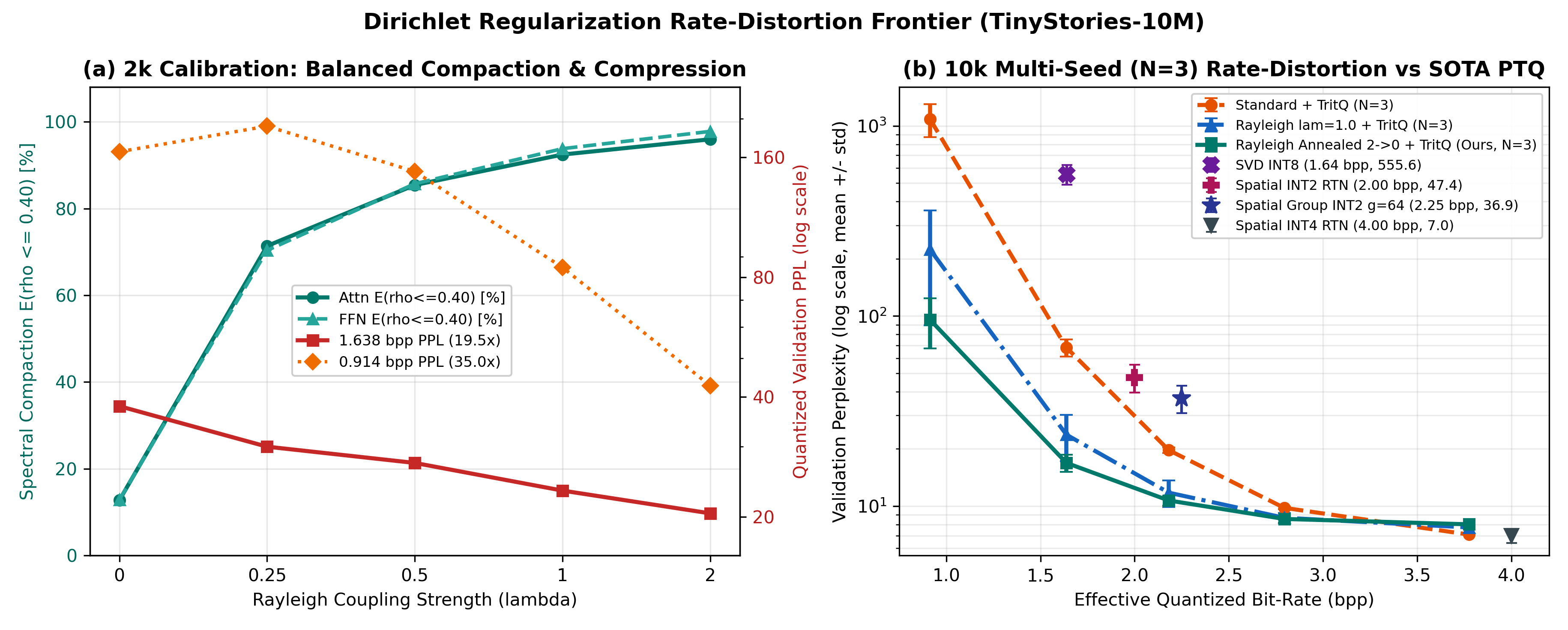
Figure 3: Calibration Sweep and Rate–Distortion Frontier (TinyStories-10M). (a) 5-point calibration sweep ($\lambda_{\text{topo}} \in {0, 0.01, 5, 15, 30}$, 2k steps) at
1.638 bpp. (b) Converged 10k-step rate–distortion frontier across1.638–3.774 bpp(Preprint Table 5).
2. Vision MLP on MNIST (234.75K parameters, 5 epochs)
| Metric | Standard MLP | Topographic MLP (dreg, $\lambda=15$) |
Gain |
|---|---|---|---|
| FP32 Test Accuracy | 97.87% | 97.58% | $-0.29%$ (preserved) |
Dirichlet Energy ($E_D$, numel) |
0.0219 | 0.0034 | $-84.5%$ roughness |
| Low-Frequency Energy ($\rho \le 0.40$) | 27.87% | 52.84% | $1.90\times$ compaction |
| Low-Pass Truncation Acc ($\rho \le 0.40$) | 30.69% | 41.41% | +10.72% abs. (+11.01% rel. retention) |
Base-3 TritQ Acc (1.64 bpp) |
87.40% | 88.59% | +1.19% accuracy |
Quantization Format (.tritq) & C11 Direct Spectral Micro-Kernel
- Exact Base-3 Trit Packing + Lloyd-Max Band-2: 5 balanced trits ${-1, 0, +1}$ pack bijectively into 1 byte ($3^5 = 243 \le 256 \Rightarrow 1.60\text{ bits/trit}$), quantized via 1D Lloyd-Max MSE-optimal scaling and decoded in $\mathcal{O}(1)$ time via a 1.25 KB L1-cache lookup table. Non-topographic parameters (
token_emb,lm_head, LayerNorms) are preserved uncompressed in FP16. - Portable C11 Micro-Kernel (
kernel/spectral_dma_kernel.c):- Zero-copy async DMA double-buffering (Win32 Events / POSIX pthreads) verified to
< 1e-5float32 parity against PyTorch. - Direct Spectral-Domain Streaming MatVec (
c_spectral_matvec_direct): Computes $y = \operatorname{IDCT}{1D}(S \cdot \operatorname{DCT}{1D}(x))$ via radix-2 $\mathcal{O}(N \log N)$ 1D-DCT directly from.tritqbitstreams without materializing $M \times N$ weights or storing DCT basis tables — cutting1024×256FFN working SRAM from8.4 MBdown to13.0 KB(650×reduction) and running~45×faster than full-matrix 2D-IDCT reconstruction (1.9e-6float32 parity).
- Zero-copy async DMA double-buffering (Win32 Events / POSIX pthreads) verified to
Reproducing Locally (CPU)
# 1. Run the master end-to-end verification suite (99 tests + C parity + trained MLP + controls)
python examples/reproduce_all.py

# 2. Build and benchmark the native C11 DMA micro-kernel
python kernel/build_kernel.py
python examples/benchmark_c_dma.py

# 3. Train a small Topographic Transformer or MNIST MLP locally
python examples/train_topographic.py
python examples/train_mlp_dirichlet.py --dataset mnist --epochs 5
python examples/evaluate_falsification.py
Repository Structure
dirichlet-regularization/
├── dreg/                            # Core Python package
│   ├── topology.py                  # 2D Dirichlet energy, DirichletLoss & annealing schedulers
│   ├── spectral.py                  # Orthonormal 2D-DCT/IDCT & BlockDCTTiler
│   ├── quantization.py              # Base3TritQuantizer & .tritq binary checkpoint format
│   ├── model.py                     # Reference TopographicTransformer & TopographicLinear
│   └── baselines.py                 # Haar random orthogonal rotation & truncated SVD controls
├── kernel/                          # Native C11 zero-copy DMA micro-kernel
│   ├── spectral_dma_kernel.c        # O(1) trit LUT + Win32/POSIX async double-buffered DMA
│   ├── build_kernel.py              # Cross-platform compiler wrapper (gcc/clang/cl)
│   └── Makefile
├── examples/                        # Local CPU/GPU reproducible scripts
│   ├── reproduce_all.py             # End-to-end verification (tests, C parity, trained MLP, controls)
│   ├── train_topographic.py         # Minimal TopographicTransformer training example
│   ├── train_mlp_dirichlet.py       # Vision MLP benchmark (synthetic / MNIST)
│   ├── evaluate_falsification.py    # Controlled Standard vs Topographic comparison
│   ├── evaluate_pareto_curve.py     # Local rate-distortion sweep & plotting
│   ├── train_multiseed_sweep.py     # Multi-seed robustness & annealing sweep
│   ├── train_gpt2_dirichlet.py      # GPT-2 fine-tuning & TritQ audit
│   └── benchmark_c_dma.py           # Native C kernel parity & throughput benchmark
├── benchmarks/                      # Modal cloud A10G GPU training & evaluation scripts
├── results/                         # Raw JSON logs backing paper Tables 4–5 and diagnostics
├── paper/                           # Academic preprint (LaTeX source, BibTeX, figures, PDF)
│   ├── paper-draft.pdf
│   ├── paper-draft.tex
│   ├── references.bib
│   └── figures/
├── tests/                           # 99 automated unit, integration, and C-kernel tests (96% cov)
├── CITATION.cff
├── pyproject.toml
└── README.md
Preprint & Citation
Read the full manuscript in paper/paper-draft.pdf:
"Inducing Spectral Smoothness in Neural Weight Manifolds via 2D Dirichlet Regularization"
Mario Raúl Carbonell Martínez (Independent Researcher)
@misc{carbonell2026dirichlet,
  title={Inducing Spectral Smoothness in Neural Weight Manifolds via 2D Dirichlet Regularization},
  author={Carbonell Mart{\'i}nez, Mario Ra{\'u}l},
  year={2026},
  howpublished={\url{https://github.com/mcarbonell/dirichlet-regularization}}
}
License
This project is licensed under the MIT License — see the LICENSE file for details.
1 maintainer

Metadata
1 maintainer
Release files for dirichlet-regularization 1.0.0
For a detailed explanation of source distributions (sdists) and built distributions (wheels), please see the package formats documentation.
Source distribution (sdist)
| File | Size | Uploaded | Provenance | Actions |
|---|---|---|---|---|
| dirichlet_regularization-1.0.0.tar.gz | 39.6 kB | Without provenance | Details for dirichlet_regularization-1.0.0.tar.gz |
Built distribution (wheel)
| File | Interpreter | ABI | Platform | Actions Reset |
|---|---|---|---|---|
| dirichlet_regularization-1.0.0-py3-none-any.whl | Python 3 | none | any | Details for dirichlet_regularization-1.0.0-py3-none-any.whl |
Total release size: 64.9 kB
Release files / dirichlet_regularization-1.0.0.tar.gz
| Download URL | dirichlet_regularization-1.0.0.tar.gz |
|---|---|
| Size | 39.6 kB |
| Tags | Source |
|
SHA-256 checksum How to use checksums |
4e64f8a6e3a999807f852be68fd597731587d8dd8f5ec65587be5f9fd75d7b60
|
|
BLAKE2b-256 checksum How to use checksums |
759a503f3b663b3b826cf6f122bb3bba2ae06eb488d10fbcfbfd81f091cf81a3
|
| Upload date | |
|
Uploaded using Trusted Publishing? What is trusted publishing? |
No |
| Uploaded via |
twine/7.0.0 CPython/3.14.2
|
Release files / dirichlet_regularization-1.0.0-py3-none-any.whl
| Download URL | dirichlet_regularization-1.0.0-py3-none-any.whl |
|---|---|
| Size | 25.3 kB |
| Tags | Python 3 |
|
SHA-256 checksum How to use checksums |
304e93c0220cc4041397ecbe5b6b8dcdbd8501caf173f9160b776313e5792c16
|
|
BLAKE2b-256 checksum How to use checksums |
8476039ae3ef8d8a3e412475124c4afc367ce69eb1fc7803647d1372de50d4eb
|
| Upload date | |
|
Uploaded using Trusted Publishing? What is trusted publishing? |
No |
| Uploaded via |
twine/7.0.0 CPython/3.14.2
|
Security for dirichlet-regularization 1.0.0
Provenance
Provenance describes where a file came from. On PyPI, provenance is shared via attestations, which provide a verifiable record of the build or publishing details. View details, limitations and caveats.
No provenance found
None of the files in this release were uploaded with provenance metadata.
A note on package security
PyPI is a repository for distributing packages, not a service for auditing them. While third-party security researchers and our staff do their best to detect and remove malicious packages, PyPI cannot guarantee the quality, security or suitability of any given package.
To learn more about protecting yourself from malicious actors, visit our package security documentation.














