
Dirichlet Regularization (dreg)
Spatial Smoothness in Neural Weight Manifolds for 2D-DCT Spectral Compression





The Core Idea
Standard neural networks treat weight matrices as unstructured, permutation-invariant point clouds. After training with isotropic $L_2$ weight decay, their 2D spatial frequency spectrum resembles flat white noise — only ~12.6% of Frobenius energy lies below normalized frequency $\rho \le 0.40$, making frequency-domain compression ineffective.
Dirichlet Regularization (dreg) introduces a simple geometric inductive bias during training: neighboring entries on a 2D weight lattice should vary smoothly, analogous to topographic organization in biological cortex.
By combining scale-invariant Riemannian Rayleigh normalization ($\mathcal{R}(W) = \sum \Delta^2 / (2|W|_F^2)$) with parameter-weighted layer aggregation, dreg eliminates rectangular FFN gradient starvation and concentrates 91.6% (Attention) and 94.2% (FFN) of total Frobenius energy below $\rho \le 0.40$ — enabling zero-overhead MSE-clipped / Lloyd–Max Base-3 Trit Quantization (.tritq) that beats both unregularized TritQ (4.04× lower PPL at 1.638 bpp, 11.4× lower PPL at sub-1-bit 0.914 bpp) and Spatial Group-wise INT2 (g=64, 2.19× lower PPL using 27% fewer bits).
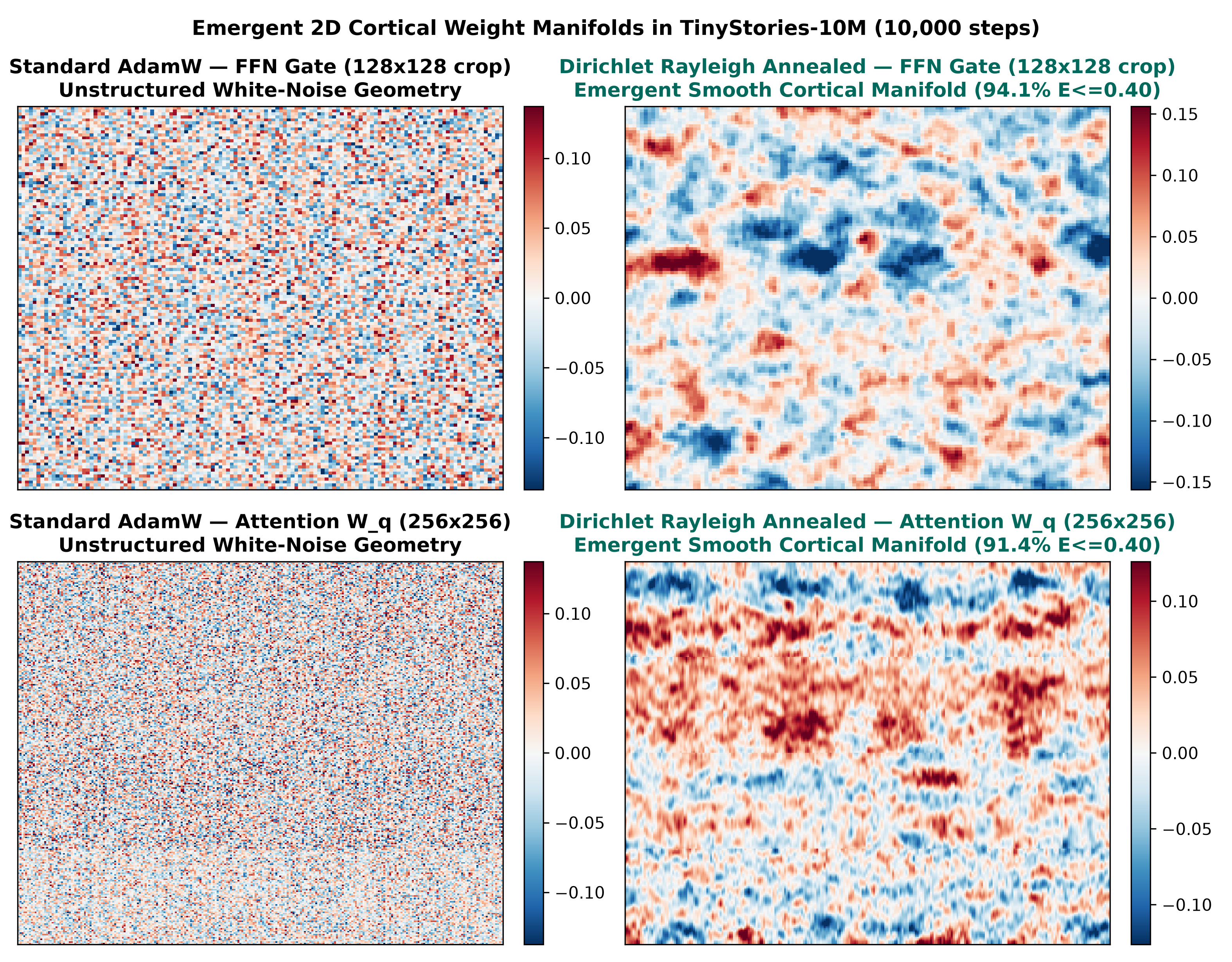
Figure 1: Emergent 2D Cortical Weight Manifolds in TinyStories-10M (10,000 steps, seed 42). Representative Layer-3 weights (
mlp.gate_projtop,attn.q_projbottom). Left: Standard AdamW yields white-noise geometry (12.9%/12.5%energy $\le 0.40$). Right: Rayleigh + parameter-weighted Dirichlet annealing ($\lambda = 2.0 \to 0$) induces continuous cortical-like weight manifolds across both rectangular FFN and square Attention projections (94.1%/91.4%energy $\le 0.40$).
The Mathematics
Standard $L_2$ weight decay penalizes magnitude and is strictly invariant to row/column permutations ($|\pi(W)\sigma(W)|_F^2 = |W|_F^2$). Dirichlet Regularization penalizes discrete 2D spatial differences on the unit lattice $\mathbb{Z}_M \times \mathbb{Z}_N$ via the separable Neumann graph Laplacians $L_M$ and $L_N$:
$$\mathcal{R}(W) = \frac{\sum_{i=1}^{M-1}\sum_{j=1}^N (W_{i+1,j}-W_{i,j})^2 + \sum_{i=1}^M\sum_{j=1}^{N-1} (W_{i,j+1}-W_{i,j})^2}{2|W|_F^2 + \epsilon} \in [0, 4]$$
Because the eigenvectors of the 1D Neumann Laplacian are exactly the orthonormal Type-II DCT basis vectors, $\mathcal{R}(W)$ diagonalizes cleanly in the 2D-DCT domain $S = D_M W D_N^\top$:
$$\mathcal{R}(W) = \frac{\sum_{k=0}^{M-1}\sum_{l=0}^{N-1} 4!\left[\sin^2!\left(\frac{\pi k}{2M}\right) + \sin^2!\left(\frac{\pi l}{2N}\right)\right] S_{k,l}^2}{2\sum_{k,l} S_{k,l}^2}$$
Weighting each layer by its parameter share $\frac{M_l N_l}{\sum_j M_j N_j}$ yields exact shape symmetry between square Attention and $4\times$ wider FFN projections, while $\langle W, \nabla_W \mathcal{R}(W)\rangle = 0$ projects the diffusion gradient tangentially onto the Frobenius sphere (preventing norm collapse during from-scratch training). For adapting outlier-heavy pre-trained LLMs (e.g., GPT-2 124M), normalization="rayleigh_sg" detaches $|W|_F^2$ to yield pure Neumann diffusion ($-\Delta W / |W|_F^2$) with identically zero DC gradient.
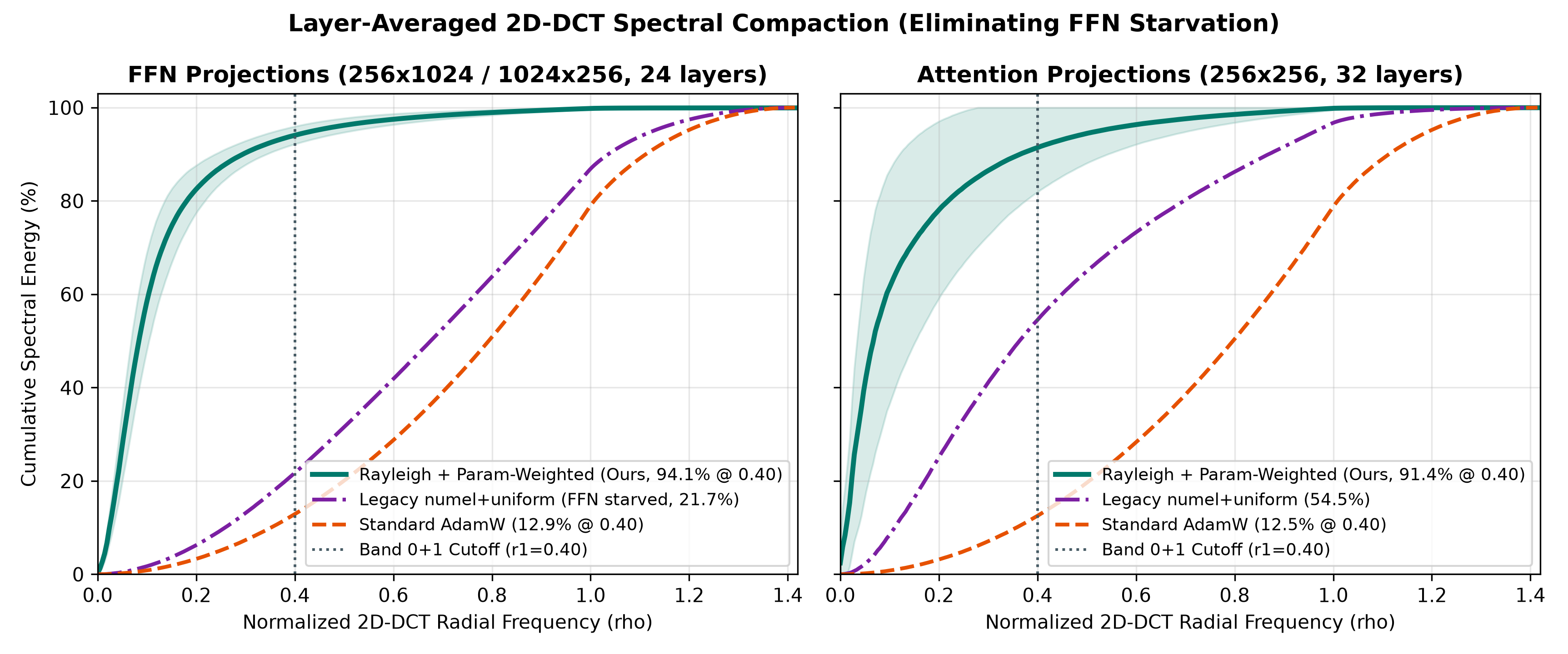
Figure 2: Layer-Averaged 2D-DCT Spectral Compaction (all 24 FFN & 32 Attention layers, TinyStories-10M, 10k steps). Legacy
numel+uniform(purple) starves FFNs at21.7%vs.54.5%Attention. Scale-invariantrayleigh + param_weighted(teal) eliminates FFN starvation completely (94.1%FFN /91.4%Attention vs.12.9%/12.5%Standard AdamW).
Quick Start
Installation
pip install dirichlet-regularization
Or from source:
git clone https://github.com/mcarbonell/dirichlet-regularization.git
cd dirichlet-regularization
pip install -e .
Optional extras:
pip install -e ".[examples]"    # torchvision + matplotlib for examples
pip install -e ".[dev]"         # pytest, pytest-cov, ruff
Apply to Any PyTorch Model (3 lines of code)
from dreg import DirichletLoss, StepCooldownScheduler

# Automatically skips nn.Embedding, lm_head, frozen weights, and deduplicates tied weights.
# For from-scratch training: normalization="rayleigh", weight_decay=1.0–2.0 + StepCooldownScheduler.
# For pre-trained LLM adaptation: normalization="rayleigh_sg" (scale lambda ~ N_total * sigma_W).
topo_reg = DirichletLoss(
    weight_decay=2.0,
    normalization="rayleigh",
    layer_weighting="param_weighted",
)
topo_sched = StepCooldownScheduler(topo_reg, total_steps=10_000, cooldown_ratio=0.15)

# Inside your training loop:
task_loss = criterion(model(inputs), targets)
topo_sched.step()
total_loss = task_loss + topo_reg(model)
total_loss.backward()
Empirical Highlights
1. TinyStories-10M Multi-Seed (N = 3, 10,000 steps / 81.92M tokens, A10G)
Controlled multi-seed (seeds = 42, 100, 2024) evaluation on 25 validation batches (204,800 tokens; full logs in results/tmlr_10000s_mseclip_multiseed_results.json):
Condition (10k, N=3) |
FP32 PPL | Attn / FFN $E_{\le 0.4}$ | 0.430 bpp (74×) |
0.914 bpp (35×) |
1.638 bpp (19.5×) |
2.181 bpp (14.7×) |
2.794 bpp (11.5×) |
|---|---|---|---|---|---|---|---|
| Standard ($\lambda=0$) | 5.81 ± 0.01 | 12.6% / 12.9% | 3472.7 ± 950.0 | 1085.5 ± 214.1 | 68.21 ± 6.94 | 19.70 ± 0.70 | 9.79 ± 0.17 |
| Rayleigh ($\lambda=1.0$) | 7.39 ± 0.02 | 91.3% / 95.0% | 1914.7 ± 558.8 | 223.8 ± 134.7 | 23.74 ± 6.51 | 11.77 ± 1.87 | 8.68 ± 0.50 |
| Rayleigh ($\lambda=2.0$) | 8.19 ± 0.06 | 96.2% / 98.3% | 1302.0 ± 395.5 | 120.6 ± 40.3 | 23.46 ± 5.71 | 12.48 ± 1.76 | 9.14 ± 0.03 |
| Rayleigh Anneal ($2\to 0$) | 7.78 ± 0.05 | 91.6% / 94.2% | 1131.4 ± 317.5 | 95.60 ± 28.26 | 16.87 ± 1.73 | 10.71 ± 0.64 | 8.56 ± 0.07 |
SOTA PTQ Baselines on the exact same 10k N=3 Standard models:
- Spatial Group-wise INT2 (
g=64,2.25 bpp):36.91 ± 6.03 PPL— beaten 2.19× by our1.638 bppmodel (27% fewer bits) and 3.45× by our2.181 bppmodel (10.71 ± 0.64 PPL). - Spatial Uniform INT2 (
2.00 bpp):47.39 ± 7.90 PPL(2.81× worse than our1.638 bpp). - Budget-Matched Quantized SVD (
INT8,~1.64 bpp):555.65 ± 65.74 PPL(32.9× worse). - Zero-Bit-Overhead Quantizer Ablation (
1.638 bpp,rayleigh_anneal2,N=3):minmax + legacy(51.55 ± 3.90) →+ Lloyd–Max Band-2(31.62 ± 2.88) →+ MSE-Clip Band-0/1(16.87 ± 1.73; verified on-disk.tritqround-trip16.702 == 16.702).
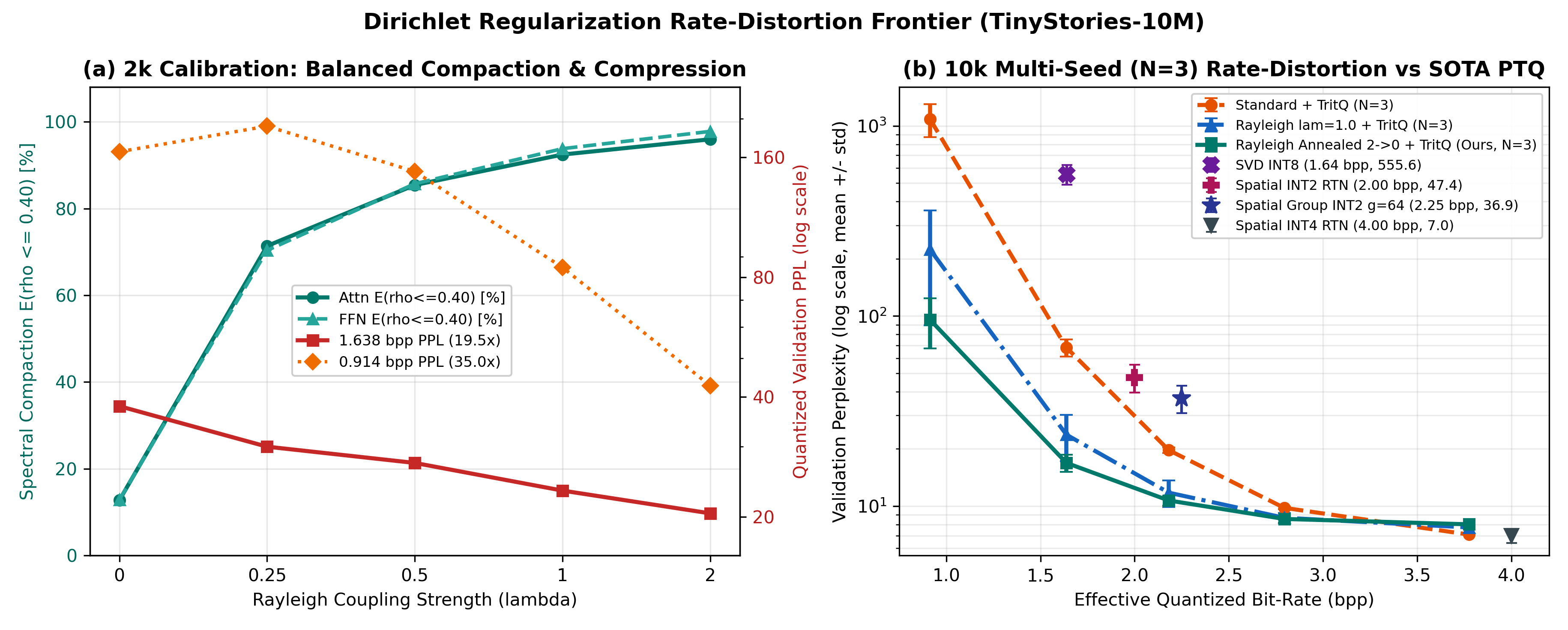
Figure 3: (a) 2k-step Rayleigh calibration sweep showing balanced Attn/FFN compaction (
12.7% → 97.8%) and monotonic compression gains. (b) Converged 10k multi-seed (N=3) rate–distortion frontier vs. SOTA PTQ baselines.
2. Pre-Trained OpenAI GPT-2 (124M, 48 Conv1D matrices / 84.9M weights)
1,500-step rayleigh_sg + param_weighted adaptation (lr=3e-4, A10G, results/gpt2_124m_rayleigh_sg_1500s_results.json):
| GPT-2 (124M) Variant | FP32 | Attn / FFN $E_{\le 0.4}$ | 1.63 bpp |
2.18 bpp |
2.79 bpp |
3.77 bpp |
Spatial INT4 (4.0b) |
|---|---|---|---|---|---|---|---|
| Base Pre-Trained (0 steps) | 11.96 | 12.6% / 12.9% | 8355.36 | 5474.80 | 2638.98 | 1761.02 | 2440.52 |
| Standard Fine-Tuned ($\lambda=0$) | 4.65 | 12.6% / 12.9% | 4130.36 | 4050.95 | 2546.29 | 684.46 | 1449.10 |
rayleigh_sg ($\lambda=25$) |
5.35 | 32.8% / 37.2% | 2052.39 | 638.34 | 152.76 | 31.96 | 963.10 |
rayleigh_sg Anneal ($200\to 0$) |
12.93 | 71.2% / 76.8% | 281.84 | 117.55 | 43.20 | 21.62 | 997.09 |
rayleigh_sg ($\lambda=500$) |
18.64 | 73.0% / 79.2% | 178.71 | 60.35 | 33.07 | 23.37 | 1115.46 |
- Cuts weight roughness by −95.6% (
0.033514 → 0.001464) and reduces compressed perplexity by 23×–77× across1.63–3.77 bpp(beating Group INT2g=643209.12 PPLat2.25 bppby 53.2× at2.18 bpp).
3. Vision MLP on MNIST (234.75K parameters, 5 epochs)
| Metric | Standard MLP | Topographic MLP (dreg, $\lambda=15$) |
Gain |
|---|---|---|---|
| FP32 Test Accuracy | 97.87% | 97.58% | $-0.29%$ (preserved) |
Dirichlet Energy ($E_D$, numel) |
0.0219 | 0.0034 | $-84.5%$ roughness |
| Low-Frequency Energy ($\rho \le 0.40$) | 27.87% | 52.84% | $1.90\times$ compaction |
| Low-Pass Truncation Acc ($\rho \le 0.40$) | 30.69% | 41.41% | +10.72% abs. |
Base-3 TritQ Acc (1.64 bpp) |
87.40% | 88.59% | +1.19% accuracy |
Quantization Format (.tritq) & C11 Direct Spectral Micro-Kernel
- Exact Base-3 Trit Packing + Zero-Overhead Optimal Quantization: 5 balanced trits ${-1, 0, +1}$ pack bijectively into 1 byte ($3^5 = 243 \le 256 \Rightarrow 1.60\text{ bits/trit}$), paired with 1D Lloyd–Max Band-2 scaling and MSE-optimal asymmetric clipping on Bands 0 & 1 (
band01_mode="mse_clip"), decoded in $\mathcal{O}(1)$ via a1.25 KBL1-cache LUT. Non-topographic parameters (token_emb,lm_head, LayerNorms) stay uncompressed in FP16. - Portable C11 Micro-Kernel (
kernel/spectral_dma_kernel.c):- Zero-copy async DMA double-buffering (Win32 Events / POSIX pthreads) verified to
3.6e-7float32 parity against PyTorch. - Direct Spectral-Domain Streaming MatVec (
c_spectral_matvec_direct): Computes $y = \operatorname{IDCT}{1D}(S \cdot \operatorname{DCT}{1D}(x))$ via radix-2 $\mathcal{O}(N \log N)$ Makhoul 1D-DCT directly from.tritqbitstreams without materializing $M \times N$ weights or storing DCT basis tables — cutting1024×256FFN working SRAM from8,448 KBdown to13.0 KB(650×reduction) and running45.6×faster than full-matrix 2D-IDCT reconstruction (8.9e-7float32 parity).
- Zero-copy async DMA double-buffering (Win32 Events / POSIX pthreads) verified to
Reproducing Locally (CPU)
# 1. Run the master end-to-end verification suite (102 tests + C parity + trained MLP + controls)
python examples/reproduce_all.py

# 2. Build and benchmark the native C11 DMA & direct spectral micro-kernel
python kernel/build_kernel.py
python examples/benchmark_c_dma.py

# 3. Train a small Topographic Transformer or MNIST MLP locally
python examples/train_topographic.py
python examples/train_mlp_dirichlet.py --dataset mnist --epochs 5
python examples/evaluate_falsification.py
Repository Structure
dirichlet-regularization/
├── dreg/                            # Core Python package
│   ├── topology.py                  # 2D Dirichlet energy (numel/edges/rayleigh/rayleigh_sg), DirichletLoss & schedulers
│   ├── spectral.py                  # Orthonormal 1D/2D-DCT/IDCT (float64 angles), spectral_matvec & BlockDCTTiler
│   ├── quantization.py              # Base3TritQuantizer (mse_clip + lloyd_max) & .tritq binary checkpoint format
│   ├── model.py                     # Reference TopographicTransformer & TopographicLinear
│   └── baselines.py                 # Haar random orthogonal rotation & truncated SVD controls
├── kernel/                          # Native C11 zero-copy DMA & direct spectral matvec micro-kernel
│   ├── spectral_dma_kernel.c        # O(1) trit LUT, Win32/POSIX async DMA, radix-2 Makhoul 1D-DCT streaming matvec
│   ├── build_kernel.py              # Cross-platform compiler wrapper (gcc/clang/cl)
│   └── Makefile
├── examples/                        # Local CPU/GPU reproducible scripts
├── benchmarks/                      # Modal cloud A10G multi-seed training, GPT-2, SOTA PTQ & figure pipelines
├── results/                         # Raw JSON logs backing all paper Tables 1–6 and ablations
├── paper/                           # Academic manuscript (LaTeX source, BibTeX, 300-DPI figures, PDF)
│   ├── paper-draft.pdf
│   ├── paper-draft.tex
│   ├── references.bib
│   └── figures/
├── tests/                           # 102 automated unit, integration, and C-kernel tests
├── CITATION.cff
├── pyproject.toml
└── README.md
Preprint & Citation
Read the full manuscript in paper/paper-draft.pdf:
"Inducing Spectral Smoothness in Neural Weight Manifolds via 2D Dirichlet Regularization"
Mario Raúl Carbonell Martínez (Independent Researcher)
@misc{carbonell2026dirichlet,
  title={Inducing Spectral Smoothness in Neural Weight Manifolds via 2D Dirichlet Regularization},
  author={Carbonell Mart{\'i}nez, Mario Ra{\'u}l},
  year={2026},
  howpublished={\url{https://github.com/mcarbonell/dirichlet-regularization}}
}
License
MIT License — see LICENSE for details.
1 maintainer

Metadata
1 maintainer
Release files for dirichlet-regularization 1.1.0
For a detailed explanation of source distributions (sdists) and built distributions (wheels), please see the package formats documentation.
Source distribution (sdist)
| File | Size | Uploaded | Provenance | Actions |
|---|---|---|---|---|
| dirichlet_regularization-1.1.0.tar.gz | 41.3 kB | Without provenance | Details for dirichlet_regularization-1.1.0.tar.gz |
Built distribution (wheel)
| File | Interpreter | ABI | Platform | Actions Reset |
|---|---|---|---|---|
| dirichlet_regularization-1.1.0-py3-none-any.whl | Python 3 | none | any | Details for dirichlet_regularization-1.1.0-py3-none-any.whl |
Total release size: 67.9 kB
Release files / dirichlet_regularization-1.1.0.tar.gz
| Download URL | dirichlet_regularization-1.1.0.tar.gz |
|---|---|
| Size | 41.3 kB |
| Tags | Source |
|
SHA-256 checksum How to use checksums |
3f8835a45ddfd384b2de1f0882a1e63847c34ad56cdfc2c736bda4af1983c44a
|
|
BLAKE2b-256 checksum How to use checksums |
c2414217125ca67062c119fec81e6d4eeede4667719d1b898c1e5a0626e629da
|
| Upload date | |
|
Uploaded using Trusted Publishing? What is trusted publishing? |
No |
| Uploaded via |
twine/7.0.0 CPython/3.14.2
|
Release files / dirichlet_regularization-1.1.0-py3-none-any.whl
| Download URL | dirichlet_regularization-1.1.0-py3-none-any.whl |
|---|---|
| Size | 26.6 kB |
| Tags | Python 3 |
|
SHA-256 checksum How to use checksums |
1e3ad308dfa312cbfc76864fb72a8badc423f52a2c50ac7e6e463ec3d935996d
|
|
BLAKE2b-256 checksum How to use checksums |
884a19e8ee6e027d6deac176127f06b48d92af5af90c9efaed204aa5a7cff15a
|
| Upload date | |
|
Uploaded using Trusted Publishing? What is trusted publishing? |
No |
| Uploaded via |
twine/7.0.0 CPython/3.14.2
|
Security for dirichlet-regularization 1.1.0
Provenance
Provenance describes where a file came from. On PyPI, provenance is shared via attestations, which provide a verifiable record of the build or publishing details. View details, limitations and caveats.
No provenance found
None of the files in this release were uploaded with provenance metadata.
A note on package security
PyPI is a repository for distributing packages, not a service for auditing them. While third-party security researchers and our staff do their best to detect and remove malicious packages, PyPI cannot guarantee the quality, security or suitability of any given package.
To learn more about protecting yourself from malicious actors, visit our package security documentation.














