
diskpack
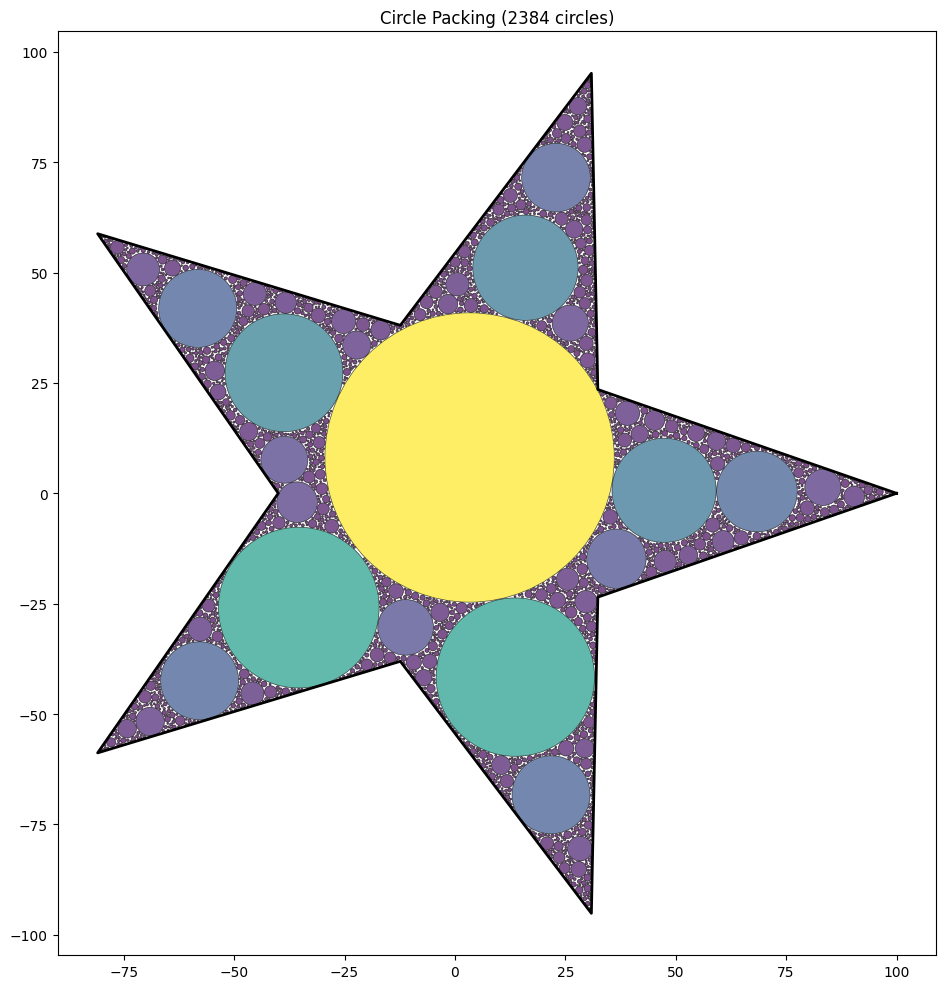
State-of-the-art circle packing for arbitrary polygons.
pip install diskpack
Quick Start
from diskpack import CirclePacker, PackingConfig
import numpy as np

# Define a polygon (list of vertices)
square = [(0, 0), (100, 0), (100, 100), (0, 100)]

# Pack circles
packer = CirclePacker([np.array(square)])
circles = packer.pack()

# Each circle is (x, y, radius)
for x, y, r in circles:
    print(f"Circle at ({x:.1f}, {y:.1f}) with radius {r:.1f}")
Choosing the Right Algorithm
diskpack offers multiple packing strategies optimized for different use cases:
| Shape Type | Best Algorithm | Config |
|---|---|---|
| Simple convex (square, rectangle) | Random sampling | PackingConfig() |
| Complex/concave (star, L-shape, letters) | Hybrid | PackingConfig(use_hybrid_packing=True) |
| Fixed radius, need speed | Hex grid | PackingConfig(fixed_radius=5.0) |
| Fixed radius, need density | Hybrid | PackingConfig(fixed_radius=5.0, use_hybrid_packing=True) |
| Artistic/organic look | Random | PackingConfig(use_hex_grid=False) |
Simple Convex Shapes
For squares, rectangles, and other simple convex polygons, the default random sampling achieves the best density:
config = PackingConfig(
    padding=0.5,
    min_radius=1.0,
)
packer = CirclePacker([np.array(square)], config)
circles = packer.pack()  # ~86% density
Complex/Concave Shapes
For stars, L-shapes, letters, and other complex polygons, hybrid mode fills corners better:
star = [
    (50, 0), (61, 35), (98, 35), (68, 57), (79, 91),
    (50, 70), (21, 91), (32, 57), (2, 35), (39, 35)
]

config = PackingConfig(
    use_hybrid_packing=True,
    verbose=True,  # See progress
)
packer = CirclePacker([np.array(star)], config)
circles = packer.pack()  # ~69% density (vs ~64% for random)
Fixed Radius Packing
When all circles must have the same radius:
# Fastest (hex grid pattern)
config = PackingConfig(fixed_radius=3.0)

# Densest (fills corners)
config = PackingConfig(fixed_radius=3.0, use_hybrid_packing=True)

# Organic look (random placement)
config = PackingConfig(fixed_radius=3.0, use_hex_grid=False)
Tuning Hybrid Mode
Hybrid mode works in three phases:
- Phase 1 (Large): Place circles ≥ 50% of max possible radius
- Phase 2 (Medium): Place circles ≥ 25% of max possible radius
- Phase 3 (Small): Fill remaining gaps with random sampling
You can tune the thresholds:
# For complex shapes with tight corners (default)
config = PackingConfig(
    use_hybrid_packing=True,
    hybrid_large_threshold=0.5,   # Phase 1: >= 50% of max
    hybrid_medium_threshold=0.25, # Phase 2: >= 25% of max
)

# For simpler shapes (more circles in Phases 1-2)
config = PackingConfig(
    use_hybrid_packing=True,
    hybrid_large_threshold=0.3,   # Phase 1: >= 30% of max
    hybrid_medium_threshold=0.1,  # Phase 2: >= 10% of max
)
Performance Tuning
config = PackingConfig(
    # Stop after N consecutive failed attempts (higher = more circles, slower)
    max_failed_attempts=200,

    # Points sampled per iteration (higher = better placements, more memory)
    sample_batch_size=50,

    # Minimum gap between circles
    padding=1.5,

    # Smallest circle to place
    min_radius=1.0,
)
API Reference
CirclePacker
CirclePacker(polygons: List[np.ndarray], config: PackingConfig = None)
polygons: List of polygon vertices. Each polygon is an Nx2 numpy array.config: Optional configuration. Uses defaults if not provided.
Methods:
pack() -> List[Tuple[float, float, float]]: Pack circles and return as listgenerate() -> Iterator[Tuple[float, float, float]]: Generate circles lazily
PackingConfig
See the docstring for full parameter documentation:
from diskpack import PackingConfig
help(PackingConfig)
Benchmark Results
Tested on 100×100 unit shapes:
| Shape | Algorithm | Time | Circles | Density |
|---|---|---|---|---|
| Square | Random | 0.31s | 49 | 86.4% |
| Square | Hybrid | 0.15s | 55 | 85.8% |
| L-Shape | Random | 0.68s | 50 | 76.9% |
| L-Shape | Hybrid | 0.30s | 36 | 79.3% |
| Star | Random | 0.32s | 39 | 64.4% |
| Star | Hybrid | 0.25s | 27 | 68.8% |
Fixed radius (r=3.0) on Star shape:
| Algorithm | Time | Circles | Density |
|---|---|---|---|
| Hex Grid | 0.007s | 40 | 40.0% |
| Hybrid | 0.08s | 51 | 51.0% |
Comparison with Shapely
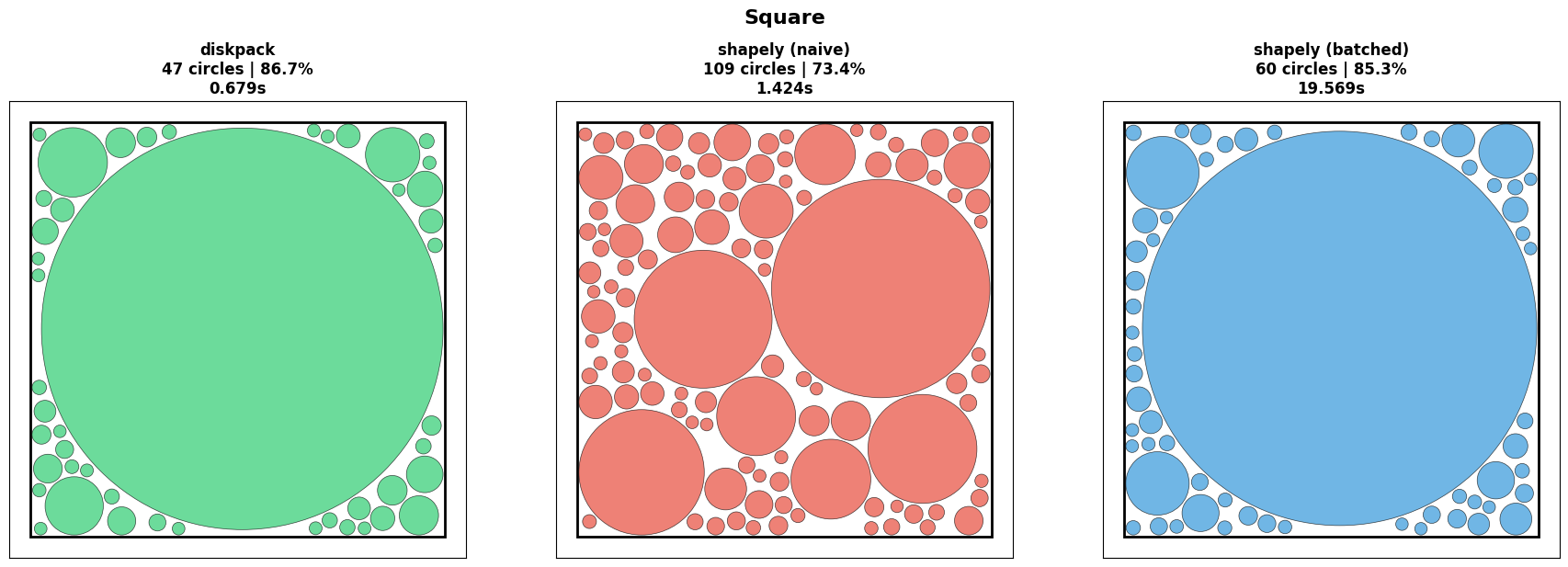
diskpack achieves higher density and faster packing compared to the Python Shapely library. Where Shapely creates Python objects for each point-in-polygon and distance check, diskpack uses vectorized NumPy operations with precomputed edge geometry and batched candidate evaluation — sampling many points per iteration and greedily placing the largest valid circle. A grid-based spatial index keeps collision detection O(1) as circle count grows. The batched Shapely method can approach similar density by also picking the best of many candidates, but at ~30x the runtime due to per-point object overhead.
| Method | Circles | Density | Time |
|---|---|---|---|
| diskpack | 47 | 86.7% | 0.679s |
| shapely (naive) | 109 | 73.4% | 1.424s |
| shapely (batched) | 60 | 85.3% | 19.569s |
See demo/diskpack_comparisons.ipynb for the full benchmark notebook.
License
MIT
1 maintainer

Download files
Download the file for your platform. If you're not sure which to choose, learn more about installing packages.
Source Distribution
Built Distribution
Filter files by name, interpreter, ABI, and platform.
If you're not sure about the file name format, learn more about wheel file names.
Copy a direct link to the current filters
File details
Details for the file diskpack-0.10.3.tar.gz.
File metadata
- Download URL: diskpack-0.10.3.tar.gz
- Upload date:
- Size: 16.4 kB
- Tags: Source
- Uploaded using Trusted Publishing? Yes
- Uploaded via:
twine/6.1.0 CPython/3.13.12
File hashes
| Algorithm | Hash digest | |
|---|---|---|
| SHA256 |
cd8157301e902a8225419a3042f3277910a104b0a4492e3448d44e8da018dd55
|
|
| MD5 |
a28f7685a2bb79459205acf4a846bce0
|
|
| BLAKE2b-256 |
e246a63a912d99e0c876c277680b36593e2dbdc1630670807ab1370189550e08
|
Provenance
The following attestation bundles were made for diskpack-0.10.3.tar.gz:
Publisher:
publish.yml on semajyllek/diskpack
-
Statement:
-
Statement type:
https://in-toto.io/Statement/v1 -
Predicate type:
https://docs.pypi.org/attestations/publish/v1 -
Subject name:
diskpack-0.10.3.tar.gz -
Subject digest:
cd8157301e902a8225419a3042f3277910a104b0a4492e3448d44e8da018dd55 - Sigstore transparency entry: 1934314946
- Sigstore integration time:
-
Permalink:
semajyllek/diskpack@17c568503f953068f69f539d2d0753e5dd5286fb -
Branch / Tag:
refs/tags/v0.10.3 - Owner: https://github.com/semajyllek
-
Access:
public
-
Token Issuer:
https://token.actions.githubusercontent.com -
Runner Environment:
github-hosted -
Publication workflow:
publish.yml@17c568503f953068f69f539d2d0753e5dd5286fb -
Trigger Event:
push
-
Statement type:
File details
Details for the file diskpack-0.10.3-py3-none-any.whl.
File metadata
- Download URL: diskpack-0.10.3-py3-none-any.whl
- Upload date:
- Size: 15.3 kB
- Tags: Python 3
- Uploaded using Trusted Publishing? Yes
- Uploaded via:
twine/6.1.0 CPython/3.13.12
File hashes
| Algorithm | Hash digest | |
|---|---|---|
| SHA256 |
332ecae18b34dfe7626f330ede8f5490629e4c7d1b8cdfa729827cb132423323
|
|
| MD5 |
ffc58ea759ca5e0b79ea33c38f5343ef
|
|
| BLAKE2b-256 |
7e3c98d04ec7d40a0e7a2406ddb08d846c137e7fb1523dba115cec588fa45330
|
Provenance
The following attestation bundles were made for diskpack-0.10.3-py3-none-any.whl:
Publisher:
publish.yml on semajyllek/diskpack
-
Statement:
-
Statement type:
https://in-toto.io/Statement/v1 -
Predicate type:
https://docs.pypi.org/attestations/publish/v1 -
Subject name:
diskpack-0.10.3-py3-none-any.whl -
Subject digest:
332ecae18b34dfe7626f330ede8f5490629e4c7d1b8cdfa729827cb132423323 - Sigstore transparency entry: 1934314972
- Sigstore integration time:
-
Permalink:
semajyllek/diskpack@17c568503f953068f69f539d2d0753e5dd5286fb -
Branch / Tag:
refs/tags/v0.10.3 - Owner: https://github.com/semajyllek
-
Access:
public
-
Token Issuer:
https://token.actions.githubusercontent.com -
Runner Environment:
github-hosted -
Publication workflow:
publish.yml@17c568503f953068f69f539d2d0753e5dd5286fb -
Trigger Event:
push
-
Statement type:














