
A Django extension that allows users to reorder and toggle visibility of admin list view, app index, and dashboard elements

Project description
Django Admin FlexList

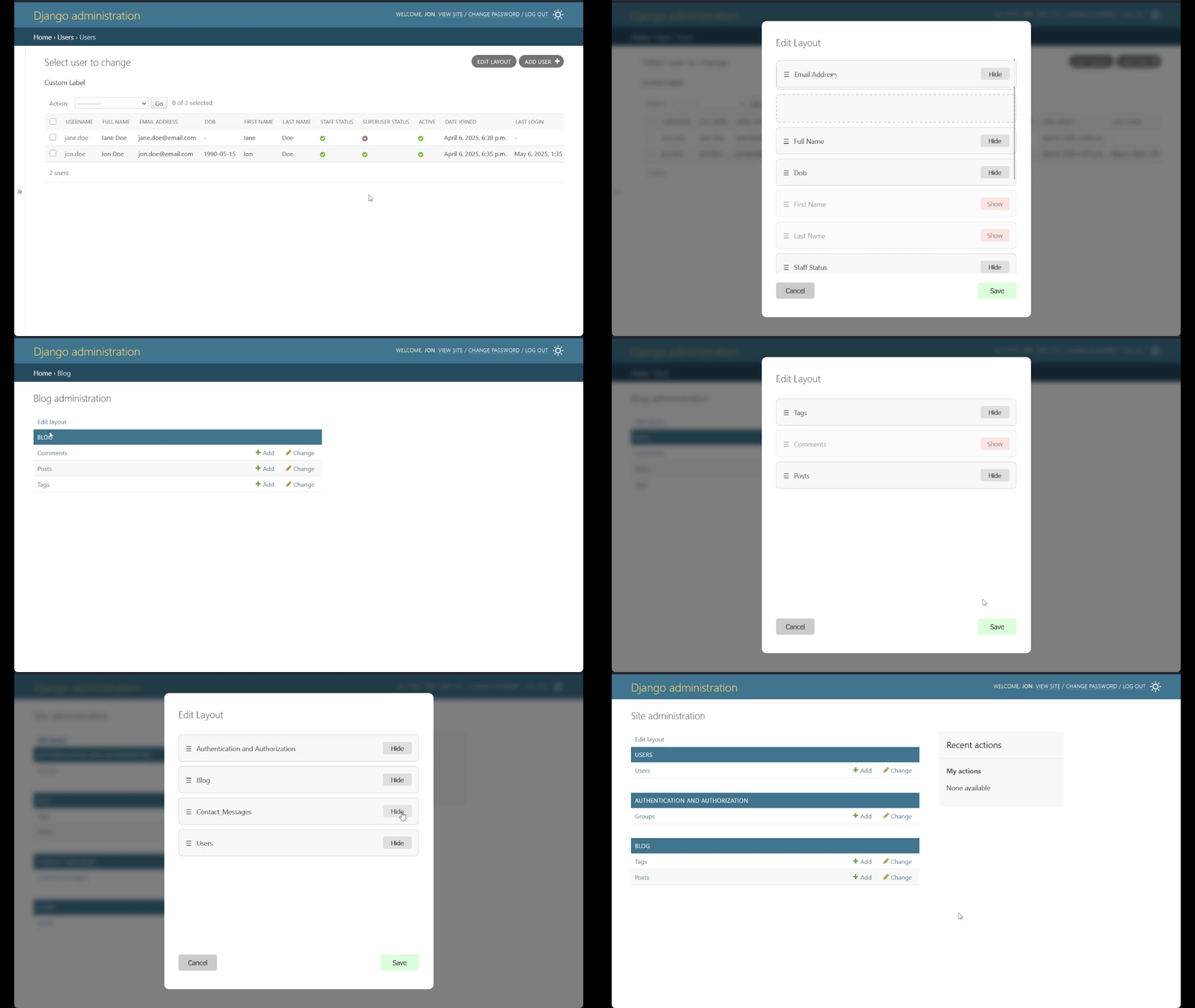
A Django package that enables users to customize the admin list view, app index, and dashboard by adding an "Edit layout" button to the page. When clicked, it opens a dialog form that allows users to:
- Toggle the visibility of columns, models, or app sections
- Change their order
- Save their preferred layout for future use
Setup
1. Install the package
To install the package, run:
$ pip install django-admin-flexlist
2. Install the app
Add "django_admin_flexlist" to INSTALLED_APPS in your project's settings.py file:
INSTALLED_APPS = [
    # ...
    "django_admin_flexlist",
    # ...
]
This allows Django to find the package's migrations and templates.
3. Apply migrations
Django Admin FlexList stores each user's layout preferences in the database. To create the necessary table, run:
$ python manage.py migrate
4. Include URLs
The package adds endpoints so the JavaScript on the custom template can load the user's preferences into the dialog form and then save the changes to the DB model. To enable those, add the following to your project's urls.py file:
urlpatterns = [
    # ...
    path("", include("django_admin_flexlist.urls")),
    # ...
]
5. Integrate functionality
The package supports customizing two types of Django admin pages: list views and index pages. Index pages include both the main dashboard (showing apps and models) and app-specific dashboards (showing models from a selected app). You can choose to integrate either or both.
5.1 Integrate list view functionality
The customization functionality is introduced by the FlexListAdmin class. It mainly implements two changes:
- Intercepts the
get_list_displaymethod to apply the user's custom changes - Uses a custom change list template that allows the user to change the layout
To use it, extend your admin class as follows:
from django_admin_flexlist import FlexListAdmin

class YourAdmin(FlexListAdmin):
    pass
Notice that you can replace admin.ModelAdmin with the FlexListAdmin class, since the latter already extends that Django class.
You don't need to implement the get_list_display method for this feature to work. If you do override it, the customization should still work without any additional changes.
In case your admin class overrides change_list_template, you can keep the "Edit layout" feature by extending your custom template as follows:
{% extends "django_admin_flexlist/change_list.html" %}
In case your custom template already extends a template other than "admin/change_list.html", you can still keep the feature by adding the following blocks to your file:
{% block extrahead %}
{{ block.super }}
{% include "django_admin_flexlist/change_list_head.html" %}
{% endblock %}

{% block object-tools-items %}
{% include "django_admin_flexlist/change_list_actions.html" %}
{{ block.super }}
{% endblock %}

{% block content %}
{{ block.super }}
{% include "django_admin_flexlist/change_list_content.html" %}
{% endblock %}
5.2 Integrate index page functionality
To enable customization on index pages, replace "django.contrib.admin" in settings.py as follows:
INSTALLED_APPS = [
    # ...
    "django_admin_flexlist.FlexListAdminConfig",  # replaces "django.contrib.admin"
    # ...
]
This swaps Django's default admin site class with one from the package, adding an "Edit layout" button and support for customizing the app and model lists. All other admin features remain unchanged.
If you're already using a custom admin site class, extend it like this:
from django_admin_flexlist import FlexListAdminSite

class YourAdminSite(FlexListAdminSite):
    pass
If you're overriding "admin/index.html" or "admin/app_index.html", you can keep this feature by including the following blocks:
- In your custom index template:
{% block extrastyle %}
{{ block.super }}
{% include "django_admin_flexlist/index_head.html" %}
{% endblock %}

{% block content %}
{{ block.super }}
{% include "django_admin_flexlist/index_actions.html" %}
{% include "django_admin_flexlist/index_content.html" %}
{% endblock %}
- In your custom app index template:
{% block extrastyle %}
{{ block.super }}
{% include "django_admin_flexlist/app_index_head.html" %}
{% endblock %}

{% block content %}
{{ block.super }}
{% include "django_admin_flexlist/app_index_actions.html" %}
{% include "django_admin_flexlist/app_index_content.html" %}
{% endblock %}
If you use the same custom template for both the index page and the app index page, include the following blocks instead:
{% block extrastyle %}
{{ block.super }}
{% if app_label %}
{% include "django_admin_flexlist/app_index_head.html" %}
{% else %}
{% include "django_admin_flexlist/index_head.html" %}
{% endif %}
{% endblock %}

{% block content %}
{{ block.super }}
{% if app_label %}
{% include "django_admin_flexlist/app_index_actions.html" %}
{% include "django_admin_flexlist/app_index_content.html" %}
{% else %}
{% include "django_admin_flexlist/index_actions.html" %}
{% include "django_admin_flexlist/index_content.html" %}
{% endif %}
{% endblock %}
6. Custom styling (optional)
The colors used by the components are defined in django_admin_flexlist/css/colors.css. You can override those values with your own, as seen in the demo project's base/static/base/css/colors.css file, and adjust your templates to use your custom CSS file, as seen in templates/admin/base_site.html.
Limitations
For list views, the implementation expects fields defined in list_display or get_list_display to be a list or tuple of strings. This simplifies serializing and deserializing changes saved to the DB model. As a result, the following Django implementation of a field isn't supported:
@admin.display(description="Name")
def upper_case_name(obj):
    return f"{obj.first_name} {obj.last_name}".upper()

class PersonAdmin(admin.ModelAdmin):
    list_display = [upper_case_name]
Demo project
To try out the package, you can run the included demo project. Make sure you have tox installed. Then:
- Clone this repository
- Run the demo project with:
$ tox -e py310-django42 -- runserver
(Replacepy310-django42with your desired Python and Django versions - seetox.inifor supported combinations)
This will:
- Spin up a Django app with the specified version
- Create a new SQLite database
- Populate it with two demo users:
- Username: "jon.doe", Password: "jon.doe"
- Username: "jane.doe", Password: "jane.doe"
The supported Python and Django versions can be found in the tox.ini file.
Release history Release notifications | RSS feed


Download files
Download the file for your platform. If you're not sure which to choose, learn more about installing packages.
Source Distribution
Built Distribution
Filter files by name, interpreter, ABI, and platform.
If you're not sure about the file name format, learn more about wheel file names.
Copy a direct link to the current filters
File details
Details for the file django_admin_flexlist-1.0.2.tar.gz.
File metadata
- Download URL: django_admin_flexlist-1.0.2.tar.gz
- Upload date:
- Size: 25.2 kB
- Tags: Source
- Uploaded using Trusted Publishing? No
- Uploaded via: twine/6.1.0 CPython/3.10.11
File hashes
| Algorithm | Hash digest | |
|---|---|---|
| SHA256 |
dfbd93c2dc2fe5a250e274196c3d9413fbd3f97009f78bfcff901de2ac1afac6
|
|
| MD5 |
0a187620f4c7682ba7f90e1a22c2ba5c
|
|
| BLAKE2b-256 |
585aae10a33676f2b9a1167cc77d5b48d5a91e49ae5fcdc51acd35c717274f11
|
File details
Details for the file django_admin_flexlist-1.0.2-py3-none-any.whl.
File metadata
- Download URL: django_admin_flexlist-1.0.2-py3-none-any.whl
- Upload date:
- Size: 31.5 kB
- Tags: Python 3
- Uploaded using Trusted Publishing? No
- Uploaded via: twine/6.1.0 CPython/3.10.11
File hashes
| Algorithm | Hash digest | |
|---|---|---|
| SHA256 |
73519e5295a584e114eedfa6841f5c22aa8e5f3e2757eeb042bdbb825d933ede
|
|
| MD5 |
34863474be79e5bc2b65c73a19ed8f49
|
|
| BLAKE2b-256 |
c75c0aec1e94d8f80761da9e051920b5f442c16ddc1acf9be308e5f97674dd73
|






