
Django Chartjs
Django Chartjs lets you manage charts in your Django application.


This is compatible with Chart.js and Highcharts JS libraries.
Using a set of predefined Class Based Views you are able to get started after writing just your SQL query.
Authors: Rémy Hubscher and contributors
Licence: BSD
Compatibility: Django 1.5+, python2.7 up to python3.7
Project URL: https://github.com/peopledoc/django-chartjs
Getting Started
Install django-chartjs:
pip install django-chartjs
Add it to your INSTALLED_APPS settings:
INSTALLED_APPS = (
    '...',
    'chartjs',
)
Using it
A simple Line Chart example.
1. Create the HTML file
{% load staticfiles %}
<html>
    <head>
        <title>django-chartjs line chart demo</title>
        <!--[if lte IE 8]>
            <script src="{% static 'js/excanvas.js' %}"></script>
        <![endif]-->
    </head>
    <body>
        <h1>Some Line Charts loaded in Ajax!</h1>

        <canvas id="myChart" width="500" height="400"></canvas>

        <script type="text/javascript" src="http://code.jquery.com/jquery-1.10.0.min.js"></script>
        <script type="text/javascript" src="{% static 'js/Chart.min.js' %}"></script>
        <script type="text/javascript">
            $.get('{% url "line_chart_json" %}', function(data) {
                var ctx = $("#myChart").get(0).getContext("2d");
                new Chart(ctx, {
                    type: 'line', data: data
                });
            });
        </script>
    </body>
</html>
2. Create the view with labels and data definition
from random import randint
from django.views.generic import TemplateView
from chartjs.views.lines import BaseLineChartView


class LineChartJSONView(BaseLineChartView):
    def get_labels(self):
        """Return 7 labels for the x-axis."""
        return ["January", "February", "March", "April", "May", "June", "July"]

    def get_providers(self):
        """Return names of datasets."""
        return ["Central", "Eastside", "Westside"]

    def get_data(self):
        """Return 3 datasets to plot."""

        return [[75, 44, 92, 11, 44, 95, 35],
                [41, 92, 18, 3, 73, 87, 92],
                [87, 21, 94, 3, 90, 13, 65]]


line_chart = TemplateView.as_view(template_name='line_chart.html')
line_chart_json = LineChartJSONView.as_view()
3. Get a Chart.js Line Chart
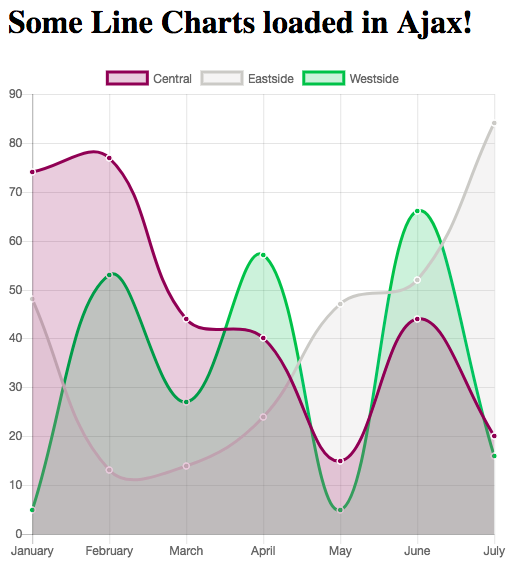
It is that simple!
For other examples including a HighCharts line chart, don’t hesitate to look at the demo project.
Also, feel free to contribute your demo!
2 maintainers


Metadata
2 maintainers
Release files for django-chartjs 1.4.0
For a detailed explanation of source distributions (sdists) and built distributions (wheels), please see the package formats documentation.
Source distribution (sdist)
| File | Size | Uploaded | |
|---|---|---|---|
| django-chartjs-1.4.0.tar.gz | 568.8 kB | Details |
Built distribution (wheel)
| File | Interpreter | ABI | Platform | Reset |
|---|---|---|---|---|
| django_chartjs-1.4.0-py3-none-any.whl | Python 3 | none | any | Details |
Total release size: 1.2 MB
Release files / django-chartjs-1.4.0.tar.gz
| Download URL | django-chartjs-1.4.0.tar.gz |
|---|---|
| Size | 568.8 kB |
| Tags | Source |
|
SHA-256 checksum How to use checksums |
f521be3b4b413549991240caab41d925971cc32c0df80b7c50907d08b2ff21d4
|
|
BLAKE2b-256 checksum How to use checksums |
bce491560842d4f157dba4c6f43b333c503d33c7f129a2df4d15b927a64543ac
|
| Upload date | |
|
Uploaded using Trusted Publishing? What is trusted publishing? |
No |
| Uploaded via |
twine/1.12.1 pkginfo/1.4.2 requests/2.18.4 setuptools/40.7.1 requests-toolbelt/0.8.0 tqdm/4.19.7 CPython/3.6.7
|
Release files / django_chartjs-1.4.0-py3-none-any.whl
| Download URL | django_chartjs-1.4.0-py3-none-any.whl |
|---|---|
| Size | 598.3 kB |
| Tags | Python 3 |
|
SHA-256 checksum How to use checksums |
9747a2ef6a0aabfbd5b3d52f0827af761eb764ed3707934aa5cb7269cc08940e
|
|
BLAKE2b-256 checksum How to use checksums |
b4773889cd99408cd51befd0e69c3d3ee96bb81715b3149e9d2749aaca664992
|
| Upload date | |
|
Uploaded using Trusted Publishing? What is trusted publishing? |
No |
| Uploaded via |
twine/1.12.1 pkginfo/1.4.2 requests/2.18.4 setuptools/40.7.1 requests-toolbelt/0.8.0 tqdm/4.19.7 CPython/3.6.7
|














