
django-openrouter




Reusable Django application for managing OpenRouter models, usage profiles, budgets and request logs from Django admin.
Your product code (translation, chat, summarization, …) talks to OpenRouter through this library instead of hardcoded settings.py keys and model ids. An operator picks active models, sets daily/monthly limits, and inspects spend in admin.
Documentation: https://svalench.github.io/django-openrouter/
Requires Python 3.11+ and Django 4.2+ (subject to Django's Python compatibility). This is a third-party integration, not an official OpenRouter SDK.
Why not settings.py?
Hardcoding OPENROUTER_MODEL = "anthropic/claude-3.5-sonnet" means a deploy to change models, budgets or a kill switch. django-openrouter stores that runtime policy in the database, caches it, and enforces limits before every request.
API keys stored in admin are encrypted in the database (Fernet, key derived from SECRET_KEY) and are write-only: after save the value cannot be viewed, only replaced or cleared. Keys can still come from the environment (OPENROUTER_API_KEY) if you prefer not to keep them in the database.
Quickstart
1. Install
pip install django-openrouter
2. Enable the app and migrate
# settings.py
INSTALLED_APPS = [
    ...,
    "django_openrouter",
]
MIDDLEWARE = [
    ...,
    "django.contrib.auth.middleware.AuthenticationMiddleware",
    "django_openrouter.middleware.CurrentUserMiddleware",
    ...,
]
python manage.py migrate
3. Configure in Django admin
- Open OpenRouter → OpenRouter settings. Paste an API key (it is encrypted and cannot be viewed after save) or leave it empty and set
OPENROUTER_API_KEYin the environment. - Run
python manage.py sync_modelsto pull the model catalog (GET /api/v1/models). - Create a Usage profile (slug
translation,chat, …), add one or more models in priority order (first is tried first), plus limits and budgets. - Set that profile as default profile if you want
chat(messages=...)without a name.
4. Call from your Django application
After configuring the chat profile, run this in a view, task, or
python manage.py shell:
from django_openrouter import chat

result = chat("chat", messages=[{"role": "user", "content": "Hello"}])
print(result.content)
print(result.model_used, result.cost_usd, result.latency_ms)
This makes a real API request and may incur provider charges. To try the integration without an API key or provider calls, run the mocked tests in Contributing. See Usage for async clients, streaming, and fallback behavior.
Screenshots: docs/img/.
Admin pages
Four models under OpenRouter. Runtime policy lives here, not in settings.py.
| Page | What it does |
|---|---|
| OpenRouter settings | Kill switch, encrypted API key, streaming, timeouts |
| OpenRouter models | Catalog from OpenRouter: price, latency, throughput |
| Usage profiles | Ordered model chain, limits, budgets, spend stats |
| Request logs | Per-call tokens, cost, latency (read-only) |
OpenRouter settings
Singleton: the changelist redirects to the only row. The row cannot be deleted.
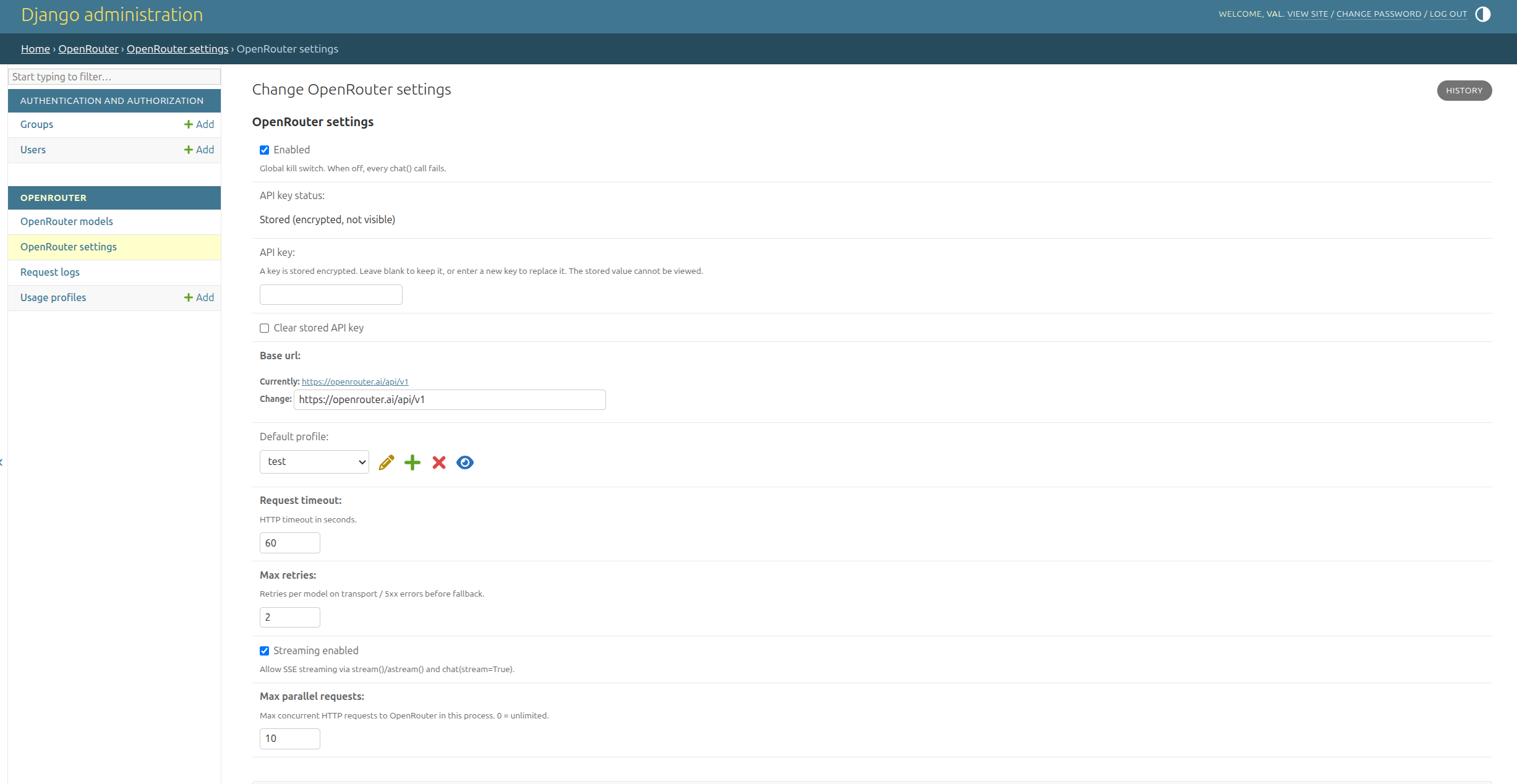
- Enabled — global kill switch. Off → every
chat()/stream()fails. - API key — write-only, Fernet-encrypted from
SECRET_KEY. After save the value cannot be viewed. Blank keeps the stored key; a new value replaces it. Clear stored API key wipes the DB key so the process falls back toOPENROUTER_API_KEY/settings.OPENROUTER["API_KEY"]. - Base URL — OpenRouter API root (
https://openrouter.ai/api/v1). - Default profile — used when
chat(messages=...)omits a profile name. - Request timeout / Max retries — HTTP timeout and retries on transport / 5xx before the next model in the chain.
- Streaming enabled — allows SSE via
stream()/astream()andchat(stream=True). Off by default. - Max parallel requests — cap on concurrent HTTP calls in this process (
0= unlimited).
OpenRouter models
Catalog from GET /api/v1/models (plus /endpoints for latency/throughput). Rows cannot be added or deleted by hand; the detail page is read-only.
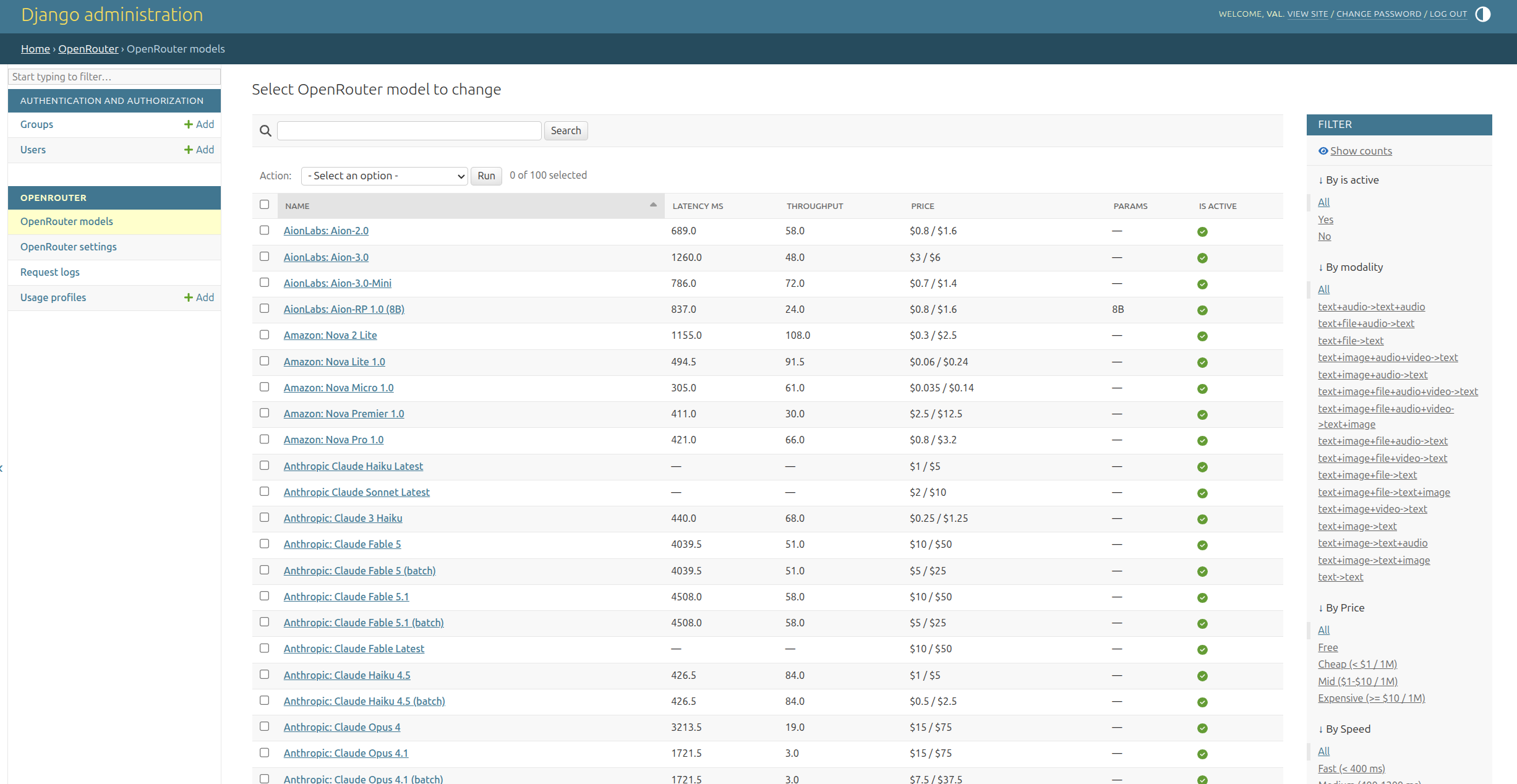
Columns: name, latency_ms (p50 TTFT), throughput (tok/s), prompt/completion price per 1M tokens, parameter size (70B / 8x7B), is_active. Click a column to sort (nulls last).
Filters: active, modality, price (free / cheap < $1 / mid $1–10 / expensive), speed (< 400 ms / 400–1200 / ≥ 1200).
Actions:
- Sync catalog with OpenRouter — upsert; models missing remotely get
is_active=False. - Assign to usage profile… — append selected models to a profile chain (skips duplicates, inactive, and paid models when the profile has
only_free_models).
The changelist refreshes from the API on first view, then serves the database for 10 minutes (CATALOG_CACHE_TIMEOUT). Same sync: python manage.py sync_models.
Usage profiles
A profile is the slug your code passes (chat, translation, …) plus an ordered model list (first is tried first; later rows are fallback on 402 / 429 / 5xx). Exhausted limits/budgets raise; they do not silently fall back.
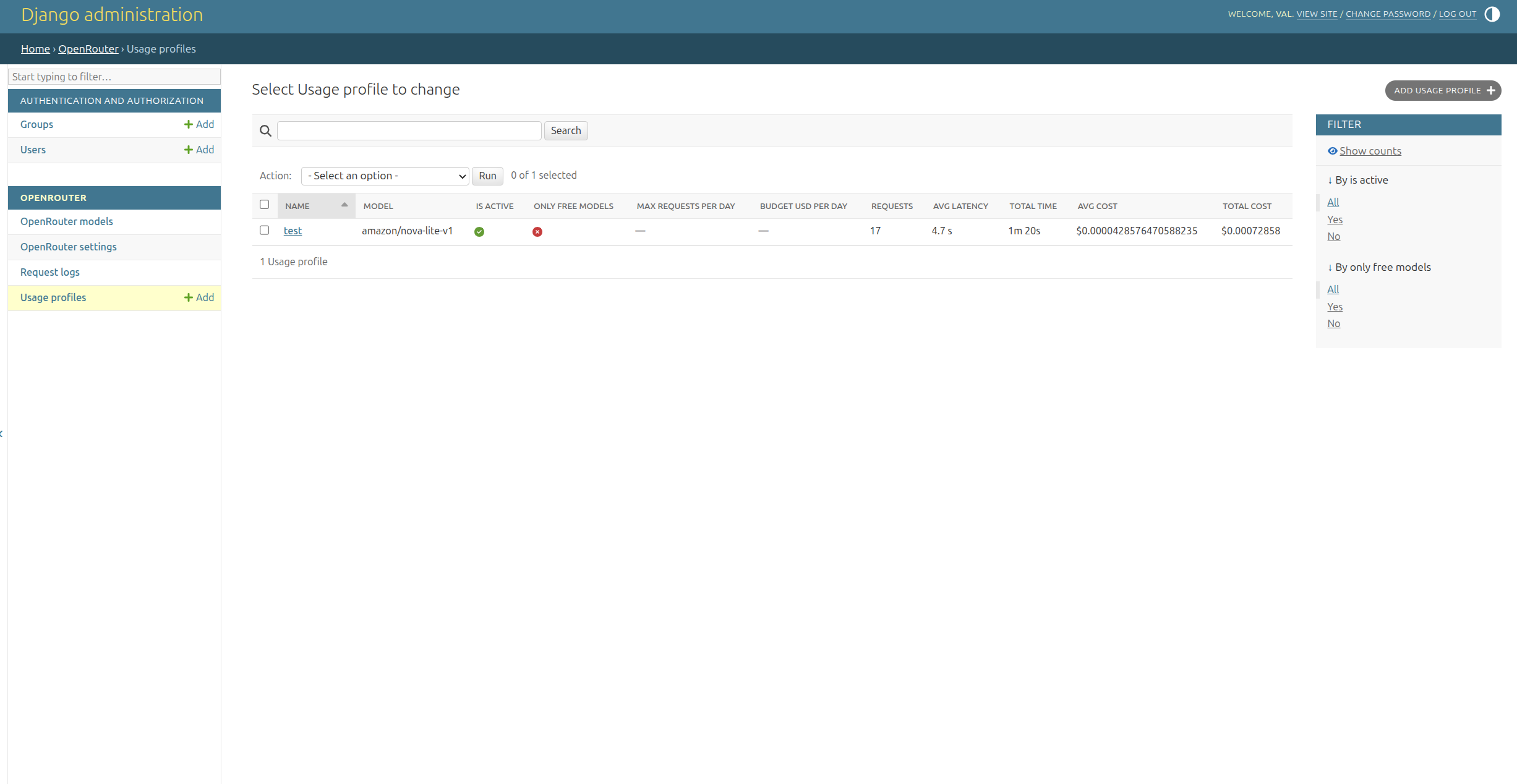
Changelist: name, primary model, active, only-free, daily request/budget caps, and aggregates from logs (request count, avg/total latency, avg/total cost).
On the form: max_tokens, temperature (0–2), daily/monthly request and USD limits (blank = unlimited), only free models, is active. Inline Models (priority order) uses catalog autocomplete (price + latency in the label; same price/speed query filters as the catalog). Saving syncs the first chain item into model.
Request logs
Read-only. Every HTTP attempt (including fallbacks and errors) is a row when DatabaseBackend is enabled (the default). Daily/monthly limits are aggregated from this table.
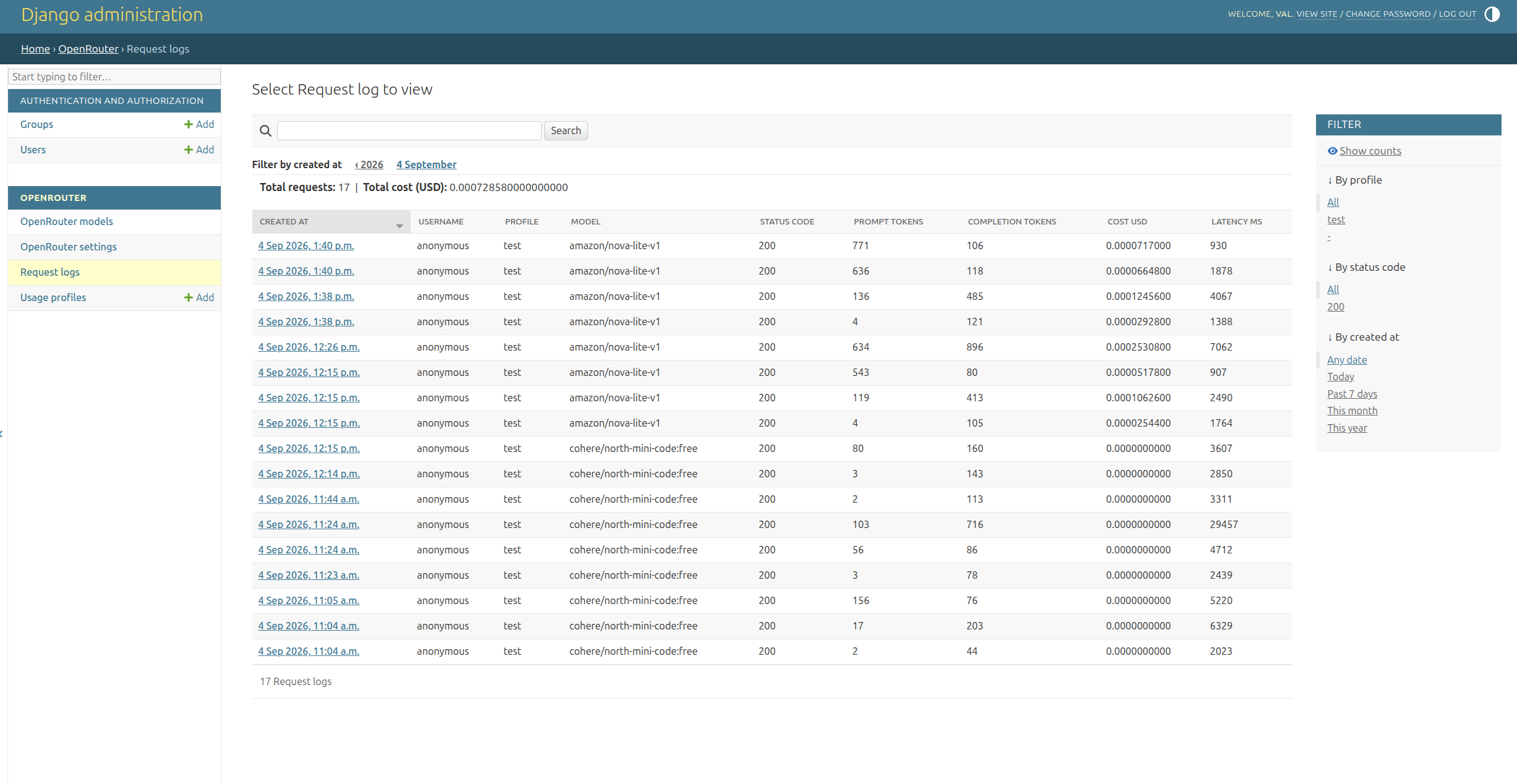
Columns: time, username, profile, model, HTTP status, prompt/completion tokens, cost, latency. Above the table: request count and USD total for the current filter. Filters: profile, status, date.
Username comes from django_openrouter.middleware.CurrentUserMiddleware (after AuthenticationMiddleware). Without it, rows show anonymous. In Celery / management commands use bound_username("worker").
Usage
from django_openrouter import chat

result = chat(
    "translation",
    messages=[{"role": "user", "content": "Translate to French: hello"}],
)
print(result.content)
print(result.model_used, result.cost_usd, result.latency_ms)
Sync client:
from django_openrouter import OpenRouterClient

client = OpenRouterClient("chat")
result = client.chat(messages=[{"role": "user", "content": "Hello"}])
Async:
from django_openrouter import achat

result = await achat("chat", messages=[{"role": "user", "content": "Hello"}])
If a profile’s limit or budget is exhausted, chat() raises BudgetExceeded or RateLimitExceeded and does not silently fall back. Fallback models are only used when OpenRouter returns 402, 429 or 5xx.
Streaming is off by default. Turn on Streaming enabled in OpenRouter settings, then iterate chunks:
from django_openrouter import stream

for chunk in stream("chat", messages=[{"role": "user", "content": "Hello"}]):
    print(chunk.delta, end="", flush=True)
chat(..., stream=True) uses the same SSE transport and returns a complete ChatResult. With streaming enabled, chat() (without stream=False) also talks SSE. stream=False forces a regular JSON response.
Async: astream("chat", messages=...) / AsyncOpenRouterClient("chat").stream(...).
Max parallel requests (default 10, 0 = unlimited) caps concurrent HTTP calls to OpenRouter in the current process — both chat() and stream(), sync and async.
Management command
python manage.py sync_models
python manage.py sync_models --api-key sk-or-...
Upserts the catalog, never deletes rows, and sets is_active=False on models that disappeared from OpenRouter.
settings.OPENROUTER
| Key | Default | Description |
|---|---|---|
CACHE_TIMEOUT |
60 |
Seconds to keep runtime config in Django’s cache |
CACHE_ALIAS |
"default" |
Cache alias (django.core.cache) |
CATALOG_CACHE_TIMEOUT |
600 |
Seconds to skip re-fetching the admin model catalog |
API_KEY |
unset | Fallback API key if the admin field is empty |
HTTP_REFERER |
unset | Sent as HTTP-Referer (OpenRouter app attribution) |
X_TITLE |
unset | Sent as X-Title |
LOG_BACKENDS |
DB only | Where request logs are written; see below |
Also accepted, in this order, when the admin API key is empty:
settings.OPENROUTER["API_KEY"]settings.OPENROUTER_API_KEY- Environment variable
OPENROUTER_API_KEY
Example:
OPENROUTER = {
    "CACHE_TIMEOUT": 60,
    "CATALOG_CACHE_TIMEOUT": 600,
    "CACHE_ALIAS": "default",
    "HTTP_REFERER": "https://my-app.example",
    "X_TITLE": "My App",
}
The default cache backend (LocMemCache) is enough. Redis/Memcached are optional.
Catalog refresh, price/speed columns and profile autocomplete filters are described under Admin pages.
Request logging backends
Every HTTP call (including failed attempts and fallbacks) is logged through the backends listed in OPENROUTER["LOG_BACKENDS"]. An entry is either a dotted path (defaults apply) or a dict with a BACKEND key plus options:
OPENROUTER = {
    "LOG_BACKENDS": [
        # 1. Project database (default): writes RequestLog rows.
        "django_openrouter.log_backends.DatabaseBackend",
        # 2. JSON Lines file with size-based rotation.
        {
            "BACKEND": "django_openrouter.log_backends.FileBackend",
            "PATH": "/var/log/myapp/openrouter-requests.jsonl",
            "MAX_BYTES": 10 * 1024 * 1024,  # rotate at 10 MB
            "BACKUP_COUNT": 5,
        },
        # 3. ClickHouse over its HTTP interface (uses httpx, no extra deps).
        {
            "BACKEND": "django_openrouter.log_backends.ClickHouseBackend",
            "URL": "http://localhost:8123",
            "DATABASE": "analytics",
            "TABLE": "openrouter_request_log",
            "USERNAME": "logger",
            "PASSWORD": "secret",
        },
    ],
}
All configured backends receive every record. Logging is best-effort: a failing backend (full disk, unreachable ClickHouse) never breaks chat() — the error is logged to the django_openrouter logger.
Backend-specific notes:
- DatabaseBackend writes to the
RequestLogmodel. Daily/monthly request limits and budgets are aggregated from that table, so keep this backend enabled if you use limits; without itcheck_limits()sees no usage. - FileBackend uses
logging.handlers.RotatingFileHandler; the line format is one JSON object per request withcreated_at,profile,model,status_code,error_message,prompt_tokens,completion_tokens,cost_usd,latency_ms,username. - ClickHouseBackend inserts
FORMAT JSONEachRowper request. Create a table like:
CREATE TABLE analytics.openrouter_request_log
(
    created_at DateTime,
    profile String,
    model String,
    status_code UInt16,
    error_message String,
    prompt_tokens UInt32,
    completion_tokens UInt32,
    cost_usd Decimal(20, 10),
    latency_ms UInt32,
    username String
)
ENGINE = MergeTree
ORDER BY (created_at, profile);
Each log row stores the Django username that triggered the call. Add django_openrouter.middleware.CurrentUserMiddleware after AuthenticationMiddleware. Unauthenticated (or non-HTTP) calls are logged as anonymous. In Celery / management commands:
from django_openrouter.current_user import bound_username

with bound_username("worker"):
    chat("chat", messages=[...])
You can also point LOG_BACKENDS at your own subclass of django_openrouter.log_backends.LogBackend (implement write(), optionally awrite()).
Limits
Usage is aggregated from RequestLog for the current calendar day and month (UsageProfile.get_usage("day"|"month")). Null limit fields mean “unlimited”.
Internationalization
Admin labels (filters, help texts, verbose names) are wrapped in gettext_lazy.
Catalogs live in src/django_openrouter/locale/<django_locale>/LC_MESSAGES/django.po.
The host project decides which languages are active. Example:
from django.utils.translation import gettext_lazy as _

LANGUAGE_CODE = "ru"
LANGUAGES = [
    ("ru", _("Русский")),
    ("uk", _("Українська")),
    ("pl", _("Polski")),
    ("be", _("Беларуская")),
    ("en-gb", _("English")),
    ("de", _("Deutsch")),
    ("fr", _("Français")),
    ("es", _("Español")),
    ("zh-hans", _("简体中文")),
]

MIDDLEWARE = [
    "django.contrib.sessions.middleware.SessionMiddleware",
    "django.middleware.locale.LocaleMiddleware",  # after SessionMiddleware
    ...
]
Django language codes (zh-hans) map to gettext dirs (zh_Hans). English in this
package is en_GB / en-gb — there is no base en catalog.
Compile after editing .po files:
msgfmt -o src/django_openrouter/locale/ru/LC_MESSAGES/django.mo \
        src/django_openrouter/locale/ru/LC_MESSAGES/django.po
Or from a Django project that has this app on INSTALLED_APPS:
python manage.py compilemessages -l ru
.mo files are not generated automatically; without them admin stays in English
even if LANGUAGE_CODE is set.
License
MIT
Contributing
See CONTRIBUTING.md for a local test setup, lint/type checks, and distribution validation. Bug reports should include a minimal reproduction and version information, never real API keys or private request data.
1 maintainer

Download files
Download the file for your platform. If you're not sure which to choose, learn more about installing packages.
Source Distribution
Built Distribution
Filter files by name, interpreter, ABI, and platform.
If you're not sure about the file name format, learn more about wheel file names.
Copy a direct link to the current filters
File details
Details for the file django_openrouter-0.1.3.tar.gz.
File metadata
- Download URL: django_openrouter-0.1.3.tar.gz
- Upload date:
- Size: 351.0 kB
- Tags: Source
- Uploaded using Trusted Publishing? Yes
- Uploaded via:
twine/7.0.0 CPython/3.13.14
File hashes
| Algorithm | Hash digest | |
|---|---|---|
| SHA256 |
60abeda204990403e68840404ecef319b65e328c6585dc78ce0ba05ab7b41d23
|
|
| MD5 |
37838270bbba484a360b7a3eaf557441
|
|
| BLAKE2b-256 |
bbf2fb7c15e2fc0702af3a2ba6068e91b3fea942f5aaf6505510e9159711c917
|
Provenance
The following attestation bundles were made for django_openrouter-0.1.3.tar.gz:
Publisher:
publish.yml on svalench/django-openrouter
-
Statement:
-
Statement type:
https://in-toto.io/Statement/v1 -
Predicate type:
https://docs.pypi.org/attestations/publish/v1 -
Subject name:
django_openrouter-0.1.3.tar.gz -
Subject digest:
60abeda204990403e68840404ecef319b65e328c6585dc78ce0ba05ab7b41d23 - Sigstore transparency entry: 2798181198
- Sigstore integration time:
-
Permalink:
svalench/django-openrouter@07811c2ded05e9cc295666ebff6fa9bca24a9a41 -
Branch / Tag:
refs/tags/v0.1.3 - Owner: https://github.com/svalench
-
Access:
public
-
Token Issuer:
https://token.actions.githubusercontent.com -
Runner Environment:
github-hosted -
Publication workflow:
publish.yml@07811c2ded05e9cc295666ebff6fa9bca24a9a41 -
Trigger Event:
push
-
Statement type:
File details
Details for the file django_openrouter-0.1.3-py3-none-any.whl.
File metadata
- Download URL: django_openrouter-0.1.3-py3-none-any.whl
- Upload date:
- Size: 999.3 kB
- Tags: Python 3
- Uploaded using Trusted Publishing? Yes
- Uploaded via:
twine/7.0.0 CPython/3.13.14
File hashes
| Algorithm | Hash digest | |
|---|---|---|
| SHA256 |
ab00d302f40c54105266e05b792e51cbdc760f9b3ff52726c4d0adf1c18dec30
|
|
| MD5 |
d81693a1809483b39726d9a051b25b75
|
|
| BLAKE2b-256 |
449b03bcf5f48e32b7d31eb25f4aa6ab6e767cfd467c100a661008f891b00c23
|
Provenance
The following attestation bundles were made for django_openrouter-0.1.3-py3-none-any.whl:
Publisher:
publish.yml on svalench/django-openrouter
-
Statement:
-
Statement type:
https://in-toto.io/Statement/v1 -
Predicate type:
https://docs.pypi.org/attestations/publish/v1 -
Subject name:
django_openrouter-0.1.3-py3-none-any.whl -
Subject digest:
ab00d302f40c54105266e05b792e51cbdc760f9b3ff52726c4d0adf1c18dec30 - Sigstore transparency entry: 2798181354
- Sigstore integration time:
-
Permalink:
svalench/django-openrouter@07811c2ded05e9cc295666ebff6fa9bca24a9a41 -
Branch / Tag:
refs/tags/v0.1.3 - Owner: https://github.com/svalench
-
Access:
public
-
Token Issuer:
https://token.actions.githubusercontent.com -
Runner Environment:
github-hosted -
Publication workflow:
publish.yml@07811c2ded05e9cc295666ebff6fa9bca24a9a41 -
Trigger Event:
push
-
Statement type:














