
Django Orbit
AI agent-native observability and debugging for Django.
Current release: v0.13.0.
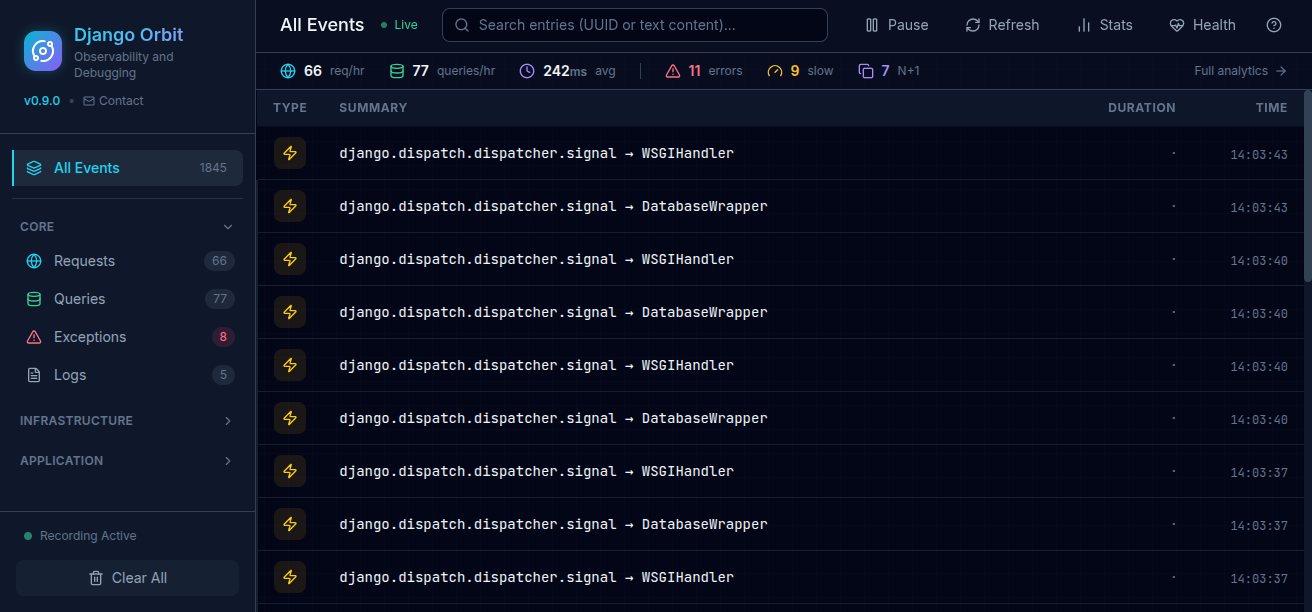
Django Orbit is a reusable Django app that records what your application is doing and exposes it through a dashboard and MCP tools. It captures requests, SQL queries, logs, exceptions, cache operations, jobs, storage, mail, permissions and more, then links related events by family_hash so humans and AI agents can debug from one coherent timeline.
Unlike Django Debug Toolbar, Orbit does not inject HTML into your app. It lives at its own isolated /orbit/ URL and is designed to observe from a distance without interfering with the host project.






Current maintenance release: v0.13.0.
Why Orbit
Django teams increasingly debug with AI coding agents, but most local observability tools are built only for humans. Orbit is built for both:
- humans get a focused dashboard for inspecting runtime behavior;
- agents get structured MCP tools for investigation and handoff;
- captured events are grouped by request family, so evidence stays connected;
- agent output is masked, bounded and read-only by default.
| Capability | Django Debug Toolbar | Django Orbit |
|---|---|---|
| Runs outside your app UI | No | Yes |
| Works with APIs and SPAs | Limited | Yes |
| Persistent request history | No | Yes |
| SQL, logs and exceptions together | Partial | Yes |
| Background jobs and infrastructure events | No | Yes |
| Agent-native MCP debugging tools | No | Yes |
| Request-to-fix handoff bundles | No | Yes |
| Plug-and-play watcher health | No | Yes |
Inspired by Laravel Telescope, Spatie Ray and Django Debug Toolbar.
What Orbit Tracks
| Category | Events |
|---|---|
| HTTP | Requests, responses, headers, body, status codes |
| Database | SQL queries, slow queries, duplicate query / N+1 signals |
| Logging | Python logging output, any level |
| Exceptions | Exception type, message, traceback and request context |
| Cache | GET hits/misses, SET, DELETE |
| Models | ORM create, update and delete events |
| Commands | manage.py executions with exit code |
| HTTP Client | Outgoing requests via supported clients |
| Sent email metadata and body previews | |
| Signals | Django signal dispatches |
| Jobs | Celery, Django-Q, RQ and APScheduler signals/hooks |
| Redis | GET, SET, DEL, HGET, LPUSH and more |
| Permissions | Authorization checks, granted/denied |
| Transactions | atomic() commits and rollbacks |
| Storage | File save/open/delete operations |
| AI/LLM | Provider/model/token metadata, latency, errors and tool-call names |
All events can be linked by family_hash, which lets you inspect every query, log and exception associated with one request or operation.
What's New in v0.13.0
- Added a versioned, metadata-first Evidence API for stable agent and integration consumers.
- Correlation now uses task-local context and restores parent state across requests and nested log scopes.
- MCP request detail now returns the Evidence API envelope and applies
MCP_MAX_LIMITsafely. - The detail panel adds an evidence-backed Investigation guide and a Copy fix handoff with ranked hypotheses and regression-test targets.
What's New in v0.12.3
- Fixed the release automation split so tagged releases use the verified PyPI trusted-publishing workflow.
- Aligned the README release markers and package-facing release notes.
What's New in v0.12.0
Orbit v0.12.0 makes Orbit more useful for AI-native Django apps and safer to release:
- AI/LLM watcher records provider, model, token usage, latency, status and tool-call names;
- prompts, completions and tool-call arguments are not captured by default;
- entry details can copy a coding-agent prompt from the current request family or exception fingerprint;
- release verification now checks version consistency, changelog, package build, Twine metadata and strict docs;
- PRs include a release/readiness checklist for tests, docs and safety review.
Installation
pip install django-orbit
For AI assistant integration, install the MCP extra:
pip install django-orbit[mcp]
Quick Start
Add Orbit to INSTALLED_APPS:
INSTALLED_APPS = [
    # ...
    "orbit",
]
Add the middleware early in the stack:
MIDDLEWARE = [
    "orbit.middleware.OrbitMiddleware",
    # ...
]
Mount the dashboard URLs:
from django.urls import include, path

urlpatterns = [
    path("orbit/", include("orbit.urls")),
    # ...
]
Run migrations and start Django:
python manage.py migrate orbit
python manage.py runserver
Visit http://localhost:8000/orbit/.
Try the Demo
git clone https://github.com/astro-stack/django-orbit.git
cd django-orbit
pip install -e .
python demo.py setup
python manage.py runserver
| URL | Purpose |
|---|---|
http://localhost:8000/ |
Demo app |
http://localhost:8000/orbit/ |
Orbit dashboard |
http://localhost:8000/orbit/stats/ |
Stats dashboard |
http://localhost:8000/orbit/health/ |
Watcher health dashboard |
MCP AI Assistant Setup
Orbit exposes a local MCP server so AI assistants can query live Django runtime evidence.
pip install django-orbit[mcp]
Add this server to Claude Desktop, Cursor, Windsurf or any MCP-compatible client:
{
  "mcpServers": {
    "django-orbit": {
      "command": "python",
      "args": ["manage.py", "orbit_mcp"],
      "cwd": "/path/to/your/django/project"
    }
  }
}
The server launches on demand over stdio. It is read-only: it queries OrbitEntry data and never mutates the host app.
Raw Telemetry Tools
| Tool | Purpose |
|---|---|
get_recent_requests |
Last N requests with status, path and duration |
get_slow_queries |
SQL queries above the configured threshold |
get_exceptions |
Exceptions within a time window |
get_n1_patterns |
Requests with duplicate-query evidence |
get_request_detail |
Versioned, metadata-only evidence for one family_hash |
get_capture_health |
Metadata-only capture readiness, safe flags and watcher state |
search_entries |
Keyword search across entries |
get_stats_summary |
Error rate, average response time and cache stats |
Agent-Native Tools
| Tool | Purpose |
|---|---|
audit_mcp_exposure |
Show the effective MCP safety policy |
preview_masked_entry |
Preview one entry exactly as an agent sees it, with masked payload and risk paths |
find_sensitive_payload_risks |
Find recent entries whose payload keys look like secrets, tokens or credentials |
list_agent_safe_fields |
Document the allowlisted fields and payload policy per entry type |
investigate_request |
Diagnose one request family: timeline, signals, queries, hypotheses and next actions |
investigate_exception_group |
Summarize an exception fingerprint and affected paths |
create_incident_bundle |
Create JSON, Markdown or prompt handoff from request, fingerprint or ticket text |
build_debug_brief |
Match natural-language ticket text to recent evidence |
investigate_endpoint |
Summarize endpoint health, errors, slow requests and related exceptions |
compare_endpoint_windows |
Compare recent endpoint behavior against a baseline window to spot regressions |
find_n_plus_one_candidates |
Rank recent duplicate-query/N+1 candidates with suggested next tools |
summarize_exception_groups |
Group recent exceptions by fingerprint with affected paths and representatives |
daily_health_brief |
Produce local daily triage from recent runtime signals |
generate_release_risk_brief |
Flag blocker/caution signals before a release |
generate_pr_context |
Produce PR-ready evidence, test plan and release-risk context from Orbit data |
propose_fix_hypotheses |
Rank likely fix directions from captured evidence |
propose_test_plan |
Suggest regression/performance tests for the observed issue |
Agent Workflow
A typical ticket-to-fix handoff looks like this:
audit_mcp_exposure()
find_sensitive_payload_risks(limit=20)
build_debug_brief("checkout returns 500 payment token rejected")
create_incident_bundle("fingerprint", "<fingerprint>", format="markdown")
create_incident_bundle("fingerprint", "<fingerprint>", format="prompt")
propose_fix_hypotheses("fingerprint", "<fingerprint>")
propose_test_plan("family_hash", "<family_hash>")
generate_pr_context("fingerprint", "<fingerprint>")
compare_endpoint_windows("/checkout/", method="POST")
find_n_plus_one_candidates(hours=24)
summarize_exception_groups(hours=24)
The goal is not for Orbit to edit code. The goal is to give a human or coding agent enough structured, safe evidence to reproduce, test and fix the issue.
The same flow works in Codex, Claude Desktop/Claude Code, Cursor and other MCP-compatible assistants; see the docs demo for the Claude-specific config path.
Agent Safety
Agent-facing output goes through Orbit's safe serializer:
- sensitive keys are masked using
MASK_KEYS; - payloads can be disabled with
MCP_INCLUDE_PAYLOADS: False; - result sizes are bounded by
MCP_MAX_LIMIT; - oversized payloads are replaced with truncation metadata;
MCP_ENABLED: Falseblocks all MCP tools with a stable disabled response;preview_masked_entry,find_sensitive_payload_risksandlist_agent_safe_fieldslet teams verify exactly what coding agents can see before sharing context.
Residual risk: MCP gives a local assistant read access to Orbit telemetry. Masking and truncation reduce exposure, but telemetry can still reveal sensitive operational context such as endpoints, SQL shape, exception messages or user identifiers. In shared, staging or sensitive environments, prefer MCP_ENABLED: False; if agents only need metadata, set MCP_INCLUDE_PAYLOADS: False.
Example:
ORBIT_CONFIG = {
    "MCP_ENABLED": True,
    "MCP_INCLUDE_PAYLOADS": True,
    "MCP_MAX_LIMIT": 100,
    "MCP_MAX_PAYLOAD_CHARS": 12000,

    # AI/LLM watcher. Metadata-only by default.
    "RECORD_LLM": True,
    "LLM_CAPTURE_CONTENT": False,
    "LLM_CAPTURE_TOOL_CALL_ARGUMENTS": False,
}
Configuration
All settings go in ORBIT_CONFIG or ORBIT in settings.py. Most projects can start with defaults.
ORBIT_CONFIG = {
    "ENABLED": True,
    "SLOW_QUERY_THRESHOLD_MS": 500,
    "STORAGE_LIMIT": 1000,

    # Access control. Set this for shared/staging environments.
    "AUTH_CHECK": lambda request: request.user.is_staff,

    # Keep Orbit from breaking the host app if a watcher fails.
    "WATCHER_FAIL_SILENTLY": True,

    # MCP / agent exposure controls.
    "MCP_ENABLED": True,
    "MCP_INCLUDE_PAYLOADS": True,
    "MCP_MAX_LIMIT": 100,
    "MCP_MAX_PAYLOAD_CHARS": 12000,
}
All watchers can be controlled individually with RECORD_* flags such as RECORD_REQUESTS, RECORD_QUERIES, RECORD_EXCEPTIONS, RECORD_JOBS, RECORD_REDIS, RECORD_TRANSACTIONS and RECORD_STORAGE.
See the configuration docs for the full list.
Dashboard
Main Dashboard: /orbit/
The main dashboard shows a live feed of captured entries. You can filter by type, search, inspect details, export JSON and navigate related entries.
Stats Dashboard: /orbit/stats/
The stats dashboard summarizes request throughput, Apdex, percentiles, error rate, slow queries, cache hit rate, job health and security/permission signals.
Health Dashboard: /orbit/health/
Each watcher registers with Orbit's health system. Failed or missing integrations are shown without taking down the rest of Orbit.
Storage Backends
By default, Orbit stores entries in the project's default database. For production or heavier usage, route Orbit writes to a dedicated database alias:
DATABASES = {
    "default": {...},
    "orbit": {
        "ENGINE": "django.db.backends.sqlite3",
        "NAME": BASE_DIR / "orbit.sqlite3",
    },
}

ORBIT_CONFIG = {
    "STORAGE_BACKEND": "orbit.backends.django_db.DjangoDBBackend",
    "STORAGE_DB_ALIAS": "orbit",
}
python manage.py migrate orbit --database=orbit
Security Model
Orbit is powerful because it records application behavior. Treat access to /orbit/ and MCP as developer/operator access.
Production Safety Checklist
- Protect
/orbit/withAUTH_CHECK. - Keep
WATCHER_FAIL_SILENTLY: Trueso Orbit cannot break the host app. - Disable MCP with
MCP_ENABLED: Falseunless a local assistant explicitly needs access. - Use
MCP_INCLUDE_PAYLOADS: Falsefor metadata-only agent access. - Keep
LLM_CAPTURE_CONTENT: FalseandLLM_CAPTURE_TOOL_CALL_ARGUMENTS: Falseoutside local debugging. - Prefer a dedicated storage backend/database for heavier or shared environments.
- Keep
IGNORE_PATHSaligned with internal health, metrics and static paths.
Recommended defaults for shared environments:
ORBIT_CONFIG = {
    "AUTH_CHECK": lambda request: request.user.is_staff,
    "MCP_ENABLED": False,  # enable only where local agent access is intended
    "MCP_INCLUDE_PAYLOADS": False,
    "LLM_CAPTURE_CONTENT": False,
    "LLM_CAPTURE_TOOL_CALL_ARGUMENTS": False,
    "WATCHER_FAIL_SILENTLY": True,
}
Orbit masks common sensitive keys in request data and agent-facing output, but you should still avoid exposing Orbit dashboards or MCP servers to untrusted users.
Roadmap
The current base makes Orbit agent-native. Next tracks:
- OpenTelemetry bridge for interoperability with wider observability tooling;
- deeper AI/LLM integrations for LangChain, LiteLLM and raw provider HTTP calls;
- dashboard affordances for copying incident bundles;
- GitHub/Jira ticket handoff flows;
- deeper query and regression analysis.
See Agent-Native Roadmap.
Contributing
Contributions are welcome. See CONTRIBUTING.md.
License
MIT. See LICENSE.
1 maintainer

Metadata
1 maintainer
Release files for django-orbit 0.13.0
For a detailed explanation of source distributions (sdists) and built distributions (wheels), please see the package formats documentation.
Source distribution (sdist)
| File | Size | Uploaded | |
|---|---|---|---|
| django_orbit-0.13.0.tar.gz | 173.9 kB | Details |
Built distribution (wheel)
| File | Interpreter | ABI | Platform | Reset |
|---|---|---|---|---|
| django_orbit-0.13.0-py3-none-any.whl | Python 3 | none | any | Details |
Total release size: 317.0 kB
Release files / django_orbit-0.13.0.tar.gz
| Download URL | django_orbit-0.13.0.tar.gz |
|---|---|
| Size | 173.9 kB |
| Tags | Source |
|
SHA-256 checksum How to use checksums |
19a2993f55783a21b8bd8ed4dd778cb85f19ce78e98c21cb8399b5194c686f15
|
|
BLAKE2b-256 checksum How to use checksums |
5c2504556d149df9d676d517cde46889a6605b0b45f9ffd88779c66acbd90e81
|
| Upload date | |
|
Uploaded using Trusted Publishing? What is trusted publishing? |
Yes |
| Uploaded via |
twine/7.0.0 CPython/3.13.14
|
Provenance
Provenance describes where a file came from. On PyPI, provenance is shared via attestations, which provide a verifiable record of the build or publishing details. View details, limitations and caveats.


PyPI Publish Attestation
PyPI verified that this artifact, at this checksum, originated from the publisher listed below.
Signed by GitHub Actions, verified by PyPI on Sep 30, 2026.
Transparency logRelease files / django_orbit-0.13.0-py3-none-any.whl
| Download URL | django_orbit-0.13.0-py3-none-any.whl |
|---|---|
| Size | 143.1 kB |
| Tags | Python 3 |
|
SHA-256 checksum How to use checksums |
be5142ef8a7b3de929fa0d76e17fba5e5a767984bc784f947ef01fcddc8c40ba
|
|
BLAKE2b-256 checksum How to use checksums |
6d8a9da04db5b5b639b0b9be9d2d85a102ae1b79c2a2852c5960352570592b64
|
| Upload date | |
|
Uploaded using Trusted Publishing? What is trusted publishing? |
Yes |
| Uploaded via |
twine/7.0.0 CPython/3.13.14
|
Provenance
Provenance describes where a file came from. On PyPI, provenance is shared via attestations, which provide a verifiable record of the build or publishing details. View details, limitations and caveats.
PyPI Publish Attestation
PyPI verified that this artifact, at this checksum, originated from the publisher listed below.
Signed by GitHub Actions, verified by PyPI on Sep 30, 2026.
Transparency log













