
Django stackstore model

Project description
Django Staskstore model
updated fork of django-staskstore-model
django-staskstore-model is a library that can support model versioning in a minimal amount of steps.
- Support Django 3, 4 and 5
- Support Python3.8, 3.9, 3.10, 3.11 and 3.12
- Admin extensions are supported.
Usage
Model
# models.py
from stackstore.models import AbstractStackModel


class MySampleModel(AbstractStackModel):
    title = models.CharField(
        max_length=100,
        null=False,
        blank=False,
    )

    body = models.TextField(
        max_length=1000,
        null=False,
        blank=False,
    )
Python shell
# Create First version instance
>>> instance = MySampleModel.objects.create(title="Test", body="This is test text")
>>> instance.pk
1

# If you save this instance, create new version instance
>>> instance.title = "Test (version2)"
>>> instance.save()
>>> instance.pk
2

# If you can fetch previous version
>>> previous_instance = instance.previous_instance()
>>> previous_instance.pk
1

# You can get next version
>>> previous_instance.next_instance().pk
2
Admin Extension
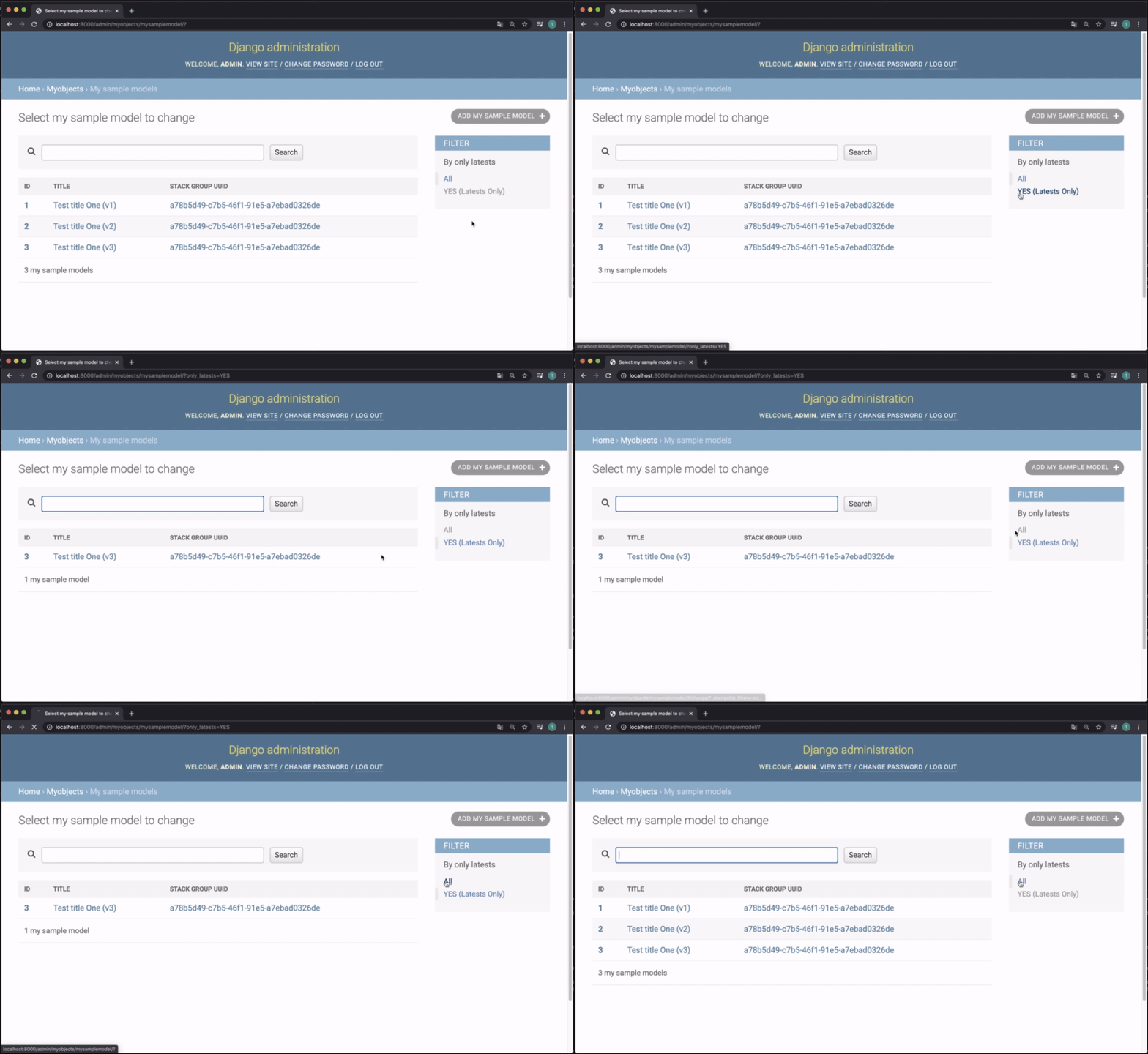
Filter to show only the latest version of the object
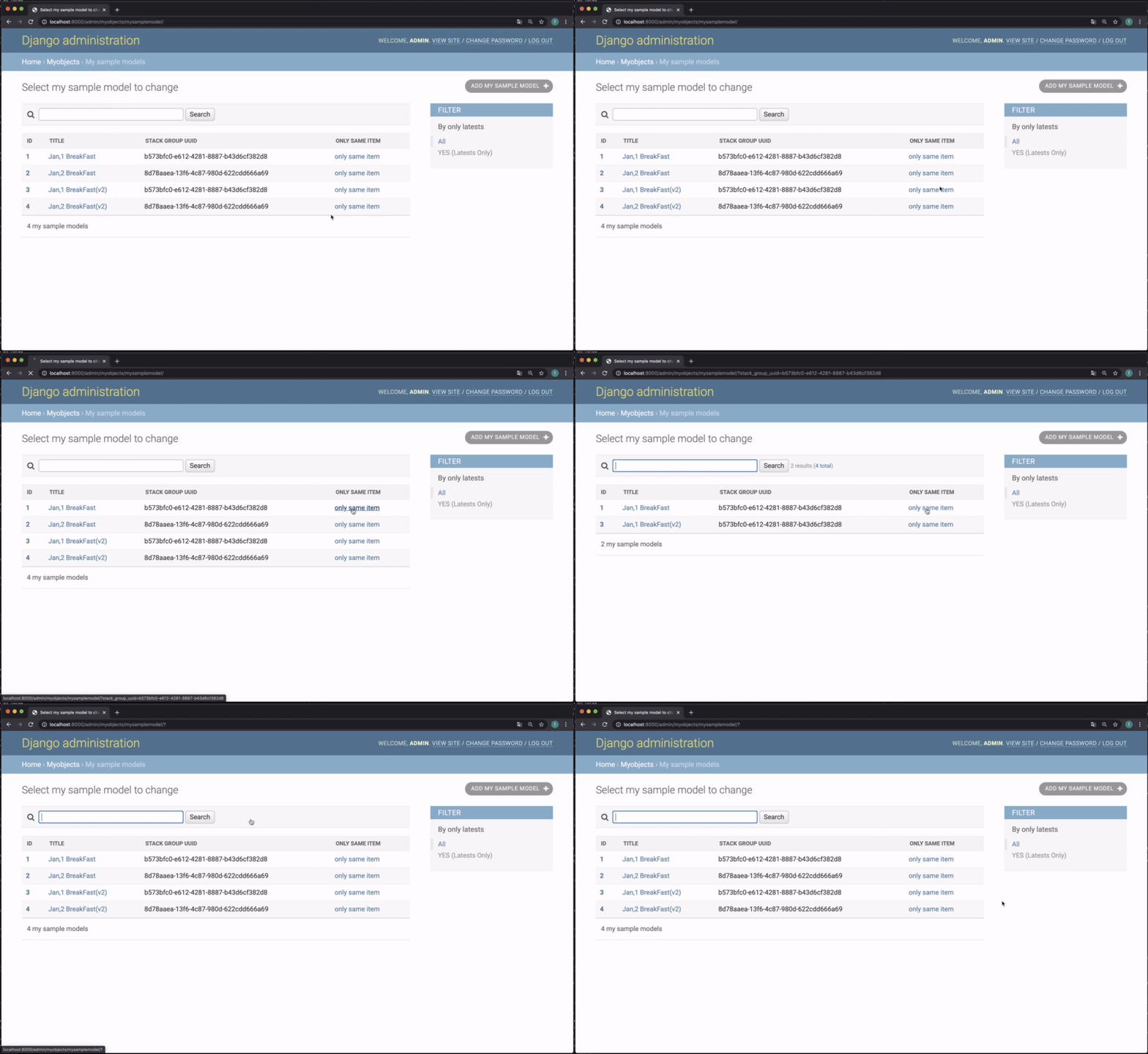
Show only items with the same stackgroup_uuid
API
QuerySet & Manager
latest_from_stack_group
Returns a QuerySet of the most recent objects in each Stackgroup.
# Create instance
>>> instance_breakfast = MySampleModel.objects.create(title="Today's breakfast", body="Spam with Egg") # Create <MySampleModel: MySampleModel object (1)>
>>> instance_lunch = MySampleModel.objects.create(title="Today's lunch", body="Spam with Beacon") # Create <MySampleModel: MySampleModel object (2)>

# Save each instance
>>> instance_breakfast.body = "Fried Egg with bread"
>>> instance_breakfast.save() # Save method create new <MySampleModel: MySampleModel object (3)>

>>> instance_lunch.body = "Meat Pasta"
>>> instance_lunch.save() # Save method create new <MySampleModel: MySampleModel object (4)>

>>> MySampleModel.objects.latest_from_stack_group() # You can fetch 3 & 4 My Sample Model
<StackStoreQuerySet [<MySampleModel: MySampleModel object (3)>, <MySampleModel: MySampleModel object (4)>]>
get_latest_from_stack_group
Returns an object that matches the collation parameter from the latest set of objects in each Stackgroup.
# Create instance
>>> instance_breakfast = MySampleModel.objects.create(title="Today's breakfast", body="Spam with Egg") # Create <MySampleModel: MySampleModel object (1)>
>>> instance_lunch = MySampleModel.objects.create(title="Today's lunch", body="Spam with Beacon") # Create <MySampleModel: MySampleModel object (2)>

# Save each instance
>>> instance_breakfast.body = "Fried Egg with bread"
>>> instance_breakfast.save() # Save method create new <MySampleModel: MySampleModel object (3)>

>>> MySampleModel.objects.get_latest_from_stack_group(body="Fried Egg with bread")
<MySampleModel: MySampleModel object (3)>
model object
save
When an object is saved, a new object is created and assigned the same stack_group_uuid as the object from which it was saved. This means that a new version will be generated.
>>> instance_breakfast = MySampleModel.objects.create(title="Today's breakfast", body="Spam with Egg") # Create <MySampleModel: MySampleModel object (1)>
>>> instance_breakfast.body = "Fried Egg with bread"
>>> instance_breakfast.save() # Save method create version object <MySampleModel: MySampleModel object (2)>
>>> MySampleModel.objects.all()
<StackStoreQuerySet [<MySampleModel: MySampleModel object (1)>, <MySampleModel: MySampleModel object (2)>]>
If you want to save the overwrite without creating a new version, you should pass False to __create_new_version in the save method.
>>> instance_breakfast = MySampleModel.objects.create(title="Today's breakfast", body="Spam with Egg")
>>> instance_breakfast.save(__create_new_version=False)
>>> instance_breakfast.pk
1
force_delete
Remove the object.
>>> instance_breakfast = MySampleModel.objects.create(title="Today's breakfast", body="Spam with Egg") # Create <MySampleModel: MySampleModel object (1)>
>>> MySampleModel.objects.all()
<StackStoreQuerySet [<MySampleModel: MySampleModel object (1)>]>
>>> instance_breakfast.force_delete()
>>> MySampleModel.objects.all()
<StackStoreQuerySet []>
Calling the existing delete method will raise a NotImplementedError exception.
same_group_items
Returns a QuerySet that returns all objects belonging to the same Stackgroup.
>>> instance_breakfast = MySampleModel.objects.create(title="Today's breakfast", body="Spam with Egg") # Create <MySampleModel: MySampleModel object (1)>
>>> [instance_breakfast.save() for i in range(2)]
>>> instance_breakfast.same_group_items()
<StackStoreQuerySet [<MySampleModel: MySampleModel object (3)>, <MySampleModel: MySampleModel object (2)>, <MySampleModel: MySampleModel object (1)>]>
previous_instance
Returns the previous version of the object.
>>> instance_breakfast = MySampleModel.objects.create(title="Today's breakfast", body="Spam with Egg") # Create <MySampleModel: MySampleModel object (1)>
>>> [instance_breakfast.save() for i in range(2)]
>>> second_gen_instance = instance_breakfast.same_group_items().order_by("pk")[1]
>>> second_gen_instance.previous_instance()
<MySampleModel: MySampleModel object (1)>
Throws a DoesNotExist exception if the object does not exist.
next_instance
Returns the next version of the object.
>>> instance_breakfast = MySampleModel.objects.create(title="Today's breakfast", body="Spam with Egg") # Create <MySampleModel: MySampleModel object (1)>
>>> [instance_breakfast.save() for i in range(2)]
>>> second_gen_instance = instance_breakfast.same_group_items()[1]
>>> second_gen_instance.next_instance()
<MySampleModel: MySampleModel object (3)>
Throws a DoesNotExist exception if the object does not exist.
latest_instance
Returns the most recent object of the Stackgroup to which its own object belongs.
>>> instance_breakfast = MySampleModel.objects.create(title="Today's breakfast", body="Spam with Egg") # Create <MySampleModel: MySampleModel object (1)>
>>> [instance_breakfast.save() for i in range(2)]
>>> first_gen_instance = instance_breakfast.same_group_items().order_by("pk")[0]
>>> first_gen_instance.latest_instance()
<MySampleModel: MySampleModel object (3)>
Throws a DoesNotExist exception if the object does not exist.
earliest_instance
Returns the oldest object in the Stackgroup to which its own object belongs.
>>> instance_breakfast = MySampleModel.objects.create(title="Today's breakfast", body="Spam with Egg") # Create <MySampleModel: MySampleModel object (1)>
>>> [instance_breakfast.save() for i in range(2)]
>>> third_gen_instance = instance_breakfast.same_group_items().order_by("pk")[2]
>>> third_gen_instance.earliest_instance()
<MySampleModel: MySampleModel object (1)>
Throws a DoesNotExist exception if the object does not exist.
Demo
The Docker configuration is provided. Please use the following command to start it. Go to http://localhost:8000 when the launch is complete.
$ docker-compose up
Login account is ID: admin Password: admin
License
MIT License
Release history Release notifications | RSS feed

Download files
Download the file for your platform. If you're not sure which to choose, learn more about installing packages.
Source Distribution
Built Distribution
Filter files by name, interpreter, ABI, and platform.
If you're not sure about the file name format, learn more about wheel file names.
Copy a direct link to the current filters
File details
Details for the file django-stackstore-model-ooppyy-1.0.tar.gz.
File metadata
- Download URL: django-stackstore-model-ooppyy-1.0.tar.gz
- Upload date:
- Size: 5.5 kB
- Tags: Source
- Uploaded using Trusted Publishing? No
- Uploaded via: twine/5.1.1 CPython/3.11.0
File hashes
| Algorithm | Hash digest | |
|---|---|---|
| SHA256 |
792d75ce0aeb7638d5c5519ddee1312276d98c30c19751508d918ae0364f9585
|
|
| MD5 |
1e7bea1a0fe7274dcd2839a1f77af11f
|
|
| BLAKE2b-256 |
48278a5e2444c4add44d6d278d76e260bce8c6a4b2767506bdaf73a045bb3026
|
File details
Details for the file django_stackstore_model_ooppyy-1.0-py3-none-any.whl.
File metadata
- Download URL: django_stackstore_model_ooppyy-1.0-py3-none-any.whl
- Upload date:
- Size: 6.6 kB
- Tags: Python 3
- Uploaded using Trusted Publishing? No
- Uploaded via: twine/5.1.1 CPython/3.11.0
File hashes
| Algorithm | Hash digest | |
|---|---|---|
| SHA256 |
5d5b4e0f73da963d4824dd63253640833f45554af44989aea1f1eb3b07596d46
|
|
| MD5 |
0001b44ebf46bc6888cd262be031d4c9
|
|
| BLAKE2b-256 |
bed12368c83b227787c6e11ee64cf1e5a489b24d89ca625cb33028f5a8ceeb6c
|






