
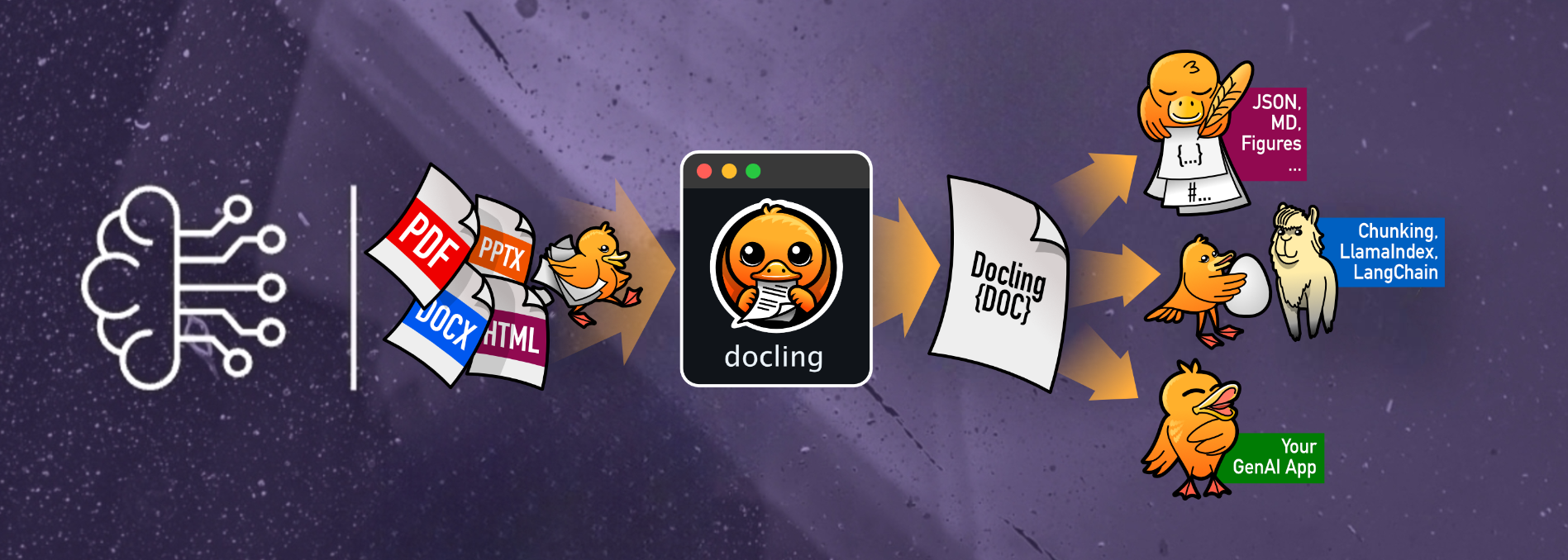


The docling-OCR-OnnxTR repository provides a plugin that integrates the OnnxTR OCR engine into the Docling framework, enhancing document processing capabilities with efficient and accurate text recognition.
Key Features:
-
Seamless Integration: Easily incorporate OnnxTR's OCR functionalities into your Docling workflows for improved document parsing and analysis.
-
Optimized Performance: Leverages OnnxTR's lightweight architecture to deliver faster inference times and reduced resource consumption compared to traditional OCR engines.
-
Flexible Deployment: Supports various hardware configurations, including CPU, GPU, and OpenVINO, allowing you to choose the best setup for your needs.
Installation:
To install the plugin, use one of the following commands based on your hardware:
For GPU support please take a look at: ONNX Runtime.
- Prerequisites: CUDA & cuDNN needs to be installed before Version table.
# For CPU
pip install "docling-ocr-onnxtr[cpu]"
# For Nvidia GPU
pip install "docling-ocr-onnxtr[gpu]"
# For Intel GPU / Integrated Graphics
pip install "docling-ocr-onnxtr[openvino]"

# Headless mode (no GUI)
# For CPU
pip install "docling-ocr-onnxtr[cpu-headless]"
# For Nvidia GPU
pip install "docling-ocr-onnxtr[gpu-headless]"
# For Intel GPU / Integrated Graphics
pip install "docling-ocr-onnxtr[openvino-headless]"
By integrating OnnxTR with Docling, users can achieve more efficient and accurate OCR results, enhancing the overall document processing experience.
Usage
from docling.datamodel.pipeline_options import PdfPipelineOptions
from docling.document_converter import (
    ConversionResult,
    DocumentConverter,
    InputFormat,
    PdfFormatOption,
)
from docling_ocr_onnxtr import OnnxtrOcrOptions


def main():
    # Source document to convert
    source = "https://arxiv.org/pdf/2408.09869v4"

    # Available detection & recognition models can be found at
    # https://github.com/felixdittrich92/OnnxTR

    # Or you choose a model from Hugging Face Hub
    # Collection: https://huggingface.co/collections/Felix92/onnxtr-66bf213a9f88f7346c90e842

    ocr_options = OnnxtrOcrOptions(
        # Text detection model
        det_arch="db_mobilenet_v3_large",
        # Text recognition model - from Hugging Face Hub
        reco_arch="Felix92/onnxtr-parseq-multilingual-v1",
        # This can be set to `True` to auto-correct the orientation of the pages
        auto_correct_orientation=False,
    )

    pipeline_options = PdfPipelineOptions(
        ocr_options=ocr_options,
    )
    pipeline_options.allow_external_plugins = True  # <-- enabled the external plugins

    # Convert the document
    converter = DocumentConverter(
        format_options={
            InputFormat.PDF: PdfFormatOption(
                pipeline_options=pipeline_options,
            ),
        },
    )

    conversion_result: ConversionResult = converter.convert(source=source)
    doc = conversion_result.document
    md = doc.export_to_markdown()
    print(md)


if __name__ == "__main__":
    main()
It is also possible to load the models from local files instead of using the Hugging Face Hub or downloading them from the repo:
from docling.datamodel.pipeline_options import PdfPipelineOptions
from docling.document_converter import (
    ConversionResult,
    DocumentConverter,
    InputFormat,
    PdfFormatOption,
)
from docling_ocr_onnxtr import OnnxtrOcrOptions
from onnxtr.models import db_mobilenet_v3_large, parseq


def main():
    # Source document to convert
    source = "https://arxiv.org/pdf/2408.09869v4"

    # Load models from local files
    # NOTE: You need to download the models first and then adjust the paths accordingly.
    det_model = db_mobilenet_v3_large("/home/felix/.cache/onnxtr/models/db_mobilenet_v3_large-1866973f.onnx")
    reco_model = parseq("/home/felix/.cache/onnxtr/models/parseq-00b40714.onnx")

    ocr_options = OnnxtrOcrOptions(
        # Text detection model
        det_arch=det_model,
        # Text recognition model
        reco_arch=reco_model,
        # This can be set to `True` to auto-correct the orientation of the pages
        auto_correct_orientation=False,
    )

    pipeline_options = PdfPipelineOptions(
        ocr_options=ocr_options,
    )
    pipeline_options.allow_external_plugins = True  # <-- enabled the external plugins

    # Convert the document
    converter = DocumentConverter(
        format_options={
            InputFormat.PDF: PdfFormatOption(
                pipeline_options=pipeline_options,
            ),
        },
    )

    conversion_result: ConversionResult = converter.convert(source=source)
    doc = conversion_result.document
    md = doc.export_to_markdown()
    print(md)


if __name__ == "__main__":
    main()
Configuration
The configuration of the OCR engine is done via the OnnxtrOcrOptions class. The following options are available:
lang: List of languages to use for OCR. Default is["en", "fr"].confidence_score: Word confidence threshold for the recognition model. Default is0.5.objectness_score: Detection model objectness score threshold. Default is0.3.det_arch: Detection model architecture. Default is"fast_base".reco_arch: Recognition model architecture. Default is"crnn_vgg16_bn".reco_bs: Batch size for the recognition model. Default is512.auto_correct_orientation: Whether to auto-correct the orientation of the pages. Default isFalse.preserve_aspect_ratio: Whether to preserve the aspect ratio of the images. Default isTrue.symmetric_pad: Whether to use symmetric padding. Default isTrue.paragraph_break: Paragraph break threshold. Default is0.035.load_in_8_bit: Whether to load the model in 8-bit. Default isFalse. (Not supported for Hugging Face loaded models yet)providers: List of providers to use for the Onnxruntime. Default isNonewhich means auto-select.session_options: Session options for the Onnxruntime. Default isNonewhich means default OnnxTR session options.
Available Hugging Face models can be found at Hugging Face.
Further information:
Please take a look at OnnxTR.
Contributing
Contributions are welcome!
Before opening a pull request, please ensure that your code passes the tests and adheres to the project's coding standards.
You can run the tests and checks using:
make style
make quality
make test
License
Distributed under the Apache 2.0 License. See LICENSE for more information.
1 maintainer

Metadata
1 maintainer
Release files for docling-ocr-onnxtr 0.3.1
For a detailed explanation of source distributions (sdists) and built distributions (wheels), please see the package formats documentation.
Source distribution (sdist)
| File | Size | Uploaded | Provenance | Actions |
|---|---|---|---|---|
| docling_ocr_onnxtr-0.3.1.tar.gz | 23.6 kB | Without provenance | Details for docling_ocr_onnxtr-0.3.1.tar.gz |
Built distribution (wheel)
| File | Interpreter | ABI | Platform | Actions Reset |
|---|---|---|---|---|
| docling_ocr_onnxtr-0.3.1-py3-none-any.whl | Python 3 | none | any | Details for docling_ocr_onnxtr-0.3.1-py3-none-any.whl |
Total release size: 41.6 kB
Release files / docling_ocr_onnxtr-0.3.1.tar.gz
| Download URL | docling_ocr_onnxtr-0.3.1.tar.gz |
|---|---|
| Size | 23.6 kB |
| Tags | Source |
|
SHA-256 checksum How to use checksums |
fa03299d3b5cd7622d570319bea0496d3dbd03c36f7132861f84f546eb82640f
|
|
BLAKE2b-256 checksum How to use checksums |
cd5ff30c05b003af8354e4f3b432b0873fc1ee1a94f4801cc39824a3410fc56d
|
| Upload date | |
|
Uploaded using Trusted Publishing? What is trusted publishing? |
No |
| Uploaded via |
twine/7.0.0 CPython/3.11.17
|
Release files / docling_ocr_onnxtr-0.3.1-py3-none-any.whl
| Download URL | docling_ocr_onnxtr-0.3.1-py3-none-any.whl |
|---|---|
| Size | 18.1 kB |
| Tags | Python 3 |
|
SHA-256 checksum How to use checksums |
64001dcaa3892aebbe16c671259878375e2c32bda63baf7bb61cd54db6f22d37
|
|
BLAKE2b-256 checksum How to use checksums |
e62e048ca3dd8e36778942971cbba9b7b6c47e8ceebfdce0b691c7492d24c4d8
|
| Upload date | |
|
Uploaded using Trusted Publishing? What is trusted publishing? |
No |
| Uploaded via |
twine/7.0.0 CPython/3.11.17
|
Security for docling-ocr-onnxtr 0.3.1
Provenance
Provenance describes where a file came from. On PyPI, provenance is shared via attestations, which provide a verifiable record of the build or publishing details. View details, limitations and caveats.
No provenance found
None of the files in this release were uploaded with provenance metadata.
A note on package security
PyPI is a repository for distributing packages, not a service for auditing them. While third-party security researchers and our staff do their best to detect and remove malicious packages, PyPI cannot guarantee the quality, security or suitability of any given package.
To learn more about protecting yourself from malicious actors, visit our package security documentation.














