
Local-first memory for AI coding agents: find what Claude Code, Codex, and Cursor already know, then share it with every agent.
Verified details
These details have been verified by PyPIProject links
GitHub Statistics
Maintainers

Project description
Docmancer
Find out what your coding agents know, then carry the useful parts to every agent.



Website · Documentation · Blog · Changelog
Coding agents remember useful things, but each one keeps a different version. Claude Code may know why a deployment changed, Codex may know a project convention, and Cursor may still carry an old instruction. The evidence is spread across memory files, rules, instructions, and session history.
Docmancer helps answer two questions:
- What do my coding agents already know?
- How do I carry the useful parts to every agent?
It discovers existing agent memory, keeps its sources attached, arranges the durable parts as local Markdown, and gives every connected agent the relevant files.
The complete single-machine product is free and local. The browser app is for people. The CLI, skills, hooks, and MCP are how agents use the same memory.
Start here
pipx install docmancer --python python3.13
docmancer setup
cd /path/to/your-project
docmancer web
setup finds every supported coding agent on the machine, shows one complete preflight plan and privacy warning, and asks for confirmation before changing anything. Once confirmed, it indexes existing memory and instructions, builds one laptop-wide canonical memory under ~/.docmancer/tree, installs or updates every detected user-level Docmancer skill, and enables automatic recall and session capture wherever the agent supports them. It does not modify the project in your current directory.
The canonical memory keeps the main things that should follow you between agents in a predictable scaffold:
~/.docmancer/tree/
├── README.md
├── profile/
│   ├── about.md
│   └── preferences.md
├── principles/
│   └── working-style.md
├── projects/
│   └── active.md
└── shared/

<project>/.docmancer/tree/
├── overview.md
├── decisions/
├── constraints/
├── workflows/
└── lessons/
Setup, explicit memory sync, and supported lifecycle capture reconcile changed evidence. Read-only Ask and web startup read the latest committed index. They do not scan files, rebuild embeddings, reconcile Shared Memory, or make maintenance-provider calls on the request path. The browser shell therefore appears immediately and queues changed-source maintenance in the background. An explicit request to remember, edit, move, duplicate, delete, or restore memory is different: Ask uses one structured provider call to prepare one complete-file proposal, then waits for approval.
When a generation provider is configured, reconciliation may send redacted evidence to it for synthesis. Deterministic local rendering remains the fallback when no provider is ready or a request fails.
web opens a loopback-only app for the current project. Its main pages each have one purpose:
- Home lets you ask Docmancer what your agents know, customise the Docmancer agent, and connect coding agents.
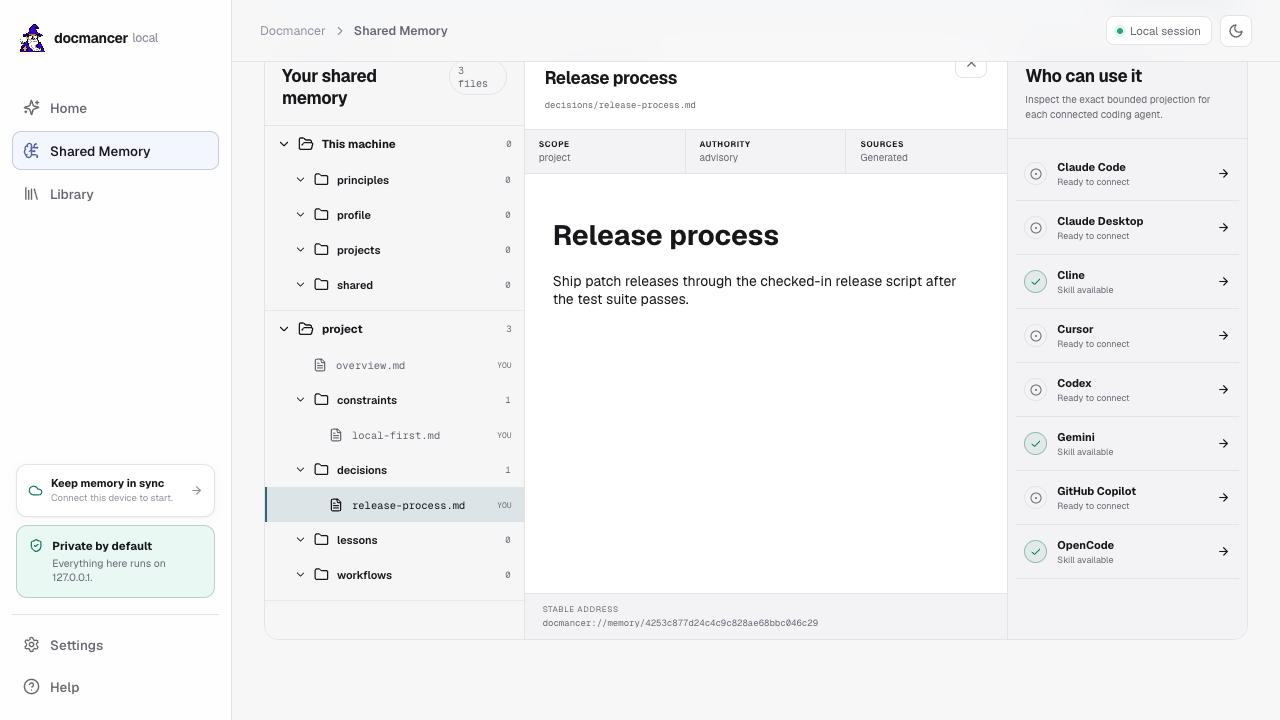
- Shared Memory shows every canonical file, how it is arranged, and the exact bounded projection prepared for each connected agent.
- Library keeps curated memory, attributable agent evidence, and technical documentation easy to inspect without mixing them together.
- Settings chooses the optional provider and model used for grounded answers and maintenance.
Claude Desktop requires a manual skill upload. Other supported integrations can be installed from the web app or CLI. Detection and installation are shown as separate states so an installed application is never mistaken for a connected agent.
Ask what your agents know
docmancer ask "Why did we choose Railway?"
Docmancer reads the current index and returns a bounded result with mandatory policy, Shared Memory, supporting agent evidence, and stable citations. When a generation provider is configured, Ask calls it by default after retrieval to turn that evidence into grounded prose. The provider never chooses what enters the evidence bundle. Use --no-answer for evidence only, or --fresh when the question must first wait for changed agent files to be indexed.
docmancer ask "What changed in our release process?" --no-answer
Ask can also prepare one complete-file Shared Memory action:
docmancer ask "Remember that production releases require a smoke test"
docmancer ask "Update decisions/release.md to require two reviewers" --apply
docmancer ask "Forget the old Railway decision" --read-only
In an interactive terminal, Docmancer prints the complete proposal and diff, then asks once with No as the default. --apply is required for non-interactive execution. --read-only disables action planning, and --json returns action and result without applying unless it is combined with --apply. Typing “yes” in a later message never authorises a stored proposal.
The same approval flow appears as an action card in saved web conversations. Temporary chats remain read-only. The proposal is stored locally, every existing-file action is hash guarded, and the browser submits only Apply or Cancel. If the file changed after planning, Docmancer reports a conflict and leaves it untouched.
If an action genuinely needs one clarification, the reply remains attached to the original request instead of becoming a new read-only question. Docmancer will not keep asking clarification questions in a loop. A short reply such as ok or yes never applies a pending proposal; use its Apply control.
Broad machine-wide requests such as “forget this old project everywhere” use shared/canonical-exclusions.md. The file contains precise literal evidence-path and text filters. Reconciliation then removes matching evidence from generated Shared Memory without editing or deleting the underlying repository, instruction file, or agent-owned memory.
Choose the retrieval profile
The default local profile needs no daemon or large model download:
docmancer setup --profile local
It uses SQLite FTS5, sqlite-vec, and the bundled Model2Vec model. For sustained ingestion and filtered vector search across roughly 50,000 to 100,000 documents, install the heavy extra, run Qdrant, and select the scale profile:
pipx install "docmancer[embeddings-heavy]"
docmancer qdrant up
docmancer setup --profile scale
The scale profile uses Qdrant, FastEmbed dense embeddings, sparse SPLADE retrieval, lexical search, and reciprocal-rank fusion. It also keeps extracted content in SQLite instead of creating two inspectable files per source. Qdrant helps with vector filtering, concurrent writes, and operational headroom. It does not fix poor source coverage, unstable retrieval units, or weak evaluation, which are handled separately by versioned sources, stable token-aware units, and retrieval benchmarks.
Both profiles implement the same memory semantics and public relevance contract. Switching profiles changes storage, embeddings, sparse retrieval, and operational capacity. It does not change authority, lifecycle, provenance, conflict handling, or what counts as Shared Memory.
Browse Shared Memory
Open docmancer web, then choose Shared Memory. The left side is the real machine and project file tree, the centre reads the selected Markdown file with its provenance and stable address, and the right side shows connected agents. Select an agent to inspect the exact bounded projection it receives.
The scaffold is opinionated, but the files are yours. You can edit them directly or use docmancer write, read, edit, and move. Stable docmancer://memory/<id> addresses survive file moves.
Connect coding agents
docmancer setup installs all detected integrations and automatic recall and capture hooks during onboarding. Use --yes only when you have already reviewed the same plan and need a non-interactive run. You can manage one integration explicitly when needed:
docmancer agent install codex --hooks
docmancer agent install claude-code --hooks
Installed skills teach agents when to ask Docmancer for prior decisions and how to write deliberate project memory when you explicitly request it. Recall hooks provide a bounded view of the shared laptop memory and relevant project evidence automatically. Supported lifecycle hooks capture durable session conclusions and reconcile them without creating a per-item approval queue.
MCP is an alternative transport over the same local services:
pipx install "docmancer[mcp]"
docmancer mcp install codex
docmancer mcp doctor
The MCP server exposes memory recall, canonical-memory reads, guarded writes, delivery inspection, decision history, and separate documentation search. It does not create a second memory store.
Keep a decision deliberately
docmancer write $'# Deployment\n\nDeploy the API on Railway.' \
  --path decisions/deployment.md \
  --scope project
Read it later:
docmancer read decisions/deployment.md
Existing-file edits and moves require the current content hash returned by read. This prevents one agent from silently overwriting a newer decision.
Import existing notes
docmancer import ./notes
Import copies Markdown into the project inbox. Docmancer never rewrites or moves the source files, and you review the complete file before turning it into curated memory.
Everyday commands
| Command | Purpose |
|---|---|
docmancer setup |
Discover agent memory and connect supported coding agents. |
docmancer web |
Open the local human interface for the current project. |
docmancer ask "..." |
Recall evidence, answer questions, or prepare one approved Shared Memory action. |
docmancer ask "..." --apply |
Apply one validated action without a confirmation prompt. |
docmancer ask "..." --read-only |
Force question answering without memory-action planning. |
docmancer common |
Show knowledge recorded independently by several agents. |
docmancer delivery |
Show installed integrations, recall state, and recent use. |
docmancer timeline |
Show how curated memory changed. |
docmancer write ... --path file.md |
Write one deliberate Markdown memory file. |
docmancer read <address-or-path> |
Read one memory file and its provenance. |
docmancer edit ... --expected-hash <hash> |
Safely edit a memory file. |
docmancer move ... --expected-hash <hash> |
Safely rename or move a memory file. |
docmancer import ./notes |
Copy arbitrary Markdown into the project inbox. |
docmancer status |
Show local memory, source, security, integration, and Cloud health. |
docmancer doctor |
Diagnose installation and configuration problems. |
docmancer providers list |
Inspect optional generation and embedding providers. |
docmancer docs query "..." |
Search the separate technical-documentation index. |
docmancer qdrant status |
Inspect the optional scale-profile vector service. |
docmancer cloud sync |
Sync optional client-encrypted revisions. |
Run docmancer --help or docmancer <command> --help for exact arguments.
Documentation is a separate Library
Your memory and third-party documentation answer different questions, so Docmancer keeps them separate:
docmancer docs add https://docs.pytest.org
docmancer docs query "How do I parametrize a fixture?"
Use ask for your decisions, preferences, rules, and agent evidence. Use docs query for libraries, APIs, and vendor documentation.
Optional AI generation and distillation
Local indexing, retrieval, Shared Memory files, and deterministic reconciliation do not require an AI provider. Configure one when you want grounded prose from Ask or provider-assisted synthesis:
docmancer providers key openrouter
docmancer providers set openrouter --default --model <model-id>
docmancer providers test openrouter
The legacy context refresh compatibility surface can build a revisioned generated artifact. Provider-backed builds group independent topics into bounded structured requests, run those batches concurrently, cache unchanged topics, preserve conflicts, and fall back to deterministic rendering per failed batch. The default operator target is eight seconds, although provider latency and corpus size can still make a build slower:
docmancer context refresh --dry-run
docmancer context refresh --provider openrouter --model <model-id>
Shared Memory is the primary product surface. Generated Context revisions remain available for existing workflows, comparison, rollback, and adoption into curated memory.
Local privacy and optional Cloud
Your memory, credentials, indexes, and local web app stay on your machine. Docmancer has no telemetry. Network access occurs only when you explicitly fetch online documentation, use an external model, check package registries, or enable Cloud.
Paid Personal Sync adds encrypted continuity across approved devices, managed history, and recovery. Team adds locally approved shared files and encrypted coordination. The hosted service receives ciphertext and cannot read your plaintext memory or execute local actions.
docmancer cloud connect
docmancer cloud sync
Local storage
| Location | Contents |
|---|---|
<project>/.docmancer/tree/ |
Curated project memory under decisions/, constraints/, workflows/, and lessons/. |
<project>/.docmancer/context/ |
Compatibility storage for revisioned generated artifacts. It is not part of the primary Shared Memory workflow. |
<project>/.docmancer/inbox/ |
Markdown explicitly imported for optional whole-file curation. Automatic session capture is processed as a transient spool. |
<project>/.docmancer/trash/ |
Recoverable deleted memory files. |
<project>/.docmancer/state/decision-journal.jsonl |
Append-only curated-file history. |
<project>/.docmancer/state/delivery.json |
Recent successful memory delivery receipts. |
~/.docmancer/memory.db |
Rebuildable machine-wide agent-memory index. |
~/.docmancer/embeddings-cache/embeddings.sqlite3 |
Content-addressed embedding cache. Older per-vector files remain readable. |
~/.docmancer/tree/ |
Automatically reconciled laptop-wide Markdown under profile/, principles/, projects/, and shared/. |
~/.docmancer/state/laptop-memory/ |
Reconciliation manifest and revision history. |
~/.docmancer/docmancer.yaml |
Local configuration. |
Requirements
Docmancer supports Python 3.11, 3.12, and 3.13. The install command above pins the interpreter because pipx otherwise selects the newest Python it can find, including 3.14, which this package does not support. If an install already went wrong, check it with:
docmancer doctor
For detailed commands, architecture, supported sources, Cloud boundaries, and troubleshooting, see the wiki. Full documentation lives at docmancer.dev/docs.
Project details
Verified details
These details have been verified by PyPIProject links
GitHub Statistics
Maintainers
Release history Release notifications | RSS feed


Download files
Download the file for your platform. If you're not sure which to choose, learn more about installing packages.
Source Distribution
Built Distribution
Filter files by name, interpreter, ABI, and platform.
If you're not sure about the file name format, learn more about wheel file names.
Copy a direct link to the current filters
File details
Details for the file docmancer-0.9.6.tar.gz.
File metadata
- Download URL: docmancer-0.9.6.tar.gz
- Upload date:
- Size: 33.2 MB
- Tags: Source
- Uploaded using Trusted Publishing? Yes
- Uploaded via: twine/7.0.0 CPython/3.13.14
File hashes
| Algorithm | Hash digest | |
|---|---|---|
| SHA256 |
59f235a86bff51466488e2c7931daf9a343e774c6db5c28e88df0efe170580cd
|
|
| MD5 |
ec70f473e29cce4acaa793cef1b001c9
|
|
| BLAKE2b-256 |
ab311128c694f7a2a323e045450abb984473993acda3abe85325b6735ed21c4c
|
Provenance
The following attestation bundles were made for docmancer-0.9.6.tar.gz:
Publisher:
publish.yml on docmancer/docmancer
-
Statement:
-
Statement type:
https://in-toto.io/Statement/v1 -
Predicate type:
https://docs.pypi.org/attestations/publish/v1 -
Subject name:
docmancer-0.9.6.tar.gz -
Subject digest:
59f235a86bff51466488e2c7931daf9a343e774c6db5c28e88df0efe170580cd - Sigstore transparency entry: 2295432284
- Sigstore integration time:
-
Permalink:
docmancer/docmancer@e5601fd90fceb55789181cf0ac18688949d2db77 -
Branch / Tag:
refs/tags/v0.9.6 - Owner: https://github.com/docmancer
-
Access:
public
-
Token Issuer:
https://token.actions.githubusercontent.com -
Runner Environment:
github-hosted -
Publication workflow:
publish.yml@e5601fd90fceb55789181cf0ac18688949d2db77 -
Trigger Event:
push
-
Statement type:
File details
Details for the file docmancer-0.9.6-py3-none-any.whl.
File metadata
- Download URL: docmancer-0.9.6-py3-none-any.whl
- Upload date:
- Size: 29.7 MB
- Tags: Python 3
- Uploaded using Trusted Publishing? Yes
- Uploaded via: twine/7.0.0 CPython/3.13.14
File hashes
| Algorithm | Hash digest | |
|---|---|---|
| SHA256 |
a0125d7a0fd87eaf28e7b8af7fcd7cfe3ff840ffc7148bdfa6e65679df4772c3
|
|
| MD5 |
6ecb1708af517426525fabbaa61f0a06
|
|
| BLAKE2b-256 |
0c7461cf741e48dbca29c334058d037f2eec71a054f8002d64959eae052a5fec
|
Provenance
The following attestation bundles were made for docmancer-0.9.6-py3-none-any.whl:
Publisher:
publish.yml on docmancer/docmancer
-
Statement:
-
Statement type:
https://in-toto.io/Statement/v1 -
Predicate type:
https://docs.pypi.org/attestations/publish/v1 -
Subject name:
docmancer-0.9.6-py3-none-any.whl -
Subject digest:
a0125d7a0fd87eaf28e7b8af7fcd7cfe3ff840ffc7148bdfa6e65679df4772c3 - Sigstore transparency entry: 2295432408
- Sigstore integration time:
-
Permalink:
docmancer/docmancer@e5601fd90fceb55789181cf0ac18688949d2db77 -
Branch / Tag:
refs/tags/v0.9.6 - Owner: https://github.com/docmancer
-
Access:
public
-
Token Issuer:
https://token.actions.githubusercontent.com -
Runner Environment:
github-hosted -
Publication workflow:
publish.yml@e5601fd90fceb55789181cf0ac18688949d2db77 -
Trigger Event:
push
-
Statement type:






