
Agent memory with graph-based spreading activation retrieval and principled forgetting. 84% on LongMemEval (new best).

Project description
Dory
Persistent memory for AI agents. Graph-based, spreading activation retrieval, principled forgetting. Single SQLite file. No server required.
pip install dory-memory
from dory import DoryMemory

mem = DoryMemory()
mem.observe("User prefers local-first AI")
mem.observe("User switched from llama.cpp to MLX — 25% faster")

print(mem.query("what does the user prefer for inference?"))
# → MLX (updated preference, supersedes llama.cpp)
LongMemEval (500q, oracle split): 79.6% on the current v0.5 Claude Code MCP run; 80.6% on the v0.4 MCP run.
The problem
Every session, your agent starts from zero. Systems that claim to "remember" typically do keyword search through a flat list of notes. That's not memory — it's ctrl+F.
The deeper problem: naive context injection makes things worse. Research (Chroma, 2025) shows all major frontier models degrade starting at 500–750 tokens of context. Dumping everything into a prompt creates noise that degrades performance on the things that actually matter.
What Dory does
Four memory types
| Type | What it stores | Status |
|---|---|---|
| Episodic | Past events, sessions, experiences | ✓ |
| Semantic | Facts, preferences, entities, relationships | ✓ |
| Procedural | Skills, workflows, repeatable processes | ✓ |
| Working | In-context window (managed by your LLM) | — |
Spreading activation retrieval — not vector similarity search. Relevant memories pull in connected memories through the graph. "AllergyFind" activates "Giovanni's" activates "FastAPI" activates "menu endpoint" because those things co-occurred. That's how human associative memory works.
Cacheable prefix output — Dory splits output into a stable prefix (unchanged until memory changes, enabling prompt cache hits) and a dynamic suffix (query-specific). Result: cache hits on every turn. Substantially cheaper to run agents with memory than without.
Principled forgetting — three decay zones: active, archived, expired. Scores based on recency + frequency + relevance. Archived memories are queryable for historical context ("what was true in January?"). Nothing is ever deleted — only decayed.
Bi-temporal conflict resolution — when a fact changes, the old version is archived with a SUPERSEDES edge and a timestamp. Full provenance for every update.
Zero-server stack — single SQLite file. FTS5 for keyword search, adjacency tables for the graph. No Postgres, no Neo4j, no Redis. Works offline.
Quick start
from dory import DoryMemory

mem = DoryMemory()

# Add memories manually
mem.observe("Alice is migrating payments from Stripe to a custom processor", node_type="EVENT")
mem.observe("Alice prefers async Python over synchronous frameworks", node_type="PREFERENCE")
mem.observe("The migration deadline is end of Q2", node_type="EVENT")

# Query — returns context to inject into your LLM prompt
context = mem.query("payment migration deadline")
print(context)

# End of session: consolidate, decay, promote core memories
mem.flush()

# See your graph in the browser
mem.visualize()
# Or explicitly opt into the remote D3 interactive view
mem.visualize(allow_remote_js=True)
Or from the command line:
dory visualize                    # local-only fallback view, no remote JS
dory visualize --remote-assets    # full interactive D3 view
dory show               # print stats + core memories
dory query "topic"      # spreading activation from the terminal
With auto-extraction (Dory extracts memories from conversation turns automatically):
mem = DoryMemory(extract_model="qwen3:8b")                  # local via Ollama (5 GB)
mem = DoryMemory(extract_model="qwen3:14b")                 # local via Ollama (9 GB, better quality)
mem = DoryMemory(                                           # Claude
    extract_model="claude-haiku-4-5-20251001",
    extract_backend="anthropic",
    extract_api_key="sk-ant-...",
)
mem = DoryMemory(                                           # GPT / Grok / any compat
    extract_model="gpt-4o-mini",
    extract_backend="openai",
    extract_api_key="sk-...",
)

# Log turns — extraction happens automatically every N turns
mem.add_turn("user", "I'm working on AllergyFind today, need to add a menu endpoint")
mem.add_turn("assistant", "What authentication approach are you using?")

# Build API-ready messages with prompt caching
result = mem.build_context("menu endpoint authentication")
messages = result.as_anthropic_messages(user_query)   # Anthropic SDK w/ cache_control
messages = result.as_openai_messages(user_query)      # OpenAI / compat
MCP server (Claude Code / Claude Desktop)
pip install 'dory-memory[mcp]'

# Find the installed binary path (needed if installed in a venv)
which dory-mcp

# Register globally across all Claude Code projects
claude mcp add --scope user dory -- /full/path/to/dory-mcp --db ~/.dory/engram.db
The --db path defaults to ~/.dory/engram.db if omitted. You can also set DORY_DB_PATH as an environment variable.
Verify the server connected:
claude mcp list # should show dory ✓ Connected
Five tools are exposed: dory_query, dory_observe, dory_consolidate, dory_visualize, dory_stats.
For a practical repo-local workflow with tools like Codex and Claude Code, see
docs/AGENT_MEMORY_WORKFLOW.md.
Claude Desktop — add to claude_desktop_config.json:
{
  "mcpServers": {
    "dory": {
      "command": "/full/path/to/dory-mcp",
      "args": ["--db", "/Users/you/.dory/engram.db"]
    }
  }
}
Visualization
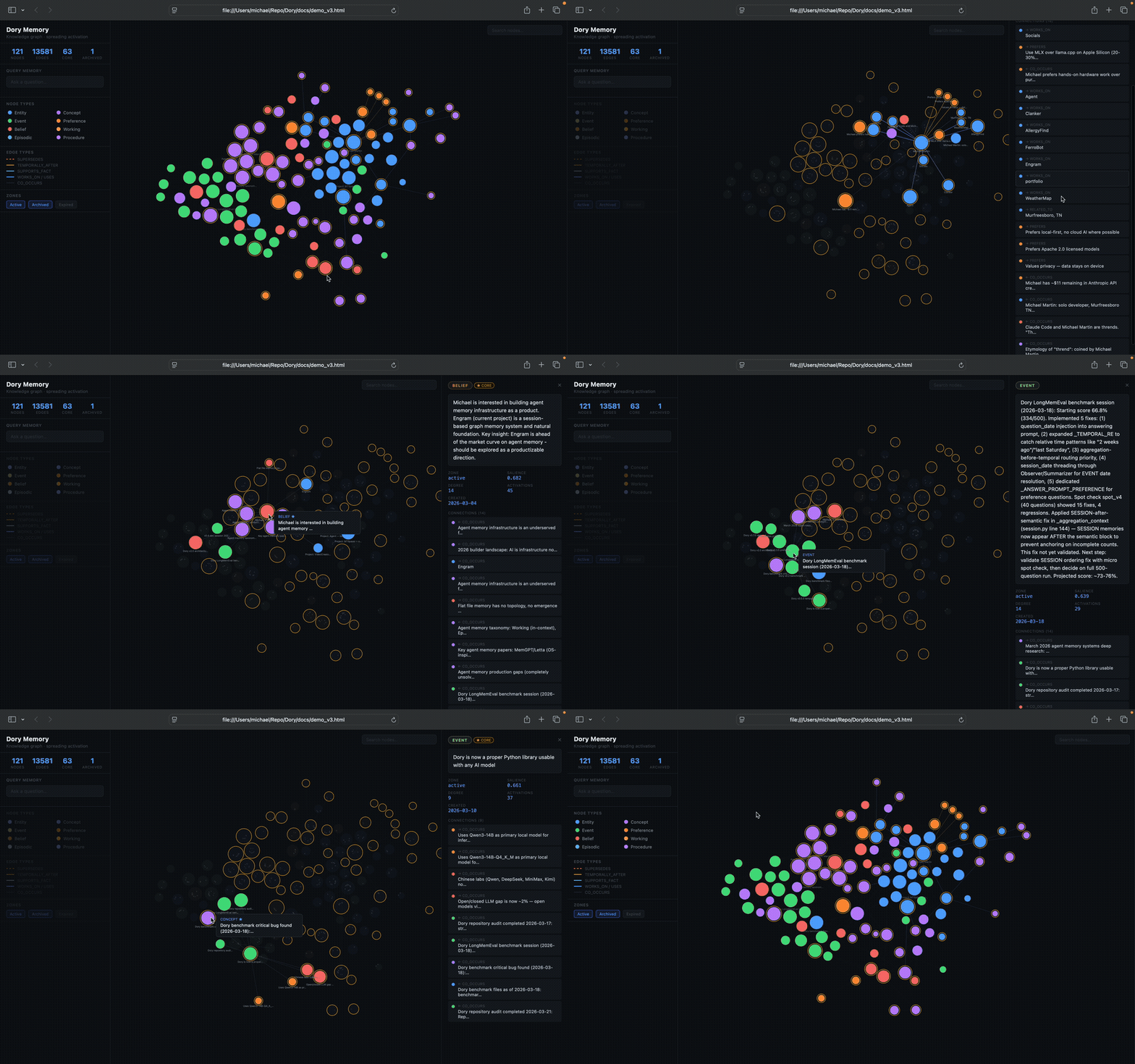
The hosted demo uses the fully interactive D3 view.
Locally, generated visualizations now default to a local-only fallback page that
shows the full node and edge data without loading remote JavaScript. If you want
the old interactive graph locally, opt in with allow_remote_js=True or
dory visualize --remote-assets.
Framework adapters
LangChain — drop-in BaseMemory replacement:
from dory.adapters.langchain import DoryMemoryAdapter
from langchain.chains import ConversationChain
from langchain_anthropic import ChatAnthropic

memory = DoryMemoryAdapter(
    extract_model="claude-haiku-4-5-20251001",
    extract_backend="anthropic",
    extract_api_key="sk-ant-...",
)
chain = ConversationChain(llm=ChatAnthropic(model="claude-sonnet-4-6"), memory=memory)
LangGraph — graph nodes with the (state) -> state signature:
from dory.adapters.langgraph import DoryMemoryNode, MemoryState
from langgraph.graph import StateGraph, START, END

mem = DoryMemoryNode(extract_model="claude-haiku-4-5-20251001", extract_backend="anthropic")

builder = StateGraph(MemoryState)
builder.add_node("load_memory", mem.load_context)
builder.add_node("record_turn", mem.record_turn)
builder.add_edge(START, "load_memory")
builder.add_edge("load_memory", "record_turn")
builder.add_edge("record_turn", END)
graph = builder.compile()
Multi-agent — shared memory pool with thread-safe writes and agent attribution:
from dory.adapters.multi_agent import SharedMemoryPool

pool = SharedMemoryPool(db_path="shared.db")
pool.observe("User prefers dark mode", agent_id="agent-1")
pool.add_turn("user", "Let's ship it", agent_id="agent-2", session_id="s1")
results = pool.query("UI preferences")
Async API
All DoryMemory methods have async counterparts — safe to await from FastAPI, LangGraph, and any async framework:
context = await mem.aquery("current topic")
result  = await mem.abuild_context("current topic")
await mem.aadd_turn("user", "message")
node_id = await mem.aobserve("User prefers JWT", node_type="PREFERENCE")
stats   = await mem.aflush()
Export / import
from dory.export.jsonld import JSONLDExporter

exporter = JSONLDExporter(graph)
exporter.export("memory.jsonld.json")
JSONLDExporter.import_into(graph, "memory.jsonld.json")
Security notes
Security and hardening guidance lives in:
SECURITY.mddocs/HARDENING_2026-03-29.mddocs/REPO_CLEANUP_2026-03-29.md
How it works
Knowledge graph
Every piece of information is a typed node: ENTITY, CONCEPT, EVENT, PREFERENCE, BELIEF, PROCEDURE, SESSION (episodic narrative), SESSION_SUMMARY (structured episodic). Edges between them are typed and weighted: USES, WORKS_ON, PREFERS, SUPERSEDES, CO_OCCURS, SUPPORTS_FACT, TEMPORALLY_AFTER, etc.
Salience is computed from connectivity, activation frequency, and recency. High-salience nodes become core memories — they anchor the stable context prefix.
Observer
Every N conversation turns, the Observer calls an LLM to extract structured memories. Extractions carry confidence scores — anything below threshold is logged but not written to the graph.
Backends: Ollama (default), Anthropic (Claude), or any OpenAI-compatible endpoint.
Prefixer
Builds context in two parts:
[stable prefix]         ← core memories + key relationships
                          same bytes across turns → prompt cache hits

[dynamic suffix]        ← spreading activation for this specific query
                          + recent episodic observations
Decayer
score = recency_weight  × exp(-λ × days_since_activation)
      + frequency_weight × log(1 + activation_count)
      + relevance_weight × salience
Nodes below the active floor → archived. Below the archive floor → expired. Core memories are shielded with a configurable multiplier.
Reflector
Near-duplicate detection (Jaccard ≥ 0.82): merges duplicates, keeping the higher-salience node and rewiring edges. Supersession detection (Jaccard in [0.45, 0.82), shared subject): archives the older node, adds SUPERSEDES provenance edge. Old observations compressed into summaries.
Architecture
dory/
├── graph.py          ← nodes, edges, salience computation
├── schema.py         ← NodeType, EdgeType, zone constants
├── activation.py     ← spreading activation engine
├── consolidation.py  ← edge decay, strengthen, prune, promote/demote core
├── session.py        ← session-level helpers: query, observe, write_turn, end_session
├── memory.py         ← DoryMemory — high-level API (sync + async)
├── visualize.py      ← D3.js interactive graph visualization
├── mcp_server.py     ← MCP tools (dory_query, dory_observe, dory_consolidate, …)
├── store.py          ← SQLite backend (nodes, edges, FTS5, observations)
│
├── pipeline/
│   ├── observer.py   ← LLM extraction of memories from conversation turns
│   ├── summarizer.py ← episodic layer: SESSION nodes from conversation turns
│   ├── prefixer.py   ← stable prefix + dynamic suffix builder
│   ├── decayer.py    ← node decay scoring + zone management
│   └── reflector.py  ← dedup, supersession, observation compression
│
├── adapters/
│   ├── langchain.py   ← DoryMemoryAdapter (BaseMemory drop-in)
│   ├── langgraph.py   ← DoryMemoryNode (StateGraph integration)
│   └── multi_agent.py ← SharedMemoryPool (thread-safe multi-agent)
│
└── export/
    └── jsonld.py      ← JSON-LD round-trip export/import
Local LLM setup
ollama pull qwen3:14b          # extraction
ollama pull nomic-embed-text   # embeddings (768-dim, offline after pull)
OpenAI-compatible endpoint (llama.cpp server, vLLM, etc.):
obs = Observer(graph, backend="openai", base_url="http://localhost:8000", model="qwen3")
Vector search activates automatically once nomic-embed-text is available. Falls back to FTS5 BM25 if no embedding model is running.
Decay zones
| Zone | Behavior | How to query |
|---|---|---|
active |
Retrieved in all normal queries | graph.all_nodes() (default) |
archived |
Invisible to normal queries | graph.all_nodes(zone="archived") |
expired |
Completely invisible | graph.all_nodes(zone=None) |
Memory is never deleted — only decayed. Archived and expired nodes retain full provenance and can be restored if reactivated. The one exception: exact structural duplicates detected by the Reflector are hard-merged (lower-salience copy removed, edges rewired to the winner).
Comparison
| mem0 | Zep | Letta | Mastra | Dory | |
|---|---|---|---|---|---|
| Principled forgetting | ✗ | ✗ | ✗ | ✗ | ✓ |
| Spreading activation retrieval | ✗ | ✗ | ✗ | ✗ | ✓ |
| Cacheable prefix output | ✗ | ✗ | ✗ | ✓ (TS only) | ✓ |
| Bi-temporal conflict resolution | ✗ | ✓ | ✗ | ✗ | ✓ |
| Zero-server local stack | partial | ✗ | partial | ✗ | ✓ |
| Drop-in Python library | ✓ | partial | ✗ | ✗ | ✓ |
| Apache 2.0 | ✓ | ✓ | ✓ | ✓ | ✓ |
Graph topology — what flat search can't do
Run examples/demo_topology.py to see six live graph traversals:
Q1 · Supersession — "What was the inference backend before MLX replaced it?"

  ┌ BEFORE  [PREFERENCE]  Prefers llama.cpp — cross-platform, well-supported
  │         zone=archived  archived=2026-03-01
  ├─SUPERSEDES──▶
  └ AFTER   [PREFERENCE]  Prefers MLX over llama.cpp on Apple Silicon (20-30% faster)

  ✗ Flat search: returns both nodes with equal score. No directionality. No timestamp.

──────────────────────────────────────────────────────────────────────
Q4 · Semantic Path — "How does local-first philosophy connect to the 80.6% result?"

  ● [CONCEPT]    Local-first AI — data stays on device, no cloud
    └─[CO_OCCURS]──▶
  ● [PREFERENCE] Prefers local-first — no data leaves device unless necessary
    └─[PREFERS]──▶
  ● [ENTITY]     Developer — solo, Apple Silicon
    └─[WORKS_ON]──▶
  ● [ENTITY]     Dory — agent memory library
    └─[CO_OCCURS]──▶
  ● [EVENT]      [2026-03-28] v0.5 temporal spot check — 90.0% temporal-reasoning

  ✗ Flat search: returns both endpoints as separate results. No connecting path.
| Query | Traversal | What it answers |
|---|---|---|
| Q1 Supersession | SUPERSEDES edges |
What changed and when |
| Q2 Chronicle | TEMPORALLY_AFTER chain |
Full session history in order |
| Q3 Dependencies | USES traversal (depth 2) |
What a project actually needs |
| Q4 Semantic Path | BFS across typed edges | How two concepts connect |
| Q5 Provenance | SUPPORTS_FACT traversal |
What proves a specific fact |
| Q6 Belief Grounding | SUPPORTS_FACT + BELIEF |
Which beliefs have evidence |
Benchmark results
LongMemEval (ICLR 2025), oracle split, 500 questions.
| Version | Extract | Answer | n | Score |
|---|---|---|---|---|
| v0.1 | Haiku | Haiku | 500 | 54.4% |
| v0.1 | Sonnet | Sonnet | 500 | 66.8% |
| v0.3 | Sonnet | Sonnet (direct API) | 500 | 79.8% |
| v0.4 | Haiku | Claude Code (MCP) | 500 | 80.6% |
| v0.5 | Haiku | Claude Code (MCP) | 500 | 79.6% |
v0.5 is statistically flat versus v0.4 overall, but the category movement is the real story:
- temporal reasoning improved after explicit reference-date anchoring
- knowledge-update regressed due to date-override failures and reflector changes
Full writeups:
Published scores for reference: Mem0 68.4%, Zep 71.2%, Mastra 94.87%¹.
¹ Mastra uses GPT-4o-mini on TypeScript. Architecturally different stacks — not directly comparable.
Note: LongMemEval oracle split uses pre-filtered context (~15K tokens per question). Performance with live, unfiltered conversations will differ.
Current priorities
The next engineering priorities are:
- fix reference-date override failures in duration calculations
- restore targeted knowledge-update synthesis without reintroducing noisy preference synthesis
- improve multi-session counting
- keep the docs and benchmark surface aligned with the shipped code
Research basis
- MemGPT: Towards LLMs as Operating Systems — two-tier memory architecture
- Zep: A Temporal Knowledge Graph Architecture — bi-temporal provenance
- MAGMA: Multi-Graph based Agentic Memory — multi-graph retrieval
- Mastra Observational Memory — cacheable prefix architecture
- LongMemEval (ICLR 2025) — evaluation benchmark
- Collins & Loftus (1975) — spreading activation in semantic memory
- Hebb (1949) — neurons that fire together wire together
- Hopfield (1982) — associative memory energy landscape (Nobel Prize in Physics, 2024)
License
Apache 2.0 — see LICENSE.
Named after Dory from Finding Nemo, because your AI agent right now is Dory. This fixes it.
Release history Release notifications | RSS feed


Download files
Download the file for your platform. If you're not sure which to choose, learn more about installing packages.
Source Distribution
Built Distribution
Filter files by name, interpreter, ABI, and platform.
If you're not sure about the file name format, learn more about wheel file names.
Copy a direct link to the current filters
File details
Details for the file dory_memory-0.6.0.tar.gz.
File metadata
- Download URL: dory_memory-0.6.0.tar.gz
- Upload date:
- Size: 102.6 kB
- Tags: Source
- Uploaded using Trusted Publishing? No
- Uploaded via: twine/6.2.0 CPython/3.14.3
File hashes
| Algorithm | Hash digest | |
|---|---|---|
| SHA256 |
df476f0bc1066bc23951428bb544f1051c790a5e92313855c35f3efd70084363
|
|
| MD5 |
8156e39b926e932205e53d7bdb7d69b0
|
|
| BLAKE2b-256 |
f5226f3397f16eec5d31af7be1b0a25df07c18104c7f548c2d4ee1d39aa29f75
|
File details
Details for the file dory_memory-0.6.0-py3-none-any.whl.
File metadata
- Download URL: dory_memory-0.6.0-py3-none-any.whl
- Upload date:
- Size: 91.6 kB
- Tags: Python 3
- Uploaded using Trusted Publishing? No
- Uploaded via: twine/6.2.0 CPython/3.14.3
File hashes
| Algorithm | Hash digest | |
|---|---|---|
| SHA256 |
0969aef460479f7de3df2bfe6ab07bc6951cf44c78e864b65fc3037004c0de3b
|
|
| MD5 |
30c61d5d9b41f52b876955525d88ceca
|
|
| BLAKE2b-256 |
ad1bba1f33a738205224f4feecdb30821a6be10999b075fc4a38259f923ef977
|






