
A reusable django [DRF] application that handles auditing of requests, logins and process

Project description
DRF Audit Trail
A reusable Django DRF application for auditing requests, logins, and custom processes.
Features
- HTTP request auditing (
RequestAuditEvent) - Login and logout auditing (
LoginAuditEvent) - Custom process auditing (
ProcessAuditEvent,StepAuditEvent,RegistrationAuditEvent) - Integration with SimpleJWT
- Django Async support
- Thread safe
- Error and stacktrace tracking
- PDF report generation
Installation
pip install drf-audit-trail
Configuration
In your settings.py:
INSTALLED_APPS = [
    ...
    "drf_audit_trail",
]

MIDDLEWARE = [
    ...
    "drf_audit_trail.middleware.RequestLoginAuditEventMiddleware",
]
Database
You can use a separate database for audit data:
DATABASES = {
    "default":  {
        "ENGINE": "django.db.backends.sqlite3",
        "NAME": BASE_DIR / "db.sqlite3",
    },
    "audit_trail": {
        "ENGINE": "django.db.backends.sqlite3",
        "NAME": BASE_DIR / "audit_trail.sqlite3",
    },
}

DRF_AUDIT_TRAIL_DATABASE_ALIAS = "audit_trail"  # Audit database alias
DJANO_DEFAULT_DATABASE_ALIAS = "default"  # Default database alias

DATABASE_ROUTERS = ["drf_audit_trail.database_router.DRFAuditTrail"]
Available Settings
Add to your settings.py as needed:
DRF_AUDIT_TRAIL_REQUEST_AUDIT_URLS = [r"^(?!/admin/jsi18n/).*$"]  # Monitored URLs (regex)
DRF_AUDIT_TRAIL_AUTH_URL = [
    "/api/token/",
    "/admin/login/",
    "/api/logout/",
    "/admin/logout/",
]  # Authentication endpoints
DRF_AUDIT_TRAIL_AUTH_STATUS_CODE_FAILED = 401  # Auth failure status code
DRF_AUDIT_TRAIL_NOTSAVE_REQUEST_BODY_URLS = ['/api/token']  # Endpoints that do not save request body
DRF_AUDIT_TRAIL_USER_PK_NAME = "pk"  # User PK field name
All settings are optional and have sensible defaults.
Audit Models
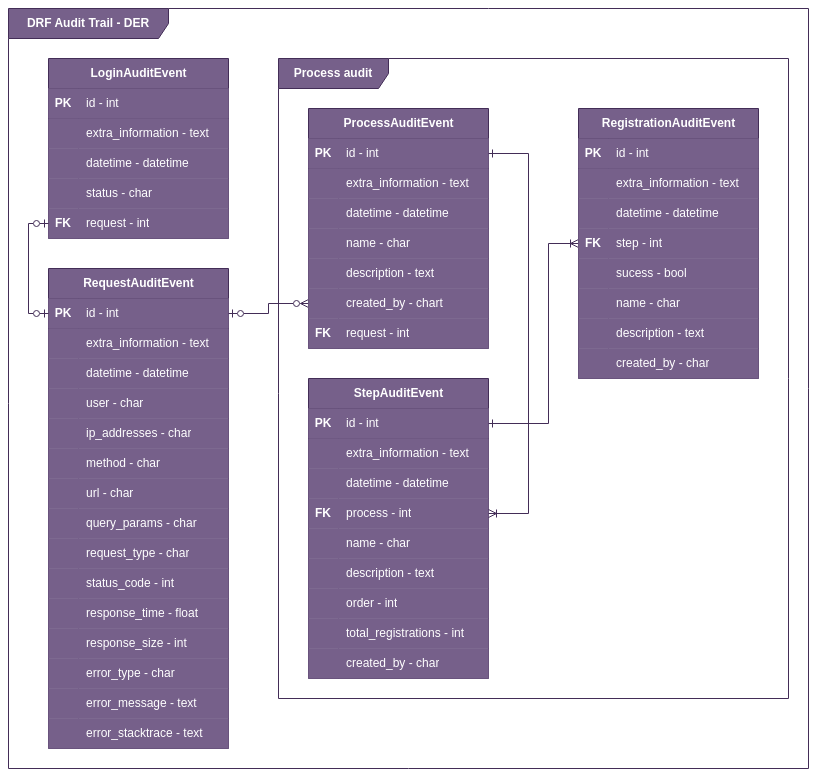
- RequestAuditEvent: HTTP request auditing.
- LoginAuditEvent: Login/logout auditing.
- ProcessAuditEvent: Custom process auditing.
- StepAuditEvent: Process step auditing.
- RegistrationAuditEvent: Execution registration for each step.
Example Usage in a View
from rest_framework.views import APIView
from rest_framework.response import Response

class TestAPIView(APIView):
    def get(self, request, *args, **kwargs):
        drf_request_audit_event = request.META.get("drf_request_audit_event")
        drf_request_audit_event["extra_informations"] = {
            "data": "Example of extra information"
        }
        return Response("ok")
Diagrams
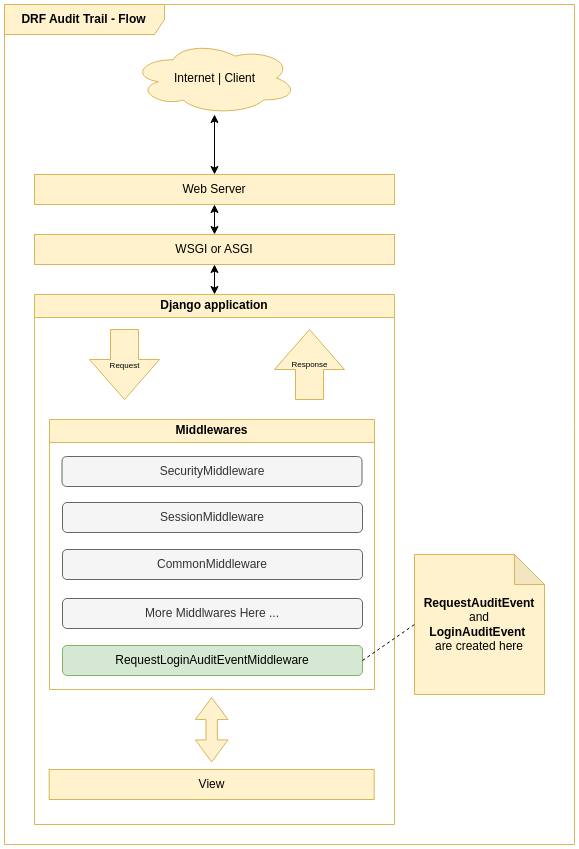
Audit Flow
ERD
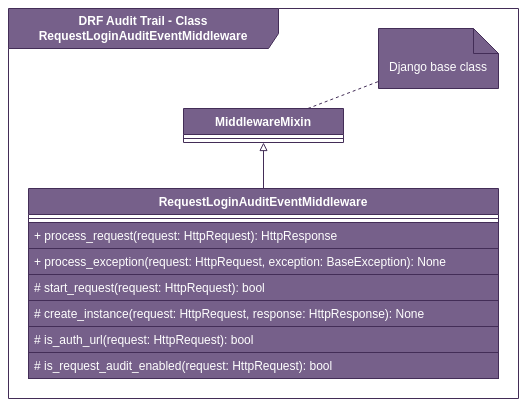
Middleware Class Diagram
Example: Process Auditing
To audit custom business processes, use the process audit utilities:
from drf_audit_trail.models import (
    ProcessAuditEvent,
    RegistrationAuditEvent,
    StepAuditEvent,
)
from drf_audit_trail.process_audit import ProcessAudit


class CreateProductProcessAudit(ProcessAudit):
    def create_process(self) -> ProcessAuditEvent:
        return self.save_model(ProcessAuditEvent(name="Criar produto"))

    def create_steps(self, process: ProcessAuditEvent):
        self.step_validation = self.save_model(
            StepAuditEvent(
                name="Validação dos Dados",
                order=1,
                process=process,
                total_registrations=2,
            )
        )

        self.step_save_db = self.save_model(
            StepAuditEvent(
                name="Salvar no banco de dados",
                order=2,
                process=process,
            )
        )

    def create_registration_step_validation_code(
        self, success, name=None, **extra_fields
    ):
        name = name or "Codigo do produto validados com sucesso"
        return self.save_model(
            RegistrationAuditEvent(
                name=name, step=self.step_validation, success=success, **extra_fields
            )
        )

    def create_registration_step_validation(self, success, name=None, **extra_fields):
        name = name or "Dados de criação validados com sucesso"
        return self.save_model(
            RegistrationAuditEvent(
                name=name, step=self.step_validation, success=success, **extra_fields
            )
        )

    def create_registration_save_db(self, success, name=None, **extra_fields):
        name = name or "Salvar no banco de dados"
        return self.save_model(
            RegistrationAuditEvent(
                step=self.step_save_db, success=success, name=name, **extra_fields
            )
        )


class ProductViewSet(ModelViewSet):
    serializer_class = ProductSerializer
    queryset = Product.objects.all()

    def create(self, request, *args, **kwargs):
        process_audit = CreateProductProcessAudit(request)

        serializer = self.get_serializer(data=request.data)
        if serializer.is_valid():
            process_audit.create_registration_step_validation_code(True)
            process_audit.create_registration_step_validation(True)
        else:
            if serializer.errors.get("code") is not None:
                process_audit.create_registration_step_validation_code(
                    False,
                    "Error de validação de codigo",
                    description=json.dumps(serializer.errors.get("code")),
                )
            validation_errors = json.dumps(serializer.errors)
            process_audit.create_registration_step_validation(
                False, "Erros de validação", description=validation_errors
            )
            raise ValidationError(serializer.errors)

        try:
            self.perform_create(serializer)
            process_audit.create_registration_save_db(True)
        except BaseException as e:
            process_audit.create_registration_save_db(False, e.__str__())
            raise

        headers = self.get_success_headers(serializer.data)
        return Response(serializer.data, status=201, headers=headers)
Handling Long Data and Preventing Database Errors
Starting from version X.X.X, DRF Audit Trail automatically prevents DataError (e.g., StringDataRightTruncation) when saving audit events, even when request parameters (like URLs or query strings) exceed the database limit.
How does it work?
- Fields sensitive to length, such as
urlandquery_paramsin theRequestAuditEventmodel, use a custom field that automatically truncates values exceeding the database limit (e.g., 2048 characters). - When truncation occurs, a warning is logged via Python (
drf_audit_trail.truncation), enabling traceability. - This ensures the audit middleware never causes a request to fail due to oversized data, making the solution robust for public APIs or endpoints with extensive parameters.
Example of truncation log
WARNING drf_audit_trail.truncation: Truncating value for field 'url' to 2048 characters. Original length: 3010.
Notes
- Truncation is transparent to the library user.
- To audit this behavior, set the log level to
WARNINGin thedrf_audit_trail.truncationlogger. - This behavior applies to all fields of type
TruncatingCharField.
License
MIT License
Notes
- All settings are optional and have default values.
- For advanced customization, see the code and docstrings.
- For questions, check the docstrings or open an issue.
Release history Release notifications | RSS feed


Download files
Download the file for your platform. If you're not sure which to choose, learn more about installing packages.
Source Distribution
Built Distribution
Filter files by name, interpreter, ABI, and platform.
If you're not sure about the file name format, learn more about wheel file names.
Copy a direct link to the current filters
File details
Details for the file drf_audit_trail-0.4.0.tar.gz.
File metadata
- Download URL: drf_audit_trail-0.4.0.tar.gz
- Upload date:
- Size: 15.7 kB
- Tags: Source
- Uploaded using Trusted Publishing? No
- Uploaded via: poetry/2.1.1 CPython/3.10.12 Linux/6.8.0-78-generic
File hashes
| Algorithm | Hash digest | |
|---|---|---|
| SHA256 |
dadd82e94da5c820feae45230eb2533a4cd0b0c578c32ba95c2603e6c29ae5d1
|
|
| MD5 |
4c200667342957cdff6ef49a19aa9d56
|
|
| BLAKE2b-256 |
636ef7d05b0aeccbe27a4adf96b6f523657696a899dfb13e91f3edf598997583
|
File details
Details for the file drf_audit_trail-0.4.0-py3-none-any.whl.
File metadata
- Download URL: drf_audit_trail-0.4.0-py3-none-any.whl
- Upload date:
- Size: 24.3 kB
- Tags: Python 3
- Uploaded using Trusted Publishing? No
- Uploaded via: poetry/2.1.1 CPython/3.10.12 Linux/6.8.0-78-generic
File hashes
| Algorithm | Hash digest | |
|---|---|---|
| SHA256 |
408e2fa8871fbf0ee294bc34325f406e612aeb9013689e97ea7ef28747d3cdd9
|
|
| MD5 |
ec3df14a2393a4fbabe9f8e0a75a5fcc
|
|
| BLAKE2b-256 |
81476098f778844adce3f0263c916c9452749c8c98525125bc1ff155d491eb18
|






