
Deterministic architectural drift detection for AI-accelerated Python repositories through cross-file coherence analysis

Project description
Drift — Finds the architecture erosion that AI-generated code silently introduces












Repo:
sauremilk/drift· Package:drift-analyzer· Command:drift· Requires: Python 3.11+97.3% precision on 263 ground-truth findings across 15 repositories · deterministic · no LLM in pipeline · full study →
Start here
What is drift?
Drift is a deterministic static analyzer that finds the architecture erosion AI-generated code silently introduces — pattern fragmentation, boundary violations, and structural hotspots — before they become normal team habits. In seconds, without any LLM in the pipeline.
Who is it for?
- Python teams with fast-growing codebases where architecture matters
- Tech leads who want fast structural feedback, not just style or type checks
- Teams using AI coding tools and seeing more cross-file drift across modules
1-minute quickstart
pip install -q drift-analyzer
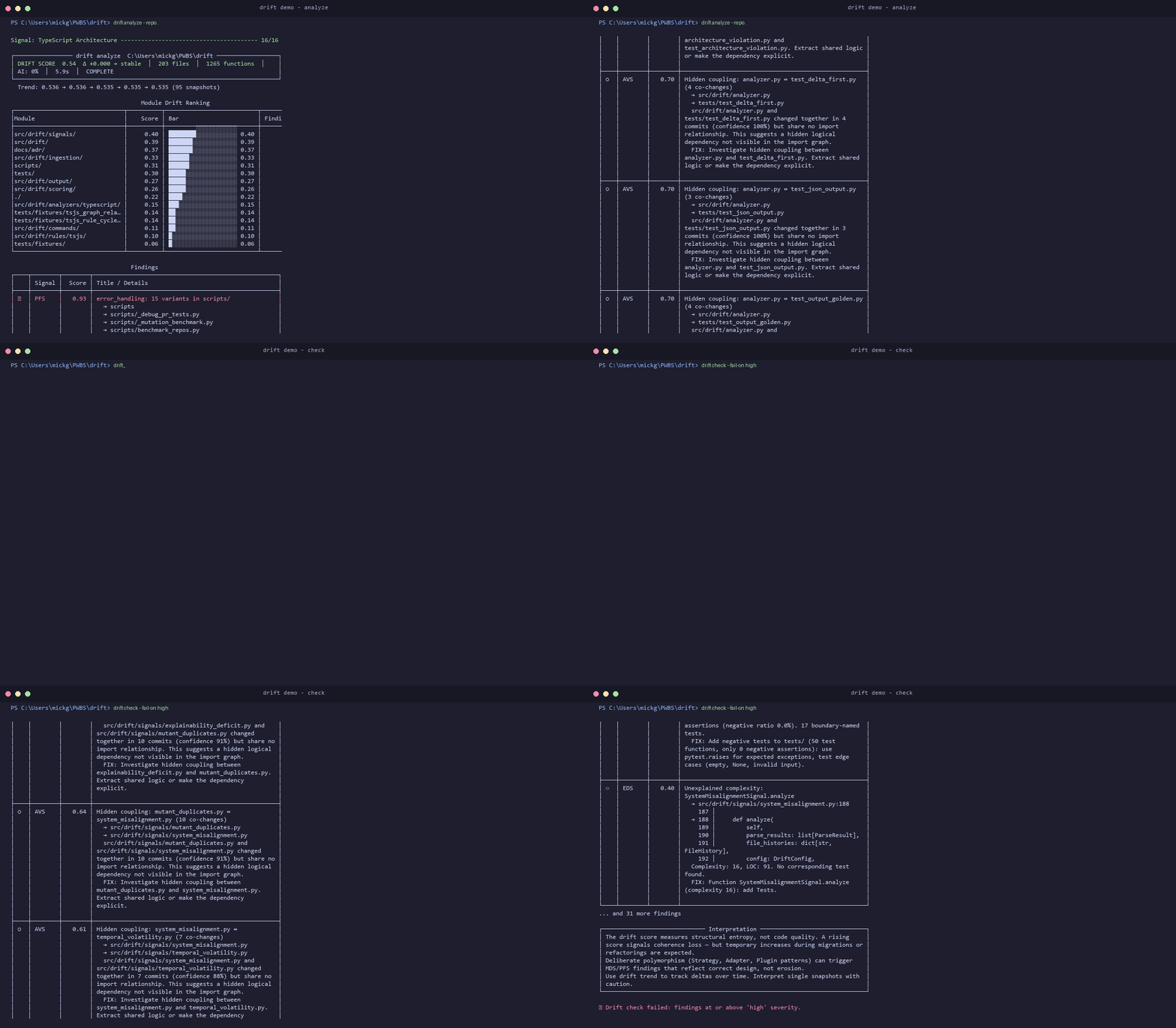
drift analyze --repo .
That gives you a drift score, the hottest modules, and actionable findings in one run.
Choose your path
- Not sure where to start? Use the central docs routing page: Start Here.
- Casual user: install drift, run
drift analyze --repo ., and start with Quick Start and Configuration. - Evaluator: review Example Findings, Trust and Evidence, and Stability and Release Status before deciding on rollout.
- Contributor: use CONTRIBUTING.md once you are ready to submit a fix, improve docs, or work on signal quality.
- Core maintainer: use CONTRIBUTING.md, DEVELOPER.md, and POLICY.md for the full quality, architecture, and release guardrails.
Release status
The PyPI classifier remains Development Status :: 3 - Alpha intentionally.
That is not a claim that the whole tool is immature. It is a conservative release signal for a product whose core Python analysis is already usable, while some adjacent surfaces still have mixed maturity.
| Area | Status | What that means today |
|---|---|---|
| Core Python analysis | Stable | Primary analysis path, CLI usage, and main signal set are the most production-ready parts of drift. |
| CI and SARIF workflow | Stable | Suitable for report-only rollout now, then selective gating once teams calibrate findings locally. |
| TypeScript support | Experimental | Optional support exists, but Python remains the primary target and the more validated path. |
| Embeddings-based parts | Optional / experimental | Not required for the core detector path and should be treated as exploratory add-ons. |
| Benchmark methodology | Evolving | Public and reproducible, but still conservative in its claims and not the final word on every repository shape. |
Why keep Alpha for now: release signaling should reflect the least mature user-facing surfaces, not only the strongest path. Drift already has stable core workflows, but the overall product story still includes experimental and evolving areas.
See Stability and Release Status for the explicit matrix and the criteria for a future move toward Beta.
Example output
DRIFT SCORE  0.52
Top finding: PFS 0.85  Error handling split 4 ways  at src/api/routes.py:42
Next action: consolidate variants into one shared pattern
If you want CI, use this
- uses: sauremilk/drift@v1
  with:
    fail-on: none
    upload-sarif: "true"
Start report-only first. Tighten to fail-on: high once the team understands the signal quality in its own repo.
Try it on a demo project
git clone https://github.com/sauremilk/drift.git
cd drift/examples/demo-project
pip install -q drift-analyzer
drift analyze --repo .
The demo project contains intentional drift patterns, so you get useful findings immediately.
Why drift
When your team uses GitHub Copilot, Cursor, or other AI coding tools, code passes CI while the repository quietly accumulates architectural drift:
- Pattern fragmentation: error handling is implemented 4 different ways across the same service
- Boundary violations: the API layer imports directly from the database layer
- Silent duplication: AI generates a new validator instead of finding the existing one
- Churn hotspots: the same files change every sprint because the structure is unclear
Your linter, type checker, and test suite won't catch this. Drift does — deterministically, without any LLM in the pipeline. That makes drift useful for architectural drift detection in AI-accelerated Python codebases, with architecture erosion analysis and cross-file coherence findings that teams can act on.
What drift catches that other checks usually don't
- Ruff / formatters / type checkers: local correctness and style signals, not cross-module coherence.
- Semgrep / CodeQL / security scanners: risky flows and policy violations, not whether patterns fragment across a codebase.
- Sonar / maintainability dashboards: broad quality heuristics, not a drift-specific score grounded in reproducible signal families.
Current public evidence: 15 real-world repositories in the study corpus, 15 scoring signals (all contributing to the composite score), and auto-calibration that rebalances weights at runtime. Full study → · Trust & limitations
Use cases
Pattern fragmentation in a connector layer
Problem: A FastAPI service has 4 connectors, each implementing error handling differently — bare except, custom exceptions, retry decorators, and silent fallbacks.
Solution:
drift analyze --repo . --sort-by impact --max-findings 5
Output: PFS finding with score 0.96 — "26 error_handling variants in connectors/" — shows exactly which files diverge and suggests consolidation.
Architecture boundary violation in a monorepo
Problem: A database model file imports directly from the API layer, creating a circular dependency that breaks test isolation.
Solution:
drift check --fail-on high
Output: AVS finding — "DB import in API layer at src/api/auth.py:18" — blocks the CI pipeline until the import direction is fixed.
Duplicate utility code from AI-generated scaffolding
Problem: AI code generation created 6 identical _run_async() helper functions across separate task files instead of finding the existing shared utility.
Solution:
drift analyze --repo . --format json | jq '.findings[] | select(.signal=="MDS")'
Output: MDS findings listing all 6 locations with similarity scores ≥ 0.95, enabling a single extract-to-shared-module refactoring.
Concrete example findings
If you are evaluating drift, the fastest way to understand the value is to look at concrete findings rather than abstract signal names.
See docs-site/product/example-findings.md for 5 short examples with code, the likely finding, why it matters, and how to fix it:
- Pattern fragmentation: three incompatible error-handling patterns in one module
- Mutant duplicate: two copied formatter functions that will drift apart later
- Architecture violation: a
db/module importing fromapi/ - Doc-implementation drift: README structure that no longer matches the repo
- Temporal volatility: a small file that became a churn hotspot in git history
More setup options
Full GitHub Action (recommended: start report-only)
name: Drift

on: [push, pull_request]

jobs:
  drift:
    runs-on: ubuntu-latest
    permissions:
      contents: read
      security-events: write

    steps:
      - uses: actions/checkout@v4
        with:
          fetch-depth: 0

      - uses: sauremilk/drift@v1
        with:
          fail-on: none           # report findings without blocking CI
          upload-sarif: "true"    # findings appear as PR annotations
Once the team has reviewed findings for a few sprints, tighten the gate:
      - uses: sauremilk/drift@v1
        with:
          fail-on: high           # block only high-severity findings
          upload-sarif: "true"
CI gate (local)
drift check --fail-on none    # report-only
drift check --fail-on high    # block on high-severity findings
pre-commit hook
The fastest way to add drift to your workflow:
# .pre-commit-config.yaml
repos:
  - repo: https://github.com/sauremilk/drift
    rev: v0.9.0
    hooks:
      - id: drift-check          # blocks on high-severity findings
      # - id: drift-report        # report-only alternative (start here)
Or use a local hook if you already have drift installed:
# .pre-commit-config.yaml
repos:
  - repo: local
    hooks:
      - id: drift
        name: drift
        entry: drift check --fail-on high
        language: system
        pass_filenames: false
        always_run: true
More setup paths:
What you get
╭─ drift analyze  myproject/ ──────────────────────────────────────────────────╮
│  DRIFT SCORE  0.52  │  87 files  │  412 functions  │  AI: 34%  │  2.1s      │
╰──────────────────────────────────────────────────────────────────────────────╯

                        Module Drift Ranking
  Module                           Score  Findings  Top Signal
  ─────────────────────────────────────────────────────────────
  src/api/routes/                   0.71       12   PFS 0.85
  src/services/auth/                0.58        7   AVS 0.72
  src/db/models/                    0.41        4   MDS 0.61

┌──┬────────┬───────┬──────────────────────────────────────┬──────────────────────┐
│  │ Signal │ Score │ Title                                │ Location             │
├──┼────────┼───────┼──────────────────────────────────────┼──────────────────────┤
│◉ │ PFS    │  0.85 │ Error handling split 4 ways          │ src/api/routes.py:42 │
│◉ │ AVS    │  0.72 │ DB import in API layer               │ src/api/auth.py:18   │
│○ │ MDS    │  0.61 │ 3 near-identical validators          │ src/utils/valid.py   │
└──┴────────┴───────┴──────────────────────────────────────┴──────────────────────┘
Drift scores all 15 signal families:
PFSPattern Fragmentation (0.16)AVSArchitecture Violations (0.16)MDSMutant Duplicates (0.13)TVSTemporal Volatility (0.13)EDSExplainability Deficit (0.09)SMSSystem Misalignment (0.08)DIADoc-Implementation Drift (0.04)BEMBroad Exception Monoculture (0.04)TPDTest Polarity Deficit (0.04)NBVNaming Contract Violation (0.04)GCDGuard Clause Deficit (0.03)BATBypass Accumulation (0.03)ECMException Contract Drift (0.03)CODCohesion Deficit (0.01)CCCCo-Change Coupling (0.005)
Signal details and scoring model:
How drift compares
Data sourced from STUDY.md §9 and benchmark_results/.
| Capability | drift | SonarQube | pylint / mypy | jscpd / CPD |
|---|---|---|---|---|
| Pattern Fragmentation (N variants per module) | Yes | No | No | No |
| Near-Duplicate Detection (AST structural) | Yes | Partial (text) | No | Yes (text) |
| Architecture Violation (layer + circular deps) | Yes | Partial | No | No |
| Temporal Volatility (churn anomalies) | Yes | No | No | No |
| System Misalignment (novel imports) | Yes | No | No | No |
| Composite Health Score | Yes | Yes (different) | No | No |
| Zero Config (no server needed) | Yes | No (server) | Partial | Yes |
| SARIF Output (GitHub Code Scanning) | Yes | Yes | No | No |
| TypeScript Support | Optional ¹ | Yes | No | Yes |
¹ Experimental via drift-analyzer[typescript]. Python is the primary target.
Drift is designed to complement linters and security scanners, not replace them. Recommended stack: linter (style) + type checker (types) + drift (coherence) + security scanner (SAST).
Full comparison: STUDY.md §9 — Tool Landscape Comparison
Ideal for
- Python teams using AI coding tools (Copilot, Cursor, Cody) in existing codebases
- Tech leads who want to catch structural erosion before it becomes team habit
- CI pipelines that need a deterministic architecture check without LLM infrastructure
Teams often describe drift as an architectural linter for repositories where GitHub Copilot and similar assistants accelerate local delivery faster than shared design conventions can keep up.
Who should adopt now
- teams with Python 3.11+ already available locally and in CI
- repositories with 20+ files and recurring refactors across modules
- teams using AI assistance enough that copy-modify drift and boundary erosion are real review problems
Who should wait
- tiny repos where a few findings would dominate the score
- teams looking for bug finding, security review, or strict pass/fail quality gates on day one
- teams without Python 3.11+ in their execution path yet
Best first target
Drift works best on Python repositories with 20+ files and some history. If you see too many findings on the first run:
- Start with
drift check --fail-on noneto just observe. - Focus on findings with score ≥ 0.7 — those have the strongest signal.
- Ignore generated code or vendor directories (configure exclusions in
drift.yaml).
Don't use drift if...
- you expect bug finding, security scanning, or type safety enforcement
- you need zero false positives on a tiny repository from day one
- you want one absolute score to replace code review judgment
Drift is most useful when teams treat the score as orientation and the findings as investigation prompts.
Small-team rollout
The safest adoption path is progressive:
- Start with
drift analyzelocally and review the top findings. - Add
drift checkin CI as report-only discipline for a short period. - Gate only on
highfindings once the team understands the output. - Tune config and policies only after reviewing real findings in your repo.
Recommended guides:
Trust and limitations
Public claims safe to repeat for v0.8.2: Drift is deterministic, benchmarked on 15 real-world repositories in the current study corpus, and uses 15 scoring signals with auto-calibration for runtime weight rebalancing and small-repo noise suppression.
What's limited: Benchmark validation is single-rater; not yet independently replicated. Small repos can be noisy. Temporal signals depend on clone depth. The composite score is orientation, not a verdict.
What's next: Independent external validation, multi-rater ground truth, signal-specific confidence intervals.
Drift is designed to earn trust through determinism and reproducibility:
- no LLMs in the detection pipeline
- reproducible CLI and CI output
- signal-specific interpretation instead of score-only messaging
- explicit benchmarking and known-limitations documentation
Interpreting the score
The drift score measures structural entropy, not code quality. Keep these principles in mind:
- Interpret deltas, not snapshots. Use
drift trendto track changes over time. A single score in isolation has limited meaning. - Temporary increases are expected during migrations. Two coexisting patterns (old and new) will raise PFS/MDS signals. This is the migration happening, not a problem.
- Deliberate polymorphism is not erosion. Strategy, Adapter, and Plugin patterns produce structural similarity that MDS flags as duplication. Findings include a
deliberate_pattern_riskhint — verify intent before acting. - The score rewards reduction, not correctness. Deleting code lowers the score just like refactoring does. Do not optimize for a low score — optimize for understood, intentional structure.
For a detailed discussion of epistemological boundaries (what drift can and cannot see), see STUDY.md §14.
Drift vs. erosion: Without
layer_boundariesindrift.yaml, drift detects emergent drift — structural patterns that diverge without explicit prohibition. With configuredlayer_boundaries, drift additionally performs conformance checking against a defined architecture. Both modes are complementary: drift does not replace dedicated architecture conformance frameworks (e.g. PyTestArch for executable layer rules in pytest), but catches cross-file coherence issues those tools do not model.
Start with the strongest, most actionable findings first. If a signal is noisy for your repository shape, tune or de-emphasize it instead of forcing an early hard gate.
Further reading:
Contributing
Drift seeks contributions that increase the credibility of static architecture findings: reproducible cases, better explainability, fewer false alarms, and clearer next actions.
If you run drift on your codebase and get surprising results — good or bad — please open an issue or start a discussion.
New here? Start contributing
- Pick an issue labelled
good first issue git clone https://github.com/sauremilk/drift.git && cd drift && make installmake test-fast— confirm everything passes- Make your change, then open a PR
Typical first contributions:
- Add a ground-truth fixture for a false positive or false negative
- Improve a finding's explanation text to be more actionable
- Write a test for an untested edge case
- Fix or extend signal documentation with a concrete example
What we value most: reproducibility, explainability, false-alarm reduction.
What we deprioritize: new output formats without insight value, comfort features, complexity without analysis improvement.
See CONTRIBUTING.md for the full guide and ROADMAP.md for current priorities.
Documentation map
- Getting Started
- How It Works
- Benchmarking and Trust
- Product Strategy
- Contributor Guide
- Developer Guide
Status
drift has working CLI, GitHub Action, configuration, JSON/SARIF output, benchmark material, and active tests.
Current release posture:
- PyPI classifier remains Alpha intentionally
- core Python analysis: stable
- CI and SARIF workflow: stable
- TypeScript support: experimental
- embeddings-based parts: optional / experimental
- benchmark methodology: evolving
Rationale and matrix: Stability and Release Status
License
MIT. See LICENSE.
Release history Release notifications | RSS feed


Download files
Download the file for your platform. If you're not sure which to choose, learn more about installing packages.
Source Distribution
Built Distribution
Filter files by name, interpreter, ABI, and platform.
If you're not sure about the file name format, learn more about wheel file names.
Copy a direct link to the current filters
File details
Details for the file drift_analyzer-0.10.0.tar.gz.
File metadata
- Download URL: drift_analyzer-0.10.0.tar.gz
- Upload date:
- Size: 593.9 kB
- Tags: Source
- Uploaded using Trusted Publishing? No
- Uploaded via: twine/6.2.0 CPython/3.11.9
File hashes
| Algorithm | Hash digest | |
|---|---|---|
| SHA256 |
5f23b59288b89aa6985a963043a1136e76cac6c24273d33ab2e8b92755fdede9
|
|
| MD5 |
3decd53fdae934042d8156772af111f4
|
|
| BLAKE2b-256 |
cb7556e1bfc5507dcf6fc5d2d18f7b68dc0fa0d7080b4bbdff3c6bfaac486011
|
File details
Details for the file drift_analyzer-0.10.0-py3-none-any.whl.
File metadata
- Download URL: drift_analyzer-0.10.0-py3-none-any.whl
- Upload date:
- Size: 202.4 kB
- Tags: Python 3
- Uploaded using Trusted Publishing? No
- Uploaded via: twine/6.2.0 CPython/3.11.9
File hashes
| Algorithm | Hash digest | |
|---|---|---|
| SHA256 |
f808ec217e94cf2aa9310a23093fd932fde47582f4dd67acb03b607c3aa9b47e
|
|
| MD5 |
0873b3f7453f23bc7526e3aa2b7be01d
|
|
| BLAKE2b-256 |
26df050dc9f70af49ee153df55645b88b98268c428d900e21da1a0a16a39b428
|






