


DRUHG
DRUHG — Dialectical Reflection Universal Hierarchical Grouping (друг).
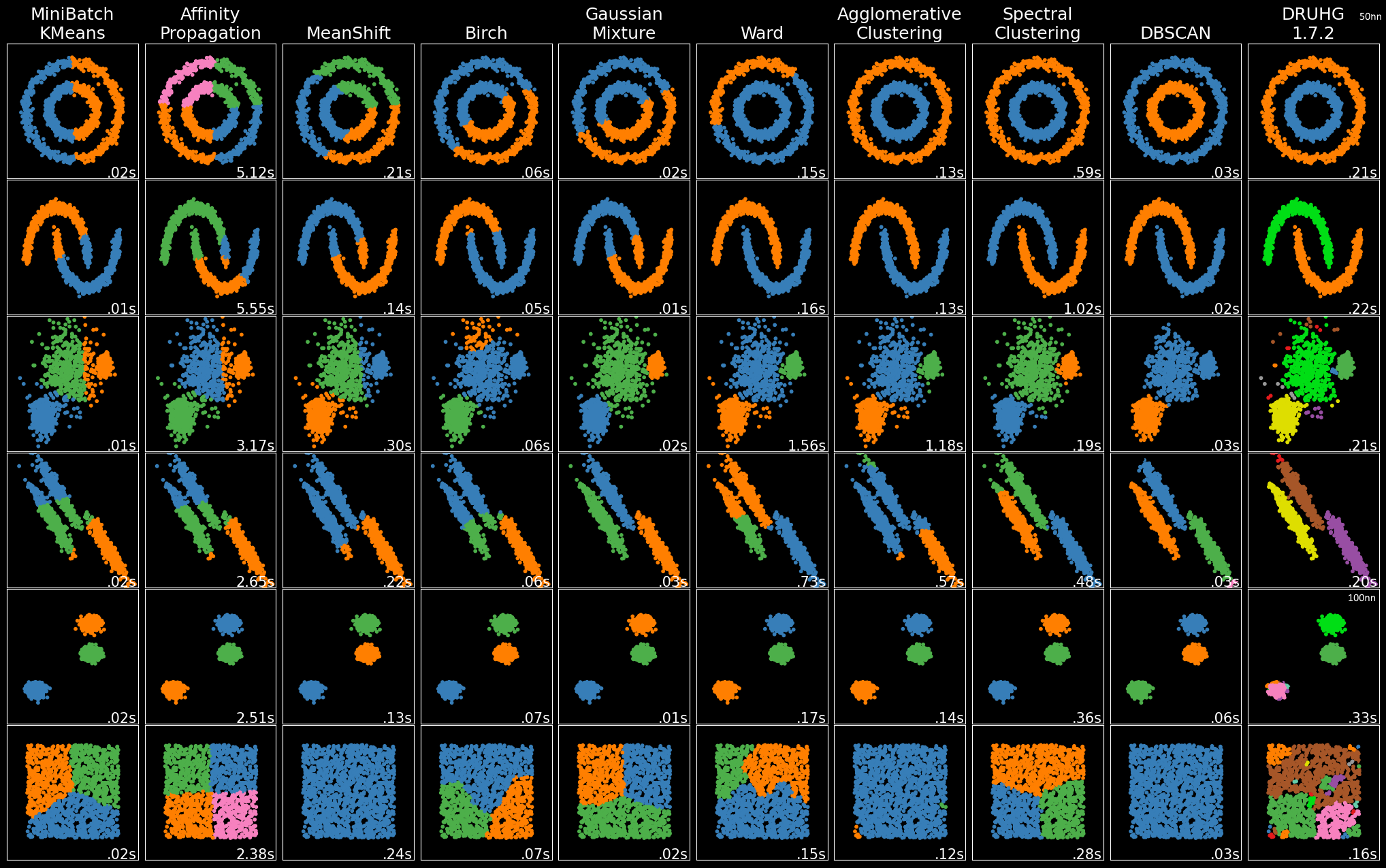
Density-based clustering that catches global outliers and lets you navigate the cluster hierarchy visually. It does not require clustering hyperparameters. The space metric (e.g. Euclidean) is the only real choice.
Optional knobs:
size_range — filter cluster size; use [1, 1] for genuine outliers.
fix_outliers — assign outliers to their closest clusters along MST edges.
max_ranking — neighbor-search depth; trade speed for precision.
Basic Concept
The algorithm applies the universal society rule: treat others as you want to be treated.
Point A inspects the surroundings of point B and converts that view into its own. Each pair A, B produces a dialectical distance max( r/(R-∩) d(r); d(R) ), where r and R are the numbers of points inside the balls from A to B and from B to A. The closest dialectical distance wins and crystallizes into an edge. The process repeats.
This orders outliers last and equal densities first. It is a strong EDA (exploratory data analysis) method, a replacement for (H)DBSCAN, and a global-outlier detector.
Evaluating all O(n²) pairs is unnecessary; only a small number of nearest neighbors matters. Control speed vs precision with max_ranking — after some k the result converges.
The cluster. The coloring formula is easiest to see through graphs and the nature of mathematical objects. Points are, edges connect, and the dictionary of key–value pairs (point-to-edge) “colors”. When two graphs connect, the two sets of points can be linked to the connecting edge:
Both graphs clusterize to the same edge; In case of mutual clusterisation it is seen as one cluster.
One graph clusterizes; its points link to the connecting edge (a regular cluster).
No clusterisation. Everything aggregates.
Each graph reflects in its rival and solves the inequality:
D N₂ L₁ ∑₁ 1 / dᵢ > N₁ (L₁ + L₂)
where:
D — dialectical distance of the connecting edge
N₁, N₂ — own and rival sides of a graph
L₁, L₂ — unique linked edges
∑₁ 1 / dᵢ — sum of reciprocals of unique linked edges
A newly formed cluster resists reclusterisation with its internal high dᵢ and low L₁. Outliers bring 1 as N₂, contribute 1 to L₂. Eventually a huge external D, N₂, or dilution of L₁ will clusterize anything.
This is drastically different from the usual overcome-xyz coefficient.
How to use DRUHG
import sklearn.datasets as datasets
from sklearn.metrics import adjusted_rand_score
import druhg

iris = datasets.load_iris()
XX = iris['data']

clusterer = druhg.DRUHG(max_ranking=50)
labels = clusterer.fit(XX).labels_
This builds the tree and labels the points. You can then reshape clusters by relabeling:
labels = clusterer.relabel(exclude=[7749, 100], size_range=[0.2, 2242], fix_outliers=True)
ari = adjusted_rand_score(iris['target'], labels)
print('iris ari', ari)
Relabeling is cheap:
exclude — break clusters by label number
size_range — restrict cluster size by fraction (values < 1) or by absolute count
fix_outliers — color outliers by connectivity
Draw the MST with DRUHG edges:
clusterer.plot(labels)Or open interactive sliders for exploration:
clusterer.plot()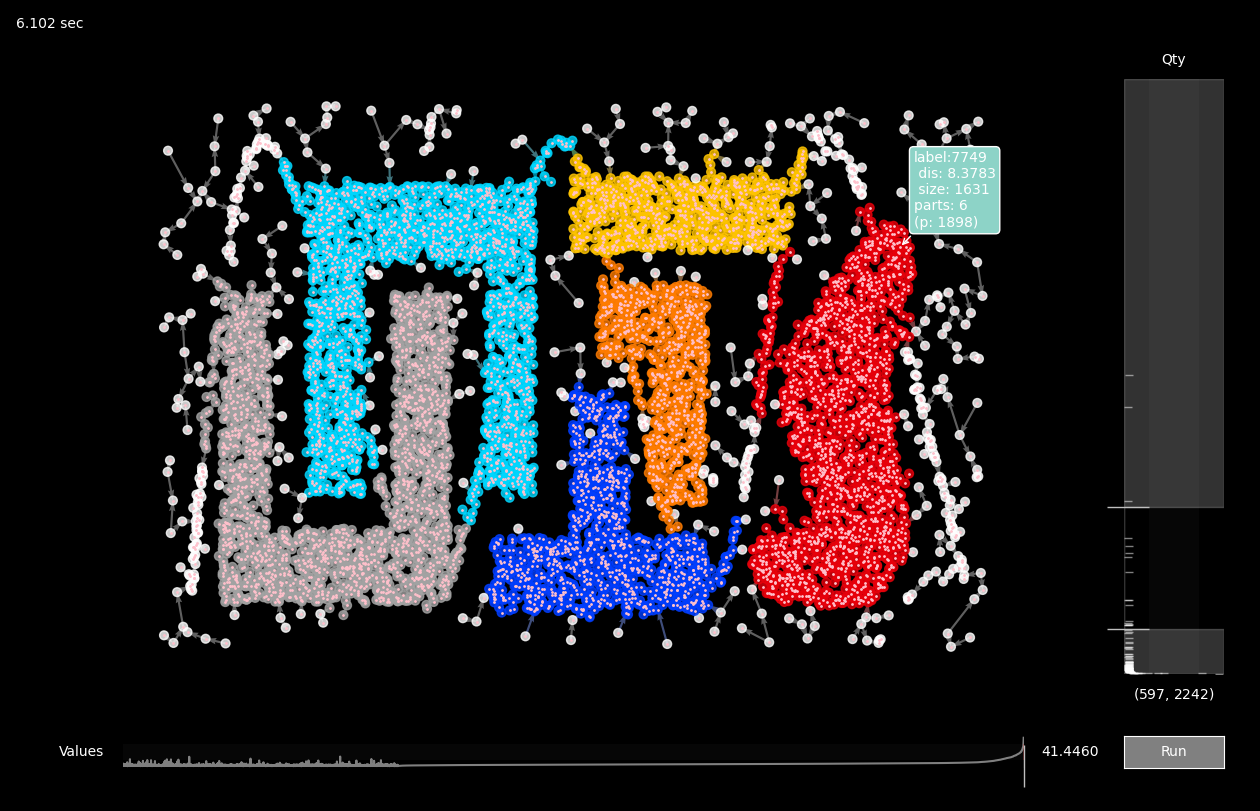
Performance
It can be slow on highly structured data. Lower max_ranking for better performance.
Installing
PyPI install, assuming an up-to-date pip:
pip install druhgRunning the Tests
After installation:
pytest druhg/tests -k "test_name"The tests may fail.
pytest druhg/tests -k "test_name" -vFor a verbose logging
pytest druhg/tests -k "test_name" -log=DEBUGFor a deep dive
Python Version
DRUHG supports Python 3.
Contributing
Contributions in any form are welcome. Help with documentation, especially tutorials, is always useful. Fork the project, make your changes, and submit a pull request:
Licensing
The druhg package is 3-clause BSD licensed.
1 maintainer

Metadata
1 maintainer
Release files for druhg 1.8.5
For a detailed explanation of source distributions (sdists) and built distributions (wheels), please see the package formats documentation.
Source distribution (sdist)
| File | Size | Uploaded | |
|---|---|---|---|
| druhg-1.8.5.tar.gz | 51.8 kB | Details |
Release files / druhg-1.8.5.tar.gz
| Download URL | druhg-1.8.5.tar.gz |
|---|---|
| Size | 51.8 kB |
| Tags | Source |
|
SHA-256 checksum How to use checksums |
8d19f582c1b45cfd481716428acc6e5f5536c8e7940c64b968df9face04d6f27
|
|
BLAKE2b-256 checksum How to use checksums |
48214eb4a2a7f85409f459bed4995acd267e241c5d100c5f1f024bf074a4ef7b
|
| Upload date | |
|
Uploaded using Trusted Publishing? What is trusted publishing? |
No |
| Uploaded via |
twine/7.0.0 CPython/3.14.7
|














