
Double Sphere & multi-model spherical-camera platform: models, calibration, conversion & 3D for wide-FOV lenses
Verified details
These details have been verified by PyPIProject links
GitHub Statistics
Maintainers

Project description
DS-MSP
Double Sphere & Multi-model Spherical-camera Platform — every wide-FOV camera model behind one interface.






A clean, tested, OpenCV-compatible Python platform for wide-FOV (fisheye / omnidirectional) cameras. One interface covers calibration, model conversion, 3D geometry, multi-camera rigs, and hardware export — so you can swap camera models in a single line and convert between them without re-shooting images.
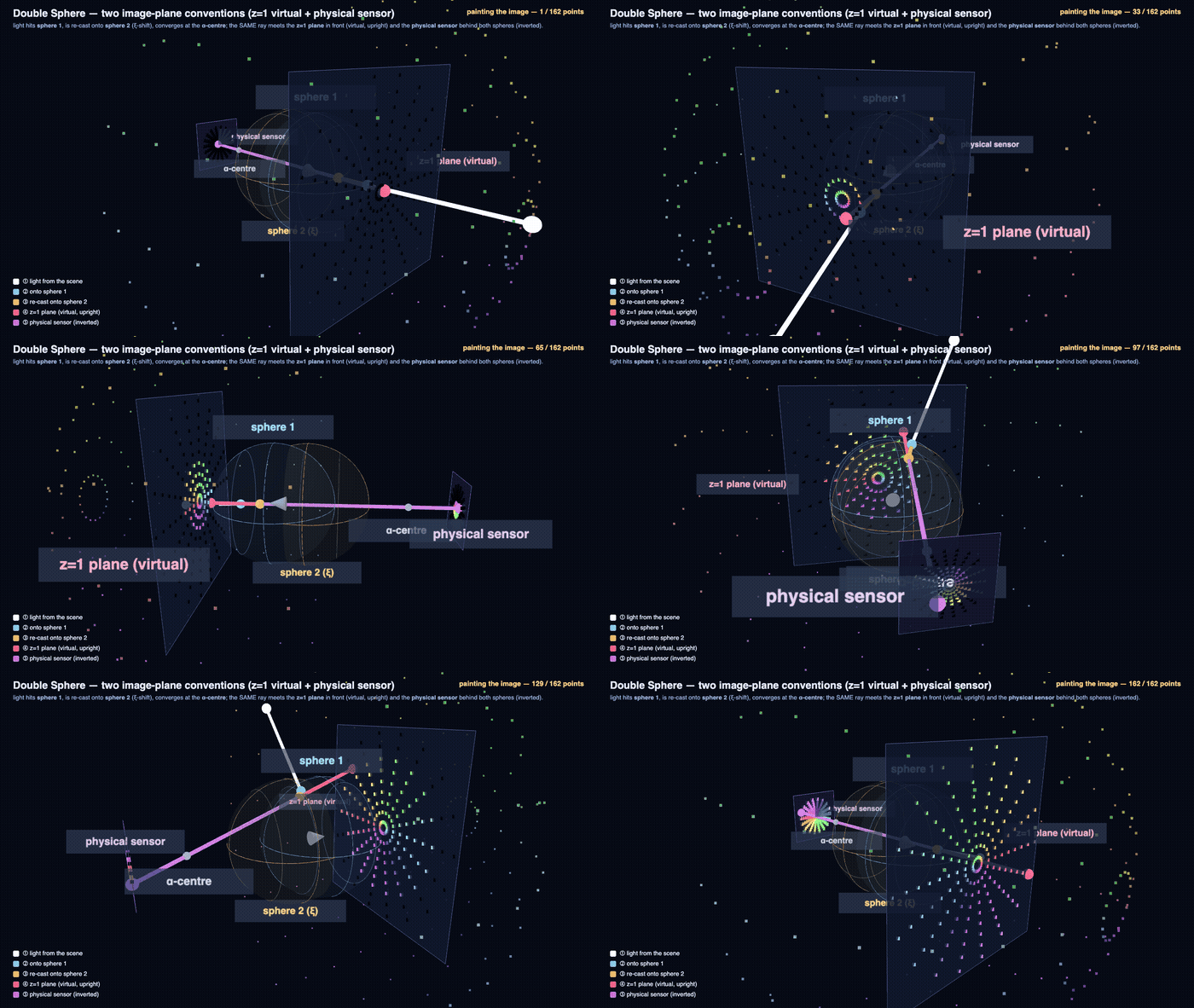
The namesake Double Sphere model in motion: each 3D point is traced through two spheres and projected to the fisheye image. Cross-checked against the library itself (
std = 2e-16). Drive it live →
Install
pip install ds-msp                 # core library
pip install "ds-msp[calib]"        # + AprilGrid detector
What do you want to do?
| Task | Recipe |
|---|---|
| Project & unproject 3D points | → Project & unproject |
Rectify a fisheye to a pinhole image (+ new K) |
→ Pinhole image & new K |
| Estimate 2D/3D pose (PnP & two-view) | → 2D/3D pose |
| Calibrate any camera from scratch | → Calibrate from scratch |
| Convert one model to another (no images, no data) | → Convert between models |
| Calibrate a multi-camera rig (any FOV) for extrinsics | → Multi-camera rig |
| Run stereo depth on raw fisheye | → Stereo depth |
| Export to TI hardware | → Hardware LDC export |
| Pick the right model | → Choosing a model |
| Learn the geometry | → Learn |
Recipes
Every recipe below is a copy-paste starting point. Each links to a fuller guide; the code uses the real API.
Project & unproject
Build any model from its intrinsics, then project 3D points to pixels and unproject pixels back to unit bearing rays — exact inverses. Every model also exposes analytic point and parameter Jacobians (no autodiff, no finite differences), so these drop straight into bundle adjustment.
import numpy as np
from ds_msp import DoubleSphereCamera

cam = DoubleSphereCamera(fx=711.57, fy=711.24, cx=949.18, cy=518.81,
                         xi=0.183, alpha=0.809, width=1920, height=1080)

pts_3d = np.array([[0., 0., 1.], [1., 1., 2.]])
px,   ok = cam.project(pts_3d)     # (N,2) pixels + validity mask
rays, ok = cam.unproject(px)       # (N,3) unit rays (exact inverse of project)
Round-trips to ~1e-13 px. The recipes below reuse this cam. → Multi-model guide
Pinhole image & new K
Rectify a raw fisheye frame to an undistorted pinhole image and get the new pinhole intrinsics K_new for it. The balance knob trades field of view against crop — 0.0 keeps the widest FOV (more black border), 1.0 is the tightest crop (no border).
import cv2, ds_msp.cv as ds_cv

img = cv2.imread("frame.png")      # your raw fisheye frame

# object API — rectified pinhole image AND its new pinhole intrinsics
img_undist, K_new = cam.undistort_image(img)

# OpenCV-style equivalent, with explicit size + balance (0 = widest FOV … 1 = tightest crop)
K_new      = ds_cv.estimateNewCameraMatrixForUndistortRectify(cam.K, cam.D, (1920, 1080), balance=0.0)
img_undist = ds_cv.undistortImage(img, cam.K, cam.D, Knew=K_new)
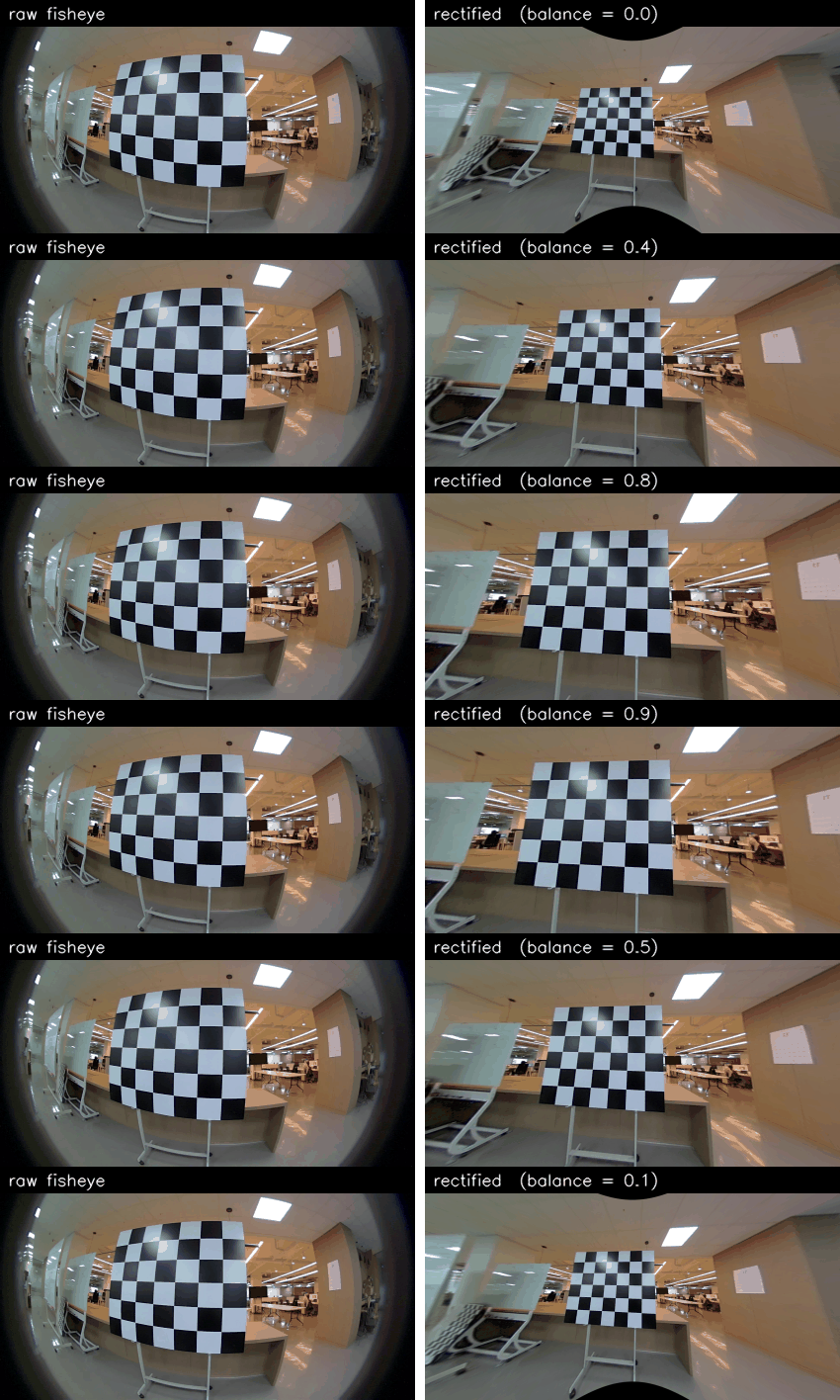
Inverse-projection error across all undistort modes is < 0.00003 px. → Multi-model guide
2D/3D pose
cam.solve_pnp is a model-agnostic convenience, not a new algorithm: it unprojects your pixels through whichever of the 8 models you use, then calls the standard cv2.solvePnP on the undistorted points — literally unproject → cv2.solvePnP(K=I, dist=None). cv2.solvePnP is correct; it only goes wrong if you hand it raw fisheye pixels with a pinhole K (the wrong distortion model). OpenCV already ships cv2.fisheye.solvePnP for Kannala-Brandt lenses — the value here is that the same one call also covers DS / UCM / EUCM / OCam / DS+. For noisy matches, cam.solve_pnp_ransac adds RANSAC outlier rejection and returns an inlier mask. All paths use front-facing (<90°) correspondences — fine for calibration boards; the two-view snippet below works on bearing rays.
from ds_msp import relative_pose, triangulate_rays

# 3D pose from 2D–3D correspondences (PnP), straight on raw fisheye
points_3d = ...   # (N,3) world points (from your board / detector)
points_2d = ...   # (N,2) matching fisheye pixels
ok, rvec, tvec = cam.solve_pnp(points_3d, points_2d)

# noisy matches? RANSAC variant rejects gross outliers + returns an inlier mask
ok, rvec, tvec, inliers = cam.solve_pnp_ransac(points_3d, points_2d)

# 2D–2D → relative pose + triangulated 3D points, on bearing rays
px1 = ...         # (N,2) pixels in image 1
px2 = ...         # (N,2) matching pixels in image 2
f1, _ = cam.unproject(px1)
f2, _ = cam.unproject(px2)
R, t         = relative_pose(f1, f2)           # camera-2 pose relative to camera-1
pts_3d, _, _ = triangulate_rays(f1, f2, R, t)  # (N,3) triangulated points
Measured PnP + reprojection RMS on bundled real images: 0.43 px / 0.85 px. → Two-view geometry
Calibrate from scratch
calibrate() is model-agnostic — the same call fits any of the 8 models from a generic seed; only the seed class changes. It runs manifold Levenberg–Marquardt with analytic Jacobians and an optional robust loss (huber / cauchy); per-view poses are re-seeded internally, so a rough focal is fine.
from ds_msp.calib import calibrate
from ds_msp.models import KannalaBrandtModel        # or DoubleSphereModel, DSPlusModel, EUCMModel, …

# your detected correspondences, per frame (e.g. from cv2 / AprilGrid):
X_world    = ...   # list of (M,3) board points
keypoints  = ...   # list of (M,2) detected pixels
visibility = ...   # list of (M,) bool masks
w, h = 1920, 1080  # image size

seed = KannalaBrandtModel(fx=0.5 * w, fy=0.5 * w, cx=0.5 * w, cy=0.5 * h)   # generic seed
result = calibrate(seed, X_world, keypoints, visibility, loss="huber", f_scale=1.0)
print(result["model"], result["rms_px"])           # calibrated model + reprojection RMS
On the capstone (real TUM-VI fisheye + AprilGrid) this matches the published intrinsics to 0.003% focal at 0.08 px median. → Calibration capstone
Convert between models (no images, no data)
Translate a calibration between any two models with no images and no recalibration: DS-MSP samples the image grid, unprojects through the source model, builds a linear seed for the target, then refines on pixel reprojection. Sub-pixel agreement; design follows Fisheye-Calib-Adapter.
from ds_msp import convert
from ds_msp.models import DoubleSphereModel, KannalaBrandtModel

# convert() takes a model (not a Camera); same DS intrinsics as `cam` above
ds = DoubleSphereModel(fx=711.57, fy=711.24, cx=949.18, cy=518.81, xi=0.183, alpha=0.809)
kb, report = convert(ds, KannalaBrandtModel, width=1920, height=1080)   # DS → OpenCV fisheye
print(report["rms_px"])            # sub-pixel agreement; no images, no recalibration
Multi-camera rig extrinsics (any FOV)
Now shipped in
pip install ds-msp(ds_msp.rig) — validated on a real 8-camera rig and the MC-Calib Blender datasets (extrinsics within ~0.16% of ground truth). Thescripts/calibrate_rig.pyCLI lives in the source tree (clone the repo).
A drop-in for MC-Calib: same calib_param.yml config schema, same output files (calibrated_cameras_data.yml, calibrated_objects_data.yml, …), interoperable both directions. It calibrates the extrinsics (where each camera sits relative to the others) plus per-camera intrinsics from a folder of ChArUco images — and adds one extension: a different camera model per camera, so one bench can mix kb fisheye, radtan pinhole, and dsplus at any FOV.
python scripts/calibrate_rig.py --init-config calib_param.yml   # write a starter config
python scripts/calibrate_rig.py --config calib_param.yml        # detect → reconstruct → bundle-adjust → MC-Calib output
Point it at a camera_parameters YAML to hold intrinsics fixed (fix_intrinsic=1, extrinsics-only) or refine them — or omit it to calibrate from scratch; if the chosen model differs, the same lens is carried into it via convert() + a warning. Detected corners are saved to detected_keypoints_data.yml and reused via keypoints_path, so re-calibrating with different models takes seconds. On the MC-Calib Blender datasets, extrinsics land within 0.16% of ground truth at sub-pixel reprojection, matching MC-Calib's own published per-camera RMS (0.92–1.07×). → Rig guide · Blender evaluation
Stereo depth
Estimate metric depth directly on raw fisheye with a sphere sweep — no rectification to pinhole, so the full wide FOV is kept. Give the reference camera + image and the source views (each as (camera, image, R, t)), sweep a set of inverse-depth planes, and back-project to a point cloud.
from ds_msp.stereo import sphere_sweep, sweep_to_points, inverse_depth_samples

ref_cam, ref_img = cam, ...        # reference camera + its image  (... = your image)
sources = ...                      # list of (camera, image, R, t) for the other posed views
depths  = inverse_depth_samples(near=0.5, far=20.0, n=64)

depth, cost, valid = sphere_sweep(ref_cam, ref_img, sources, depths)
points = sweep_to_points(ref_cam, depth, valid)        # (N,3) metric point cloud
Hardware LDC export
Generate a TI Jacinto LDC displacement-mesh lookup table (J7 / TDA4) directly from a calibrated model:
from ds_msp.ldc import TI_LDC_MeshGenerator

res = TI_LDC_MeshGenerator(cam).generate_mesh_and_intrinsics(1920, 1080, downsample_factor=4, balance=0.5)
mesh_lut, K_new = res["mesh_lut"], res["K_new"]
Choosing a model
All 8 models live behind one CameraModel contract with analytic Jacobians, convert, and Kalibr + MC-Calib I/O.
| model | params | role |
|---|---|---|
radtan |
9 | OpenCV pinhole (Brown-Conrady); mild distortion, not a fisheye model |
kb |
8 | OpenCV fisheye (Kannala-Brandt); dependable baseline, iterative unproject |
ucm |
5 | Unified Camera Model |
eucm |
6 | Enhanced UCM |
ds |
6 | Double Sphere (Usenko 2018); exact >180° half-space validity |
dsplus |
9 | DS+ — best accuracy, closed-form-invertible, differentiable |
eucmplus |
9 | EUCM+ — evaluated and deprecated as a default (see below) |
ocam |
10 | OCamCalib (Scaramuzza) |
Rule of thumb (directional, not a guarantee):
- ≥170° FOV → start with Double Sphere (the cheapest closed form that fits).
- ~120–150° → the spherical family (UCM/EUCM/DS) can collapse at these angles; if it does, use KB, or DS+/EUCM+ when you need a closed-form inverse.
- Always confirm with the median reprojection error, not the model class.
About DS+ and EUCM+:
- DS+ is the best-accuracy model tested and the only closed-form-invertible model that matches KB on hard lenses (~21% win on a demanding 158° full-FOV lens: 0.224 vs KB 0.285 px). The trade-off: its unproject is ~2× slower than KB (Ferrari quartic). Pick it when you need a differentiable / closed-form unproject with deterministic latency — not for raw throughput.
- KB stays the right default when unproject throughput rules and an iterative inverse is acceptable.
- EUCM+ is Pareto-dominated by DS+ at equal parameter count and is deprecated as a default. Use EUCM when 2 distortion DOF suffice; reach for DS+ when they don't.
→ Choosing a model · DS+/EUCM+/KB case study
Verify it
Every claim is backed by a number you can reproduce — 446 tests passing, CI green.
- Inverse projection (all undistort modes): mean error < 0.00003 px.
- 3D reconstruction of checkerboard corners: 1.168 mm mean; recovered 20.01 cm square (target 20.00).
- PnP + reprojection RMS on real test images: 0.43 px / 0.85 px.
- KB / RadTan vs OpenCV: agree to ~1e-13.
- Bundled DS calibration converges to fx≈711.6, fy≈711.2, cx≈949.2, cy≈518.8, xi≈0.183, alpha≈0.809 at 0.64 px RMS.
pytest
bash verify_all.sh
python benchmarks/benchmark.py
Learn
DS-MSP doubles as a runnable curriculum in wide-FOV geometry. Every chapter in docs/learn/ prints a verifiable number — from the projection models through real calibration, model conversion, and the DS+/EUCM+/KB case study (which openly documents a hypothesis the authors had to retract). Start at the Learn index.
Credits
DS-MSP stands on prior work, and credit stays prominent:
- Fisheye-Calib-Adapter — Sangjun Lee, arXiv:2407.12405. The conversion design and model set follow it.
- MC-Calib — Rameau, Park, Bailo, Kweon, CVIU 2022. The rig pipeline follows MC-Calib's design (config schema, result format, workflow); files interoperate both ways. Full credit to the MC-Calib authors.
- Double Sphere — Usenko, Demmel, Cremers, 3DV 2018 (arXiv:1807.08957; basalt-headers).
- Kannala-Brandt (2006), RadTan / Brown-Conrady (1966), OCamCalib (Scaramuzza), EUCM (Khomutenko et al. 2016), UCM (Geyer & Daniilidis / Mei & Rives).
- Kalibr (Furgale et al.), dscamera, and Muhammadjon Boboev (the original Python DS calibration this project grew from).
License
Dual-licensed (see LICENSING.md):
- MIT for the generic library.
- PolyForm-Noncommercial-1.0.0 for the DS+/EUCM+ models and the robust calibration/conversion engine — free for research, academic, and other noncommercial use with attribution to Munna-Manoj; commercial use requires a separate license.
SPDX: MIT AND LicenseRef-PolyForm-Noncommercial-1.0.0. Please cite via CITATION.cff.
Project details
Verified details
These details have been verified by PyPIProject links
GitHub Statistics
Maintainers
Release history Release notifications | RSS feed


Download files
Download the file for your platform. If you're not sure which to choose, learn more about installing packages.
Source Distribution
Built Distribution
Filter files by name, interpreter, ABI, and platform.
If you're not sure about the file name format, learn more about wheel file names.
Copy a direct link to the current filters
File details
Details for the file ds_msp-0.9.0.tar.gz.
File metadata
- Download URL: ds_msp-0.9.0.tar.gz
- Upload date:
- Size: 177.0 kB
- Tags: Source
- Uploaded using Trusted Publishing? Yes
- Uploaded via: twine/6.1.0 CPython/3.13.12
File hashes
| Algorithm | Hash digest | |
|---|---|---|
| SHA256 |
da15c3eba9f18b792ff9b1c6a880c5b099ca00b2131aa79a6e29bc0ca8f6aaa3
|
|
| MD5 |
96ca4259dc3724bf9ca3a235934ad37f
|
|
| BLAKE2b-256 |
c2e19146a03a8b2683a12bd08e7a7a5be3e9364f8fd550ef67f8d1187e76330d
|
Provenance
The following attestation bundles were made for ds_msp-0.9.0.tar.gz:
Publisher:
release.yml on Munna-Manoj/DS-MSP
-
Statement:
-
Statement type:
https://in-toto.io/Statement/v1 -
Predicate type:
https://docs.pypi.org/attestations/publish/v1 -
Subject name:
ds_msp-0.9.0.tar.gz -
Subject digest:
da15c3eba9f18b792ff9b1c6a880c5b099ca00b2131aa79a6e29bc0ca8f6aaa3 - Sigstore transparency entry: 2036693633
- Sigstore integration time:
-
Permalink:
Munna-Manoj/DS-MSP@5e1ad0dd4961530c86b9bdf858ac47c434f7014b -
Branch / Tag:
refs/heads/main - Owner: https://github.com/Munna-Manoj
-
Access:
public
-
Token Issuer:
https://token.actions.githubusercontent.com -
Runner Environment:
github-hosted -
Publication workflow:
release.yml@5e1ad0dd4961530c86b9bdf858ac47c434f7014b -
Trigger Event:
push
-
Statement type:
File details
Details for the file ds_msp-0.9.0-py3-none-any.whl.
File metadata
- Download URL: ds_msp-0.9.0-py3-none-any.whl
- Upload date:
- Size: 210.0 kB
- Tags: Python 3
- Uploaded using Trusted Publishing? Yes
- Uploaded via: twine/6.1.0 CPython/3.13.12
File hashes
| Algorithm | Hash digest | |
|---|---|---|
| SHA256 |
772c608e316c9b94d2e8f4f11ee783a37c261f8eec6d7d4ebcb0a65af526871b
|
|
| MD5 |
edd83d4dd851f88432efbb1d2b3dd545
|
|
| BLAKE2b-256 |
315ca69afc39f6befe62b549d9e1dbdf2a2e659ea67aa1550b1e4fe63b8f0163
|
Provenance
The following attestation bundles were made for ds_msp-0.9.0-py3-none-any.whl:
Publisher:
release.yml on Munna-Manoj/DS-MSP
-
Statement:
-
Statement type:
https://in-toto.io/Statement/v1 -
Predicate type:
https://docs.pypi.org/attestations/publish/v1 -
Subject name:
ds_msp-0.9.0-py3-none-any.whl -
Subject digest:
772c608e316c9b94d2e8f4f11ee783a37c261f8eec6d7d4ebcb0a65af526871b - Sigstore transparency entry: 2036694306
- Sigstore integration time:
-
Permalink:
Munna-Manoj/DS-MSP@5e1ad0dd4961530c86b9bdf858ac47c434f7014b -
Branch / Tag:
refs/heads/main - Owner: https://github.com/Munna-Manoj
-
Access:
public
-
Token Issuer:
https://token.actions.githubusercontent.com -
Runner Environment:
github-hosted -
Publication workflow:
release.yml@5e1ad0dd4961530c86b9bdf858ac47c434f7014b -
Trigger Event:
push
-
Statement type:






