
dworshak-secret is a light-weight library for local credential access. By adding dworshak-secret as a dependency to your Python project, you enable your program or script to leverage secure credentials, typically added with the dworshak-prompt.Obtain().secret() function or managed directly with the dworshak CLI.
All secrets are stored Fernet-encrypted in a SQL database file. No opaque blobs — every entry is meaningful and decryptable via the library.
Example
Typical package inclusion. See below for guidance concerning Termux and iSH Alpine.
uv add "dworshak-secret[crypto]"
from dworshak_secret import DworshakSecret
from dworshak_prompt import Obtain

# Initialize the vault (create key and DB if missing)
client = DworshakSecret()
client.initialize_vault()

# Store and retrieve credentials by prompting the user on their local machine
obtain = Obtain()
username = obtain.secret("rjn_api", "username")
secret = obtain.secret("rjn_api", "password")

# ---

# Alternatively, store secrets with a script ....
## (NOT recommended to keep 'set' calls in your codebase or in system history)
client.set("rjn_api", "username", "davey.davidson")
client.set("rjn_api", "password", "s3cr3t")

## ...and then retrieve credentials in your codebase.
username = client.get("rjn_api", "username")
password = client.get("rjn_api", "password")

# ---

# List stored items
for service, item in client.list_contents():
    print(f"{service}/{item}")
Capture stdout environment variables for bash scripting by using the --emit flag
TESTSET=$(dworshak-secret set "myservice" "myitem" "myvalue" --emit)
echo $TESTSET

TESTGET=$(dworshak-secret get "myservice" "myitem" --emit)
echo $TESTGET
Running dworshak-secret set "myservice" "myitem", without including a value, will prompt the user for input, which will be hidden.
Alternatively, install the dworshak CLI and use:
TESTOBTAIN=$(dworshak prompt obtain secret "myservice" "myitem" --emit)
echo $TESTOBTAIN
This works because the multiplexer will skip the console input and route the user to the web interface or the GUI.
Include Cryptography Library
Here we cover using dworshak-secret as a dependency in your project.
The central question is how to properly include the cryptography package.
On a Termux system, cryptography can (B) be built from source or (A) the precompiled python-cryptography dedicated Termux package can be used.
Termux Installation
A. Use python-cryptography
This is faster but pollutes your local venv with other system site packages.
pkg install python-cryptography
uv venv --system-site-packages
uv add dworshak-secret
B. Allow cryptography to build from source (uv is better at this compared to using pip)
pkg install rust binutils
uv add "dworshak-secret[crypto]"
iSH Alpine installation
apk add py3-cryptography
uv venv --system-site-packages
uv add dworshak-secret
Why Dworshak Over keyring?
Keyring is the go-to for desktop Python apps thanks to native OS backends, but it breaks on Termux because there's no keyring daemon or secure fallback, leaving you with insecure plaintext or install headaches.
Dworshak avoids that entirely with a portable, self-contained Fernet-encrypted SQLite vault that works the same on Linux, macOS, Windows, and Termux on Android tablets.
You get reliable programmatic access via dworshak_secret.DworshakSecret().get() (or dworshak_prompt.Obtain().secret()).
The Dworshak ecosystem is field-ready for real scripting workflows like API pipelines and skip-the-playstore localhost webapps.
When keyring isn't viable, Dworshak just works.
CLI
dworshak is the intended CLI layer, but the dworshak-secret CLI can also be used directly.
pipx install "dworshak-secret[typer,crypto]"
dworshak-secret helptree
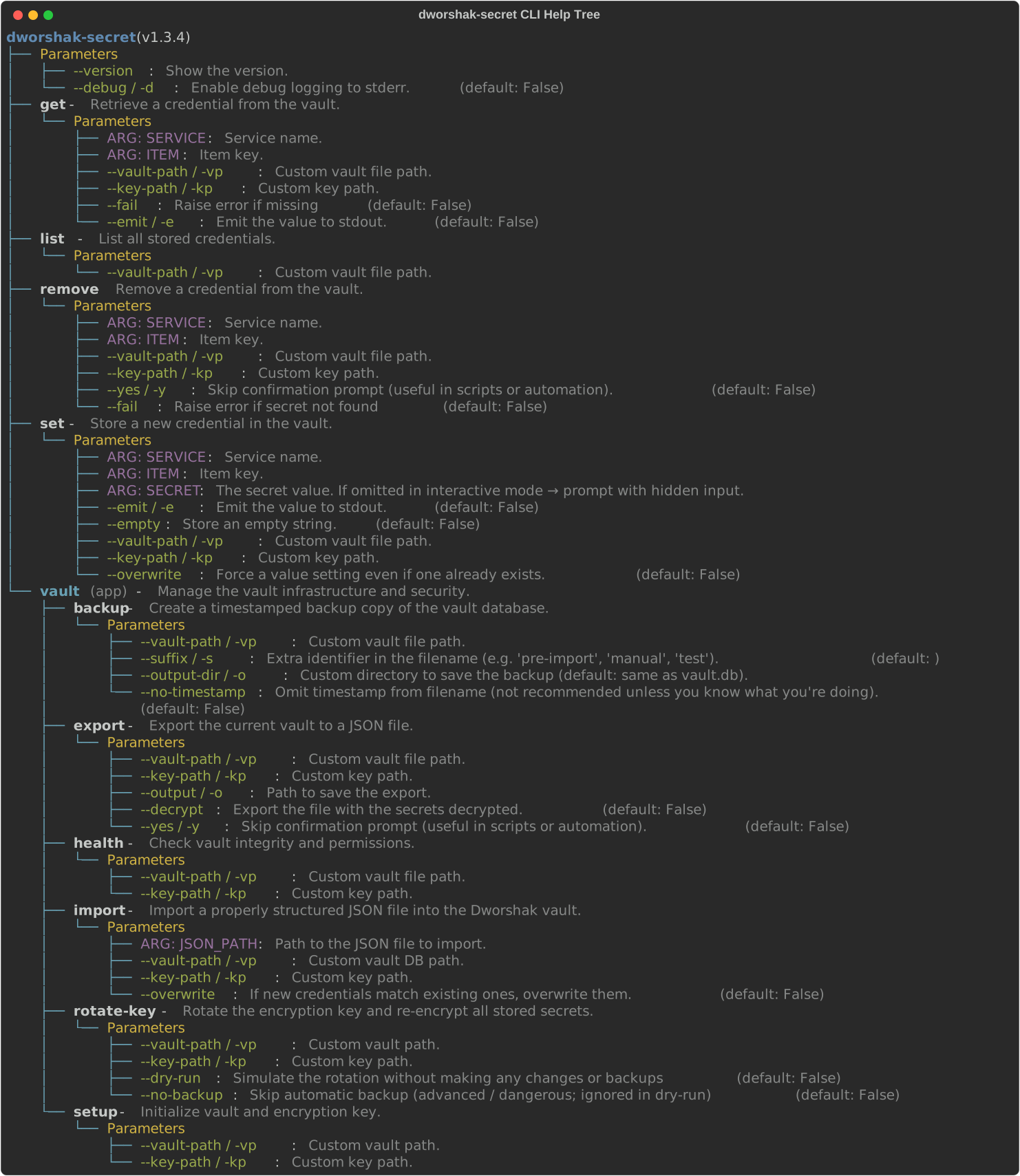
helptree is utility function for Typer CLIs, imported from the typer-helptree library.
- GitHub: https://github.com/City-of-Memphis-Wastewater/typer-helptree
- PyPI: https://pypi.org/project/typer-helptree/
Sister Projects in the Dworshak Ecosystem
- CLI/Orchestrator: dworshak
- Interactive UI: dworshak-prompt
- Secrets Storage: dworshak-secret
- Plaintext Pathed Configs: dworshak-config
- Classic .env Injection: dworshak-env
pipx install dworshak
pip install dworshak-secret
pip install dworshak-config
pip install dworshak-env
pip install dworshak-prompt
1 maintainer

Metadata
1 maintainer
Release files for dworshak-secret 1.3.6
For a detailed explanation of source distributions (sdists) and built distributions (wheels), please see the package formats documentation.
Source distribution (sdist)
| File | Size | Uploaded | |
|---|---|---|---|
| dworshak_secret-1.3.6.tar.gz | 24.7 kB | Details |
Built distribution (wheel)
| File | Interpreter | ABI | Platform | Reset |
|---|---|---|---|---|
| dworshak_secret-1.3.6-py3-none-any.whl | Python 3 | none | any | Details |
Total release size: 51.2 kB
Release files / dworshak_secret-1.3.6.tar.gz
| Download URL | dworshak_secret-1.3.6.tar.gz |
|---|---|
| Size | 24.7 kB |
| Tags | Source |
|
SHA-256 checksum How to use checksums |
d7b58533a9f7de9b0bb1c459183cd6ac125f71e186debf3c64ad6dcab29712c0
|
|
BLAKE2b-256 checksum How to use checksums |
ddcac285c023cceadc3349ebc8405bce5a484bdbc09aff411db813ef74fc45fa
|
| Upload date | |
|
Uploaded using Trusted Publishing? What is trusted publishing? |
Yes |
| Uploaded via |
twine/6.1.0 CPython/3.13.12
|
Provenance
Provenance describes where a file came from. On PyPI, provenance is shared via attestations, which provide a verifiable record of the build or publishing details. View details, limitations and caveats.


PyPI Publish Attestation
PyPI verified that this artifact, at this checksum, originated from the publisher listed below.
Signed by GitHub Actions, verified by PyPI on Jul 7, 2026.
Transparency logRelease files / dworshak_secret-1.3.6-py3-none-any.whl
| Download URL | dworshak_secret-1.3.6-py3-none-any.whl |
|---|---|
| Size | 26.5 kB |
| Tags | Python 3 |
|
SHA-256 checksum How to use checksums |
c9422cdf11dc6f5474f674a14825c0cbecb05912bac17a1fb5541c635c3d3060
|
|
BLAKE2b-256 checksum How to use checksums |
1c185425409fc9744912a0f238742a5f267d4dde2e0ce2b97a21e71b7dac30d8
|
| Upload date | |
|
Uploaded using Trusted Publishing? What is trusted publishing? |
Yes |
| Uploaded via |
twine/6.1.0 CPython/3.13.12
|
Provenance
Provenance describes where a file came from. On PyPI, provenance is shared via attestations, which provide a verifiable record of the build or publishing details. View details, limitations and caveats.
PyPI Publish Attestation
PyPI verified that this artifact, at this checksum, originated from the publisher listed below.
Signed by GitHub Actions, verified by PyPI on Jul 7, 2026.
Transparency log













