
NVIDIA Earth2Studio


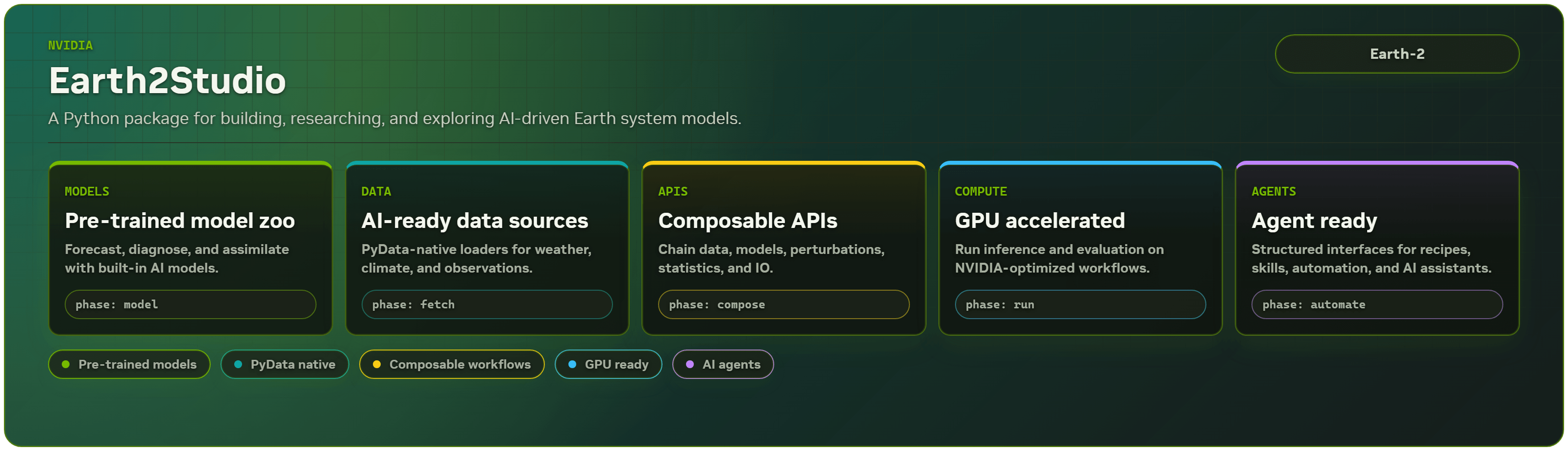
Earth2Studio is a Python-based package designed to get users up and running with AI Earth system models fast. Our mission is to enable everyone to build, research and explore AI driven weather and climate science.
- Earth2Studio Documentation -
Install | User-Guide | Examples | API
Quick start
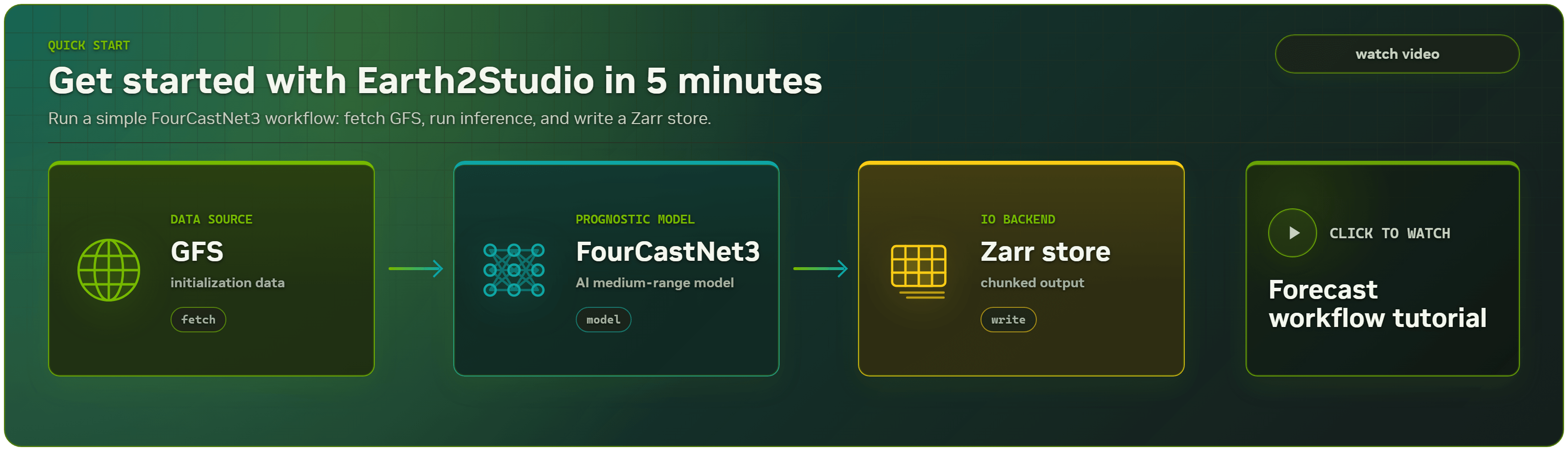
Running AI weather prediction can be done with just a few lines of code.
- For detailed installation steps, including model-specific installations, see the install guide.
- See the examples gallery providing different inference workflow samples.
- Swap out data sources or models depending on your use case!
Tutorial
Agent-assisted setup
Automate setup with your preferred coding agent using NVIDIA Earth2Studio skills. Install the Earth2Studio skill set, then ask your favorite agent (Claude, Codex, OpenCode, etc) to recommend a model, configure an environment, or run a first deterministic forecast. Find more Earth2Studio skills in the NVIDIA Skills catalog.
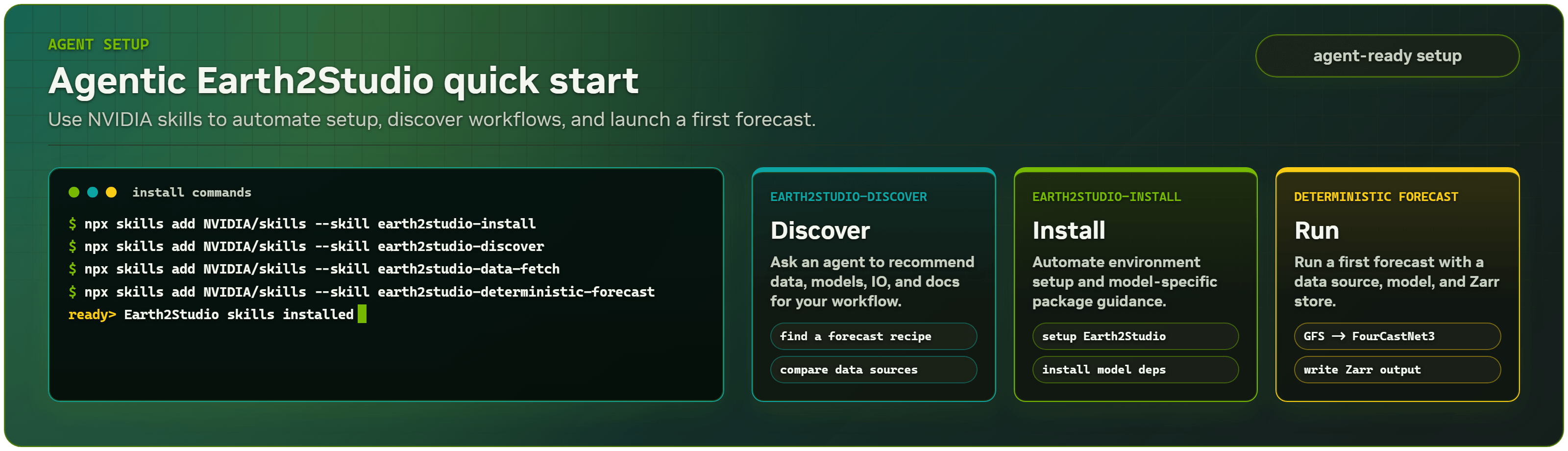
npx skills add NVIDIA/skills --skill earth2studio-install
npx skills add NVIDIA/skills --skill earth2studio-discover
npx skills add NVIDIA/skills --skill earth2studio-data-fetch
npx skills add NVIDIA/skills --skill earth2studio-deterministic-forecast
Example agent prompts:
Use the Earth2Studio discover skill to recommend a starter forecast workflow.
Use the Earth2Studio install skill to set up my environment for FourCastNet3 inference.
Create a script to fetch ERA5 surface winds data for March 2024.
Create a deterministic forecast workflow with GFS, FourCastNet3, and a Zarr output store.
NVIDIA FourCastNet3
from earth2studio.models.px import FCN3
from earth2studio.data import GFS
from earth2studio.io import ZarrBackend
from earth2studio.run import deterministic as run

model = FCN3.load_model(FCN3.load_default_package())
data = GFS()
io = ZarrBackend("outputs/fcn3_forecast.zarr")
run(["2025-01-01T00:00:00"], 10, model, data, io)
ECMWF AIFS
from earth2studio.models.px import AIFS
from earth2studio.data import IFS
from earth2studio.io import ZarrBackend
from earth2studio.run import deterministic as run

model = AIFS.load_model(AIFS.load_default_package())
data = IFS()
io = ZarrBackend("outputs/aifs_forecast.zarr")
run(["2025-01-01T00:00:00"], 10, model, data, io)
Google Graphcast
from earth2studio.models.px import GraphCastOperational
from earth2studio.data import GFS
from earth2studio.io import ZarrBackend
from earth2studio.run import deterministic as run

package = GraphCastOperational.load_default_package()
model = GraphCastOperational.load_model(package)
data = GFS()
io = ZarrBackend("outputs/graphcast_operational_forecast.zarr")
run(["2025-01-01T00:00:00"], 4, model, data, io)
Latest News
- WeatherNext 2 Cyclones, operational and Mini prognostic model wrappers.
- CAMulator, NSF NCAR CAM6 climate emulator with prescribed forcing data and conservation fixers.
- FuXi-S2S, global daily prognostic model for subseasonal-to-seasonal forecasting.
- CorrDiff ERA5-HRRR, generative downscaling from ERA5 to HRRR over the contiguous United States.
For a complete list of latest features and improvements see the changelog.
Overview
Earth2Studio is an AI inference pipeline toolkit focused on weather and climate applications that is designed to ride on top of different AI frameworks, model architectures, data sources and SciML tooling while providing a unified API.
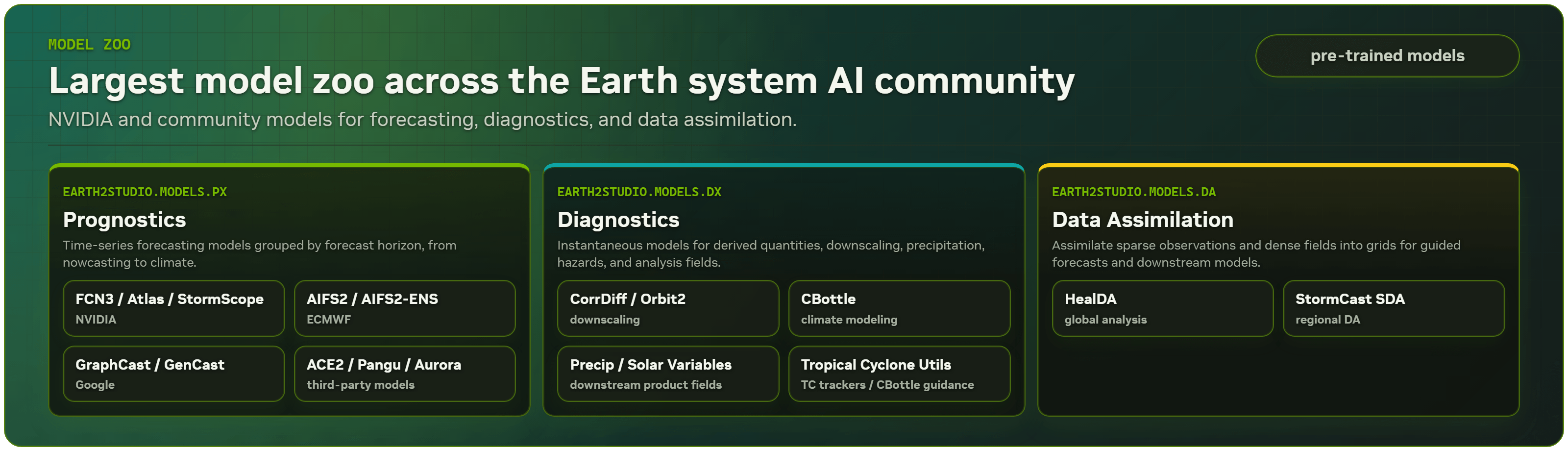
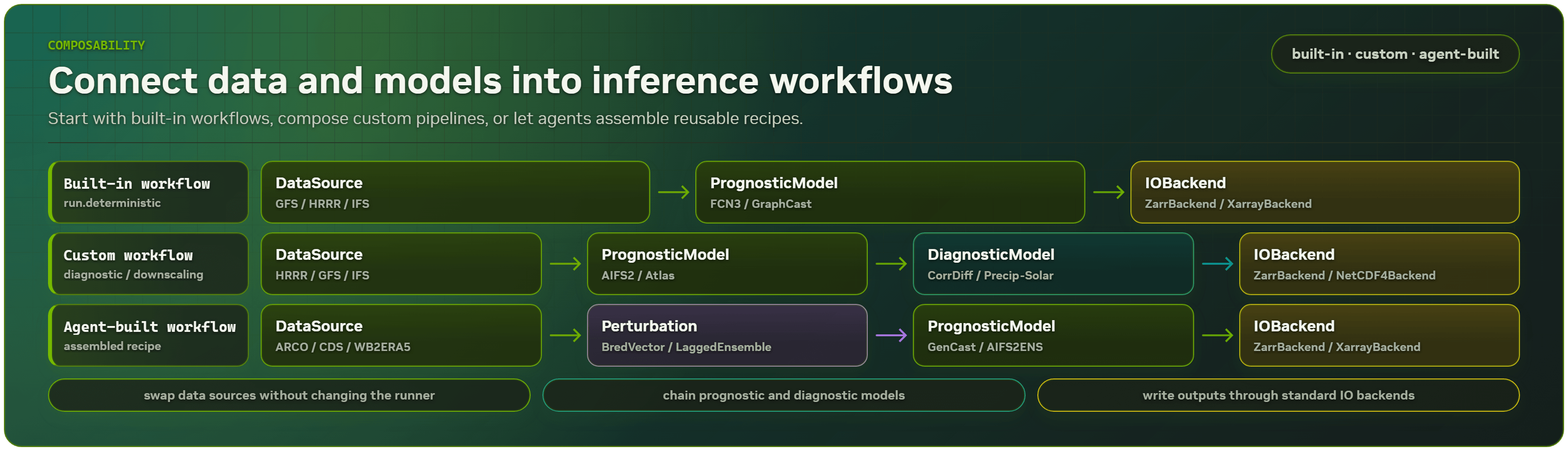
The composability of the different core components in Earth2Studio easily allows the development and deployment of increasingly complex pipelines that may chain multiple data sources, AI models and other modules together.
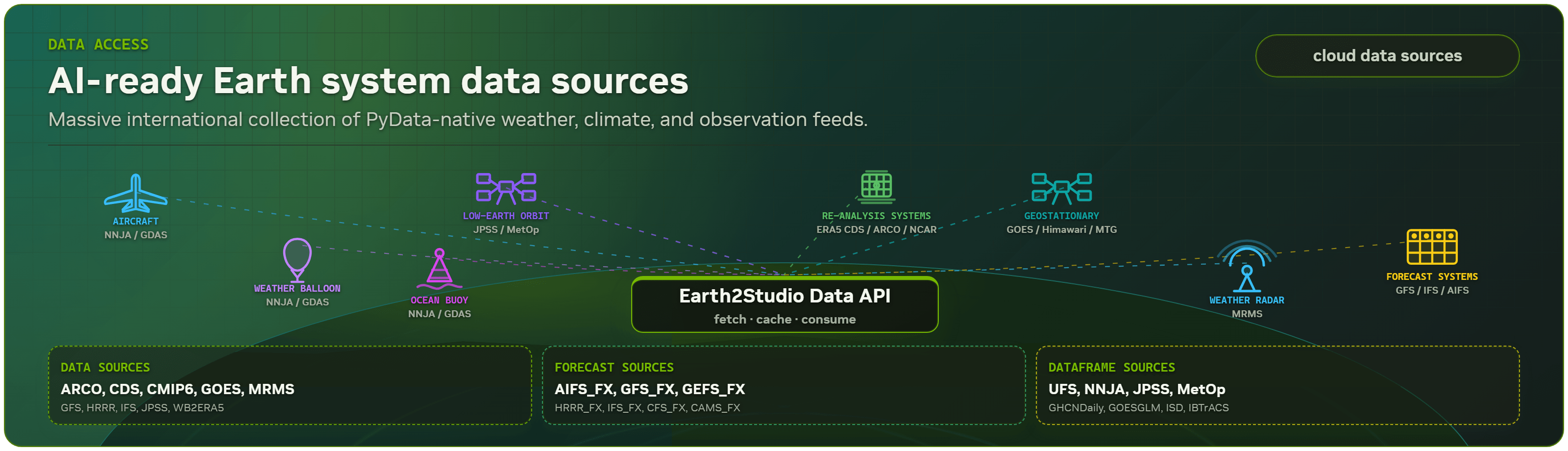
The unified ecosystem of Earth2Studio provides users the opportunity to rapidly swap out components for alternatives. In addition to the largest model zoo of weather/climate AI models, Earth2Studio is packed with useful functionality such as optimized data access to cloud data stores, statistical operations and more to accelerate your pipelines.
Earth-2 Open Models
Access state of the art Nvidia open models for climate and weather: Earth-2 Open Models. For training recipes for these models, see the PhysicsNeMo repository.
Contributors
Check out the contributing document for details about the technical requirements and the user guide for higher level philosophy, structure, and design.
License
Earth2Studio is provided under the Apache License 2.0, refer to the LICENSE file for full license text.
Metadata
Release files for earth2studio 0.20.0
For a detailed explanation of source distributions (sdists) and built distributions (wheels), please see the package formats documentation.
Source distribution (sdist)
| File | Size | Uploaded | Provenance | Actions |
|---|---|---|---|---|
| earth2studio-0.20.0.tar.gz | 991.7 kB | Without provenance | Details for earth2studio-0.20.0.tar.gz |
Built distribution (wheel)
| File | Interpreter | ABI | Platform | Actions Reset |
|---|---|---|---|---|
| earth2studio-0.20.0-py3-none-any.whl | Python 3 | none | any | Details for earth2studio-0.20.0-py3-none-any.whl |
Total release size: 2.3 MB
Release files / earth2studio-0.20.0.tar.gz
| Download URL | earth2studio-0.20.0.tar.gz |
|---|---|
| Size | 991.7 kB |
| Tags | Source |
|
SHA-256 checksum How to use checksums |
15646c6668f56bf28ffad81c1cea11c0961e379cd2cd831bc60403e464075460
|
|
BLAKE2b-256 checksum How to use checksums |
5b9b517b5e9f85e4ca6704f861153e0179f51ba942a15994b1cd7b6e30accb6f
|
| Upload date | |
|
Uploaded using Trusted Publishing? What is trusted publishing? |
No |
| Uploaded via |
twine/7.0.0 CPython/3.14.8
|
Release files / earth2studio-0.20.0-py3-none-any.whl
| Download URL | earth2studio-0.20.0-py3-none-any.whl |
|---|---|
| Size | 1.3 MB |
| Tags | Python 3 |
|
SHA-256 checksum How to use checksums |
4f72d2bfeb25fd0641dbaad7d536e57ea788031a9be036d909a8560369edec06
|
|
BLAKE2b-256 checksum How to use checksums |
77111b2d47e1efb2c770bdc9851b463ad4245ef4a4240841faa0e7ca63b037e7
|
| Upload date | |
|
Uploaded using Trusted Publishing? What is trusted publishing? |
No |
| Uploaded via |
twine/7.0.0 CPython/3.14.8
|
Security for earth2studio 0.20.0
Provenance
Provenance describes where a file came from. On PyPI, provenance is shared via attestations, which provide a verifiable record of the build or publishing details. View details, limitations and caveats.
No provenance found
None of the files in this release were uploaded with provenance metadata.
A note on package security
PyPI is a repository for distributing packages, not a service for auditing them. While third-party security researchers and our staff do their best to detect and remove malicious packages, PyPI cannot guarantee the quality, security or suitability of any given package.
To learn more about protecting yourself from malicious actors, visit our package security documentation.














