
🎙️ EchoAI Helper


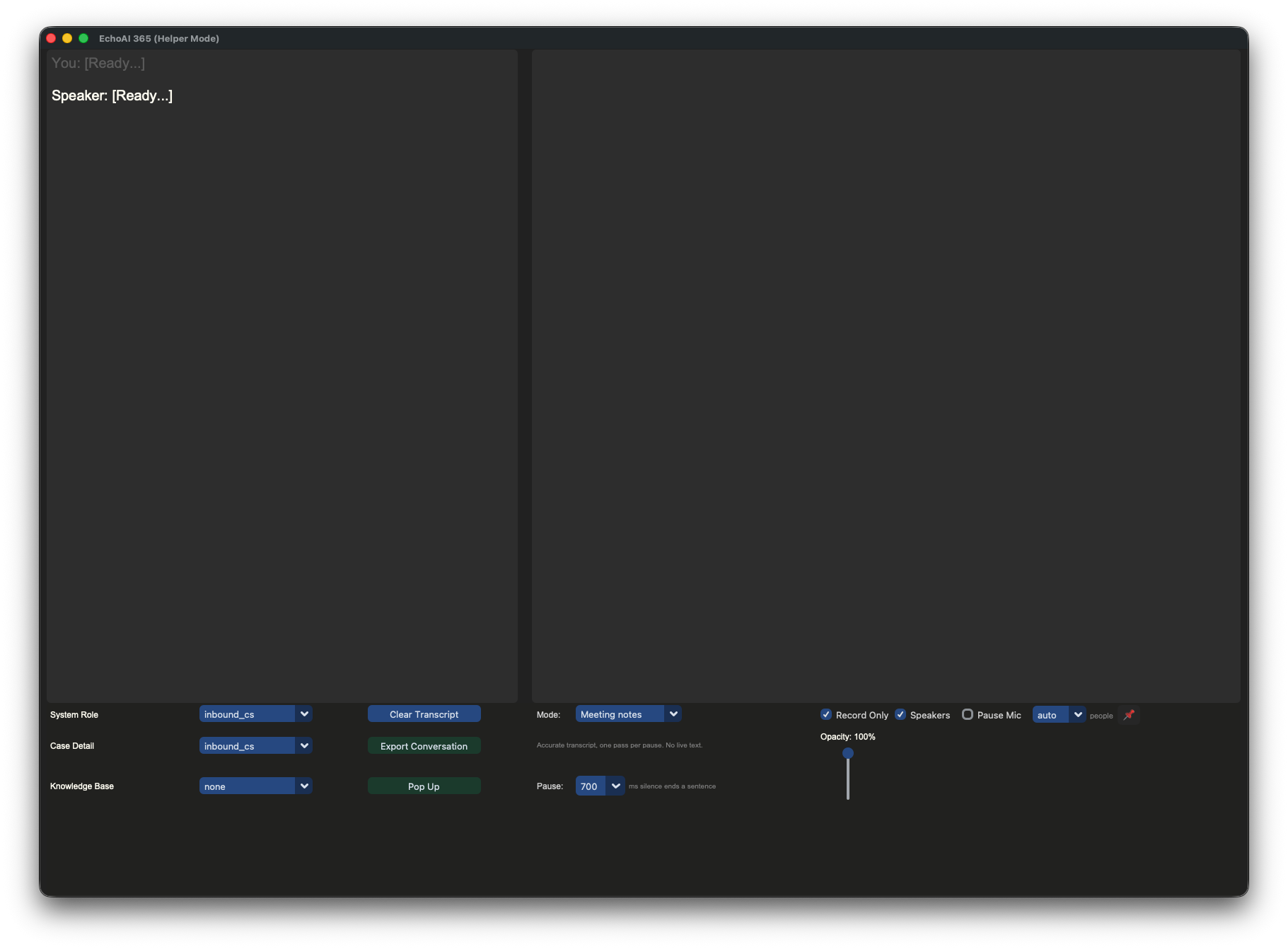
Real-time meeting transcription and interview assistance, running on your own machine. It records both sides of a conversation — your microphone and whatever the meeting app is playing — transcribes them as they happen, labels who is speaking, and exports readable notes.
Speech recognition is local. Audio never leaves the machine unless you ask a language model to clean up the finished transcript.

✨ What it does
- Local speech recognition — FunASR / SenseVoice, on-device, GPU-accelerated where one is available (Metal on Apple Silicon, CUDA on Windows)
- Automatic language detection — Mandarin, Cantonese, English, Japanese and Korean, switching per utterance, including mid-sentence code-switching
- Both sides of the call — your microphone and the far end, on separate tracks
- Speaker labelling — voices on the far-end track are told apart, with the number of people configurable when you know it
- Pause-based segmentation — sentences are cut where people actually pause, not on a fixed timer, so the model sees whole utterances
- Crash-safe recording — every settled sentence is written to disk as it is produced; a crash costs the last line, not the meeting
- LLM cleanup on export — an optional pass that fixes mis-heard words using the surrounding conversation, through an API key or through a coding-agent CLI on a subscription you already pay for
- Markdown and JSON export — Markdown to read, JSON as a complete record
- Noise kept out of the transcript — room noise that reaches the model comes back as a bare "."; 169 of 1312 lines in one real meeting, now dropped
- Pause your own track — muting yourself in the meeting app does not reach this one, and pausing roughly halves the model's work
- Recovers a lost microphone — a Bluetooth headset that drops out is detected and capture is rebuilt, rather than silently recording nothing
- Live reply suggestions — for interviews, where a prompt is wanted while the other person is still talking
💡 Two modes
| Meeting notes | Live interview | |
|---|---|---|
| Text appears | at each pause | as you speak (~0.6s) |
| Model calls | one per sentence | roughly three times as many |
| Best for | an accurate record | a prompt you can act on |
Switch in the app; the several settings that differ move together.
🎬 Demo
https://github.com/user-attachments/assets/0d627e4a-960b-4628-8bbc-8d892f02cfd1
⚡ Install
macOS
uv tool install echoai-helper     # uv brings its own Python 3.12
echoai-helper setup               # audio routing — one password prompt
echoai-helper install-launcher    # adds an icon to Launchpad
Launch from Launchpad, or run echoai-helper.
Apple Silicon. Transcription runs on Metal and keeps up comfortably. Intel Macs install and run, but see known limitations — there is no Metal path, so they fall back to the CPU.
setup installs a virtual audio device and builds the Multi-Output that lets
you hear a meeting while it is being recorded. macOS asks for a password once,
because that installs an audio driver — nothing else needs a privilege, and
Audio MIDI Setup is not involved.
The app takes the audio output while it runs and gives it back silently when it
quits, including after a crash. echoai-helper setup --restore does it by hand;
--status shows what routing is in place.
Prefer Homebrew?
A formula is in packaging/ for a tap. Homebrew
can declare the virtual audio device as a dependency, which removes the one step
that needs a password.
Windows
uv tool install echoai-helper
echoai-helper
No audio setup step: Windows exposes WASAPI loopback directly, so the far end of
a call is capturable without a virtual device. The macOS-only commands (setup,
install-launcher) report that there is nothing to do. See
known limitations — this path has not been re-tested since
the segmentation rework.
What has actually been tested
Stated precisely, because "should work" and "has been run" are different claims and the difference matters when you are deciding whether to install it.
| Install | Live meeting | Notes | |
|---|---|---|---|
| M4 Mac mini, 16GB, macOS 26.3, Python 3.12 | ✅ | ✅ | The development machine. Every measurement in this README comes from it. |
| Other Apple Silicon (M1–M3) | — | — | Same wheels, same Metal path. Expected to work; not run. |
| Intel Mac | ✅ resolves | ❌ | Installs — uv falls back to torch 2.2.2 — but no Metal, so CPU only. See known limitations. |
| Windows 10/11 | ✅ resolves | ❌ | Dependencies resolve. The capture path has not been run since the segmentation rework. |
"Live meeting" means real calls, in Mandarin, Cantonese and English, with the transcript exported afterwards — not a smoke test. The longest was 84 minutes and 1311 lines.
The Mac mini has no built-in microphone, so the microphone track has only been exercised through a Bluetooth headset and a wired input. Disconnecting and reconnecting that headset mid-recording is tested, because that is how the microphone was found to die silently in the first place.
If you run it somewhere not on this list, an issue saying so — working or not — is genuinely useful.
First run
Speech models (~1.5GB) download on first launch. Nothing else is needed.
Why Python 3.12 specifically
Not caution. The vendored src/custom_speech_recognition imports aifc and
audioop at module level, and both were removed from the standard library in
Python 3.13. uv installs a suitable interpreter itself, and its 3.12 build
ships tkinter, so there is no separate Tk step.
🎯 Using it
- Open the app. If audio routing is not in place, it offers to finish it.
- Pick a mode, and set the number of people if you know it.
- Hold your meeting. Nothing needs touching — though Pause Mic is there for the stretches you are muted anyway, and it roughly halves the model's work.
- Export — one dialog covers format, cleanup, which model to clean with, and merging over-split speakers.
Cleanup runs in the background with a progress bar and an estimate, and can be stopped: whatever finished is kept.
Choosing a cleanup backend
| Cost | Speed (measured) | |
|---|---|---|
API (conf.yaml) |
per token | 5–8s per batch of lines |
| Claude CLI | included in a subscription | 20–50s per batch |
Both are offered at export, and the dialog turns the per-batch figure into an estimate for the transcript in hand. The live reply suggestions always use the configured API — a CLI takes seconds per answer, which is too late to be useful while someone is still talking.
Past recordings
echoai-helper sessions              # list them
echoai-helper sessions --export 0   # export one again
echoai-helper sessions --delete 0
Re-exporting is the point: a different format, another pass of cleanup, a different number of speakers, without re-recording anything. An unfinished session from the last 12 hours is offered on the next launch.
⚙️ Configuration
Model settings live in conf.yaml; everything else is in the app. Installed
from a wheel the shipped copy sits inside the package, so make yourself an
editable one:
echoai-helper config # writes conf.yaml where you can reach it, and prints the path
That copy overrides the defaults. You will not usually need it — both values
below already ship as auto.
FunASR:
  model_name: "iic/SenseVoiceSmall"
  device: "auto"        # cuda, then mps, then cpu
  language: "auto"      # zh, en, yue, ja, ko

LLM:
  provider: "openai"    # openai | litellm | cli
Both auto values are load-bearing rather than lazy defaults:
device: "auto"— measured on an M4, dual-track real-time factor is 2.04 on cpu (falling behind twice over) against 0.35 on Metal. Landing on cpu by accident means transcription that cannot keep up. Naming a device explicitly is also wrong on every machine that does not have it, and this file travels.language: "auto"— pinning a language does not bias the model, it forces the syllables onto words of that language. A Cantonese call transcribed withlanguage: "en"comes back as fluent nonsense.
An OpenAI key goes in .env (see .env.example), or in a file called .llm
holding nothing else. Both are gitignored.
🔍 Troubleshooting
echoai-helper check-audio           # what is being captured, and from where
echoai-helper setup --status        # what routing is in place
Nothing from the far end (macOS). The meeting app has its own audio settings
and remembers them. Set its speaker to EchoAI Meeting.
Nothing from the microphone over Bluetooth. A Bluetooth headset can only send its microphone to one device; if it is on a phone call, the Mac gets silence. This now recovers on its own: the app notices within about five seconds that the device has stopped delivering, waits without touching anything while no microphone is available, and rebuilds capture as soon as one is. You will see it in the log:
[WARN] You: no audio for 31s — the device is gone. Rebuilding capture.
[INFO] You: capture restored on 'Your Headset'
You are muted in the meeting but still being transcribed. Expected — muting in Zoom or WeChat silences your outgoing audio, not this app's own input stream. Use Pause Mic. It resets to off every launch, deliberately: a pause that survived a restart would look like recording and not be.
More speakers than people. Voice prints drift with volume and connection quality, so one person can end up split across several labels. Set the number of people before the meeting, or merge them at export — the export carries the voice prints, so this works after the fact.
🛠️ Development
git clone https://github.com/colakang/echoai_helper.git
cd echoai_helper
uv venv --python 3.12 .venv
uv pip install --python .venv/bin/python -e .
.venv/bin/python -m pytest tests/ -q
.venv/bin/python main.py            # run from the checkout
docs/macos-audio-setup.md covers the audio
routing, what has been measured, and where the sharp edges are.
📝 Known limitations
- Recovering the microphone interrupts the meeting audio for ~0.4s. When a device dies, PortAudio can only be recovered by restarting it, which invalidates every open stream — so the far-end track is rebuilt too, whether or not anything was wrong with it. Measured at 378ms. It buys back a microphone track that would otherwise be dead for the rest of the call.
- Speaker labelling is tuned against a clean two-party recording and over-splits on group calls over a lossy connection. Merging at export is the workaround, not the cure.
- The Windows capture path is untested since the segmentation rework. Its detector threshold was lowered to pass silence through, because segmentation now happens on pauses and a recogniser that only reports speech never delivers them — reasoned, not verified. Reports welcome.
- Intel Macs fall back to the CPU. PyTorch has shipped no Intel-Mac build
since 2.2.2, and there is no Metal path on Intel regardless;
uvresolves to that older torch and installs cleanly. But an M4 already measures a dual-track real-time factor of 2.04 on CPU — falling behind twice over — and an Intel CPU is slower again. Expect transcription not to keep up with a live meeting. Untested: reasoned from the wheel availability and the CPU measurement. - macOS audio routing is a shared setting. Selecting the Multi-Output changes the output for every app, and macOS sometimes moves it back after sleep. Checked at every launch.
🤝 Contributing
Pull requests welcome; for anything substantial, open an issue first. See CONTRIBUTING.md.
🙌 Credits
- FunASR — speech recognition and speaker embeddings
- silero-vad — voice activity detection
- WhisperLiveKit — the LocalAgreement idea behind stable partial transcripts
- BlackHole — virtual audio device on macOS
- CustomTkinter — interface
- Ecoute — the original inspiration
- @zixing0131 — core audio processing
📞 Contact
📄 License
MIT — see LICENSE.
1 maintainer

Download files
Download the file for your platform. If you're not sure which to choose, learn more about installing packages.
Source Distribution
Built Distribution
Filter files by name, interpreter, ABI, and platform.
If you're not sure about the file name format, learn more about wheel file names.
Copy a direct link to the current filters
File details
Details for the file echoai_helper-1.3.2.tar.gz.
File metadata
- Download URL: echoai_helper-1.3.2.tar.gz
- Upload date:
- Size: 2.4 MB
- Tags: Source
- Uploaded using Trusted Publishing? No
- Uploaded via:
uv/0.10.8 {"installer":{"name":"uv","version":"0.10.8","subcommand":["publish"]},"python":null,"implementation":{"name":null,"version":null},"distro":{"name":"macOS","version":null,"id":null,"libc":null},"system":{"name":null,"release":null},"cpu":null,"openssl_version":null,"setuptools_version":null,"rustc_version":null,"ci":null}
File hashes
| Algorithm | Hash digest | |
|---|---|---|
| SHA256 |
424eb1bfdf0c1852d1f422eaa8e9fb6973554d0918d1681b08717a9afd1a0322
|
|
| MD5 |
79f2ba6ef5c06ae3101436141eff2ad6
|
|
| BLAKE2b-256 |
260c752981f392aee481c4cb3134fa0074fc1e93bb4afb6de6a7ee6e31c2da75
|
File details
Details for the file echoai_helper-1.3.2-py3-none-any.whl.
File metadata
- Download URL: echoai_helper-1.3.2-py3-none-any.whl
- Upload date:
- Size: 2.4 MB
- Tags: Python 3
- Uploaded using Trusted Publishing? No
- Uploaded via:
uv/0.10.8 {"installer":{"name":"uv","version":"0.10.8","subcommand":["publish"]},"python":null,"implementation":{"name":null,"version":null},"distro":{"name":"macOS","version":null,"id":null,"libc":null},"system":{"name":null,"release":null},"cpu":null,"openssl_version":null,"setuptools_version":null,"rustc_version":null,"ci":null}
File hashes
| Algorithm | Hash digest | |
|---|---|---|
| SHA256 |
4f5b3a7d3928631efa49e622eacf7a65c19edd98e1aa7bc42370f07677fc0d80
|
|
| MD5 |
c290aed8a7a14793f3c3dd47c6349e0c
|
|
| BLAKE2b-256 |
2da96b70875e6843d8360fd98e742ef0f7d182c6763a7393133870a83de25e41
|














