
A library and CLI tool for analyzing SEC EDGAR filings with financial metrics and forecasting.
Verified details
These details have been verified by PyPIProject links
GitHub Statistics
Maintainers

Project description
EDGAR Analytics





Analyze SEC EDGAR filings in seconds. Retrieve 10-K and 10-Q financial statements, compute 25+ GAAP/IFRS metrics, forecast revenue with ARIMA/SARIMAX, and get actionable alerts — all from a single CLI command or Python import.
pip install edgar-analytics
edgar-analytics AAPL MSFT GOOGL --csv report.csv
Table of Contents
- Overview
- Features
- Installation
- Quick Start
- Usage
- Core Modules
- Detailed Method Reference
- Logging & Debugging
- Extensibility
- Testing
- Contributing
- Star History
- License
Overview
EDGAR Analytics is a Python library designed to:
- Retrieve and parse financial statements from the SEC's EDGAR system (via edgartools).
- Compute key financial metrics (including GAAP, IFRS, intangible, goodwill, net debt, etc.).
- Optionally forecast revenue using a strategy-based architecture (ARIMA by default).
- Summarize results with rich, colorized console output and optional CSV exports.
It handles complexities such as:
- Multi-year and multi-quarter filing retrieval (10-K and 10-Q).
- Flexible synonyms to accommodate IFRS/GAAP labeling differences.
- Automatic sign-flipping of negative expenses.
- Common ratio calculations (Current Ratio, Debt-to-Equity, Free Cash Flow, etc.).
- Alert detection for negative margins, high leverage, negative free cash flow streaks, spikes in working capital.
- Strategy-based forecasting with a default ARIMA approach or customizable forecasting strategy.
- A fully scriptable CLI with rich console output.
IFRS & GAAP Filers
Supports both U.S. GAAP and IFRS filers. Foreign private issuers that file IFRS-based statements (e.g., Form 20-F) are automatically handled if synonyms match IFRS-labeled line items.
Features
- Annual & Quarterly Snapshots: Retrieve the latest 10-K (annual) and 10-Q (quarterly) metrics for a given company.
- Multi-Year Analysis: Pull multiple 10-K and 10-Q statements to compute YoY growth, QoQ growth, and CAGR.
- Key Ratios & Metrics: Current Ratio, Debt-to-Equity, Free Cash Flow, margins, intangible ratios, net debt, lease liabilities, and more.
- Alerts:
- Negative net margin
- High leverage (debt-to-equity above threshold)
- Consecutive quarters of negative free cash flow
- Significant quarterly spikes in inventory/receivables
- Revenue Forecasting:
- By default, uses an ARIMA-based strategy for annual or quarterly data.
- Easily swap in your own forecasting logic by implementing a custom strategy (see Extensibility).
- Command-Line Interface (CLI):
- Analyze one or more tickers with a single command
- Rich, colorized console output
- Configurable logging levels and output formats
- Optional forecast disabling for faster analysis
- Comprehensive Logging:
- Colorized console output with configurable verbosity
- Structured JSON logs for debugging and analysis
- Optional CSV Output: Save summarized metrics to CSV.
Installation
You can install EDGAR Analytics using pip or set it up within a local virtual environment for development.
Using pip
pip install edgar-analytics
Setting Up a Local Virtual Environment
-
Create a Virtual Environment
python3 -m venv venv
source ./venv/bin/activate   # or venv\Scripts\activate on Windows
pip install --upgrade pip setuptools wheel
-
Install in Editable Mode (for contributing)
pip install -e ".[test]"
Make sure you're in the repo's root directory (where
setup.pyis located).
Quick Start
Once installed, analyze a company via the CLI:
edgar-analytics AAPL --csv my_report.csv
This command:
- Fetches Apple's latest annual (10-K) and quarterly (10-Q) metrics.
- Retrieves multi-year data for deeper analysis (CAGR, YoY growth, etc.).
- Automatically forecasts next annual and quarterly revenue using the default ARIMA strategy.
- Logs everything to the console with rich, colorized output and saves a CSV summary to
my_report.csv.
Usage
CLI Usage
Use the edgar-analytics command with various options to customize your analysis:
edgar-analytics TICKER [PEER1 PEER2...] [OPTIONS]
Options:
--csv PATH: Save results to a CSV file--years N: Number of years of 10-K data to retrieve (default: 3)--quarters N: Number of quarters of 10-Q data to retrieve (default: 10)--log-level LEVEL: Set console logging level (DEBUG/INFO/WARNING/ERROR/CRITICAL)--debug: Enable debug mode (shortcut for --log-level DEBUG)--disable-forecast: Skip revenue forecasting to speed up analysis--identity NAME <EMAIL>: Override default EDGAR identity for SEC compliance--suppress-logs: Show only final summary panels for cleaner output
The console output is colorized using Rich, making it easy to read and navigate results.
Examples:
-
Basic Analysis
edgar-analytics AAPLAnalyzes AAPL with default settings (3 years, 10 quarters).
-
Extended Historical Data
edgar-analytics AAPL --years 5 --quarters 12
Retrieves 5 years of annual data and 12 quarters of quarterly data.
-
Multiple Companies with Debug Output
edgar-analytics AAPL MSFT GOOGL --debug --csv results.csv
Analyzes multiple companies with full debug logging and CSV output.
-
Fast Analysis (No Forecasting)
edgar-analytics AAPL --disable-forecast --suppress-logs
Quick analysis without forecasting and minimal console output.
Programmatic Usage
You can also use the library in your own Python scripts. For example:
from edgar_analytics.orchestrator import TickerOrchestrator

def main():
    orchestrator = TickerOrchestrator()
    orchestrator.analyze_company(
        ticker="AAPL",
        peers=["MSFT", "GOOGL"],
        csv_path="analysis_outputs/summary.csv",
        n_years=5,                # Optional: override default of 3 years
        n_quarters=8,             # Optional: override default of 10 quarters
        disable_forecast=False,    # Optional: skip forecasting if True
        identity="Name <email>"   # Optional: override default SEC identity
    )

if __name__ == "__main__":
    main()
Key Steps (inside analyze_company):
- Validates the ticker symbol (e.g.,
AAPL). - Fetches annual (10-K) and quarterly (10-Q) snapshots.
- Retrieves multi-year data, computing YoY, CAGR, etc.
- Forecasts annual & quarterly revenue using the default ARIMA strategy (or a custom strategy if configured).
- Summarizes everything in rich console output and optional CSV.
Check out the example scripts in examples to learn more.
Core Modules
-
metrics.py
Computes financial metrics (Revenue, Net Income, margins, ROE, Free Cash Flow, IFRS expansions, interest coverage, etc.). -
forecasting.py
Provides a strategy-based system for revenue forecasting.ArimaForecastStrategy: Uses ARIMA or SARIMAX if enough data is available.forecast_revenue(): A convenience function that calls the chosen strategy.
-
multi_period_analysis.py
Gathers multi-year or multi-quarter data, computing growth rates (YoY, QoQ) and CAGR. -
orchestrator.py
High-level orchestration (TickerOrchestrator) to fetch EDGAR data, compute metrics, run multi-year analysis, forecast, and produce final outputs. -
reporting.py
Summarizes results in a DataFrame, renders rich console output, and optionally saves to CSV. -
logging_utils.pyConfigures dual logging system with rich console output and structured JSON logs. -
data_utils.py,synonyms_utils.py,synonyms.py,config.py- Helpers for data parsing, synonyms, numeric formatting, and config thresholds.
-
cli.py
Click-based command-line interface with rich output formatting.
Detailed Method Reference
Below is a select reference for the most commonly used methods. For a deeper or more technical reference, see the in-code docstrings.
| Method | Purpose | Usage |
|---|---|---|
cli.main() |
Entry point for the CLI (edgar-analytics). |
CLI: Invoked by console script. Not typically called directly in Python code. |
TickerOrchestrator.analyze_company() |
Orchestrates data retrieval, multi-year analysis, forecasting, and final reporting for a main ticker + optional peers. | Python: python<br/>orch = TickerOrchestrator()<br/>orch.analyze_company("AAPL", ["MSFT"], csv_path="out.csv")<br/> |
metrics.get_single_filing_snapshot() |
Retrieves the latest 10-K or 10-Q for a Company, parses it into a dictionary of metrics + filing info. | Internally used by _analyze_ticker_for_metrics(). |
multi_period_analysis.retrieve_multi_year_data() |
Fetches multiple 10-K/10-Q filings for multi-year or multi-quarter growth analysis, CAGR, etc. Returns annual_data, quarterly_data, yoy_revenue_growth, and cagr_revenue. |
Python: python<br/>data = retrieve_multi_year_data("AAPL", 3, 8)<br/>print(data["annual_data"], data["cagr_revenue"])<br/> |
forecasting.forecast_revenue() |
Main entry for forecasting next revenue (1-step) using a specified or default strategy (ArimaForecastStrategy). Negative forecasts are preserved to surface declining trends; NaN/Inf results fall back to the last known value. |
CLI: Called under the hood by the Orchestrator. Python: python<br/>from edgar_analytics.forecasting import forecast_revenue<br/>fcst = forecast_revenue(rev_dict) |
forecasting.ArimaForecastStrategy |
Default ARIMA-based strategy that tries ARIMA/SARIMAX model candidates and picks one by AIC. | Custom: python<br/>strategy = ArimaForecastStrategy()<br/>fcst = forecast_revenue(rev_data, strategy=strategy)<br/> |
reporting.ReportingEngine.summarize_metrics_table() |
Builds a final summary of metrics for all tickers, renders rich console output, and optionally saves to CSV. | Internally used by analyze_company(), though you can call it directly with a valid metrics_map. |
TickerDetector.validate_ticker_symbol() |
Regex-based validation of ticker format. | Used to filter out invalid tickers (e.g., @@@). |
Refined FCF Computation
Starting with v0.1.0+, EDGAR Analytics applies a smarter fallback when a direct "capital expenditures" line item is missing from the cash flow statement. Specifically:
- Checks for an explicit "capital expenditures" row (via synonyms).
- If not found:
- Takes the net investing outflow (if negative).
- Subtracts intangible purchases and business acquisitions (when detected).
- The remainder is treated as approximated "capex."
This helps avoid over-counting large M&A deals or intangible acquisitions as ongoing capital expenditures. You can see this improvement in:
synonyms_utils.compute_capex_single_periodandcompute_capex_for_columnmetrics.pyfor single filing snapshots.multi_period_analysis.pyfor multi-quarter data.
Disclaimer:
Even with these refinements, certain unusual transactions may still appear in overall investing outflows. Thus, the library's fallback remains an approximation for investor/analyst guidance only.
Logging & Debugging
EDGAR Analytics provides two parallel logging outputs:
-
Console (Rich):
- Level controlled by
--log-level(INFO by default) or--debug - Colorized, minimal, user-friendly log messages
- Can be suppressed with
--suppress-logsfor cleaner output - Supports multiple log levels (DEBUG/INFO/WARNING/ERROR/CRITICAL)
- Level controlled by
-
JSON Log File:
- Always written to
edgar_analytics_debug.jsonl - Contains all logs at DEBUG level (and above) in structured JSON
- Uses
RotatingFileHandler(10 MB max, 3 backups) to prevent unbounded growth - Ideal for debugging or integration with log management systems
- Includes detailed context (file, line number, function name)
- Handlers are flushed and closed on process exit via
atexit
- Always written to
Test Logging & Ticker Orchestrator
- The Orchestrator and ReportingEngine now consistently use loggers named
edgar_analytics.orchestratorandedgar_analytics.reporting - This ensures that test fixtures using
caplog.at_level(..., logger="edgar_analytics.orchestrator")or"edgar_analytics.reporting"will capture and verify expected log lines - Third-party loggers (edgar, edgartools, httpx) are automatically adjusted based on the chosen log level
Extensibility
EDGAR Analytics is modular, letting you add or override behavior easily:
- Synonyms: Extend or override synonyms in
synonyms.pyfor custom labeling. - Alert Thresholds:
config.pycontains all alert thresholds (negative margins, high leverage, net debt/EBITDA, interest coverage, FCF streaks, inventory/receivables spikes). - Additional Metrics: Add new ratio logic to
metrics.pyor wherever suitable. - Custom Forecast Strategies:
- The library exposes a
ForecastStrategyabstract base class inforecasting.py. - By default, we use
ArimaForecastStrategy. You can create your own strategy subclass and pass it toforecast_revenue()(or the Orchestrator if you modify its internal logic).
from edgar_analytics.forecasting import ForecastStrategy, forecast_revenue
from edgar_analytics.data_utils import parse_period_label

class MyGrowthStrategy(ForecastStrategy):
    def forecast(self, rev_dict: dict, is_quarterly=False) -> float:
        # Example: always increase last known revenue by +5%
        if not rev_dict:
            return 0.0
        sorted_periods = sorted(rev_dict.keys(), key=parse_period_label)
        last_val = rev_dict[sorted_periods[-1]]
        return last_val * 1.05

# Usage:
data_map = {"2020": 100, "2021": 200}
fcst = forecast_revenue(data_map, strategy=MyGrowthStrategy())
print(fcst)
- The library exposes a
- Reporting Formats:
ReportingEnginesupports rich console output and CSV. Extend it for Excel, JSON, or any other output format.
Testing
We use pytest to ensure reliability and coverage.
From the project root (where pytest can discover tests/):
pytest -v --cov=edgar_analytics --cov-report=term-missing
# To run in parallel threads: pytest --maxfail=1 --disable-warnings -v -n auto tests
The test suite includes fixtures for capturing and verifying log outputs, particularly useful for testing the Orchestrator and ReportingEngine components.
Contributing
We welcome contributions! See CONTRIBUTING.md for the full guide, including development setup, coding standards, and financial accuracy guidelines.
Quick links:
- Report a bug
- Report a data accuracy issue
- Request a feature
- Ask a question
- Security policy
- Code of Conduct
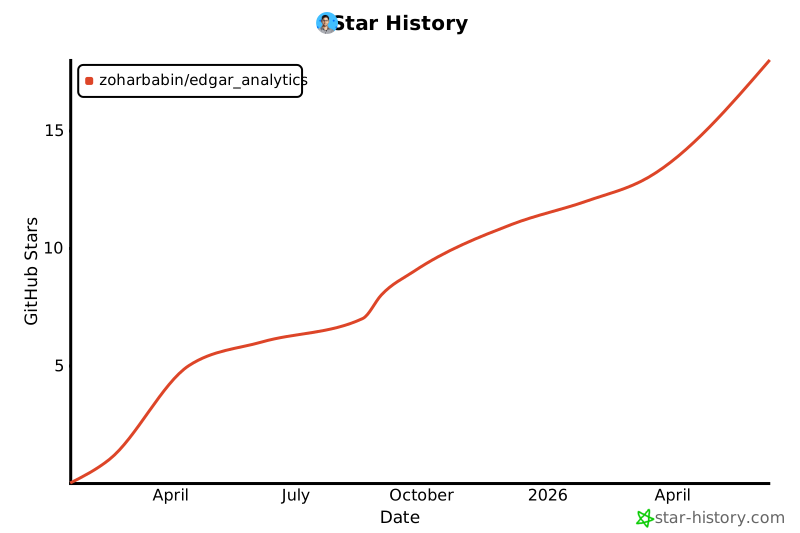
Star History
License
MIT License
(See LICENSE for details.)
Disclaimer:
This tool extracts data from public SEC filings. Always review official filings directly for investment decisions. The library and its maintainers are not responsible for any inaccuracies or any decisions made based on these outputs.
Happy Analyzing! If you find this useful, please give us a star — it helps others discover the project.
Project details
Verified details
These details have been verified by PyPIProject links
GitHub Statistics
Maintainers
Release history Release notifications | RSS feed


Download files
Download the file for your platform. If you're not sure which to choose, learn more about installing packages.
Source Distribution
Built Distribution
Filter files by name, interpreter, ABI, and platform.
If you're not sure about the file name format, learn more about wheel file names.
Copy a direct link to the current filters
File details
Details for the file edgar_analytics-0.5.0.tar.gz.
File metadata
- Download URL: edgar_analytics-0.5.0.tar.gz
- Upload date:
- Size: 86.4 kB
- Tags: Source
- Uploaded using Trusted Publishing? Yes
- Uploaded via: twine/6.1.0 CPython/3.13.12
File hashes
| Algorithm | Hash digest | |
|---|---|---|
| SHA256 |
5c6006402111fdf0872e7e27a9d514ae788a2697d6e1368ceca959feea9cd8bd
|
|
| MD5 |
77001459a3c68fc9d03b0d7443bba876
|
|
| BLAKE2b-256 |
cf2d3f00095de9b015b9ea1b7f9d795dbe52f9ad5c360800579130a1ba2a8507
|
Provenance
The following attestation bundles were made for edgar_analytics-0.5.0.tar.gz:
Publisher:
workflow.yml on zoharbabin/edgar_analytics
-
Statement:
-
Statement type:
https://in-toto.io/Statement/v1 -
Predicate type:
https://docs.pypi.org/attestations/publish/v1 -
Subject name:
edgar_analytics-0.5.0.tar.gz -
Subject digest:
5c6006402111fdf0872e7e27a9d514ae788a2697d6e1368ceca959feea9cd8bd - Sigstore transparency entry: 1329348091
- Sigstore integration time:
-
Permalink:
zoharbabin/edgar_analytics@1d67259aa63fe91830438133648501499dc7a93a -
Branch / Tag:
refs/tags/v0.5.0 - Owner: https://github.com/zoharbabin
-
Access:
public
-
Token Issuer:
https://token.actions.githubusercontent.com -
Runner Environment:
github-hosted -
Publication workflow:
workflow.yml@1d67259aa63fe91830438133648501499dc7a93a -
Trigger Event:
push
-
Statement type:
File details
Details for the file edgar_analytics-0.5.0-py3-none-any.whl.
File metadata
- Download URL: edgar_analytics-0.5.0-py3-none-any.whl
- Upload date:
- Size: 83.5 kB
- Tags: Python 3
- Uploaded using Trusted Publishing? Yes
- Uploaded via: twine/6.1.0 CPython/3.13.12
File hashes
| Algorithm | Hash digest | |
|---|---|---|
| SHA256 |
48a06f6077e2c3981fd8cecef69e8de736e456e0f2f1bf89fcacb1de68f785dd
|
|
| MD5 |
f2e5e225cbf2d0cb7d5d4eb0c7050153
|
|
| BLAKE2b-256 |
542e0665b4fe7ae2a2af08b0221ff01231d5d2590af1feef7e0d6db1b9f7b234
|
Provenance
The following attestation bundles were made for edgar_analytics-0.5.0-py3-none-any.whl:
Publisher:
workflow.yml on zoharbabin/edgar_analytics
-
Statement:
-
Statement type:
https://in-toto.io/Statement/v1 -
Predicate type:
https://docs.pypi.org/attestations/publish/v1 -
Subject name:
edgar_analytics-0.5.0-py3-none-any.whl -
Subject digest:
48a06f6077e2c3981fd8cecef69e8de736e456e0f2f1bf89fcacb1de68f785dd - Sigstore transparency entry: 1329348187
- Sigstore integration time:
-
Permalink:
zoharbabin/edgar_analytics@1d67259aa63fe91830438133648501499dc7a93a -
Branch / Tag:
refs/tags/v0.5.0 - Owner: https://github.com/zoharbabin
-
Access:
public
-
Token Issuer:
https://token.actions.githubusercontent.com -
Runner Environment:
github-hosted -
Publication workflow:
workflow.yml@1d67259aa63fe91830438133648501499dc7a93a -
Trigger Event:
push
-
Statement type:






